Direct Answer
The skincare capsule blister packaging technical requirements should be defined before the fill formula, capsule shell, mold, or commercial sample is finalized. For serum capsules, the pack is not a downstream decoration decision: its moisture barrier, oxygen barrier, cavity geometry, sealing conditions, and transport performance directly influence shell flexibility, seam integrity, oxidation, leakage, and dose appearance.
Procurement teams should therefore lock five inputs at the project gate: intended markets, target fill weight, fill viscosity and oxidation sensitivity, shell material, and expected storage and shipment conditions. The ODM can then select a compatible mold and evaluate blister materials against the finished capsule rather than an assumed format. This sequence reduces tooling changes, artwork revisions, stability restarts, and launch risk. It is especially important for retinol, facial oil, eye serum, cleansing oil, hair oil, and vegan-shell formats, where apparently minor material interactions can become visible defects after heat, humidity, or cross-border transit.

Key Takeaways for Private Label Buyers
- Source the capsule and blister as one system. Require the capsule producer, thermoformer, lidding supplier, and packing site to disclose material specifications and change-control responsibilities.
- Do not approve the formula on bulk stability alone. Test the filled capsule inside the proposed commercial blister, secondary carton, and shipment configuration.
- Freeze fill weight before mold release. Cavity volume, shell thickness, seam position, tail geometry, and blister pocket dimensions are interdependent.
- Match barrier performance to the ingredients. Retinol and oxidation-sensitive oils may require greater light and oxygen protection than a visually similar facial serum.
- Separate pilot approval from scale approval. Confirm that commercial filling, drying, inspection, and blister-sealing equipment reproduce the approved sample under ISO 22716 controls.
- Make market access part of packaging qualification. Colorants, labeling, material declarations, and local conformity requirements must be reviewed before artwork and tooling become difficult to change.
Buyer Context
Serum-capsule buyers often begin with the active ingredients or a reference appearance. That approach can create an avoidable sequencing error. A capsule may look acceptable in a laboratory tray yet soften in a humid warehouse, adhere to a blister pocket, lose fill through the seam, or oxidize after exposure to residual oxygen and light. For a multinational launch, the same SKU may move through air freight, ocean freight, uncontrolled port storage, and climate zones with materially different heat and humidity profiles.
The risk is higher when a brand is qualifying alternative capacity after a quality event, labor disruption, or failed third-party audit. Under those conditions, copying the incumbent capsule dimensions without obtaining its shell composition, mold tolerances, and packaging barrier data does not constitute technical equivalence. Buyers evaluating a serum capsules manufacturer should request system-level comparability rather than visual matching alone.
Portfolio architecture also matters. The skincare capsule product lines used for facial oil, eye serum, cleansing oil, and hair oil may share a platform, but they do not automatically share packaging requirements. A retinol capsule requires particular attention to light exposure, oxygen ingress, antioxidant strategy, and assay retention. Vegan shells introduce another variable because plant-derived polymers and plasticizers can respond differently to the fill and ambient moisture than conventional gelatin systems.
Regulatory review must run in parallel. United States projects should be screened against the FDA’s regulatory framework for cosmetics, the FDA color additive permitted-use database, and FDA cosmetic labeling requirements. Saudi-market projects should incorporate applicable SASO conformity assessment standards. These checks affect shell color, claims, label content, and documentation even when the physical blister remains unchanged.

Capsule Formula, Shell, Mold, and Packaging Factors
Fill Formula and Fill Weight
The ODM should document viscosity at a defined temperature, density, suspended solids, volatility, water activity where relevant, peroxide risk, and compatibility with the shell. An anhydrous appearance does not by itself prove compatibility. Fragrance components, solvents, surfactants, and botanical oils can migrate into or extract plasticizer from the shell, changing flexibility and leakage resistance.
Fill weight should be stated as a target with an approved production tolerance. A proposed ±5% tolerance may be suitable for one cosmetic format but remains an illustrative starting point, not a universal acceptance criterion. The buyer should review dose appearance, consumer emptying behavior, mass variation, and filling-line capability before authorizing tooling. Relevant platform options can be compared across serum capsule products rather than inferred from capsule length alone.
Shell Material and Mold Geometry
Shell specifications should identify the polymer base, plasticizer system, colorant, opacity, residual moisture range, seam construction, and supplier change-control procedure. For vegan capsules, the exact plant-derived system matters more than a generic vegan declaration. Buyers should also confirm whether origin, allergen, animal-derived material, and traceability documents support corporate ESG and market requirements.
The mold determines more than visual form. Body-to-tail ratio, seam location, wall distribution, twist-off behavior, and nominal fill volume affect processing and consumer use. A custom mold also creates tooling ownership, maintenance, replacement, and business-continuity questions. An experienced cosmetic softgel capsule factory should provide controlled drawings, tolerances, cavity identification, and a backup-tooling policy before sample approval.
Blister Material, Storage, and Stability
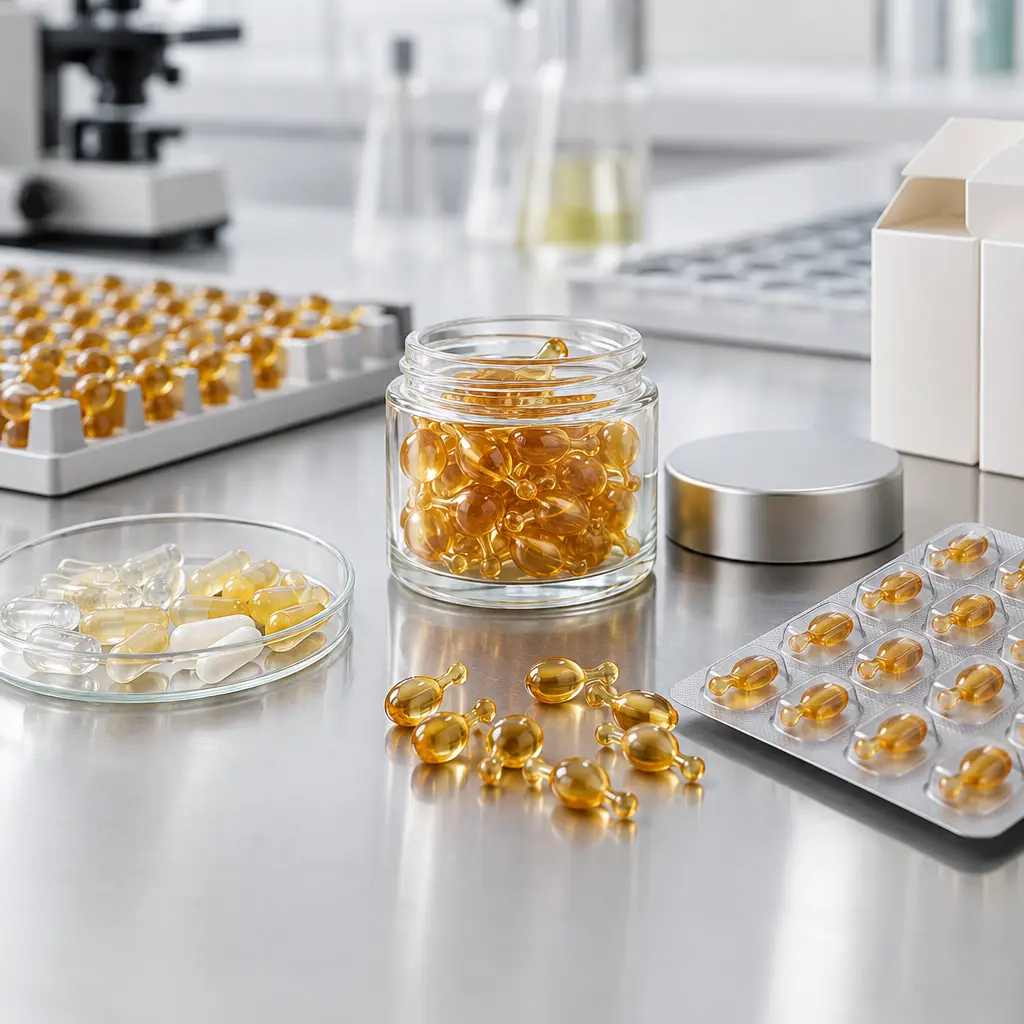
Blister qualification should compare forming web, lidding foil, seal coating, pocket clearance, light transmission, water-vapor transmission, oxygen transmission, and sealing window. The pocket must restrain movement without compressing the capsule seam. Buyers should ask whether sealing heat can transfer enough energy to deform the shell and whether lubricants or capsule surface oils interfere with seal integrity.
Stability protocols should reflect commercial distribution. Illustrative conditions may include long-term storage at 25°C/60% relative humidity, accelerated storage at 40°C/75% relative humidity, and a 5°C condition to identify brittleness, haze, or phase behavior. Final conditions and duration must follow the formula, markets, claims, and risk assessment. Evaluation should include appearance, odor, leakage, capsule adhesion, shell deformation, fill assay where appropriate, oxidation indicators, blister seal integrity, and opening performance. Buyers reviewing retinol serum capsules should require testing in the final light-protective configuration.
Shipment qualification should add vibration, drop, compression, temperature cycling, and post-transit inspection. The protocol should use the intended carton count, dividers, pallet pattern, and freight mode. This evidence is essential when a skincare capsules OEM is being approved as geographically diversified capacity rather than merely as a sampling source.

Decision Framework Table
| Factor | What to Check | Why It Matters | ODM Buyer Note |
|---|---|---|---|
| Fill formula | Viscosity, density, volatility, oxidation sensitivity, fragrance and solvent profile | Controls filling accuracy, shell interaction, and ingredient stability | Approve the commercial-equipment fill, not only a hand-filled laboratory sample |
| Shell system | Polymer, plasticizer, colorant, opacity, moisture range, seam construction | Determines flexibility, brittleness, leakage risk, and market documentation | Require composition disclosure under confidentiality controls and formal change notification |
| Fill weight and mold | Target mass, tolerance, cavity volume, seam position, tail and wall geometry | Links dose presentation to filling capability and blister-pocket dimensions | Freeze controlled drawings before tooling and artwork release |
| Blister structure | Forming web, lidding, barrier data, seal coating, pocket clearance, opening force | Protects the cosmetic capsule from moisture, oxygen, light, and mechanical stress | Compare supplier declarations with finished-pack stability results |
| Storage and shipment | Climate zones, freight mode, temperature excursions, compression and vibration | Reveals defects that static laboratory storage may not reproduce | Test the saleable configuration and retain samples by lot |
| Scale transfer | Drying cycle, inspection method, line speed, sealing window, reject controls | Prevents divergence between approved samples and mass production | Audit batch records and validation evidence for the selected cosmetic softgel products |
ODM Manufacturing Considerations
For skincare capsule blister packaging technical requirements, the approved sample must represent a defined product system rather than an attractive capsule evaluated in isolation. The record should identify the serum formula version, shell material, mold, nominal fill weight, blister components, carton configuration, coding method, and intended shipment route. This discipline becomes especially important when a brand must replace an incumbent supplier after a quality failure or serious third-party audit finding.
Sample Confirmation and Formula Customization
Confirm samples against written criteria for appearance, odor, opening behavior, capsule dimensions, fill consistency, and package condition. Retain signed reference samples from the agreed configuration. If the ODM adjusts emollients, antioxidants, botanical ingredients, pigments, or fragrance, request a new technical assessment because small formula changes may affect flow during filling, shell flexibility, sensory performance, or storage behavior.
Buyers should also distinguish laboratory prototypes from samples made with production-intent materials and processes. A lab sample can establish direction, but it may not demonstrate routine line performance. The supplier should state what will change at pilot and full production stages. Reviewing the manufacturer’s capsule technology and OEM/ODM process can help procurement teams organize these decision points.
Shell, Mold, and Package Selection
Document whether the shell is gelatin-based, plant-derived, or another validated cosmetic capsule system. Request its composition declaration, plasticizer information, colorant details, animal-origin statement, and relevant market restrictions. For a vegan skincare capsule, confirm the specific shell platform and supporting documentation instead of relying on a general plant-based description.
Mold approval should cover shape, dimensions, seam location, opening feature, surface finish, usable dose range, tooling ownership, and revision control. Packaging trials should use the intended blister web, lidding material, pocket layout, carton, and capsule count. Confirm that the filling and packing lines can handle the capsule without excessive pressure and that consumers can remove it without tearing or crushing the shell.

Stability, MOQ, Documents, and Shipment
The shelf-life plan should monitor serum appearance, odor, fill uniformity, shell condition, package closure quality, and relevant active or oxidation markers. For sensitive formats such as retinol capsules, the final blister and carton should be included from the start of the program.
Request separate minimum quantities for the serum batch, capsule run, custom shell color, printed blister components, cartons, and dedicated tooling. These quantities rarely align perfectly, so the agreement should define ownership, storage, and disposal of residual materials. Labeling documents should include the ingredient declaration, net quantity or capsule count, responsible-party information, batch code format, use instructions, warnings where required, and destination-market language versions.
Shipment specifications should identify case count, pallet layout, stacking limits, seasonal route assumptions, and temperature-excursion procedures. This is also relevant when a corporate sourcing policy introduces carbon-reporting or supplier-emissions targets: the buyer needs verifiable data for the actual manufacturing and logistics route, not a general sustainability statement.
Common Problems or Failure Cases
Capsule shell brittleness: Capsules crack during packing or opening. Possible causes include incorrect moisture balance, unsuitable storage exposure, excessive drying, or interaction between the shell and fill ingredients. Compare newly produced units with retained and transported samples.
Sticking or shell deformation: Capsules become tacky, flatten, or adhere to the blister surface. Review capsule conditioning, surface residue, storage humidity, pocket dimensions, carton compression, and heat exposure during distribution.
Fill separation: Suspended powders, pigments, waxes, or active-containing phases may settle or form visible gradients. Examine samples from the beginning, middle, and end of the filling run, then compare them after storage. A formula that appears uniform in a mixing vessel may not remain uniform in a small single-dose form.
Capsule leakage: Facial oil or eye serum may appear around the seam, neck, or opening point. The investigation should separate formula-shell interaction from filling contamination, weak sealing, package compression, and dimensional mismatch.
Fragrance sensitivity: Fragrance materials can influence shell softness, odor transfer, or long-term appearance. Test the final fragrance concentration and supplier, not only the unfragranced base. A fragrance change should be treated as a technical formula revision.
Packaging deformation: Blister pockets may warp, lidding may lift, or cartons may crush in transit. Review forming consistency, sealing parameters, packed-product pressure, corrugated case strength, pallet loading, and route conditions before changing the capsule itself.
A useful failure investigation compares bulk serum, loose capsules, packaged capsules, component lots, retained samples, and production records. Change one variable at a time whenever possible so the corrective action can be verified.

Supplier Checklist
- Obtain the complete shell declaration, including origin, plasticizer, color system, and market limitations.
- Record the formula revision, viscosity range, density, nominal dose, fill acceptance limits, and sampling frequency.
- Confirm mold identity, controlled drawings, maintenance responsibility, storage location, and custom-tooling rights.
- Review evidence covering brittleness, sticking, deformation, separation, leakage, odor change, and active sensitivity.
- Approve the exact blister, lidding, carton, label, coding, and optional jar components by specification or item number.
- Request the shelf-life protocol, interim reports, deviation process, complaint procedure, and retained-sample policy.
- Separate formula, capsule, printing, packaging, and tooling minimums, including residual-material ownership.
- Verify specifications, ingredient documents, batch records, certificates of analysis, label files, and shipment instructions.
- Audit information security, change notification, traceability, business continuity, worker protections, environmental records, and insurance coverage.
FAQ
What should be fixed before a serum-capsule sample is approved?
Approve the formula revision, shell system, mold, fill specification, capsule appearance, opening method, blister materials, pack count, artwork version, acceptance criteria, and proposed production route. Photographs and general sensory approval are not sufficient controls.
Can an ODM guarantee that a proprietary formula will never be disclosed?
No responsible supplier can promise absolute zero risk. Verify role-based system access, separation of customer files, download restrictions, access logs, confidentiality obligations, employee training, physical access controls, backup security, and incident-response procedures. An audit should test actual permissions rather than reviewing policies alone.
How can buyers protect supply during a global raw-material shortage?
Qualify technically acceptable alternate sources, provide rolling forecasts, define reserved capacity, agree on safety-stock responsibilities, and include allocation and early-warning terms in the supply agreement. Priority-customer status should be documented, but it cannot replace approved materials and continuity planning.
How should a buyer evaluate worker-treatment risks?
Review independent social-audit results, age-verification controls, payroll samples, working-hour records, overtime consent, grievance channels, and corrective-action closure. Worker interviews should include employees performing capsule forming, filling, inspection, blister packing, and warehouse handling.
Is a blister always better than a jar for serum capsules?
No. A blister separates doses and can limit repeated exposure of remaining capsules, while a jar may simplify counting and consumer handling. The decision depends on shell behavior, capsule shape, barrier needs, packing automation, retail presentation, and demonstrated shipment performance. The same facial oil capsule may require separate qualification for each package form.
Which labeling documents should a US buyer request?
Request the finished ingredient declaration, product identity, net contents or numerical count, business details, warnings where applicable, batch-code format, and artwork approval record. FDA guidance states that cosmetic marketers are responsible for compliant labeling, and permitted-use restrictions should be checked when color additives are used.