Category: Packaging & Compliance

  • How to Scope Blister Packaging for Capsules Before Choosing a Capsule Skincare Manufacturer

    How to Scope Blister Packaging for Capsules Before Choosing a Capsule Skincare Manufacturer

    Direct Answer

    Scope blister packaging before selecting the manufacturer by defining the finished product system: serum formulation, shell composition, capsule geometry, cavity dimensions, forming material, lidding, sealing process, and distribution conditions. This skincare capsule blister packaging buyer guide recommends making that specification the basis of supplier qualification—not treating packaging as an accessory selected after sample approval.

    Before appointing a serum capsules manufacturer, require production-representative samples in the proposed blister, documented acceptance criteria, and an agreed stability and transport evaluation plan. Separate formula approval from packaging approval and commercial release. Establish who owns tooling, who qualifies packaging converters, and who authorizes material substitutions.

    The sourcing decision should turn on demonstrated compatibility and repeatable manufacturing controls. A visually acceptable sample should not be treated as evidence of shelf life, transit performance, or scale readiness. Where evidence remains incomplete, make the gap an explicit qualification condition rather than an assumption embedded in the launch schedule.

    Key Takeaways for Private Label Buyers

    • Issue a common packaging specification before comparing supplier quotations or capacity proposals.
    • Qualify the fill, shell, cavity, and seal together; require approval before changing any component.
    • Request separate minimum order quantities for capsules, forming materials, printed lidding, and finished packs.
    • Include aged-pack opening, leakage, and shipment checks in the skincare capsules OEM sampling scope.
    • Keep sample delivery, tooling readiness, stability evidence, and launch authorization as distinct milestones.

    Buyer Context

    When an incumbent suffers a quality failure or capacity interruption, use a controlled transfer dossier rather than relying on a replacement supplier to reproduce appearance alone. For established skincare capsule product lines, request the approved component specifications, historical deviations, retained samples, and packaging change history. For private label retinol capsules, include the analytical methods and acceptance criteria supporting product stability.

    A corporate sustainability mandate should trigger a separate evidence review. ISO 22716 addresses cosmetic production, control, storage, and shipment; its scope does not cover environmental protection or personnel safety. Evaluate packaging material traceability, emissions records, and labor practices separately from the ISO 22716 cosmetic GMP guidelines. Apply this separation to PZIK and every alternative supplier. ([iso.org](https://www.iso.org/standard/36437.html?utm_source=openai))

    For UAE launches, ask regulatory teams to confirm the applicable conformity route through UAE MoIAT standards and conformity services before artwork approval. MoIAT publishes a cosmetics-specific conformity service card; do not assume another market’s documentation resolves local requirements. ([eservices.moiat.gov.ae](https://eservices.moiat.gov.ae/backend/api/v1.1/UploadAttachment/GetAttachmentByRecordId?download=true&recordAttachmentId=644921&utm_source=openai))

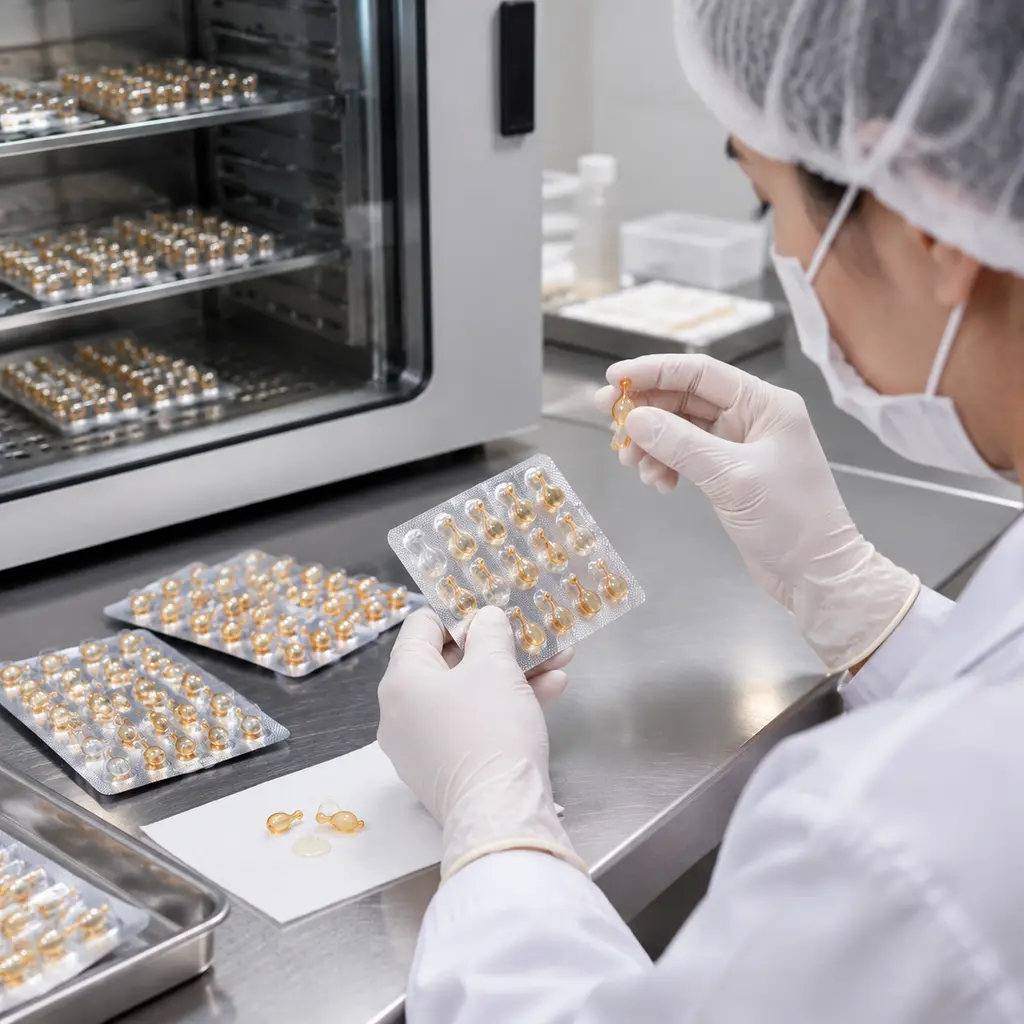
    Packaging engineer inspecting serum capsule geometry and blister cavity fit
    Packaging engineer inspecting serum capsule geometry and blister cavity fit

    Capsule Formula, Shell, Mold, and Packaging Factors

    Fill Formula and Dose

    Specify fill weight independently of total capsule weight. Request the target, tolerance, sampling method, and delivered-dose assessment after opening. Define viscosity at a stated measurement temperature and require a production filling trial. For facial oil and cleansing oil capsules, include leakage and residue checks rather than accepting nominal cavity volume as proof of usable dose.

    For retinol serum capsules, require an oxidation-control rationale covering formulation, processing, and packaging. Research in the International Journal of Cosmetic Science identifies light and oxygen among retinol degradation drivers. Treat that evidence as a reason to request product-specific testing—not as validation of any proposed blister. ([onlinelibrary.wiley.com](https://onlinelibrary.wiley.com/doi/10.1111/ics.12853))

    Shell Composition and Aging

    Require the exact shell composition, material origin, plasticizer system, and supplier change controls. For vegan shells, request composition and traceability evidence rather than relying on a category name. Compare candidate cosmetic softgel products using the intended fill and finished pack.

    Softgel manufacturing literature identifies moisture exchange and fill–shell compatibility as stability considerations. Use these mechanisms to structure cosmetic testing, while recognizing that pharmaceutical examples do not establish skincare performance. Assess tackiness, brittleness, deformation, seam integrity, and twist-off behavior throughout aging. ([aenova-group.com](https://www.aenova-group.com/content/Aenova_Whitepaper_Pharmaceutical_Softgel_Capsules.pdf))

    Mold Geometry and Cavity Fit

    Obtain dimensional drawings for the capsule body, neck, and twist-off tip, including manufacturing tolerances. Ask the cosmetic softgel capsule factory to demonstrate cavity clearance with representative dimensional variation. Check for tip contact, pinching during sealing, and damage during removal. Compare stock and custom molds on tooling ownership, maintenance, transferability, and replacement availability—not appearance alone.

    Barrier Materials and Opening Method

    Softgel packaging selection should account for moisture, oxygen, light, and material compatibility. Request forming-web and lidding specifications, barrier data with test conditions, and finished-pack evidence. Do not treat film data alone as acceptance of the complete package. ([aenova-group.com](https://www.aenova-group.com/content/Aenova_Whitepaper_Pharmaceutical_Softgel_Capsules.pdf))

    For the proposed serum capsule products, compare transparent thermoformed and opaque aluminum-based options against the actual protection requirement. Trial peel-open and push-through formats with aged capsules; document opening effort, capsule damage, and seal integrity. If a jar is the alternative, include repeated opening and handling in the comparison. Record the tradeoff between visibility, protection, material use, and validated performance.

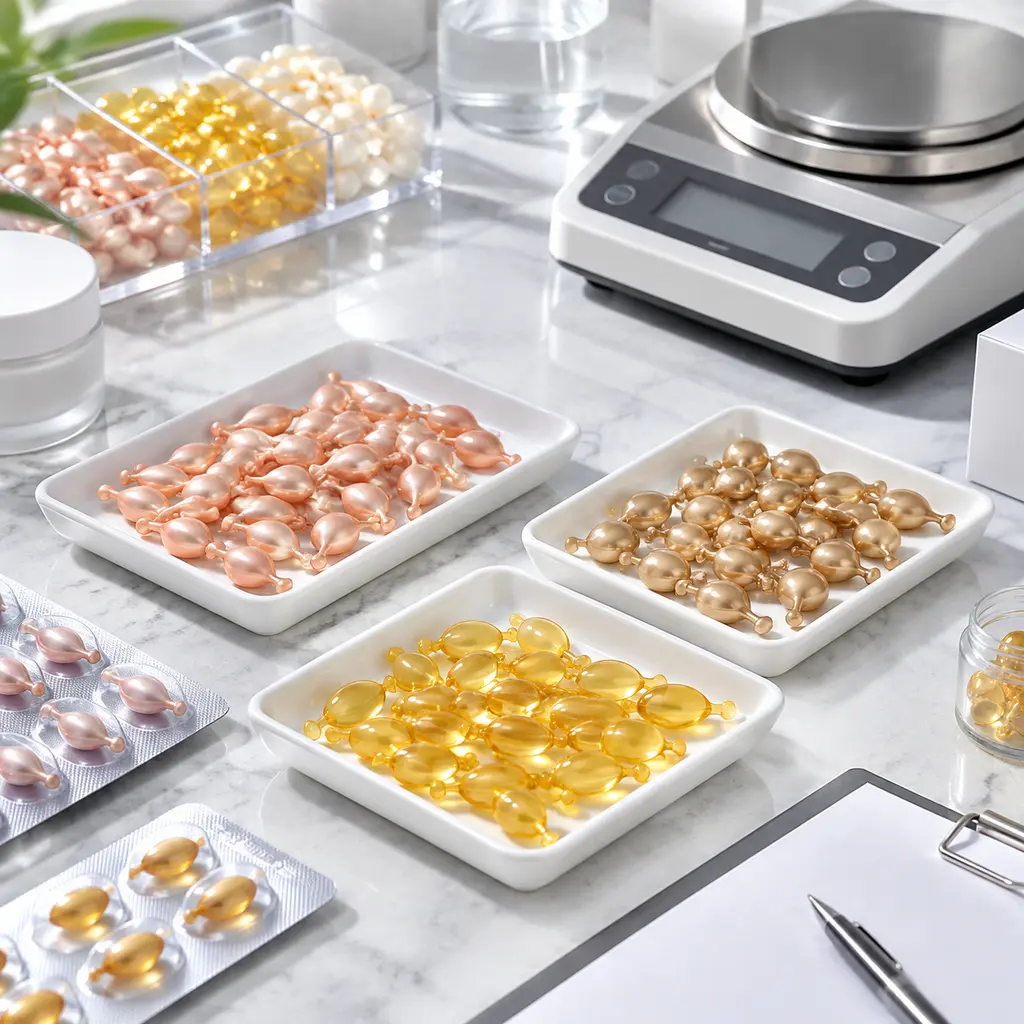
    Serum capsule fill-weight sampling beside shell and blister packaging samples
    Serum capsule fill-weight sampling beside shell and blister packaging samples

    Storage, Stability, and Shipment

    FDA identifies temperature, sunlight, air, and moisture exposure as factors affecting cosmetic shelf life and places responsibility for determining shelf life on the manufacturer. Accordingly, request a finished-pack protocol addressing intended storage, accelerated evaluation, ongoing real-time observation, and relevant transport exposures. ([fda.gov](https://www.fda.gov/cosmetics/cosmetics-labeling/shelf-life-and-expiration-dating-cosmetics?utm_source=openai))

    Set product-specific limits for leakage, appearance, odor, shell handling, seal performance, and relevant chemical attributes. Define shipment temperature and humidity limits from evidence, with monitoring and excursion procedures. Require a documented rationale before introducing desiccants. Do not convert a brief screening result into an unsupported shelf-life claim.

    Labeling and Release Responsibilities

    Reserve space for the applicable identity, net contents, ingredient declaration, business information, and warnings. The FDA summary of cosmetics labeling requirements distinguishes obligations for inner and outer packaging. Have regulatory reviewers approve the specific blister-and-carton configuration rather than assuming the carton carries every required statement. ([fda.gov](https://www.fda.gov/cosmetics/cosmetics-labeling-regulations/summary-cosmetics-labeling-requirements))

    Decision Framework Table

    Use this framework to align procurement, formulation, packaging engineering, QA, and regulatory reviewers before supplier nomination.

    Factor What to Check Why It Matters ODM Buyer Note
    Formula and dose Viscosity method, fill-weight limits, delivered dose Defines measurable product acceptance Approve production-representative samples
    Shell Composition, origin, aged handling Tests compatibility and claim support Control supplier substitutions
    Mold and cavity Dimensions, tolerances, removal trial Identifies mechanical damage risks Document tooling ownership
    Barrier and seal Material structure, integrity, opening performance Evaluates the assembled package Approve the operating window
    Storage and shipment Stability plan, route exposures, excursion rules Connects release evidence to distribution Assign disposition authority
    Supply continuity Component minimums, converter capacity, alternative sources Exposes dependencies before nomination Require change approval and transfer provisions

    Quality-control inspection of serum capsule blister packs during stability review
    Quality-control inspection of serum capsule blister packs during stability review

    ODM Manufacturing Considerations

    This skincare capsule blister packaging buyer guide continues with the decisions that turn an initial concept into a supplier quotation. Ask each OEM/ODM manufacturer to identify what its sample represents, which specifications remain provisional, and which changes would require another approval. A capsule that looks acceptable at a presentation meeting does not establish readiness for commercial release.

    Confirm samples against an agreed reference: appearance, odor, skin feel, opening experience, and the amount available for application. Separate formula approval from artwork and commercial approval so purchasing cannot accidentally authorize an unresolved product specification. Record whether samples use the proposed ingredients and shell option or temporary substitutes.

    For custom serum development, define the intended application and exclusions before requesting revisions. An eye serum capsule and a hair oil capsule have different sensory expectations. Ask how changes to fragrance, ingredient solubility, or fill viscosity affect manufacturing feasibility. Require the quotation to identify ownership of the final formulation and access to the specifications needed for future procurement.

    For shell and mold selection, obtain a written menu of available materials, colors, shapes, and decoration restrictions. Ask which choices introduce separate development charges or component commitments. A vegan shell claim requires supporting composition documentation; appearance alone cannot establish material origin. Clarify ownership, maintenance charges, and replacement responsibility for any custom tooling.

    Packaging approval should connect the approved capsule version to a specific blister configuration and carton count. Request a concise stability conclusion identifying unresolved observations and the person authorized to accept them. Ask whether the proposed shelf life is supported for that exact configuration, and how later formula changes affect the conclusion.

    Break the MOQ into finished capsules, printed lidding, cartons, and any dedicated materials. Confirm sample charges, expected sample quantities, unused-component ownership, reorder requirements, and the consequences of artwork revisions. Labeling documents should identify the ingredient declaration, responsible business details, directions, and required warnings for the destination market. The FDA summary of cosmetics labeling requirements provides a U.S. reference; the supplier’s artwork approval does not replace the brand’s regulatory review.

    Define shipment conditions in the purchase specification, including approved routes, warehouse handoffs, packaging orientation where relevant, and disposition responsibility after a recorded departure from agreed conditions. If a corporate carbon-neutrality requirement prompts supplier replacement, request the proposed capsule site’s reporting boundary and supporting records before treating a corporate sustainability statement as site-specific evidence.

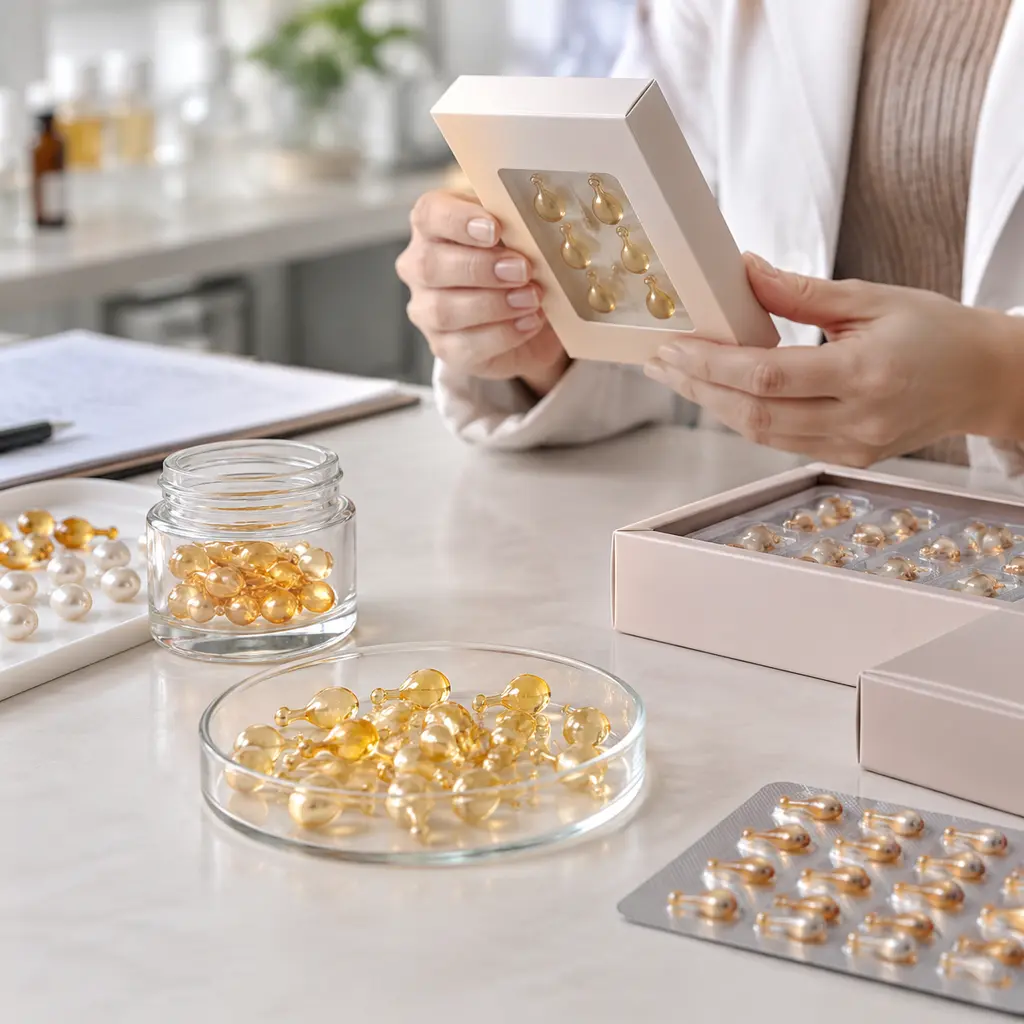
    Buyer and laboratory technician reviewing serum capsule samples and blister packaging options
    Buyer and laboratory technician reviewing serum capsule samples and blister packaging options

    Common Problems or Failure Cases

    Brittle capsules at consumer use: A shell can appear intact in its blister yet fracture during opening. Preserve affected packs and compare complaint samples with retained units. Ask whether the issue follows a particular shell lot, storage location, or elapsed storage period before authorizing a material change.

    Sticking or flattened capsules: Capsules may adhere to the cavity or develop a flattened surface. Buyers sometimes accept this as cosmetic variation without checking whether removal damages the shell. Establish an appearance reference that distinguishes acceptable variation from deformation that prevents normal use.

    Separated fill or unexpected odor: Visible layering in a facial oil capsule can indicate a formulation issue requiring investigation. Fragrance sensitivity complaints also deserve structured review even when no manufacturing deviation is found. Preserve the approved ingredient and fragrance versions, document complaint patterns, and avoid adding masking fragrance before identifying the cause.

    Leakage discovered during packing: Oily marks can originate from a damaged capsule or contamination during handling. Quarantine affected units and require the supplier to establish the source before releasing replacement stock. Repacking alone does not explain whether other capsules share the defect.

    Distorted blister cards: Bowed cards can interfere with cartoning, retail presentation, or capsule removal. Record where distortion first appears and whether it follows a packaging batch or shipment. If a serious quality incident forces a supplier change, carry the defect history and acceptance examples into the replacement supplier’s brief.
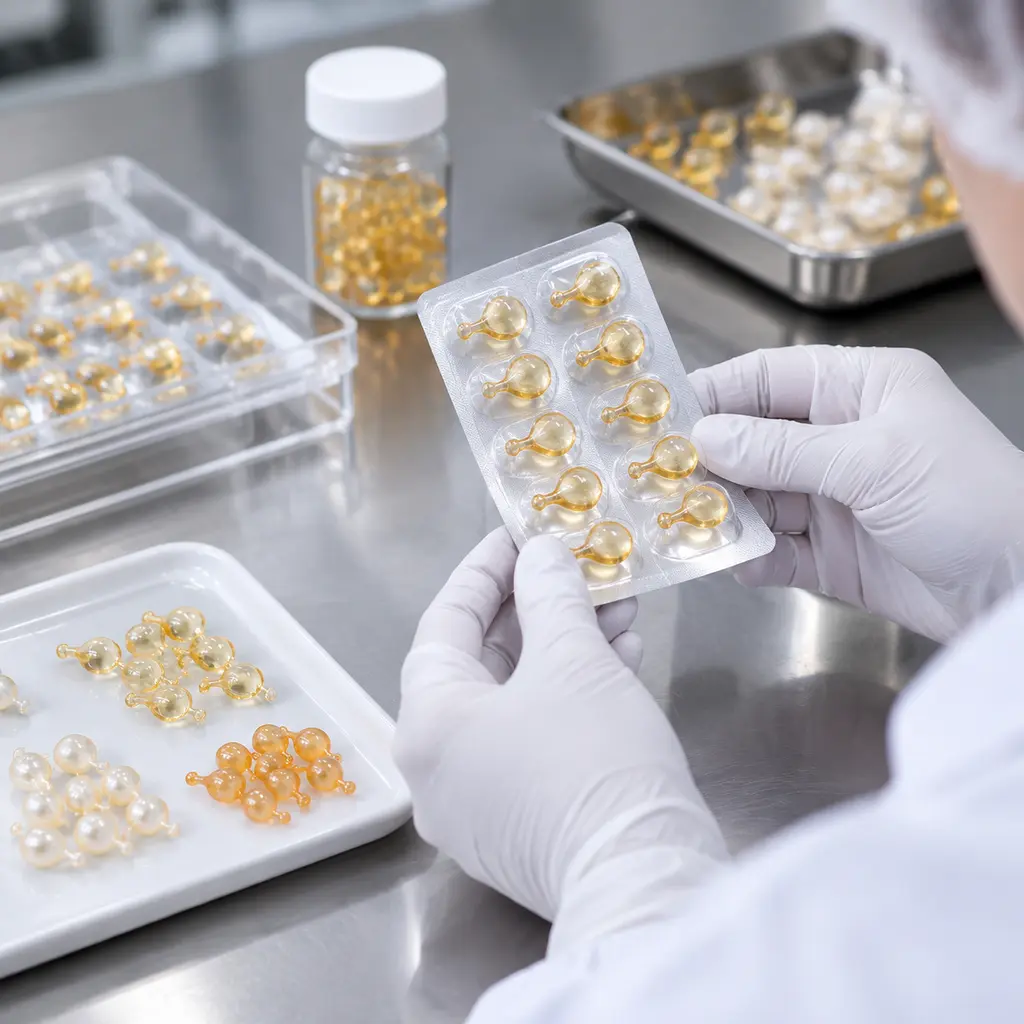
    Quality technician inspecting serum capsule appearance and blister card deformation
    Quality technician inspecting serum capsule appearance and blister card deformation

    Supplier Checklist

    • Identify the legal manufacturer, capsule production site, packaging site, and any subcontracted activities.
    • Obtain a version-controlled product specification covering shell material, ingredients, fill viscosity conditions, nominal fill weight, and acceptable appearance.
    • Require documented conclusions on leakage risk, oxidation sensitivity, heat and humidity exposure, and compatibility with the proposed blister or jar.
    • Define the sample scope, approval authority, unresolved items, and permitted differences from commercial supply.
    • Itemize component MOQs, development charges, purchasing commitments, and ownership of unused printed materials.
    • Review the stability conclusion, labeling documents, shipment requirements, and process for reporting deviations.
    • Assign responsibility for complaint investigation, retained samples, replacement stock, and corrective-action closure.
    • Verify destination-market responsibilities. For UAE distribution, confirm applicable requirements through UAE MoIAT and the relevant local authorities; a general factory credential does not establish product authorization.

    FAQ

    Can a manufacturer guarantee that our core formula will never be disclosed?

    No supplier can credibly promise absolute protection. Request evidence of role-based access, access removal when staff leave, controlled laboratory entry, and restrictions on subcontractor disclosure. The confidentiality agreement should cover the formula, specifications, samples, and permitted recipients. Ask how suspected disclosure is investigated and reported.

    How can we verify priority supply during a raw-material shortage?

    Ask for contractual allocation rules tied to identified capsule materials, forecast commitments, and reserved capacity. Clarify whether a reservation covers the fill ingredients, shell inputs, and printed packaging. Require notification deadlines and an escalation process. A verbal promise of strategic-customer status provides little purchasing certainty.

    What insurance evidence matters if a major quality complaint occurs?

    Request current policy evidence showing the insured entity, covered activities, territories, limits, deductibles, and relevant exclusions. Have an insurance adviser check whether product liability and recall expenses are covered separately and whether your sales markets are included. Insurance limits do not establish that every complaint will be compensated.

    Can we use one approved capsule sample for several blister designs?

    Use it as a product reference, but obtain an explicit assessment for each proposed configuration. Different counts, card dimensions, and cavity arrangements can change handling and removal. Document which configurations the supplier has accepted and which remain provisional.

    What should a useful quotation include beyond the capsule unit price?

    Request itemized development, tooling, testing, printed-component, assembly, and freight charges. Include payment milestones and responsibility for rejected materials. Compare quotations using the same capsule specification, packaging count, evidence package, and delivery terms.

    Which documents should accompany the first commercial order?

    Agree on an order-specific document list covering release status, batch identification, relevant test results, approved artwork, and shipping records. The capsule claims and documentation review can help organize questions, but the purchase agreement should define actual deliverables.

    References

  • Skincare Capsule Shape and Dose Packaging Options to Settle Before Sampling

    Skincare Capsule Shape and Dose Packaging Options to Settle Before Sampling

    Direct Answer

    Capsule shape, unit dose, shell system, and final packaging should be approved as one technical package before sampling. The central decision in evaluating skincare capsule shape and dose packaging options is not whether an oval, teardrop, or twist-off capsule looks distinctive. It is whether the selected geometry can hold the target serum fill weight, seal consistently, survive the intended climate and distribution lane, and dispense the promised facial or hair application dose without leakage or excessive residue.

    The correct sequence is fill formulation, shell compatibility, dose definition, mold selection, primary-packaging selection, and stability validation. Reversing that sequence creates predictable rework. A custom mold selected for visual impact may have an unfavorable seam, insufficient internal volume, or a tail that breaks inconsistently. A jar selected before humidity testing may accelerate shell softening or brittleness. Buyers should therefore require production-representative capsules and packaging during sampling, rather than approving a hand-filled formula in a provisional shell.

    Key Takeaways for Private Label Buyers

    • Freeze the target application dose and fill-weight tolerance before authorizing a production mold.
    • Review the serum, shell, plasticizer, colorant, and packaging as one compatibility system.
    • Do not assume gelatin and plant-derived shells respond identically to heat, humidity, or fill ingredients.
    • Test jar, blister, and secondary packaging under the intended storage and shipment conditions.
    • Require sample records covering mold identity, actual fill weight, leakage results, and batch traceability.
    • Keep labeling and market classification under regulatory review; a cosmetic capsule must not be presented as an ingestible supplement.

    Serum capsule shape and fill-weight sampling review
    Serum capsule shape and fill-weight sampling review

    Buyer Context

    For multinational procurement teams, this decision becomes material when a current supplier has a quality incident, an unexpected capacity interruption, or no qualified line for a new capsule format. A replacement source cannot be assessed solely through formula matching. Its capsule mold inventory, shell controls, filling equipment, environmental controls, packaging network, and change-control discipline must also be qualified.

    The risk differs by product. Retinol capsules require disciplined light and oxygen management. Facial oil and cleansing oil capsules may challenge the shell through ingredient migration. Eye serum capsules require a tightly controlled dose because the application area is small. Hair oil capsules may need greater volume and a geometry that remains easy to open with wet hands. Plant-derived shells require documentary verification before a vegan positioning is approved.

    Buyers comparing a new serum capsules manufacturer should also distinguish laboratory capability from scalable process capability. The relevant question is whether the approved sample can transfer to routine production without changing the shell recipe, mold, fill process, or packaging material. Broader serum capsule products can help procurement map platform commonality, but each SKU still requires its own compatibility assessment.

    Capsule Formula, Shell, Mold, and Packaging Factors

    Fill Formula and Unit Dose

    Start with the intended consumer use: one capsule per eye area, face, cleansing event, or hair application. Convert that use into a target fill weight and an agreed tolerance. The ODM should measure net fill gravimetrically across multiple machine positions, not infer dose from nominal mold volume. Fill viscosity, suspended ingredients, air entrapment, and temperature sensitivity affect pumping accuracy and seam contamination.

    Low-water oil serums are common, but compatibility cannot be assumed. Fragrance components, solvents, botanical extracts, and active carriers can migrate into the shell or alter its mechanical behavior. Retinol formulas also require oxidation controls appropriate to the formula and package. Buyers reviewing retinol serum capsules should request stability data tied to the proposed shell color, opacity, headspace, and primary pack. Ingredient acceptability should be screened against the European Commission’s CosIng ingredient database, Health Canada’s cosmetic ingredient requirements, and the destination market’s rules.

    Shell Material and Mechanical Performance

    Shell selection involves more than choosing gelatin or a plant-derived polymer. Procurement should document the polymer source, plasticizer system, colorants, opacifiers, residual moisture controls, allergen statements, and animal-origin status where relevant. A vegan claim requires supplier documentation and segregation controls; appearance alone is insufficient.

    The finished shell should be evaluated for seam integrity, puncture resistance, opening force, brittleness, tackiness, deformation, and interaction with the fill. These properties can shift during aging. Qualification of a cosmetic softgel capsule factory should therefore include environmental control records and shell-material change notification, not only finished-product inspection.

    Vegan and gelatin capsule shell inspection in a cosmetic laboratory
    Vegan and gelatin capsule shell inspection in a cosmetic laboratory

    Mold Geometry and Opening Route

    Oval and round formats are mechanically simple but may require piercing or cutting. Teardrop and twist-off formats provide a defined opening route, although tail dimensions and shell thickness must be controlled to avoid premature breakage or difficult dispensing. A custom cosmetic mold adds differentiation but also introduces tooling qualification, maintenance, replacement, and ownership questions.

    Before tooling approval, request dimensional drawings, nominal capacity, cavity count, mold identification, acceptable cosmetic defects, and confirmation of who owns and stores the mold. The sample scope should state whether capsules are machine-produced with the intended tooling. Reviewing a skincare capsule product line can identify existing geometries that reduce validation exposure, while a custom shape should be treated as an engineering change.

    Packaging, Storage, and Shipment Compatibility

    Jars offer efficient consumer access but expose remaining capsules to repeated oxygen and humidity exchange. Blisters isolate individual doses and can provide stronger moisture, oxygen, and light protection depending on material construction and seal quality. The ODM must confirm compatibility among the capsule, blister cavity or jar, closure liner, desiccant where used, and secondary carton.

    Packaging trials should use sale-intent materials and realistic capsule counts. Check capsules at the top and bottom of jars for sticking, compression, oil transfer, color change, and opening performance. For blisters, inspect seal integrity, capsule deformation, cavity fit, and opening force. Packaging artwork should follow the FDA Cosmetics Labeling Guide, while market responsibility and safety obligations should be reviewed under the FDA’s regulatory framework for cosmetics.

    Stability protocols should cover the intended shelf life, heat and humidity exposure, light where relevant, and transport stress based on actual distribution lanes. Acceptance criteria should include leakage, shell appearance, odor, fill assay where applicable, dose delivery, and package integrity. An ISO 22716 environment supports process discipline, but it does not replace product-specific stability evidence. Buyers assessing skincare capsules OEM capability should require the same formula, shell, mold, and pack configuration for approval and commercial production.

    Decision Framework Table

    Factor What to Check Why It Matters ODM Buyer Note
    Application dose Target fill weight, tolerance, and delivered residue Controls consumer use and claim consistency Approve measured output, not nominal volume
    Fill formulation Viscosity, water content, oxidation sensitivity, and ingredient migration Affects filling accuracy and shell aging Lock the commercial formula before compatibility testing
    Shell system Polymer source, plasticizer, moisture, colorants, and origin documents Drives mechanical performance and claim eligibility Require notification before shell-component changes
    Mold Geometry, dimensions, capacity, seam, tail, ownership, and maintenance Determines dose capacity and opening behavior Record the mold identifier in the approved specification
    Primary pack Jar barrier, closure, liner, blister materials, and seal integrity Controls environmental exposure and leakage risk Test production-intent components
    Stability Heat, humidity, light, aging, and performance criteria Identifies interactions that initial samples cannot show Include shell and package performance in the protocol
    Sampling scope Quantity, tooling route, batch records, and test outputs Determines whether the sample represents scale-up Separate appearance samples from qualification samples
    Shipment Carton loading, compression, temperature exposure, and lane profile Protects capsules beyond the factory gate Define release and arrival inspection criteria

    Procurement may use the capsule skincare collection to compare platform formats and encapsulated retinol skincare to review category-specific requirements. These comparisons should inform technical due diligence rather than substitute for SKU-level validation.

    Retinol capsule blister and jar packaging compatibility review
    Retinol capsule blister and jar packaging compatibility review

    ODM Manufacturing Considerations

    When comparing skincare capsule shape and dose packaging options, treat the approved sample as a controlled commercial reference rather than a general visual concept. The confirmation record should state capsule geometry, nominal fill weight and tolerance, shell color, seam appearance, opening method, odor, surface feel, package count, and acceptable cosmetic defects. Retain signed samples from the final pilot lot so production teams and incoming inspectors evaluate against the same standard.

    Formula customization should begin with the target dose and dispensing behavior. An anhydrous facial oil may run well in a small twist-tip capsule, while a higher-viscosity eye serum may require a larger opening or different fill temperature. Ask the ODM to document viscosity range, ingredient addition order, deaeration controls, and limits for pigments, fragrance, suspended ingredients, and oxidation-sensitive materials. Review relevant ingredients against the European Commission’s CosIng ingredient database and destination-market restrictions before locking the formula.

    Shell selection should consider more than a gelatin or vegan claim. Request the complete shell composition, plasticizer system, colorants, residual-moisture target, and compatibility findings for the proposed serum. Plant-derived shells can meet specific brand positioning, but they still require verification under the intended heat and humidity conditions. The supplier should also clarify whether the product is regulated and labeled as a cosmetic rather than an ingestible supplement. Additional background is available in the vegan skincare capsule overview.

    For mold selection, compare an established cavity with a newly developed shape. Existing tooling generally shortens development, while a custom mold can create a distinctive dose format but adds engineering, tooling validation, maintenance, and replacement considerations. Confirm cavity dimensions, seam location, tip break behavior, embossing limits, tooling custody, and the procedure for changes. See the available capsule mold options before approving artwork around an unverified capsule silhouette.

    Packaging must be evaluated as part of the capsule system. A jar requires suitable closure torque, liner selection, headspace, and moisture protection. A blister requires compatible forming film, lidding material, pocket depth, and sealing parameters. Review the completed pack at planned stability intervals for retinol color shift, oil odor, shell softening, adhesion, brittleness, and package distortion. MOQ should be separated into formula batch minimum, encapsulation run minimum, custom-color minimum, tooling quantity, and printed-package minimum. Shipment approval should define case orientation, pallet pattern, storage range, container loading, seasonal exposure controls, and whether temperature loggers are required on sensitive routes.

    Labeling files should include the ingredient declaration, net contents, responsible-party details, lot coding method, warnings when applicable, and substantiation for cosmetic claims. For US-bound products, use the FDA Cosmetics Labeling Guide as a starting point, while recognizing that the brand remains responsible for final market compliance. A structured OEM/ODM development process is especially important when qualifying an alternate source after a quality incident or abrupt capacity interruption at an incumbent supplier.

    Lab packaging compatibility review for serum capsules in jars and blister packs
    Lab packaging compatibility review for serum capsules in jars and blister packs

    Common Problems or Failure Cases

    • Shell brittleness: Capsules crack during packing or consumer handling when shell moisture falls outside its working range. Investigate warehouse humidity, drying parameters, package barrier performance, and prolonged exposure to air after opening.
    • Sticking or deformation: Capsules may adhere to one another or flatten in a jar after warm storage. Possible causes include excess shell moisture, formula migration into the shell, insufficient cure time, unsuitable liners, or compression from an overfilled container.
    • Fill separation: Pigments or suspended cosmetic ingredients can settle, producing inconsistent appearance or dose composition. Review particle size, mixing time, suspension design, holding time before filling, and whether the formula remains uniform throughout the run.
    • Capsule leakage: Oil around the seam may result from poor sealing, fill contamination in the seal area, excessive internal volume, impact damage, or incompatibility between the serum and shell. Inspect leakage by cavity, production time, and package position rather than averaging the result across a lot.
    • Fragrance sensitivity: A fragrance can change odor during storage or affect shell flexibility. Compare fragranced and fragrance-free controls, then assess the finished capsule rather than relying only on bulk serum observations.
    • Packaging deformation: Blister pockets can collapse under stacking pressure, while jars can warp or lose closure performance during hot shipment. Test saleable cartons and shipper cases, not only loose capsules stored in laboratory containers.

    For oxidation-sensitive formats, review the full component set used for retinol capsules, including light barrier, oxygen exposure after opening, headspace, and secondary packaging.

    Quality control inspection of facial oil capsule shells and finished packaging
    Quality control inspection of facial oil capsule shells and finished packaging

    Supplier Checklist

    • Obtain the fill formula specification, viscosity range, nominal dose, fill-weight tolerance, and ingredient sourcing records.
    • Verify shell material, plasticizers, colorants, moisture limits, allergen statements, and animal-origin or vegan declarations.
    • Review mold dimensions, cavity count, seam location, tip performance, tooling control, and replacement responsibility.
    • Request pilot samples in the intended jar or blister, with the proposed liner, lidding film, carton, and shipper.
    • Define stability conditions, timepoints, acceptance criteria, retained samples, and responsibility for out-of-specification investigations.
    • Separate MOQ information for bulk formula, capsule run, shell color, printed components, and custom tooling.
    • Confirm batch coding, ingredient-list support, safety documentation, claim files, and destination-market label review.
    • Audit filling-room controls, line clearance, foreign-material prevention, traceability, complaint handling, and recall readiness.
    • Document shipment temperature limits, carton strength, palletization, freight handoffs, and contingency capacity.
    • For a 2030 carbon-neutral sourcing policy, request measurable energy, emissions, waste, and improvement records rather than relying on a general sustainability statement.

    FAQ

    Can an ODM guarantee that our core serum formula will never be disclosed?

    No supplier can credibly promise absolute zero risk. Buyers should verify role-based system access, encrypted file transfer, access logs, separated customer folders, restricted laboratory access, controlled batch documents, employee confidentiality terms, and rules for external testing. The agreement should define ownership, permitted use, retention periods, breach notification, and deletion or return of confidential records.

    How can strategic supply priority be protected during a global raw-material shortage?

    Use a written allocation framework covering forecast commitments, reserved capacity, safety-stock ownership, lead-time triggers, and escalation contacts. Prequalify alternate grades or sources where formula performance permits. Priority language is meaningful only when supported by inventory evidence, supplier commitments, and a tested continuity plan.

    What proves that environmental and carbon records are transparent?

    Request permits, energy and water data, waste manifests, treatment-system maintenance records, emissions methodology, and corrective-action history. Confirm reporting boundaries for Scope 1 and Scope 2 emissions and whether records can be traced to source documents during an independent audit. Environmental claims should identify the site, reporting period, baseline, and verification status.

    Can we switch from a jar to blister packaging after formula approval?

    Not without further evaluation. The new pack changes moisture, oxygen, light, sealing, compression, and shipment exposure. Produce samples in the intended blister structure and reassess shell condition, dose release, seal quality, appearance, and package integrity before commercial production.

    How many sample rounds should be planned?

    There is no universal number. A practical scope often includes a formula-and-shell feasibility sample, a revised appearance or sensory sample, and a packaging-confirmation pilot. Additional rounds may be needed for a custom mold, vegan shell, fragrance, suspended ingredients, or a highly oxidation-sensitive serum.

    Which documents are needed for multi-market labeling?

    Request the complete ingredient nomenclature, formula percentages for regulatory review, product specifications, safety support, claim substantiation, lot-code format, shelf-life basis, and packaging artwork controls. Screen Canadian requirements against Health Canada’s cosmetic ingredient resources, then complete a market-specific legal review.

    References

  • Skincare Capsule Set Packaging Technical Requirements: Retail Count Decisions Before Development

    Skincare Capsule Set Packaging Technical Requirements: Retail Count Decisions Before Development

    Direct Answer

    For serum capsules, decide the retail count and packaging format before formula and shell development. The capsule count determines the total fill volume, package dimensions, consumer-use period, labeling space, shipping configuration, and stability conditions the finished set must meet. The practical starting point is to define the intended use period and dose per application, then test a representative capsule, fill weight, shell, and package together. The primary skincare capsule set packaging technical requirements are capsule integrity, controlled fill weight, compatibility between the formula and shell, protection from oxygen, light, heat, and humidity, and evidence that the selected blister or jar maintains performance through the intended shelf life. A count selected for merchandising alone can create avoidable risk: it may not match the formula’s use period, may require a different mold or package footprint, or may increase exposure to oxidation after opening. Confirm these decisions in documented samples before approving production tooling or artwork.

    Key Takeaways for Private Label Buyers

    • Set the retail count from the intended application cadence and use period, then validate the capsule size and total pack volume against that decision.
    • Review the formula, shell material, fill viscosity, and fill weight as one compatibility system; a successful formula sample alone does not establish capsule performance.
    • Compare blister and jar formats using real filled capsules, including sealing, dispensing, product exposure after opening, and shipment conditions.
    • Require documented checks for leakage, seal integrity, oxidation control, and stability under the storage conditions relevant to distribution.
    • Before tooling approval, confirm mold availability, sample scope, minimum order quantity, package dimensions, labeling documents, and change-control expectations.

    Buyer Context

    Retail count is an operational decision, not a finishing detail. It affects how a product is positioned, replenished, packed, and assessed by the consumer, while also setting constraints for the manufacturer. A short regimen may favor a compact blister with individually protected doses. A larger count may suit a jar, but the buyer must assess repeated opening and exposure to ambient air and humidity. Neither format is inherently superior: the right selection depends on the formula, shell, use instructions, channel, and distribution conditions.

    This decision becomes more consequential when a mature brand qualifies a new supplier after an incumbent quality event or an adverse third-party audit. A packaging change can introduce a fresh set of failure modes even when the bulk formula is unchanged. It also matters when a brand adds retinol capsules, facial oil capsules, eye serum capsules, cleansing oil capsules, hair oil capsules, or vegan capsule shells to an existing portfolio. Each product’s viscosity, ingredient profile, intended dose, and sensitivity to environmental exposure can alter the requirements for fill weight, shell selection, and pack count.

    For procurement and quality teams, the objective is to freeze the pack architecture early enough to avoid downstream rework, while preserving a controlled path for engineering changes. Buyers evaluating serum capsule products should compare the proposed format with the target retail channel and pack-out requirements. For a retinol project, review the product-specific considerations for retinol serum capsules alongside the packaging proposal. Supplier qualification should include the manufacturer’s serum capsules manufacturing scope, quality controls, and ability to reproduce an approved sample at production scale.

    Serum capsule retail count and packaging review with filled capsules and pack samples
    Serum capsule retail count and packaging review with filled capsules and pack samples

    Capsule Formula, Shell, Mold, and Packaging Factors

    Formula and fill weight

    Begin with the dose the brand intends a consumer to use per application. The proposed fill weight should support that use without forcing an awkward capsule size or an unrealistic count per pack. Ask the ODM to report the target and observed fill-weight variation from representative samples, together with the measurement method and acceptance criteria. Confirm whether the finished formula’s viscosity can be filled consistently at the proposed weight and whether the process remains stable across the expected production run. Changes to oils, emollients, antioxidants, or other ingredients can affect flow, fill accuracy, and interaction with the shell. A formula approval should therefore identify the actual filled capsule, not only a bulk sample.

    Shell material and mold selection

    Identify the shell material and its relevant composition before comparing samples. For a vegan capsule shell, request the material specification and evidence that it is suitable for the intended formula and package. Review capsule appearance, seam or closure integrity, flexibility, brittleness, and signs of leakage after handling and storage. Mold selection constrains capsule shape, capacity, and the way the dose is dispensed. Ask whether the proposed mold is existing or custom, what sample scope is included, and which tooling, lead-time, and change-control conditions apply. A new shape should be evaluated with the final packaging rather than treated as a cosmetic-only adjustment.

    Package compatibility and stability

    For blister packaging, verify that each cavity accommodates the capsule without excessive compression and that the sealing process does not deform the shell. Review seal integrity and the package’s barrier properties against the formula’s sensitivity to oxygen, light, heat, and humidity. For a jar, assess capsule fit, count accuracy, dispensing, and the effect of repeated opening. Specify how the product should be protected and stored during transport, warehousing, and retail handling; agree on shipment conditions before samples are dispatched. Stability evidence should reflect the intended capsule and package combination. Request the protocol, sample configuration, storage conditions, time points, and recorded observations rather than relying on an unqualified statement that testing is complete.

    Retail count should also be consistent with the labeling and documentation plan. Confirm the declared net contents or count, ingredient and other required label information for each target market, and ownership of artwork review. Establish who supplies packaging specifications and who approves final proofs. Regulatory review is market-specific; the FDA’s summary of cosmetics labeling requirements is a useful starting point for U.S. projects, but it does not replace a market-by-market assessment.

    Capsule fill-weight sampling and shell inspection for skincare capsules
    Capsule fill-weight sampling and shell inspection for skincare capsules

    Decision Framework Table

    Factor What to Check Why It Matters ODM Buyer Note
    Retail count and dose Use cadence, intended use period, fill weight per capsule, and total package capacity Connects the consumer proposition to capsule size, package footprint, and production quantities Approve count and dose together; request a filled sample at the proposed weight
    Formula and shell Shell material, formula viscosity, appearance, closure integrity, and leakage observations Compatibility issues can undermine capsule integrity or filling consistency Document the approved formula and shell specification; assess vegan material claims separately
    Mold and capsule geometry Available shape and capacity, custom tooling scope, sample availability, and change control Geometry affects dose capacity, handling, and packaging fit Confirm whether tooling is existing or custom before locking artwork and schedule
    Blister or jar Fit, sealing, barrier performance, access, count accuracy, and repeated-opening exposure Packaging affects protection, dispensing, and product condition after opening Test production-representative filled capsules in the proposed pack
    Storage and shipment Heat and humidity exposure, light and oxygen controls, and agreed transport conditions Distribution conditions can affect both shell and formula performance Align stability samples and shipment instructions with the intended supply route
    Evidence and launch control Stability protocol, leakage and fill-weight records, label documents, MOQ, and sample scope Clear records support qualification and controlled launch decisions Agree acceptance criteria and document ownership before production approval

    Skincare capsule stability review comparing blister and jar packaging
    Skincare capsule stability review comparing blister and jar packaging

    ODM Manufacturing Considerations

    ODM development should begin with a written sample brief that defines the intended capsule type, application area, target fill behavior, shell preference, package format, retail count, and destination markets. The approved sample should be identified by formula code, shell code, mold number, nominal fill weight, color standard, fragrance status, and packaging components. A loose description such as ‘gold facial capsule’ is not an adequate production reference. Buyers should retain sealed approval samples and request that the manufacturer retain matching control samples from the same lot.

    Formula customization must account for how the fill behaves during dosing, encapsulation, storage, and consumer use. A facial oil capsule may need a different rheology profile from an eye serum capsule, even when both are anhydrous. Ask the ODM to document the acceptable viscosity range at a stated temperature, ingredient restrictions, antioxidant system, fragrance level, and any suspended material. Changes to oils, silicones, esters, botanical extracts, pigments, or fragrance can affect flow, separation, oxidation, and interaction with the shell. Review market-specific color restrictions against the FDA color additive permitted-use database when a shell or fill uses color additives.

    Shell selection should be recorded as a controlled specification rather than a marketing description. Confirm the shell-forming system, plasticizer system, colorants, opacity, moisture limits, and whether the requested vegan claim is supported by composition and supplier documentation. The selected geometry should also be tied to a specific tool and approved dimensions. Review available capsule mold options with the intended dispensing action in mind: twist-off tips, narrow necks, decorative forms, and very small eye serum capsules may create different sealing and break-off behavior.

    Packaging trials should use production-representative capsules and final component materials. Jar liners, induction seals, blister films, lidding foil, closures, and internal trays can alter moisture exposure or apply damaging pressure. For products such as retinol capsules, the review should include light exposure and headspace management. The stability protocol should state test orientation, duration, checkpoints, acceptance criteria, and responsibility for investigating changes in odor, appearance, mass, shell texture, and package function.

    MOQ discussions should separate formula-batch minimums, encapsulation-run minimums, custom shell or color minimums, printed component minimums, and finished-goods order quantities. A small commercial order can still require excess printed packaging or a larger bulk batch. The quotation should explain ownership and disposition of unused bulk, shells, and components.

    Before artwork release, obtain the ingredient declaration, net-content basis, directions, warnings where applicable, responsible-party details, batch coding format, shelf-life basis, and market-specific supporting documents. US-bound projects should be checked against the FDA summary of cosmetics labeling requirements. Shipment specifications should define case count, pallet pattern, temperature or humidity precautions, acceptable transit duration, and the process for evaluating capsules exposed to excursions. These controls should be included in the quality agreement for the selected OEM/ODM service scope.

    Serum capsule fill-weight sampling and approval sample review in a cosmetic laboratory
    Serum capsule fill-weight sampling and approval sample review in a cosmetic laboratory

    Common Problems or Failure Cases

    Shell brittleness: Capsules may crack during counting, packing, or consumer handling when shell moisture moves outside its operating range. Investigate shell composition, conditioning records, storage humidity, package barrier performance, and transit exposure. Do not treat a passing appearance check at the factory as proof of performance after distribution.

    Sticking or deformation: Soft capsules can adhere to one another or flatten in a jar after heat exposure, excessive compression, or shell-to-fill migration. Confirm whether the issue occurs only in bulk bags, after jar filling, or under accelerated storage. Pack density and closure design may be contributing factors.

    Fill separation: Clouding, sediment, or phase separation can appear when a customized serum contains incompatible oils, extracts, powders, or fragrance components. Compare retained bulk, freshly filled capsules, and aged capsules to distinguish a formula issue from shell interaction.

    Leakage: Pinholes, weak seams, incomplete tip formation, or internal pressure can produce oily residue in jars and blisters. Review leakage by cavity, machine time, tool position, and storage condition. The investigation should include destructive inspection and fill-weight data, not only visual sorting.

    Fragrance sensitivity: A fragrance accepted in a bench sample may soften the shell, migrate through it, or change odor during aging. Fragranced variants should therefore be qualified independently rather than inferred from an unscented base.

    Packaging deformation: Blister cavities can compress capsules, while jars or liners may warp under heat and compromise closure function. Use actual production components when confirming facial oil capsule packs and investigate component dimensional changes alongside capsule condition.

    Serum capsule shell and blister packaging compatibility QC inspection
    Serum capsule shell and blister packaging compatibility QC inspection

    Supplier Checklist

    • Confirm the legal manufacturing entity, production site, relevant cosmetic manufacturing certifications, and scope covered by each audit.
    • Request controlled specifications for formula, shell material, nominal fill weight, viscosity range, mold identity, dimensions, and finished appearance.
    • Define the approval sample, control-sample retention period, change-control process, and conditions requiring buyer reapproval.
    • Review batch records for weighing, mixing, encapsulation, conditioning, inspection, counting, and packaging.
    • Examine leakage, seam, weight-variation, microbial, oxidation, and package-function test methods with written acceptance limits.
    • Require stability protocols using the commercial shell and final jar or blister components under relevant heat, humidity, and light conditions.
    • Separate each MOQ driver and document responsibility for excess ingredients, shells, and printed materials.
    • Verify ingredient lists, allergen or fragrance statements, vegan-shell evidence, claims support, coding, and destination-market labeling files.
    • Agree on release documents, defect escalation, root-cause deadlines, corrective-action evidence, insurance certificates, and recall responsibilities.
    • Record carton configuration, transit controls, excursion handling, and pre-shipment inspection scope.

    FAQ

    How should we protect a confidential serum formula during ODM development?

    Use a signed confidentiality agreement plus role-based system access, controlled formula codes, download and print logs, restricted laboratory access, and confidentiality obligations for ingredient suppliers. Ask for evidence from the information-security process and audit access records. No supplier can credibly promise absolute zero risk, but it should demonstrate layered controls and a documented breach-response procedure.

    Can a manufacturer guarantee priority supply during a global ingredient shortage?

    An unconditional guarantee is rarely credible. Strategic allocation should be supported by a forecast agreement, reserved capacity or inventory terms, approved secondary sources, safety-stock rules, and a written allocation method. Confirm whether substitute ingredients trigger new samples, compatibility work, and buyer approval.

    What environmental evidence is relevant to serum-capsule sourcing?

    Request site-level permits, discharge monitoring, waste manifests, energy and emissions records, and the boundaries and methodology used for carbon reporting. For a group carbon-neutrality policy, specify whether evidence must be independently assured and whether it covers the capsule manufacturing site rather than only corporate offices.

    How can a buyer assess worker-treatment risk at the capsule factory?

    Review recent independent social-audit reports, corrective actions, payroll and working-hour sampling, age-verification procedures, grievance channels, and labor-agency controls. Include unannounced audit rights and remediation obligations in the supplier agreement.

    Should every custom fragrance or shell color receive separate testing?

    Yes when the change could affect migration, shell flexibility, oxidation, light transmission, or regulatory status. The ODM should document a risk assessment and define whether a focused compatibility study or a complete stability program is required.

    What should happen if production capsules differ from the approved sample?

    Quarantine the affected lot, compare it with retained controls, and evaluate the deviation against written limits for weight, dimensions, color, odor, texture, leakage, and package function. Release should require documented buyer authorization when the result falls outside the approved specification.

    References

  • Skincare Capsule Label Review Product Route: A Buyer Framework for Private-Label Launches

    Skincare Capsule Label Review Product Route: A Buyer Framework for Private-Label Launches

    Direct Answer

    A skincare capsule label review product route should be selected only after three elements are reconciled: the intended cosmetic claims, the technical configuration of the capsule, and the regulatory status of the finished product in each sales market. Buyers should not approve artwork based solely on an ingredient list or a standard packaging template. The review must connect the fill formula, shell material, capsule count, net contents, directions, warnings, substantiation file, and packaging format to the exact commercial route.

    For most private-label serum capsules, the lowest-risk route is a clearly defined cosmetic positioning supported by product-specific stability and performance evidence. Claims that imply treatment, physiological change, or disease mitigation may shift the product into a drug or other regulated category. Before authorizing a serum capsules manufacturer to print packaging, procurement, regulatory, quality, and marketing teams should complete one controlled review of the label, formula specification, and market dossier. This prevents a compliant capsule from being placed inside noncompliant commercial packaging.

    serum capsule label review with carton ingredient list and capsule specification
    serum capsule label review with carton ingredient list and capsule specification

    Key Takeaways for Private Label Buyers

    • Fix the product route and permitted claims before formula sign-off, mold commitment, or printed-packaging production.
    • Review the fill and shell as one compatibility system; leakage, migration, brittleness, and oxidation cannot be assessed independently.
    • Define fill weight tolerances and capsule count controls in the quality agreement, not only in a commercial quotation.
    • Qualify the actual jar, blister, sachet, or secondary carton through stability and shipment simulation.
    • Require substantiation, ingredient nomenclature, warnings, artwork files, and batch traceability documents before launch approval.

    Buyer Context

    Serum-capsule sourcing creates a concentrated risk profile because the consumer receives a formula, a unit-dose shell, and a protective package as one integrated system. A facial oil may remain chemically stable in bulk yet soften a capsule shell after filling. A technically sound retinol blend may oxidize if the selected jar has excessive headspace or is repeatedly opened. A vegan shell may meet a marketing requirement but fail in high-humidity distribution if its polymer system and packaging barrier are not validated.

    This issue becomes material when a brand is transferring production after a supplier quality incident, establishing a second source for continuity, or entering a capsule category that its incumbent factory cannot support. Under those conditions, speed cannot replace route control. The replacement ODM must demonstrate that the commercial batch uses the same approved formula, raw-material grades, mold geometry, filling process, and packaging specification as the qualified sample.

    Product type also changes the review emphasis. Retinol capsules require particular attention to oxygen, light, temperature, and claim wording. Eye serum capsules require tight control of fill weight, opening behavior, and directions because the application area is sensitive. Cleansing oil capsules may contain surfactants that interact differently with the shell than an anhydrous facial oil. Hair oil capsules may need a larger dose and different mold geometry. Buyers comparing skincare capsule product lines should therefore request product-specific evidence rather than accept a platform-level compatibility statement.

    Label governance is equally important. The FDA requires the product identity and accurate net quantity on the principal display panel, with information such as the responsible company and ingredient declaration placed appropriately on the package. FDA also cautions that a product presented as changing skin structure or acting through physiological activity may be regulated as a drug rather than solely as a cosmetic. Buyers should use the FDA Cosmetics Labeling Guide as a route-control reference, while recognizing that final responsibility remains with the company marketing the product. ([fda.gov](https://www.fda.gov/cosmetics/cosmetics-labeling/cosmetics-labeling-regulations?utm_source=openai))

    Advertising language on the website, carton, marketplace listing, and sales materials must be reviewed together. The FTC advertising substantiation guidelines require a reasonable evidentiary basis for objective claims, with health or safety claims generally demanding competent and reliable scientific evidence. Gulf-market programs should separately evaluate claims against the Gulf Standardization Organization framework. For pigmentation-related positioning, the AAD treatment standards for hyperpigmentation provide useful clinical context for keeping cosmetic appearance claims distinct from treatment representations. ([gso.org.sa](https://www.gso.org.sa/store/standards/GSO%3A871902/GSO%202528%3A2024?utm_source=openai))

    retinol capsule shell inspection and leakage quality control
    retinol capsule shell inspection and leakage quality control

    Capsule Formula, Shell, Mold, and Packaging Factors

    Fill Formula and Oxidation Control

    The ODM should disclose whether the serum is anhydrous, emulsified, or otherwise dependent on a specialized shell system. Review oils, solvents, surfactants, botanical extracts, fragrance components, and active ingredients for migration or plasticizing effects. For retinol serum capsules, request assay retention, color and odor monitoring, oxygen-control measures, and confirmation that the commercial raw-material grade matches the tested formula. Claims should reflect the finished-product evidence, not only supplier literature for an individual ingredient.

    Shell Material and Aging

    Do not accept ‘vegan capsule shell’ as a complete material specification. Request the polymer system, plasticizer, colorant, opacity, allergen status, animal-origin statement, and relevant market declarations. Evaluate brittleness, tackiness, deformation, seam integrity, and opening force through the intended shelf life. A qualified skincare capsules OEM should be able to explain how humidity and temperature affect both the shell and the fill rather than presenting them as separate components.

    Fill Weight and Mold Selection

    Fill weight determines dose consistency, capsule dimensions, consumer experience, net-contents declarations, and packaging count. Confirm the target weight, manufacturing tolerance, inspection frequency, rejection criteria, and reconciliation method. Custom molds should be assessed for tooling ownership, maintenance, replacement lead time, and transfer restrictions. A distinctive shape has commercial value only if it fills consistently, releases from the mold without damage, and survives packing at scale.

    Packaging and Storage Compatibility

    Jar packaging should be reviewed for barrier performance, headspace, closure integrity, desiccant requirements, capsule abrasion, and repeated consumer opening. Blisters can improve unit protection but introduce sealing-material and cavity-fit requirements. The final configuration should undergo stability and distribution testing with the same shell, fill, closure, liner, blister film, carton, and shipment conditions intended for launch. Buyers evaluating private label skincare capsules should reject evidence generated in substitute packaging unless a documented equivalence assessment is available.

    facial oil capsule jar and blister packaging compatibility review
    facial oil capsule jar and blister packaging compatibility review

    Decision Framework Table

    Factor What to Check Why It Matters ODM Buyer Note
    Product route Intended use, claims, directions, warnings, and target markets Claims may change the applicable regulatory pathway Approve route language before artwork and commercial production
    Fill formula Composition, viscosity, oxidation sensitivity, ingredient grades, and batch specification The bulk serum must remain stable inside the selected shell Require a formula-specific compatibility and stability summary
    Shell system Polymer, plasticizer, colorant, moisture behavior, seam integrity, and origin statements Shell aging can cause leakage, tackiness, or brittleness Match the declared shell to the tested commercial material
    Fill weight Target, tolerance, sampling plan, rejection limits, and net-content calculation Variation affects dose consistency and label accuracy Include controls in the quality agreement and batch record
    Mold Shape, cavity size, tooling ownership, maintenance, and scale-up capability Geometry influences filling, sealing, handling, and packaging fit Confirm whether the mold is exclusive, shared, or supplier-owned
    Packaging Jar or blister barrier, closure, liner, cavity fit, and secondary carton The package controls oxygen, moisture, light, and physical damage Test the exact launch configuration from a qualified cosmetic softgel capsule factory
    Evidence file Stability, compatibility, claims substantiation, artwork control, and traceability documents Documentation supports release, market review, and incident response Link each claim to a named test or approved rationale
    Sample scope Formula identity, shell identity, mold, fill weight, packaging, and shipment conditions A visually similar sample may not represent the commercial SKU Use controlled samples from the intended process and cosmetic softgel products platform

    ODM Manufacturing Considerations

    An ODM program should convert the skincare capsule label review product route into one controlled specification rather than a series of disconnected sample decisions. This is especially important when a brand is qualifying alternate capacity after a serious quality incident, labor disruption, or sudden production loss at its current manufacturer. The first confirmation sample should identify the formula version, nominal fill weight, shell composition, mold code, color, fragrance status, package format, and intended market. Keep a signed reference sample and photographic record so later submissions can be compared against the same standard.

    Formula customization should begin with a written sensory and performance brief covering viscosity, spread, color, odor, active format, and dispensing behavior. For retinol capsules, define the exact retinoid and oil base. For facial oil capsules, document acceptable natural variation in botanical ingredients. Fragrance-free and fragranced versions should be sampled separately because perfume materials can change odor perception and may interact with the shell or package.

    Shell options should be evaluated with the actual fill, not selected from appearance samples. Ask the ODM to identify whether the proposed shell is gelatin-based, plant-based, or a composite system and to provide material specifications and traceability. A vegan capsule route also requires a documented definition of which shell, fill, color, and processing inputs are covered by the claim.

    Use the supplier’s mold options to compare stock and proprietary shapes against dose, opening experience, line capability, and package dimensions. The approved sample record should state the mold identifier and target mass rather than relying on broad labels such as small or large. A proprietary shape also requires written terms for tooling ownership, maintenance, replacement, storage, and transfer if the manufacturing relationship ends.

    Package-fit work should use filled capsules in production-intent jars, blisters, liners, closures, and cartons. Review compression, capsule movement, odor transfer, seal behavior, and consumer removal. Aging work should define test conditions, checkpoints, acceptance criteria, and the formula-shell-package configuration under review. Changing a fragrance, shell material, pigment, liner, or blister structure after testing can invalidate the relevance of earlier results.

    MOQ should be separated into formula batching, capsule production, custom shell color, mold work, printed components, and finished assembly. Buyers should also confirm which sample rounds are included, how many capsules are supplied, and whether pilot samples use commercial equipment and materials. The OEM/ODM process should end with a production file covering the final ingredient declaration, product identity, net contents, responsible company details, warnings or directions, batch coding, shelf-life basis, certificate format, and destination-market documents. For the United States, the FDA guide identifies required label elements and their placement, while the FTC expects objective advertising claims to have support before publication. Gulf-bound artwork may also require review against the allowed-claims criteria in the GSO framework.

    Shipment instructions should state temperature expectations, humidity protection, stacking limits, carton orientation, pallet pattern, route assumptions, and arrival inspection timing. Include a written procedure for evaluating capsules after a temperature excursion or damaged shipment rather than automatically accepting or rejecting an entire lot.

    Serum capsule sample confirmation with shell mold and packaging review in an ODM laboratory
    Serum capsule sample confirmation with shell mold and packaging review in an ODM laboratory

    Common Problems or Failure Cases

    Shell brittleness: Capsules may crack during packing, shipping, or consumer opening when the shell loses flexibility. Inspect units from multiple storage conditions and record fracture location, not just the number of cracked capsules.

    Sticking or deformation: Warm or humid storage can cause capsules to adhere, flatten, or take the shape of surrounding units in a jar. Compare upright and side-storage samples and examine whether the closure, liner, capsule count, or internal movement contributes to the problem.

    Fill separation: Suspended ingredients, pigments, or botanical fractions may settle inside the capsule. Sampling only the beginning of a filling run can miss variation. Examine units from the beginning, middle, and end of production and define an acceptable visual and analytical uniformity range.

    Capsule leakage: Leakage can originate at the seam, a thin shell area, an overfilled cavity, or a sharp blister contact point. Record the defect location and match it to filling, drying, sorting, and packing records. Repacking leaking capsules without identifying the source leaves the same risk in future batches.

    Fragrance sensitivity: A scent that seems balanced in an open laboratory sample may become intense after weeks in a closed jar. Fragrance can also migrate into liners or secondary material. Evaluate odor after storage and repeated opening, using both filled and package-control samples.

    Packaging deformation: Blister cavities, trays, liners, or closures may distort under heat, compression, or vibration and transfer pressure to the capsules. Empty-component inspection is insufficient; assess the complete retail and shipping configuration.

    Quality control inspection of serum capsules for leakage deformation and blister packaging damage
    Quality control inspection of serum capsules for leakage deformation and blister packaging damage

    Supplier Checklist

    • Confirm the legal manufacturer, production address, approved filling line, and any subcontracted steps.
    • Obtain the controlled formula, ingredient specifications, shell composition, mold identifier, and nominal fill specification.
    • Define acceptance limits for mass variation, cracks, leakage, sticking, deformation, color, odor, and fill uniformity.
    • Review representative filled-pack samples under expected storage and transport conditions.
    • Separate MOQ figures for bulk capsules, custom materials, printed packaging, and final assembly.
    • Verify batch traceability, retained-sample duration, deviation handling, change approval, and complaint investigation procedures.
    • Request current labeling files, certificates, test methods, and destination-market support documents.
    • Review sourcing contingencies for critical oils, shell inputs, antioxidants, fragrances, and packaging components.
    • Check cybersecurity permissions, restricted formula access, visitor controls, and rules governing subcontractors.
    • For groups pursuing a 2030 carbon-neutral supply strategy, request traceable energy, emissions, waste, and corrective-action records rather than relying on policy statements.

    FAQ

    What should be approved before a serum capsule sample becomes the production reference?

    Approve the exact formula version, shell, mold, target mass, appearance, odor, package components, label copy, and acceptance criteria. Mark and retain physical samples. Approval based only on color and hand feel is not adequate for production release.

    Can an ODM guarantee that a confidential capsule formula will never be disclosed?

    No responsible supplier can promise absolute risk elimination. Buyers should verify role-based system access, encrypted file transfer, restricted laboratory and production access, physical document control, confidentiality obligations, subcontractor limits, access logs, and procedures for employee departure or suspected data loss.

    How can a buyer secure priority supply during a global raw-material shortage?

    Use written allocation terms supported by rolling forecasts, reserved capacity, safety-stock rules, approved alternate sources, and advance notice requirements. Confirm whether priority applies to raw materials, capsule line time, and packaging components. Strategic status without measurable commitments provides little protection.

    How can buyers check whether factory workers are treated fairly?

    Review recent independent social-compliance audits, payroll and time records, age-verification procedures, grievance channels, corrective actions, and worker interviews. Audit scope should cover temporary labor and high-demand periods, when excessive overtime and wage issues are more likely to be hidden.

    Which labeling documents should be requested for a US capsule launch?

    Request the final ingredient declaration, product identity, net-quantity basis, responsible-party details, warnings and directions where applicable, batch-code format, artwork proof, and support for objective website or package claims. The brand’s regulatory reviewer should assess the complete outer and immediate-container presentation.

    Should US and Gulf markets use the same capsule claims and artwork?

    Not automatically. A shared technical file may support both markets, but label placement, language, responsible-party information, permitted claims, and local notification or registration needs can differ. Complete a market-specific review before printing components.

    References

    • FDA Cosmetics Labeling Guide for US cosmetic label elements, placement, business information, ingredient declarations, and net contents. ([fda.gov](https://www.fda.gov/cosmetics/cosmetics-labeling-regulations/cosmetics-labeling-guide))
    • FTC advertising substantiation guidelines for truthful, non-deceptive, evidence-supported objective claims. ([ftc.gov](https://www.ftc.gov/business-guidance/resources/advertising-faqs-guide-small-business?utm_source=openai))
    • The Gulf Standardization Organization framework, including current Gulf technical requirements governing cosmetic claims. ([gso.org.sa](https://www.gso.org.sa/store/standards/GSO%3A871902/GSO%202528%3A2024?utm_source=openai))
  • Skincare Capsule Set Packaging and Retail Count Strategy: Decisions to Settle Before Sampling

    Skincare Capsule Set Packaging and Retail Count Strategy: Decisions to Settle Before Sampling

    Direct Answer: Freeze the System, Not Just the Capsule Count

    The decision is not simply whether to sell 30 or 60 capsules. A buyer should lock five linked variables before sampling: daily dose, retail count, fill weight, shell and mold configuration, and final package architecture. For skincare capsule set packaging, packaging options cannot be separated from formulation and stability decisions. Changing one variable after compatibility work begins can invalidate leakage, oxidation, artwork, and line-trial results. For a once-daily serum, 7- or 14-count sets can support controlled trial use, while 28- or 30-count formats align with a monthly regimen. Samples should use the intended formula, production-representative shell material, nominal fill weight, and either the target mold or a formally documented surrogate. Procurement teams evaluating a serum capsules manufacturer should approve count, geometry, package material, labeling market, and shipment profile through one cross-functional gate before authorizing tooling or artwork.

    Key Takeaways for Private Label Buyers

    • Select retail count from dose frequency, channel requirements, and intended regimen rather than carton dimensions alone.
    • Approve fill viscosity, fill weight, shell composition, and capsule geometry as one technical specification.
    • Test the actual blister or jar because packaging can change moisture exposure, oxidation, friction, and leakage risk.
    • Require production-representative samples; laboratory hand-filled capsules are insufficient for final qualification.
    • Define pilot scope, labeling documents, shipment conditions, and change-control responsibilities before launch approval.

    Buyer Context: Why Early Alignment Matters

    Serum capsules are a coupled delivery system. Retinol, facial oil, eye serum, cleansing oil, and hair oil fills can behave differently even when placed in the same nominal shell. A change in oil blend, suspended active, antioxidant system, or fragrance may alter viscosity, seal integrity, shell migration, and long-term appearance. Buyers comparing serum capsule products should therefore treat the capsule and its package as components of the formula rather than as decoration selected after development.

    This issue becomes material when a group must qualify replacement capacity after a quality interruption or adverse supplier audit, or when an existing plant lacks the required softgel capability. A custom retinol capsules program cannot be transferred safely from a drawing and ingredient list alone. The receiving ODM needs approved raw-material specifications, process parameters, mold data, packaging bills of material, test methods, and acceptance criteria. A sub-30-day sample target and an ISO 22716 pilot from 1,000 retail units can shorten the cycle only when these inputs are frozen and reviewed in parallel.

    Serum capsule packaging samples under cross-functional buyer review
    Serum capsule packaging samples under cross-functional buyer review

    Capsule Formula, Shell, Mold, and Packaging Factors

    Fill Formula and Fill Weight

    Most cosmetic softgel systems are better suited to anhydrous or carefully controlled low-water fills. Water-containing, cream-like, or highly polar formulas require specific shell-compatibility evidence rather than assumption. Confirm viscosity at filling and expected storage temperatures, pumpability, particulate size, sedimentation behavior, and interaction with shell plasticizers. For oxidation-sensitive materials, including the formulas commonly reviewed within a capsule skincare collection, assess oxygen exposure during compounding and filling, light protection, antioxidant strategy, and package headspace.

    Nominal fill weight must correspond to the intended facial dose and label declaration. The buyer should request individual-unit weight data, net-fill calculation methodology, sampling frequency, and action limits. Average weight alone can conceal underfilled or overfilled capsules. The approved sample should also establish opening behavior, serum release, residue, and whether the dose can be expressed without shell tearing or splashing.

    Shell Material and Mold Selection

    Shell selection commonly involves gelatin-based systems or plant-derived polymer systems using materials such as modified starch and carrageenan. A vegan capsule shell requires more than a commercial statement: request composition, animal-origin declarations, allergen status, plasticizer information, country of origin, and change-notification commitments. Buyers qualifying a cosmetic softgel capsule factory should also review shell moisture control, brittleness, tackiness, color stability, and seal performance under the intended climate profile.

    A stock mold can reduce qualification work, but it may force compromises in fill weight, tip design, brand geometry, and pack density. A custom mold requires an approved cavity drawing, dimensions, tolerances, ownership terms, maintenance responsibility, replacement rules, and confirmation that the same tooling platform supports pilot and commercial production. For private label serum capsules, procurement should reject any sampling plan that uses an unrecorded substitute mold without a documented comparability rationale.

    Capsule shell inspection and serum fill-weight sampling
    Capsule shell inspection and serum fill-weight sampling

    Packaging Compatibility, Storage, and Performance

    Blisters isolate individual capsules and can provide stronger control over handling and repeated oxygen or humidity exposure, subject to forming-web and lidding-foil barrier performance. Jars simplify the consumer format but expose the full capsule population whenever the closure opens. Jar resin, closure liner, headspace, capsule-to-capsule friction, and any desiccant must be evaluated together. For private label skincare capsules, the stability protocol should use the final package or a justified production-equivalent configuration.

    Testing should cover real-time and accelerated stability appropriate to target markets, plus shipment simulation for heat, humidity, vibration, compression, and orientation. Review leakage, seal failure, shell adhesion, brittleness, deformation, discoloration, odor, fill assay where relevant, and package integrity. The shipment master carton and pallet pattern are part of this assessment, particularly for multi-market launches.

    Label architecture must also be resolved before package dimensions are frozen. Net contents, ingredient presentation, responsible-party information, warnings, and market language can affect carton area and leaflet requirements. Use the FDA cosmetics labeling requirements as a US control point, supported by market-specific review. A published US and EU cosmetic regulation comparison can orient the packaging discussion but does not replace legal approval. Formula safety files should reference applicable Cosmetic Ingredient Review Expert Panel safety assessments and substantiation held by the responsible party.

    Decision Framework Table

    Factor What to Check Why It Matters ODM Buyer Note
    Use pattern and count Daily dose, 7-, 14-, 28-, or 30-count configuration, channel, and refill cadence Determines cavity count, carton size, label quantity, and consumer compliance Approve the count before blister tooling and artwork development
    Fill formula Viscosity, water exposure, particulates, oxidation controls, and ingredient compatibility Influences filling accuracy, shell migration, leakage, and shelf stability Require the sampled formula to match the commercial formula
    Fill weight Nominal dose, unit variation, test method, sampling frequency, and action limits Controls dose consistency, label accuracy, and capsule dimensions Review individual data rather than batch averages only
    Shell Material composition, plasticizer, moisture behavior, origin declarations, and vegan evidence Affects brittleness, tackiness, seal integrity, and substantiation Place composition changes under formal change control
    Mold Stock or custom status, cavity drawing, tolerances, tip geometry, ownership, and maintenance Controls capsule shape, opening performance, line compatibility, and transferability Confirm pilot and commercial equipment use equivalent tooling
    Primary package Blister barrier or jar resin, closure, liner, headspace, and pack density Changes oxygen, humidity, light, friction, and handling exposure Test retinol softgel capsules in the intended package
    Stability and shipment Target climates, package-specific stability, leakage inspection, vibration, and compression Identifies failures that static laboratory storage may miss Define acceptance criteria and excursion escalation before release
    Pilot scope Bulk capsules, decorated pack, line trial, sample quantity, documents, and retained units Prevents an incomplete sample from being treated as launch-ready evidence State whether the 1,000-unit pilot includes final packaging and QC records

    Retinol capsule blister and jar packaging compatibility review
    Retinol capsule blister and jar packaging compatibility review

    ODM Manufacturing Considerations

    For a serum-capsule OEM or ODM project, sampling should confirm the complete commercial system rather than the capsule appearance alone. The approval record should identify the formula version, fill weight, capsule shell material, mold specification, primary package, closure, label artwork, and storage conditions. A sample that looks acceptable in a tray may still fail after filling, transport, or extended contact with a blister film or jar insert.

    Begin with formula customization. The supplier should document the target viscosity, oil phase, fragrance level, active ingredients, color, and fill-weight tolerance. Facial oil capsules, retinol capsules, eye serum capsules, and cleansing oil capsules can require different oxygen, light, and material controls. Ask whether the proposed formula can be filled consistently through the supplier’s equipment and whether any ingredient interaction may affect the shell. For a cream-serum or higher-viscosity formula, request evidence that the formula remains pumpable and homogeneous during production.

    Shell selection should be treated as a formulation decision. Gelatin softgels may offer familiar processing behavior, while vegan shells may use different polymers, plasticizers, moisture levels, and sealing conditions. The supplier should state the shell composition, colorants, residual moisture range, storage limits, and compatibility observations. A vegan skincare capsule may need a separate qualification path because shell flexibility and sealing behavior can differ from a conventional shell. Review the supplier’s vegan capsule options alongside the proposed serum formula.

    Mold selection affects capsule shape, volume, tooling lead time, and visual consistency. Ask whether the proposed mold is a standard configuration or a new tool, and request dimensional drawings before approving artwork or retail packaging. The mold should be qualified with the actual shell and fill formula, because a nominally identical size can behave differently when shell thickness, fill density, or sealing conditions change. Details on capsule mold options should be included in the sampling record.

    Packaging compatibility needs its own confirmation. For blister packaging, examine cavity depth, seal temperature, film composition, oxygen and moisture protection, and the possibility of capsule abrasion during loading. For a jar, verify insert diameter, headspace, closure torque, capsule count, and whether the capsules can be removed without compression. Retinol and facial oil formats generally deserve additional light and oxygen review. The package should also be assessed after heat, humidity, vibration, and compression exposure that represent the intended shipment route.

    Stability review should compare the filled capsule in its final package, not only the bulk formula. Request observations for shell appearance, leakage, odor, color, fill separation, capsule weight, seal integrity, and package deformation at the agreed storage conditions. The supplier should define what constitutes a failure and how results will be recorded. Confirm the MOQ and sample scope in writing, including whether custom shell colors, mold changes, printed blisters, and retail cartons require separate minimum quantities.

    Labeling documents should cover the ingredient declaration, net contents, batch coding method, shelf-life or period-after-opening basis where applicable, storage statement, country-of-origin information, and any required warnings. The FDA summary of cosmetics labeling requirements is a useful reference for checking the document package, although the final requirements depend on the destination market. Shipment conditions should specify temperature exposure, carton orientation, pallet protection, humidity controls, and inspection points on arrival.

    OEM/ODM manufacturing services should therefore be evaluated through a controlled sample approval process. This matters especially when a brand is changing suppliers after a quality incident, adding a new capsule category, or responding to a group-wide supply-chain and sustainability requirement.

    OEM technician reviewing serum capsule shell condition and blister and jar packaging compatibility
    OEM technician reviewing serum capsule shell condition and blister and jar packaging compatibility

    Common Problems or Failure Cases

    Shell brittleness: A capsule may crack during filling, packing, or shipment when shell moisture is outside the suitable range or when storage conditions are too dry. Review shell moisture, sealing behavior, carton protection, and handling temperature together. Do not approve a shell based only on visual gloss.

    Sticking or deformation: Capsules can adhere to one another, cling to blister film, or flatten under excessive compression. Causes may include surface tack, residual heat, unsuitable film, excessive headspace pressure, or an insert that compresses the product. Check the capsule after actual loading and after simulated transport.

    Fill separation: A facial oil or eye serum formula may become cloudy, stratified, or inconsistent if the formula is not stable during holding and filling. Ask for a defined mixing method, holding time, temperature range, and fill-weight sampling procedure. If the active or fragrance phase separates, the capsule dose may not be uniform.

    Leakage: Leakage may originate at the seal, from shell damage, or from incompatibility between the fill and shell material. A supplier should inspect seal integrity and test capsules in the final package. Retinol and aromatic oil formulas deserve particular attention because oxidation or fragrance migration can be noticed before visible leakage occurs.

    Fragrance sensitivity: Fragrance can migrate into a blister film, liner, carton, or neighboring capsule surface. It can also change the perceived odor of the serum after storage. Request compatibility observations and retain reference samples from the approved batch.

    Packaging deformation: Blister cavities may collapse under stacking pressure, while jar inserts can deform or press against capsules. Confirm the package dimensions, closure torque, carton compression resistance, and pallet pattern before approving a production order.

    Supplier Checklist

    • Record the formula version, target fill weight, viscosity range, shell material, shell color, and mold identification.
    • Request a written explanation of shell compatibility, seal integrity controls, leakage inspection, and fill-weight sampling.
    • Confirm whether the mold is standard or custom, and obtain dimensional drawings and tool ownership terms.
    • Approve the actual blister, jar, insert, liner, closure, and carton with filled capsules inside.
    • Review stability observations covering appearance, odor, separation, oxidation indicators, leakage, and package deformation.
    • Define sample quantities, revision limits, MOQ by component, approval authority, and change-control requirements.
    • Obtain ingredient, labeling, batch coding, storage, and market-specific cosmetic documentation before artwork release.
    • Specify shipment temperature, humidity exposure, pallet protection, inspection timing, and damage-claim procedures.
    • Audit access controls for formula files, sample records, artwork, and production data, including user permissions and backup practices.
    • Ask for environmental permits, waste records, emissions monitoring, worker-hour records, and independent audit history where required by the buyer.
    • Review business-continuity plans for raw-material interruption, labor disruption, equipment failure, and sudden demand from strategic accounts.

    FAQ

    Can an OEM supplier guarantee that our capsule formula will not be leaked?

    No supplier should promise absolute secrecy without describing controls. Ask for confidentiality terms, role-based access to formula files, physical production segregation where appropriate, sample destruction rules, visitor controls, and an audit trail for document downloads and revisions. The protection should cover both digital systems and paper production records.

    How can a buyer protect supply priority during a raw-material shortage?

    Request a documented allocation policy, approved alternative materials, safety-stock rules, supplier lead-time data, and escalation contacts. A strategic supply agreement may define reserved capacity and notification periods, but the supplier should still show how shell materials, oils, cartons, and blister films are qualified before an interruption occurs.

    What environmental evidence should a global skincare buyer request?

    Request current permits, wastewater and emissions records, waste-transfer documents, energy data, and corrective-action reports from environmental audits. Ask whether records can be traced to a production site and reporting period. A carbon statement should identify its boundary and calculation method rather than present only a general sustainability claim.

    What should be approved before a retinol capsule sample is accepted?

    Approve the formula identity, fill weight, shell, mold, light-protective package, odor, appearance, and storage conditions. Review oxidation-related observations and confirm that the label and storage statement match the destination market. Retain an approved reference sample for later batch comparison.

    Is a jar or blister better for serum capsules?

    Neither is universally better. A blister can separate doses and provide a defined barrier, while a jar can support a more flexible count and presentation. The decision depends on shell sensitivity, formula oxidation risk, removal force, package compatibility, shipment compression, and the user’s expected handling.

    What happens if the first sample works but the commercial batch does not?

    The approval record should connect the sample to the mold, shell lot, formula version, filling parameters, packaging components, and release tests. Ask the supplier to compare pilot and commercial records, investigate deviations, and obtain written approval before changing shell material, formula, mold, or packaging.

    References

    Quality control inspection of filled skincare capsules, fill weight, retained samples, and stability packaging
    Quality control inspection of filled skincare capsules, fill weight, retained samples, and stability packaging

  • Retinol Capsule Product Brief and Product Route for Private-Label Skincare

    Retinol Capsule Product Brief and Product Route for Private-Label Skincare

    Direct Answer

    A retinol capsule product brief product route should be approved only after the buyer has aligned five interdependent variables: the retinol fill formula, capsule shell, mold geometry, unit fill weight, and final packaging system. The central sourcing decision is not simply which retinol percentage to specify. It is whether the selected system can preserve retinol potency, control leakage, support consistent dose evacuation, and remain stable through filling, storage, and international shipment.

    For most private-label programs, an anhydrous serum in a light-protective, single-dose capsule is the most defensible starting route. The buyer should require compatibility evidence for the fill and shell, retinol assay data, packaging stability, and documented manufacturing controls. A qualified serum capsules manufacturer should also demonstrate that the sampled formula, shell, mold, and production process will transfer to commercial scale without re-engineering. Product claims must remain cosmetic and be reviewed against applicable market requirements, including the Modernization of Cosmetics Regulation Act of 2022.

    Retinol capsule shell inspection during ODM laboratory review
    Retinol capsule shell inspection during ODM laboratory review

    Key Takeaways for Private Label Buyers

    • Source the system, not the active alone. Retinol concentration has limited value if oxygen exposure, shell migration, or packaging transmission causes potency loss.
    • Lock the commercial specification before pilot production. Define fill weight, shell material, color, seam integrity, mold geometry, and allowable weight variation in the approved brief.
    • Test the marketed pack. Jar, bottle, and blister formats create different exposure to light, oxygen, heat, humidity, and repeated consumer handling.
    • Separate vegan positioning from technical performance. Plant-derived shells require documented composition, processing controls, and compatibility testing; the claim should not rely on appearance or supplier shorthand.
    • Review evidence behind each claim. Cosmetic appearance claims, retinol assay, stability data, and labeling documents should be reconciled before artwork approval across the intended skincare capsule product lines.
    • Preserve scale-transfer discipline. The approved sample and mass-production route should use the same critical raw materials, fill process, shell platform, and packaging specification.

    Buyer Context

    Serum capsules concentrate several supply-chain risks into one small delivery format. A conventional serum is primarily a bulk formulation and packaging compatibility exercise. A capsule adds a second formulation system: the shell. The fill and shell can exchange moisture, plasticizers, oils, colors, or volatile components over time. A visually acceptable sample may therefore develop softening, brittleness, deformation, odor change, potency loss, or seam leakage after extended storage.

    This matters when a brand is qualifying alternative capacity after an incumbent quality incident, unexpected line interruption, or failed supplier audit. It also matters when an existing factory lacks encapsulation equipment for a planned category extension. A replacement supplier must reproduce more than a laboratory formula. It must control shell preparation, encapsulation conditions, mold setup, drying, sorting, inspection, and pack-out under an auditable quality system. Buyers evaluating a cosmetic softgel capsule factory should assess these steps as one validated process rather than isolated purchasing items.

    The route also changes by application. Private label retinol capsules require particular attention to oxidation and light exposure. Facial oil capsules may place greater emphasis on sensory profile and shell compatibility. Eye serum capsules need controlled unit dosing and clean evacuation. Cleansing oil and hair oil capsules can require different fill viscosity, rupture behavior, and capsule volume. A custom softgel mold may improve differentiation, but it adds tooling qualification, dimensional controls, and packaging-fit risk.

    Regulatory status must be determined market by market. In the United States, cosmetic products generally do not receive FDA premarket approval, except for applicable color additives, but responsible persons retain obligations for safety substantiation, facility registration, product listing, records, and adverse-event processes under MoCRA. Buyers should review FDA guidance on cosmetics and United States law and evaluate production controls against the ISO 22716 cosmetic GMP standard.

    Fill-weight sampling for private label serum capsules
    Fill-weight sampling for private label serum capsules

    Capsule Formula, Shell, Mold, and Packaging Factors

    Fill Formula and Retinol Control

    An anhydrous oil or silicone-compatible serum is commonly selected because water can complicate shell integrity and retinol stability. The buyer should request the retinol input basis, finished-product target, assay method, antioxidant strategy, oxygen-control procedure, and end-of-shelf-life acceptance criterion. A nominal retinol percentage on the ingredient brief is not equivalent to verified potency in the finished capsule.

    Fill viscosity must be measured at defined processing conditions. A fill that is too mobile can increase leakage risk or migrate into the seam; a fill that is too viscous may challenge dosing accuracy and consumer evacuation. Fragrance, botanical oils, solvents, and retinol carriers should be screened for interaction with the shell. The selected route should be represented in the commercial retinol serum capsules sample rather than substituted after approval.

    Shell Material, Fill Weight, and Mold

    Gelatin and plant-derived shell systems have different moisture sensitivity, processing windows, tactile properties, and compatibility profiles. A vegan capsule claim requires ingredient-origin declarations and cross-contamination controls, not merely a plant-based shell description. Buyers should examine shell composition, colorant status, brittleness, deformation, seam strength, and aging under heat and humidity.

    Fill weight is both a dose-control and cost-control parameter. The specification should define the target, tolerance, sampling method, and rejection process. Mold geometry determines capsule volume, twist-off behavior, surface area, seam length, and how completely the consumer can dispense the serum. Existing molds usually reduce qualification complexity; custom molds require tooling trials, dimensional inspection, evacuation testing, and confirmation that the shape can move through counting and packing equipment. These capabilities should be reviewed within the broader cosmetic softgel products portfolio.

    Packaging, Storage, and Shipment

    Blister packaging generally provides stronger unit-level separation, while a jar or bottle may provide operational simplicity and a different consumer experience. Neither route should be approved without data. For a multidose container, review repeated opening, headspace, closure seal, capsule abrasion, and light transmission. For a blister, review cavity fit, sealing conditions, barrier structure, capsule adhesion, and puncture performance.

    Stability testing should use the final shell, fill, color, and marketed pack. The protocol should include defined ambient and accelerated conditions, relevant light exposure, leakage review, appearance, odor, shell texture, unit weight, microbiological controls where applicable, and retinol assay. Shipment qualification should reflect expected heat, humidity, vibration, compression, and transit duration. The buyer should also confirm carton orientation, pallet configuration, and temperature-monitoring rules for high-risk lanes before approving private label serum capsules for launch.

    Retinol capsule packaging review for jar and blister compatibility
    Retinol capsule packaging review for jar and blister compatibility

    Decision Framework Table

    Factor What to Check Why It Matters ODM Buyer Note
    Retinol formula Input basis, finished assay, antioxidants, oxygen control, viscosity, and cosmetic claim language Nominal concentration does not establish retained potency or market-compliant positioning Request data from the final capsule and marketed pack
    Capsule shell Material origin, composition, moisture response, seam strength, aging, and fill compatibility Shell failure can create leakage, deformation, brittleness, or claim risk Verify vegan documentation separately from technical qualification
    Fill weight Target, tolerance, sampling frequency, equipment capability, and rejection criteria Variation affects dose consistency, capsule appearance, and commercial yield Reconcile development samples with production specifications
    Mold geometry Volume, seam length, twist-off function, dimensional tolerance, and evacuation performance Shape influences manufacturability, consumer use, and packaging fit Require tooling and line trials for a custom mold
    Packaging Light and oxygen barrier, closure integrity, blister seal, cavity fit, and abrasion risk The pack determines exposure throughout shelf life and consumer use Do not extrapolate results from a laboratory container
    Stability and shipment Assay, leakage, odor, appearance, shell texture, heat, humidity, vibration, and transit controls Passing bulk tests does not establish finished-product resilience Approve shipment conditions alongside the commercial specification
    Manufacturing governance ISO 22716 alignment, batch records, deviation controls, change notification, and sample-to-scale equivalence Uncontrolled changes can invalidate prior compatibility and stability evidence Confirm whether a 1,000-unit pilot can scale beyond 500,000 units without formula or supplier transfer

    For accelerated development, the governance question is whether an under-30-day route replaces sequential waiting with parallel work, rather than omitting qualification. A disciplined skincare capsules OEM can run formula confirmation, shell compatibility, packaging review, documentation preparation, and pilot planning concurrently. The buyer should still apply formal approval gates before commercial release, particularly when replacing a supplier or preparing a synchronized multi-market launch.

    ODM Manufacturing Considerations

    A workable ODM route starts with a controlled sample confirmation rather than a broad formula brief. The buyer should approve the retinol concentration range, serum texture, fragrance profile, capsule appearance, shell material, fill weight, and intended use before commercial planning begins. For a retinol capsule, the sample record should identify the active form, carrier oils, supporting ingredients, color, odor, and any exclusion requirements. A retained reference sample is useful when the formula moves from laboratory batches to production.

    Fill formula customization should be assessed alongside capsule behavior. A thin facial oil, a more viscous serum, and a silicone-containing formula can require different filling settings and shell specifications. The supplier should document whether the fill remains uniform during storage, whether separation occurs after temperature cycling, and whether the formula places pressure on the capsule seam. Fragrance should be reviewed separately because volatile components can affect odor retention, shell compatibility, or consumer sensitivity. Brands developing facial oil capsules, eye serum capsules, or hair oil capsules should request a formula-specific compatibility review instead of assuming that one fill base transfers across all formats.

    Shell selection normally includes gelatin and plant-derived options, with the decision tied to market positioning, moisture tolerance, tactile behavior, and packaging conditions. A vegan shell may support a particular retail requirement, but it still needs evaluation for brittleness, deformation, and performance during shipment. Mold selection affects capsule shape, dosing capacity, visual identity, and production consistency. Standard shapes may simplify sampling, while a custom mold can support a distinctive product presentation but requires more dimensional and tooling review. Buyers can compare available routes through the supplier information on capsule shell selection and product routes and the manufacturer’s pages for vegan skincare capsules.

    Packaging compatibility should be tested with the actual primary pack, closure, liner, and transport configuration. A jar may allow convenient access but can expose capsules to repeated air and handling. A blister can provide individual separation but may create pressure or abrasion at the cavity edges. The supplier should check whether the capsule changes shape in the selected bottle, whether the closure compresses the product, and whether the pack protects the fill from heat and light during ordinary distribution. The packaging review should include the final label panel, lot coding area, storage statement, and unit count.

    Stability review should cover appearance, odor, shell condition, fill uniformity, leakage, and retinol-related quality measurements at defined intervals. The buyer should receive a written protocol or summary that identifies the storage conditions, test timing, acceptance criteria, and sample quantity. A short development route may be suitable for early sampling, but it does not replace evidence needed for a commercial launch. MOQ should be stated separately for formula development, plain capsules, custom molds, printed packaging, and finished retail units. This prevents a sample quotation from being mistaken for a full production commitment.

    Labeling documents should include the ingredient declaration in the intended market format, product specification, batch documentation, storage guidance, packaging material information, and any available allergen or fragrance disclosures relevant to the formula. The buyer remains responsible for market-specific review, but the supplier should provide accurate manufacturing information to support that review. For United States distribution, claims and labeling should be checked against the FDA overview of cosmetics and U.S. law.

    Shipment conditions should define temperature exposure limits, carton configuration, pallet or case protection, transit duration assumptions, and procedures for handling damaged cartons. A supplier should explain what happens when a shipment arrives with deformed capsules, leaking units, or packaging compression. The agreed inspection method should distinguish manufacturing defects from transport damage and establish evidence requirements for a claim.

    OEM ODM laboratory review of retinol serum capsules, fill samples, capsule molds, and packaging components
    OEM ODM laboratory review of retinol serum capsules, fill samples, capsule molds, and packaging components

    Common Problems or Failure Cases

    Capsule shell brittleness can appear when moisture balance is unsuitable for the shell or when the product is stored in a dry, warm environment. Units may crack during filling, cartoning, or consumer handling. The buyer should inspect samples from the center and edges of a case, not only units selected from a laboratory presentation set. A shell that feels acceptable at the factory may behave differently after several weeks in the intended distribution climate.

    Sticking and shell deformation are common packaging risks. Capsules can adhere to one another when surface moisture, residual processing material, or elevated storage temperature is not controlled. A soft shell may flatten under excessive pressure in a jar or blister cavity. The supplier should test the final package orientation, headspace, closure force, and carton stacking pattern. Photographs of individual units are less informative than a documented inspection of packed cases after simulated handling.

    Fill separation may create visible layers, inconsistent appearance, or uneven dosing between early and late units. This can occur with oil blends, suspended ingredients, or formulas that are not adequately reviewed for storage behavior. The buyer should ask how the fill is mixed before dosing, how hold time is controlled, and how samples are taken during a run. A clear serum is not automatically a stable serum; odor, color, and viscosity can change before a defect is obvious.

    Leakage can result from a weak seam, overfilled capsules, incompatible formula components, or stress from the packaging cavity. Testing should include upright and inverted storage, handling simulation, and inspection after temperature exposure. If a retinol capsule is packed in a jar, the supplier should assess whether repeated consumer removal creates abrasion or pressure on neighboring units. If it is packed in a blister, cavity dimensions and sealing pressure deserve equal attention.

    Fragrance sensitivity is another practical failure case. A fragrance may become stronger during storage, interact with the shell, or trigger complaints even when the formula passes a basic appearance check. Unscented and lightly scented versions should be reviewed separately. Packaging deformation can also create avoidable claims: a softened bottle, warped tray, or compressed lid may be caused by the pack material rather than the serum capsule itself. The supplier should identify the responsible component and provide corrective-action records rather than treating every complaint as a formula issue.

    Supplier Checklist

    • Confirm the shell material, shell color, capsule dimensions, fill weight tolerance, and target formula viscosity.
    • Request representative samples from the proposed commercial shell, mold, fill formula, and packaging route.
    • Review records for leakage, seam integrity, shell deformation, fill separation, odor change, and capsule sticking.
    • Ask how retinol exposure to oxygen, light, heat, and repeated handling is controlled within the finished product route.
    • Verify compatibility with the selected jar, bottle, blister, closure, liner, carton, and shipping case.
    • Obtain the MOQ for sampling, standard production, custom mold work, printed packaging, and finished retail units.
    • Request ingredient, specification, batch, storage, labeling, packaging, and shipment documents before approval.
    • Define sample approval, retained samples, inspection points, defect classifications, and complaint investigation timing.
    • Ask how formula and manufacturing information are protected, including access controls, physical segregation, and subcontractor restrictions.
    • Request evidence of raw-material continuity planning and a written allocation process for strategic accounts during shortages.
    • Review environmental records relevant to the site, including waste handling, emissions monitoring, and the availability of traceable audit documentation.
    • Confirm shipment temperature limits, carton protection, transit assumptions, and responsibility for transport-related damage.

    FAQ

    Can an OEM supplier protect our retinol capsule formula from disclosure?

    Ask for a written confidentiality agreement, role-based information access, physical separation of development and production records, controlled sample handling, and restrictions on subcontractors. Protection should cover the formula, mold specification, fill settings, packaging files, and test results. No supplier can honestly promise absolute security, so the buyer should evaluate documented controls and audit rights rather than relying on a verbal assurance.

    How can a buyer secure supply when key raw materials become scarce?

    Request a continuity plan that identifies approved alternatives, qualification lead times, reserved capacity principles, and allocation rules for strategic accounts. The supplier should explain which components are single-source, how substitutions affect the retinol serum, and what evidence is required before a substitute enters production. Written notification and change-control procedures are important for private-label launches.

    What environmental records should a skincare capsule buyer review?

    Ask whether the manufacturing site maintains records for wastewater, emissions, waste disposal, energy use, and corrective actions. The buyer should also ask whether records can be traced to the relevant production site and reviewed by an independent auditor. Environmental statements should distinguish measured data from future targets and should cover the capsule, fill, and packaging operations where relevant.

    What is the most useful sample set before approving production?

    Request samples made with the proposed shell, mold, fill formula, fill weight, and primary package. Inspect units from multiple points in the batch and retain approved samples for comparison. The review should cover appearance, odor, texture, leakage, deformation, package fit, label information, and behavior after defined storage exposure.

    Can a retinol capsule use the same packaging as a facial oil capsule?

    It may be possible, but compatibility must be demonstrated with the retinol formula. Retinol products can have different light, oxygen, odor, and storage requirements from a general facial oil. Confirm cavity dimensions, closure fit, material compatibility, protection from exposure, and the final package handling process before reusing an existing format.

    What should happen after a serious quality complaint?

    The supplier should have a documented complaint process covering sample retention, batch traceability, containment, root-cause analysis, corrective action, and communication timing. The buyer should also verify product-liability insurance scope, geographic coverage, policy limits, and exclusions. Insurance does not replace quality controls, but it clarifies the financial framework for a major incident.

    References

    FDA, Cosmetics and U.S. Law, for visible claims concerning cosmetic labeling, product claims, and regulatory responsibilities.

    Serum Capsules, Capsule Shell Selection and Product Routes, for background on shell and product-route considerations in cosmetic softgel development.

    Quality inspection of skincare serum capsules for jar and blister packaging compatibility
    Quality inspection of skincare serum capsules for jar and blister packaging compatibility

  • Mold Reuse and Project-Fit Review: Packaging and Mold Questions to Settle Before Sampling

    Mold Reuse and Project-Fit Review: Packaging and Mold Questions to Settle Before Sampling

    Direct Answer

    Cosmetic capsule mold reuse packaging options should be approved only after the ODM confirms that the existing mold geometry, target fill weight, shell material, serum viscosity, sealing behavior, and final packaging system operate as one validated configuration. A stock mold may shorten tooling lead time, but it is not automatically suitable for a new retinol serum, facial oil, eye serum, cleansing oil, or hair oil formula. Even small changes in fill density, shell elasticity, capsule dimensions, or storage conditions can affect seam integrity, leakage, oxidation, dispensing, and line efficiency.

    Before authorizing samples, procurement teams should require a written project-fit review covering mold ownership, dimensional specifications, prior production history, fill-weight tolerance, shell compatibility, packaging clearance, stability scope, and shipment conditions. The objective is not simply to determine whether a mold can produce a capsule. It is to determine whether the proposed formula-shell-mold-packaging system can remain stable, compliant, scalable, and commercially consistent through mass manufacturing.

    Key Takeaways for Private Label Buyers

    • Treat mold reuse as a technical qualification decision, not an administrative shortcut.
    • Approve the fill formula, capsule shell, mold geometry, and packaging format as a single system.
    • Confirm whether the target fill weight can be achieved without seam stress, underfilling, or excessive capsule deformation.
    • Test the finished capsules in the intended jar, blister, pouch, or dispensing package rather than relying on bulk samples.
    • Define heat, humidity, oxidation, leakage, and transportation checks before sampling begins.
    • Record mold ownership, exclusivity, maintenance responsibility, replacement timing, and change-control requirements in the manufacturing agreement.

    capsule shell inspection during serum capsule OEM sampling review
    capsule shell inspection during serum capsule OEM sampling review

    Buyer Context

    For established beauty groups, capsule sampling is often reviewed as a minor NPD task. In practice, it can become a concentrated supply-chain risk. A formula may pass laboratory evaluation but fail after contact with the shell. A visually acceptable capsule may deform in a narrow-neck jar. A stock mold may meet the desired appearance but deliver an unsuitable fill volume. These issues commonly surface late, after packaging artwork, stability planning, or launch allocation has already been approved.

    The exposure is higher when a brand is qualifying alternative capacity after a supplier quality incident, labor disruption, or sudden capacity constraint. It also increases when the group enters a capsule category that its incumbent factory cannot support, or when headquarters requires additional geographic manufacturing resilience. Under these conditions, procurement must distinguish rapid sampling from qualified industrial readiness.

    Product type materially changes the review. Retinol serum capsules require disciplined oxidation and light-exposure controls. Facial and hair oil capsules may introduce different viscosity, density, fragrance, and shell-interaction risks. Eye serum capsules require close review of dose consistency and intended application. Cleansing oil capsules may involve surfactants or solvents that alter shell performance. Vegan shells require confirmation of polymer composition, moisture behavior, process window, and compatibility with the selected fill.

    Buyers comparing skincare capsules OEM capabilities should therefore request evidence at the system level. A broad capsule skincare collection demonstrates product range, but project approval should depend on documented capability for the exact formula, shell, mold, package, and distribution route. U.S. programs should also align documentation responsibilities with the FDA’s regulatory framework for cosmetics and the safety-substantiation, facility-registration, and product-listing obligations associated with the Modernization of Cosmetics Regulation Act of 2022. ([fda.gov](https://www.fda.gov/cosmetics))

    Capsule Formula, Shell, Mold, and Packaging Factors

    Fill Formula and Fill Weight

    The ODM should disclose the proposed fill-weight target, operating tolerance, density assumption, and method of in-process verification. The same mold cavity may hold different weights when formulas have different densities or flow characteristics. A high-viscosity serum may fill less consistently, while a low-viscosity oil may increase migration or leakage risk if the seam and shell are not optimized.

    Ask whether the sample formula is identical to the intended production formula. Changes in active concentration, carrier oil, fragrance, antioxidant system, or rheology after sampling can invalidate earlier compatibility observations. For encapsulated retinol skincare, the supplier should also explain oxygen management during compounding, holding, filling, and packaging.

    Shell Material and Aging Behavior

    Shell selection should address elasticity, brittleness, moisture sensitivity, color stability, and interaction with the fill. Buyers evaluating vegan capsule shells should request the full shell composition, relevant raw-material documentation, and evidence that the shell remains functional across expected storage and transportation conditions. If natural or organic positioning is planned, ingredients and claims should be screened against the COSMOS organic and natural cosmetics standard before artwork is finalized. COSMOS defines certification criteria for qualifying products and raw materials rather than serving as a general manufacturing claim. ([cosmos-standard.org](https://cosmos-standard.org/))

    Mold Reuse and Custom Geometry

    A reusable stock mold can be appropriate when its cavity volume, capsule dimensions, seam location, demolding behavior, and production history fit the project. Procurement should ask for a mold drawing, dimensional tolerances, maintenance records, expected service life, and disclosure of whether the geometry is shared with other customers.

    A custom mold may be justified when the brand requires distinctive geometry, controlled unit dose, improved packaging fit, or stronger differentiation. However, custom tooling adds qualification work. The agreement should define ownership, storage, preventive maintenance, damage responsibility, replacement approval, and whether the ODM may use the mold for other cosmetics programs. Review the supplier’s broader serum capsule products to determine whether an existing platform already meets the functional requirement before creating new tooling.

    fill-weight sampling and capsule mold review in a cosmetic manufacturing facility
    fill-weight sampling and capsule mold review in a cosmetic manufacturing facility

    Packaging Compatibility and Distribution Conditions

    Packaging must be evaluated with finished capsules, not empty components. Jar testing should assess capsule-to-capsule compression, neck clearance, closure torque, liner contact, headspace, and consumer dispensing. Blister review should cover cavity dimensions, sealing conditions, barrier performance, puncture risk, and capsule removal force. Flexible pouches require scrutiny of barrier properties, seal integrity, and compression during secondary packing.

    For packaging governance, buyers should document material specifications, supplier change notification, migration-risk review, and sustainability claims. European packaging requirements and sustainability considerations are discussed in research on cosmetic packaging regulatory and sustainability factors. Packaging selection should also preserve formula protection rather than prioritizing appearance alone.

    Stability and Performance Review

    The protocol should cover the filled capsule inside the final package under relevant heat, humidity, light, and ambient conditions. Evaluation points should include leakage, seam opening, shell softening or brittleness, discoloration, odor change, weight change, capsule blocking, package interaction, and dispensing performance. The buyer should also request transportation simulation or shipment-condition review where cross-border distribution exposes capsules to prolonged heat or compression.

    Sampling from an experienced cosmetic softgel capsule factory should produce decision-grade evidence, not only visually acceptable units. The sample report should identify the formula revision, shell batch, mold identifier, fill-weight result, packaging lot, process date, and any deviations. This traceability allows QA, regulatory, R&D, legal, and procurement teams to evaluate the same technical baseline.

    Decision Framework Table

    Factor What to Check Why It Matters ODM Buyer Note
    Fill formula Viscosity, density, oxidation sensitivity, ingredient-shell interaction Controls fill consistency, leakage risk, and stability Freeze the sample formula revision before qualification
    Shell system Material composition, elasticity, moisture response, aging behavior Determines seam integrity and storage performance Require separate evidence for gelatin and vegan shells
    Fill weight Target, tolerance, measurement method, cavity utilization Affects dose consistency, appearance, and seam stress Review actual sample data, not nominal capacity alone
    Mold option Drawing, ownership, prior use, maintenance, dimensional tolerance Influences scalability, exclusivity, and replacement risk Document whether the mold is stock, modified, or custom
    Primary packaging Jar or blister clearance, barrier, liner contact, compression Can protect or destabilize otherwise acceptable capsules Test the complete commercial pack configuration
    Stability plan Heat, humidity, light, ambient storage, leakage, shell aging Supports shelf-life and launch-risk decisions Agree on acceptance criteria before testing begins
    Scale-up readiness Line speed, process controls, in-process inspection, batch traceability Prevents formula or quality drift between sample and production Confirm the same process architecture supports scale-up

    Buyers can use a private label skincare capsules portfolio to shortlist formats, but final authorization should follow project-specific evidence. A qualified serum capsule supplier should be able to explain not only what can be sampled, but what can be repeatedly manufactured, packed, released, and shipped without uncontrolled technical change.

    retinol capsule packaging compatibility and lab stability review
    retinol capsule packaging compatibility and lab stability review

    ODM Manufacturing Considerations

    When comparing cosmetic capsule mold reuse packaging options, treat the ODM sample as a controlled manufacturing reference rather than a general product concept. The approved sample should identify the serum formula revision, target fill mass, shell composition, capsule dimensions, color, odor, closure appearance, and intended primary package. Approval should also state which characteristics may vary during scale-up and who must authorize any change.

    Formula customization should start with the intended capsule format. Retinol serum, facial oil, eye serum, cleansing oil, and hair oil fills can behave differently during pumping, encapsulation, storage, and consumer opening. The supplier should disclose whether the sample was made on production equipment or laboratory equipment and provide measured viscosity, density, target mass, and an acceptance range from multiple sampled capsules. Relevant product formats can be compared through retinol capsule and facial oil capsule applications.

    Shell selection should document the polymer or gelatin system, plasticizer, colorant, opacity, and any animal-origin or vegan status. If natural or organic positioning is planned, confirm whether the ingredients, processing, and supporting records align with the COSMOS organic and natural cosmetics standard; a plant-derived shell alone does not establish certification.

    For mold selection, request the tooling number, nominal geometry, expected fill range, and evidence that the existing mold can run the selected shell and serum combination. A custom shape should have written terms covering access, storage, repair, replacement, and future factory transfer. Review these choices alongside the supplier’s capsule technology capabilities before authorizing tooling expenditure.

    Packaging trials should use production-intent components. For jars, evaluate capsule count, closure liner interaction, dispensing access, and movement during transport. For blisters, confirm formed-pocket dimensions, sealing materials, opening force, and protection from oxygen, light, and moisture. Stability work should compare initial and aged samples for appearance, odor, fill uniformity, shell flexibility, leakage, and package function under anticipated temperature and moisture exposures.

    Clarify MOQ separately for laboratory samples, pilot output, commercial capsules, printed components, and custom molds. Before production, obtain the proposed INCI list, specifications, certificate templates, batch coding format, artwork requirements, and label responsibility matrix. US-market labels and safety responsibilities should be evaluated against the FDA’s regulatory framework for cosmetics. Shipment planning should define carton configuration, pallet limits, temperature precautions, transit duration, and the response process for delayed or visibly stressed deliveries.

    Retinol serum capsule packaging review with jar and blister samples
    Retinol serum capsule packaging review with jar and blister samples

    Common Problems or Failure Cases

    Shell brittleness: Capsules may crack during counting, jar filling, or consumer handling when the shell loses too much moisture or is incompatible with the fill. Compare retained samples from different storage exposures and perform an opening test rather than relying only on visual inspection.

    Sticking or deformation: Capsules can adhere to one another or flatten when shell composition, residual surface material, storage conditions, and package compression are poorly balanced. This may make a single capsule difficult to remove without damaging adjacent units.

    Fill separation: Pigments, suspended actives, or blended oils can stratify between preparation and encapsulation. Require top, middle, and bottom sampling from the holding vessel, plus finished-capsule checks at the beginning and end of the run.

    Leakage: A capsule may appear acceptable immediately after production but release serum after transport or aging. Investigate fill chemistry, closing quality, mechanical handling, and package pressure together. Sorting out leaking units does not correct the underlying process.

    Fragrance sensitivity: Fragrance components can alter shell feel, odor, color, or flexibility. Test the final fragrance level in the selected shell rather than extrapolating from an unfragranced base.

    Package deformation: A blister may warp or a jar closure may loosen after temperature cycling or distribution vibration. The primary package, secondary carton, capsule count, and transit packing should be evaluated as one system.

    Supplier Checklist

    • Confirm the legal manufacturing site, relevant cosmetic scope, production line, and subcontracted steps.
    • Record formula revision, fill viscosity, density, target mass, acceptance limits, and sampling method.
    • Identify shell composition, origin claims, colorants, plasticizers, and storage requirements.
    • Inspect capsule dimensions, closure line, surface condition, opening behavior, and leakage results.
    • Verify whether the mold is existing or custom and document tooling control, condition, and replacement terms.
    • Test production-intent jars or blisters with the approved capsule count and pack-out method.
    • Review aged samples for odor, color, separation, flexibility, oxidation indicators, and package function.
    • Separate MOQ and lead times for formula, capsules, packaging, printing, and tooling.
    • Check INCI, specifications, batch records, test reports, label files, and claim-support documents.
    • Define shipment temperature precautions, carton strength, pallet pattern, inspection timing, and deviation handling.
    • Assess business continuity if the current supplier has experienced a quality event or sudden capacity interruption.
    • Request measurable environmental data if headquarters requires a carbon-neutral supplier pathway.

    Serum capsule fill-weight sampling and QC inspection
    Serum capsule fill-weight sampling and QC inspection

    FAQ

    Can an existing capsule mold be reused for a new serum?

    Possibly, but geometric fit alone is insufficient. Confirm the mold’s fill range, shell system, closing performance, output rate, capsule opening behavior, and compatibility with the intended jar or blister before accepting it.

    What should be locked when the ODM sample is approved?

    Lock the formula revision, raw-material references, shell composition, color, target fill mass, mold number, capsule dimensions, primary package, test methods, and acceptance criteria. Record which changes require a new sample.

    Can a factory guarantee that our core formula will never be leaked?

    No supplier can credibly promise absolute protection. Buyers should verify role-based system access, network separation, controlled formula files, physical access restrictions, audit logs, confidentiality terms, employee controls, and rules governing external laboratories and subcontractors.

    How should strategic supply be protected during a global raw-material shortage?

    Request approved alternate sources, forecast and reservation procedures, safety-stock rules, allocation terms, and evidence of supplier capacity. Priority commitments should be contractual and tied to named materials rather than stated informally.

    How much insurance protection is available for a major quality complaint?

    Review current certificates and policy wording for product liability, recall expenses, covered territories, exclusions, deductibles, and per-occurrence and aggregate limits. Confirm that the insured legal entity is the entity manufacturing the capsules.

    How can buyers assess whether production workers are treated fairly?

    Review recent independent social-audit findings, corrective-action closure, working-hour and payroll samples, age-verification controls, grievance channels, and subcontractor oversight. A certificate should not replace worker-record sampling and follow-up.

    References

  • Capsule Stability Review Inputs and Product Route Decisions for Private-Label Skincare

    Capsule Stability Review Inputs and Product Route Decisions for Private-Label Skincare

    Direct Answer

    A practical capsule stability review inputs product route analysis should determine whether the proposed fill formula, capsule shell, mold geometry, and final packaging can function as one stable commercial system. Buyers should not approve retinol capsules, facial oil capsules, or eye serum capsules by reviewing the bulk serum alone. The review must cover fill viscosity and oxidation sensitivity, shell compatibility, target fill weight, seam integrity, leakage, capsule deformation, packaging interaction, storage conditions, and shipment exposure.

    The correct route depends on the dominant risk. Oxidation-sensitive fills may require stronger oxygen and light controls. Hygroscopic or volatile ingredients can change shell flexibility. A custom mold may improve differentiation but create additional tooling, filling, and packaging validation work. Stability testing should therefore use production-representative capsules in the intended blister, jar, pouch, or unit-dose pack. The resulting data should define the formula route, packaging route, release specifications, and launch conditions for the private label serum capsules project.

    Lab stability review of serum capsules with jar and blister packaging
    Lab stability review of serum capsules with jar and blister packaging

    Key Takeaways for Private Label Buyers

    • Approve the fill, shell, mold, and packaging as an integrated system rather than four independent purchasing decisions.
    • Define measurable acceptance criteria for fill weight, leakage, seam quality, oxidation, odor, color, capsule hardness, and disintegration during use.
    • Run stability in the intended commercial package because jars, blisters, closures, liners, and headspace can materially change exposure to oxygen, moisture, and light.
    • Require pilot capsules to use production-representative raw materials, equipment settings, and process controls before confirming the final serum capsule products route.
    • Separate cosmetic evidence from pharmaceutical assumptions. FDA drug stability guidance may inform risk-based study design, but it is not automatically a cosmetic testing requirement.
    • Connect stability conclusions to labeling, shipment conditions, supplier specifications, change control, and launch inventory decisions.

    Buyer Context

    For an established brand, capsule instability is not merely a formulation issue. It is a multi-market supply risk that can affect batch release, launch timing, claims support, packaging procurement, and recall exposure. A capsule that performs well during sampling may soften, stick, leak, oxidize, or discolor after filling, storage, or international transportation. These failures are especially consequential when a replacement manufacturer is being qualified after a quality incident, capacity interruption, or third-party audit finding at an incumbent supplier.

    The risk profile varies by product. Retinol capsules require close attention to oxygen, light, antioxidant strategy, and fill-shell interaction. Facial and hair oil capsules may be physically simple but remain vulnerable to rancidity, fragrance migration, or package staining. Eye serum capsules typically require tight control of unit dose, opening behavior, and residue. Cleansing oil capsules need sufficient shell integrity during storage while still opening predictably in consumer use. Vegan shells introduce a separate material route that must be evaluated against the specific oil blend, humidity range, processing temperature, and desired shelf performance.

    These products are cosmetic softgel formats, not ingestible supplements. The applicable safety assessment, ingredient review, claims, labeling, and GMP documentation must follow the intended cosmetic market. Buyers evaluating skincare capsules OEM capacity should confirm that the manufacturer operates under the ISO 22716 cosmetic GMP standard and can provide batch records, raw-material traceability, packaging controls, deviation handling, retained samples, and documented change control. For European Union projects, ingredient naming and restrictions should be checked against the Cosmetics Regulation and the European Commission CosIng ingredient database, recognizing that a CosIng entry alone does not establish authorization.

    Capsule shell inspection and fill-weight sampling during quality control
    Capsule shell inspection and fill-weight sampling during quality control

    Capsule Formula, Shell, Mold, and Packaging Factors

    Fill Formula

    The first review input is the complete fill formula, including active concentration, carrier oils, antioxidants, fragrance, pigments, botanical extracts, and processing aids. The ODM should identify ingredients that may oxidize, crystallize, separate, migrate into the shell, or alter viscosity over time. Fill viscosity must remain compatible with dosing accuracy and sealing conditions at production temperature. The buyer should request fill-weight results across the beginning, middle, and end of a pilot run, not only an average from selected capsules.

    For encapsulated retinol skincare, the analytical plan should distinguish appearance control from active-content control. A capsule can retain an acceptable appearance while the formula loses potency, or it can develop color without an equivalent functional change. Specifications should therefore identify which attributes are release tests, stability indicators, or observational checks.

    Shell Material

    Shell selection should be based on compatibility data rather than a general preference for gelatin or vegan materials. Relevant variables include water activity, plasticizer system, shell thickness, elasticity, seam formation, oxygen transmission, and sensitivity to heat or humidity. Buyers comparing private label skincare capsules should ask whether the proposed shell has been evaluated with a materially similar oil phase and active system.

    Shell aging must be monitored through practical observations such as brittleness, tackiness, denting, sticking, seam opening, sweating, and rupture force. Cruelty-free or vegan positioning also requires documented material declarations and certification logic; it should not be inferred from appearance or supplier marketing language.

    Mold and Fill Weight

    Custom molds affect more than aesthetics. Capsule geometry changes the surface-area-to-volume relationship, seam length, orientation during filling, opening behavior, pack density, and mechanical stress during handling. Narrow tails, sharp transitions, or highly decorative profiles may increase process sensitivity. Before approving tooling, the buyer should confirm target fill weight, dimensional tolerance, cavity consistency, expected throughput, inspection method, and ownership of the mold.

    A custom project should also establish whether commercial production can use the same formula and process parameters demonstrated during sampling. This avoids formulation re-engineering between the approved sample and mass production of the broader skincare capsule product lines.

    Packaging, Storage, and Distribution

    Packaging is part of the stability system. A jar may expose capsules to repeated oxygen and humidity exchange after opening, while a blister can provide stronger unit-dose protection but requires verification of cavity dimensions, sealing conditions, and barrier performance. Closures, liners, desiccants, secondary cartons, and package headspace should be specified before formal stability begins.

    The FDA states that determining cosmetic shelf life is the manufacturer’s responsibility and notes that companies may expose cosmetics to different temperatures and humidity levels to evaluate performance. Buyers should review the FDA shelf-life information for cosmetics without treating it as a prescriptive protocol. The FDA Q1A(R2) stability guidance can provide useful principles concerning environmental stress, container-closure systems, representative batches, and shipment excursions, but its formal scope is drug substances and drug products.

    Retinol capsule packaging review for jar and blister compatibility
    Retinol capsule packaging review for jar and blister compatibility

    Decision Framework Table

    Factor What to Check Why It Matters ODM Buyer Note
    Fill formula Viscosity, oxidation, separation, odor, color, and ingredient migration Determines dosing consistency and chemical stability Require the final commercial formula, not a laboratory substitute
    Shell system Material declaration, plasticizer, thickness, seam quality, brittleness, and tackiness Controls leakage resistance and handling performance Review gelatin and vegan routes against the actual fill
    Fill weight Target, tolerance, sampling method, and run-position results Affects dose consistency, appearance, and pack fit Request raw pilot data and deviation rules
    Mold geometry Dimensions, seam length, cavity consistency, opening behavior, and ownership Influences filling yield, inspection, and scalability Confirm commercial equipment compatibility before tooling approval
    Primary packaging Jar or blister barrier, closure, liner, headspace, seal, and light protection Changes oxygen, moisture, and mechanical exposure Test production-representative packaging with the capsules
    Storage and shipment Heat, humidity, light, vibration, compression, and temperature excursions Reveals failure modes not visible in retained room samples Align conditions with distribution lanes and launch markets
    Documentation Specifications, methods, batch records, stability protocol, labeling files, and change control Supports multi-function approval and investigation readiness Include requirements in the quality agreement for the cosmetic softgel capsule factory

    The preferred route is the combination that meets predefined quality criteria with the fewest unresolved interfaces. Buyers should resist selecting a shell, mold, or package solely because it performed in another formula. Instead, the approval package should demonstrate that the complete capsule skincare collection configuration remains manufacturable, inspectable, transportable, and stable under the intended commercial conditions. For oxidation-sensitive concepts, the evidence package for retinol softgel capsules should receive particular scrutiny before launch inventory is committed.

    ODM Manufacturing Considerations

    A capsule stability review inputs product route should move from an agreed sample to commercial production through controlled approval gates. The buyer should first confirm the sample code, ingredient list, sensory profile, capsule dimensions, color, nominal fill weight, shell type, and proposed pack. A retained approval sample and signed specification reduce the risk of later disputes over appearance or texture.

    For fill formula customization, define which attributes may change and which are fixed. Retinol capsules may require tighter limits for oxygen exposure and antioxidant performance, while facial oil or hair oil capsules may prioritize spreadability and fragrance tolerance. The target viscosity must suit encapsulation at the intended processing temperature. If the formula separates, crystallizes, or reacts with the shell, adjusting only the filling settings will not create a reliable product. Buyers considering different product formats can compare retinol capsule, facial oil capsule, and eye serum capsule requirements before approving a common base formula.

    Shell selection should cover composition, moisture behavior, color system, opacity, and compatibility with the fill. A plant-derived shell can support a vegan positioning, but the supplier should identify its polymer system and any processing constraints rather than relying on a general vegan statement. Relevant options are summarized in vegan skincare capsule formats. Mold selection then determines capsule shape, dose capacity, opening behavior, and line efficiency. Review existing capsule mold options before authorizing a custom tool, because a new mold adds validation work and may alter the minimum production quantity.

    Packaging compatibility must be assessed with the actual decorated jar, pouch, or blister components, including liners, closures, adhesives, and printing. The stability plan should define time points, storage environments, acceptance criteria, and tests for appearance, odor, assay where relevant, shell moisture, deformation, sticking, and package function. MOQ discussions should separate formulation trials, color matching, mold trials, packaging orders, and finished-goods production; these quantities are rarely identical.

    Before release, request the approved INCI declaration, finished-product specification, batch record references, certificate of analysis format, safety data where applicable, artwork approval, lot coding format, and available market-specific safety documentation. Ingredient screening for European projects can reference the European Commission CosIng database, although a database entry does not by itself establish that a finished cosmetic is compliant. Shipment instructions should state acceptable temperature and humidity ranges, carton configuration, pallet limits, container-loading controls, and the response process when transit data fall outside the agreed range. A manufacturer experienced with supplement capsules is not automatically qualified for cosmetic serum encapsulation; verify the actual cosmetics line, controls, and records.

    Lab stability review of serum capsule shell options and final packaging components
    Lab stability review of serum capsule shell options and final packaging components

    Common Problems or Failure Cases

    Shell brittleness: Capsules may crack during packing or consumer handling when shell moisture falls outside its working range. Investigate shell composition, storage humidity, drying parameters, and moisture transfer into the fill or packaging rather than simply increasing shell thickness.

    Sticking or deformation: Softgel capsules can become tacky, flattened, or fused together under heat and humidity. A jar that performs in an air-conditioned warehouse may fail in parcel distribution or a warm retail environment. Confirm the pack with the final capsule count and realistic storage orientation.

    Fill separation: Pigments, suspended actives, or waxy components may settle or form visible gradients. Check samples from different points in the filling run and after storage. A uniform bulk formula does not guarantee uniform individual capsules if mixing and hold times are poorly controlled.

    Capsule leakage: Oil around capsules can result from weak seals, incompatible fill ingredients, mechanical compression, or damage during packing. Record the defect pattern by cavity, batch stage, and package location to distinguish tooling or process issues from distribution damage.

    Fragrance sensitivity: Fragrance materials and essential oils can soften, discolor, or permeate certain shells. Evaluate the complete fragrance blend at the intended level; conclusions based on the unfragranced base are insufficient.

    Packaging deformation: Closures, trays, or blister webs may warp, lose seal strength, or transfer odor during storage. Decoration can also change after exposure to oils. Use production-intent components rather than visually similar stock packs.

    QC inspection for facial oil capsule deformation and packaging compatibility
    QC inspection for facial oil capsule deformation and packaging compatibility

    Supplier Checklist

    • Identify the exact cosmetic capsule line, shell system, mold ownership, cavity configuration, and nominal fill-weight tolerance.
    • Review the approved formula, viscosity range, mixing controls, bulk hold time, and controls for oxidation-sensitive ingredients.
    • Request data covering heat and humidity storage, shell condition, fill appearance, package function, and predefined acceptance limits.
    • Confirm whether jars, blisters, liners, closures, labels, and decorated components were evaluated as a complete pack.
    • Separate laboratory sample quantities, engineering trials, packaging MOQs, and commercial batch requirements in the quotation and project plan.
    • Verify ingredient traceability, change-notification rules, deviation handling, complaint investigation, and retained-sample periods.
    • Check labeling support: INCI nomenclature, warnings, net contents, batch coding, shelf-life basis, claims files, and destination-market documents.
    • Define shipment temperature, humidity protection, carton and pallet standards, data-logger responsibility, and disposition rules for abnormal transit conditions.
    • Assess contingency capacity if the current supplier has suffered a quality incident, labor interruption, or sudden capacity loss. Require evidence rather than an unsupported capacity promise.
    • For companies with 2030 carbon targets, request site-specific energy, emissions, wastewater, and improvement records linked to the manufacturing location.

    FAQ

    What should be signed off before an ODM capsule sample is considered approved?

    Approve a uniquely coded sample with its formula revision, shell material, color, shape, fill weight, odor, application feel, pack components, and measurable specifications. Keep retained samples with both parties and document which changes require written buyer approval.

    How can a buyer protect a confidential core formula?

    No factory can responsibly promise zero disclosure risk. Verify role-based system access, segregated project folders, controlled formula downloads, confidentiality agreements, access logs, restricted laboratory and production records, employee obligations, and rules for subcontractors. Ask how data backups and physical records are isolated and destroyed.

    How should raw-material shortages be handled for strategic projects?

    Require an agreed allocation policy, safety-stock basis, forecast window, approved alternative-source process, and notification deadline. Priority supply should be supported by capacity reservations or documented inventory commitments. Substituting an oil, antioxidant, fragrance, or shell input without approval can invalidate prior testing.

    What labor and environmental evidence is reasonable to request?

    Review recent independent social audits, payroll and working-hour samples, age-verification controls, grievance procedures, wastewater permits, emissions records, and corrective-action closure. Carbon data should identify the reporting boundary and manufacturing site. These records help test claims concerning fair treatment, child labor prevention, overtime, and environmental transparency.

    What insurance evidence matters if a major quality complaint occurs?

    Ask for current product-liability and recall-policy certificates showing insured entities, territories, exclusions, limits, deductibles, and expiration dates. Confirm whether coverage extends to the destination markets and private-label products. Insurance does not replace written investigation, recall, indemnity, and notification responsibilities.

    Does cruelty-free certification confirm that a capsule is vegan?

    No. Cruelty-free and vegan address different criteria. The Leaping Bunny cruelty-free certification standard focuses on animal-testing controls, while vegan status also requires review of shell, fill, colors, processing aids, and relevant supplier declarations.

    References

  • Eye Serum Capsule Development: Packaging and Mold Questions to Settle Before Sampling

    Eye Serum Capsule Development: Packaging and Mold Questions to Settle Before Sampling

    Direct Answer

    For brands evaluating eye serum capsules private label packaging options, the critical decision is not whether the capsule looks premium. It is whether the formula, shell, mold, fill weight, primary package, and shipment conditions function as one validated system. Before sampling, the buyer should require documented confirmation of shell composition, formula viscosity, oxygen sensitivity, unit dose, seal integrity, package compatibility, storage limits, and the supplier’s scale-up method.

    For eye-area products, packaging risk is unusually visible. A small leak, shell deformation, odor change, or inconsistent dose can create consumer complaints and trigger costly market holds. The sampling brief should therefore specify the intended use case, including retinol capsules, facial oil capsules, cleansing oil capsules, hair oil capsules, or water-sensitive eye serum formats. A qualified ODM should test the selected capsule and package together, not approve them as separate components. Review the supplier’s serum capsules manufacturer capabilities, quality documentation, and production controls before approving a mold or final artwork.

    Key Takeaways for Private Label Buyers

    • Source against a complete specification: Require shell material, fill composition, target fill weight, mold geometry, packaging format, and transport conditions in the sampling brief.
    • Separate appearance from performance: A clear, colored, or pearlescent shell must still meet requirements for seal strength, puncture behavior, aging, and leakage control.
    • Validate formula-package compatibility: Oil-soluble actives, volatile materials, retinoids, fragrances, and botanical extracts can affect shell flexibility, odor, migration, or oxidation.
    • Test the commercial pack early: Blisters, jars, trays, and sachet-style secondary packs can create different compression, humidity, and handling conditions.
    • Protect launch timing: Confirm whether the sampling mold, pilot mold, and production mold are identical or whether a later tooling change could require renewed testing.
    • Require evidence, not assurances: Ask for batch records, fill-weight results, stability protocols, packaging specifications, labeling documents, and corrective-action procedures.

    Buyer Context

    Capsule skincare is often selected to support controlled dosing, clean application, and a differentiated presentation across global channels. Those advantages are only realized when the capsule format remains stable through filling, packing, warehousing, and consumer use. This is particularly important for eye serum capsules, where a small unit may contain a concentrated serum or facial oil intended for the delicate eye contour.

    International procurement teams should treat the capsule as a primary container, not merely as a decorative delivery form. A retinol formula may require protection from light and oxygen. A cleansing oil capsule may require a shell that tolerates a higher oil load without becoming tacky. A hair oil capsule may need a larger mold and stronger tear behavior. Vegan capsule shells may meet a brand requirement but introduce different moisture sensitivity, flexibility, or sealing characteristics from gelatin-based alternatives.

    The same principle applies when evaluating serum capsule products or retinol serum capsules. The procurement question is not simply whether a supplier has a catalog formula. It is whether the supplier can maintain the approved formula, shell, tooling, and packaging configuration when the program moves from sample to regional launch. This becomes material when a group is diversifying away from an incumbent supplier after a quality incident, adding a new specialty line, or building a second manufacturing source for supply continuity.

    Capsule Formula, Shell, Mold, and Packaging Factors

    Formula and fill behavior

    Start with the physical properties of the fill rather than the marketing claim. Record viscosity, density, color, odor, active sensitivity, and any volatile or particulate content. The fill must flow consistently through the selected equipment and remain within the agreed dose tolerance. A highly fluid serum can increase leakage risk if the seal is not properly formed. A thicker cream-like fill can create air entrapment, incomplete dosing, or visible variation between units.

    For retinol, antioxidant, or fragrance-containing formulas, require an oxidation-control plan that addresses headspace, light exposure, container closure, and warehouse temperature. Ask whether the formula is filled under controlled conditions and whether the supplier monitors fill weight throughout the batch. For eye-area use, confirm that the finished formula and its packaging are assessed for odor transfer, visible contamination, and consumer handling performance without making unsupported medical or safety claims.

    Shell material and aging

    Shell selection should be based on compatibility and regulatory positioning. Gelatin and vegan shell systems can differ in water activity, flexibility, sealing window, appearance, and sensitivity to heat or humidity. A vegan capsule shell may support a brand’s positioning, but it should not be approved without comparative aging and leakage data under the intended distribution conditions.

    Ask for the shell specification, supplier qualification records, colorant or opacifier declaration, allergen statement where applicable, and change-control process. If the shell contains pigments or the product uses a colored visual effect, review the applicable ingredient and labeling documentation. The CIR safety profile of iron oxide pigments is a useful reference when iron oxide colorants are part of the proposed system, although the supplier remains responsible for confirming the finished product’s regulatory status in each market.

    Mold geometry and fill weight

    Mold selection affects more than appearance. It determines the capsule surface area, seam length, opening behavior, available fill volume, packing density, and the amount of material exposed during consumer use. A custom softgel mold may create a distinctive shape, but it also increases tooling ownership, qualification, replacement, and change-control requirements.

    Before approving a custom mold, request drawings or controlled specifications showing dimensions, nominal fill weight, tolerance, seam location, and opening method. Confirm whether the same tooling can be used for sampling and production. If not, require a bridging plan that explains how the supplier will compare the two formats. The buyer should also determine whether the mold is owned by the brand, the ODM, or a third party, and how the tooling will be protected if the manufacturing relationship changes.

    Packaging compatibility and storage

    Evaluate the capsule inside the intended primary package. Blisters can provide separation and dose visibility but may create compression or puncture points. Jars can improve packing flexibility but may expose capsules to repeated air exchange, handling friction, and humidity. Trays, cartons, and inserts must hold the capsule without deforming the shell during transit.

    Request compatibility testing for the actual package components, including contact materials, adhesives, inks, liners, and closure systems. Confirm the recommended heat and humidity range, light protection, shipment orientation, pallet configuration, and transport vibration assumptions. Stability work should compare the capsule alone with the finished commercial pack. A package that performs well in a controlled laboratory environment may still fail after extended exposure to warehouse heat, seasonal humidity, or repeated distribution handling.

    For broader sourcing review, compare the requirements against private label serum capsules, private label skincare capsules, and encapsulated retinol skincare programs. The objective is to identify which technical controls are standard, which require custom development, and which documents must be approved by the brand’s quality and regulatory teams.

    Decision Framework Table

    Factor What to Check Why It Matters ODM Buyer Note
    Fill formula Viscosity, density, active sensitivity, odor, and fill behavior Controls dose consistency, leakage risk, and oxidation exposure Approve a retained sample and a controlled fill specification
    Shell material Gelatin or vegan composition, moisture response, pigments, and sealing range Affects flexibility, appearance, aging, and regulatory documentation Require material declarations and change-control commitments
    Fill weight Nominal dose, tolerance, sampling frequency, and equipment calibration Supports consumer consistency and batch release decisions Review in-process records, not only a final average result
    Mold Dimensions, seam position, opening method, ownership, and production continuity Influences tooling risk, user experience, and scale-up comparability Confirm whether sampling and mass production use identical tooling
    Primary package Blister, jar, tray, liner, closure, compression, and contact materials Determines protection from humidity, oxygen, light, and physical damage Test the commercial pack before artwork and launch approval
    Stability and shipment Heat, humidity, light, vibration, orientation, and warehouse assumptions Reveals leakage, odor, color, shell, and seal changes during distribution Obtain the protocol, acceptance criteria, reports, and deviation process

    Cosmetic softgel products should therefore be evaluated through a documented technical gate: formula approval, shell approval, mold approval, package approval, stability review, and pilot-batch release. This sequence gives procurement, R&D, QA, regulatory, and legal teams a common decision record before commercial commitments are made.

    Technician inspecting eye serum capsule shell quality in a cosmetic laboratory
    Technician inspecting eye serum capsule shell quality in a cosmetic laboratory

    Fill-weight sampling and quality inspection for serum capsules
    Fill-weight sampling and quality inspection for serum capsules

    Eye serum capsules undergoing blister and jar packaging compatibility review
    Eye serum capsules undergoing blister and jar packaging compatibility review

    ODM Manufacturing Considerations

    Before sampling begins, an OEM/ODM buyer should convert the eye serum capsule concept into a written sample brief. The brief should identify the intended serum texture, active ingredients, fragrance level, target fill weight, capsule appearance, shell preference, primary package, sales markets, and expected use direction. This prevents a sample from being approved only because it looks attractive while the formula, shell, or package remains unsuitable for production.

    Sample confirmation and formula customization

    Request a documented sample set that separates formula variables from packaging variables. A useful round includes at least two fill viscosities or active systems when the formula is still under development, together with a clear record of fill weight, shell material, color, fragrance, and storage condition. For retinol capsules or other oxidation-sensitive serum capsules, ask the supplier to identify the proposed oxygen-control approach, light protection, and recommended package headspace. For facial oil capsules or cleansing oil capsules, request confirmation that the fill remains homogeneous after storage and does not soften the shell.

    Customization should cover more than fragrance and color. The supplier should explain which ingredients may affect shell moisture, elasticity, odor, or seal strength. If the product will be positioned alongside hydrogel patches, cream, mask, or anti-aging skincare, confirm that the capsule dose and application direction remain clear on the label without implying a medical effect.

    Shell options and mold selection

    Ask whether the capsule uses a gelatin-based shell, a vegan shell, or another cosmetic-grade shell system, and request the relevant material description and compatibility limitations. Shell choice affects brittleness, deformation risk, appearance, sealing behavior, and storage tolerance. Vegan capsule shells may require closer control of moisture and temperature, particularly when the fill contains volatile fragrance or a high proportion of oils.

    Mold selection should be based on dose, application ergonomics, and packaging geometry. A small teardrop shape may suit an eye serum, while a larger oval may be more appropriate for hair oil or body-use formats. Ask for the mold drawing or dimensional specification, target fill-weight tolerance, cavity count, and whether the mold is dedicated or shared. The proposed shape should fit the selected blister pocket or jar without excessive compression, empty space, or lid contact.

    Packaging compatibility and stability review

    Confirm the package early enough to test the complete product system. A blister may provide individual dose separation and strong presentation control, while a jar may support flexible counting and a simpler customer routine. Either format can create problems if the capsule rubs against a sharp edge, contacts an incompatible adhesive, sticks to the inner surface, or becomes difficult to remove with wet hands.

    Ask for a written stability protocol covering the filled capsule and final package. The review should monitor appearance, shell texture, leakage, odor, fill uniformity, color change, and package deformation under the intended storage and shipment conditions. The supplier should also state whether samples are tested upright, inverted, or in mixed orientations. For export projects, confirm how heat exposure during loading, transit, and warehouse storage will be managed.

    MOQ, documents, and shipment conditions

    MOQ should be separated into development samples, pilot production, and routine production. Ask whether the minimum applies to each mold, formula, fragrance, color, package, or total order. Clarify the sample revision limit and whether unused samples, mold work, and package tooling are retained for later production.

    Labeling documents should match the destination market. Request the ingredient declaration, net contents basis, batch and expiry coding method, product specification, packaging material description, and applicable safety or quality documents. The FDA Cosmetics Labeling Guide is a useful reference for checking whether the proposed artwork includes the information expected for a cosmetic product in the United States. For Australia, compare the intended claims and product positioning with Australia’s TGA cosmetic-therapeutic boundary guidance.

    Shipment conditions should be agreed in writing: carton orientation, inner trays, temperature limits, pallet configuration, protection from compression, and the inspection point for transit damage. A supplier should also explain how a shipment is handled if capsules arrive stuck together, deformed, leaking, or outside the agreed appearance specification.

    For related development references, buyers can review the supplier’s pages on capsule technology, mold options, and OEM/ODM services alongside the supplier’s written quotation and test records.

    Eye serum capsule shell inspection and blister packaging compatibility review in an OEM laboratory
    Eye serum capsule shell inspection and blister packaging compatibility review in an OEM laboratory

    Common Problems or Failure Cases

    Shell brittleness: A capsule may crack during handling when moisture balance, shell composition, or storage temperature is unsuitable. This is especially important for vegan shell projects. Check retained samples after transport simulation and inspect both the seam and the area around the fill port or narrow tip.

    Sticking and deformation: Capsules can stick to one another or to a blister surface when residual moisture, surface finish, package pressure, or warehouse heat is poorly controlled. A jar can create similar problems when capsules are compressed under the lid. Test the actual production package with repeated opening and closing, not only loose capsules in a laboratory tray.

    Fill separation: An oil-based serum may show visible separation, sediment, or color variation when the formula is not physically stable. This can lead to inconsistent dosing even if the capsule shell remains intact. Request a defined mixing procedure, fill-temperature range, visual acceptance standard, and retest plan for samples stored in different orientations.

    Leakage: Leakage may come from weak seals, excessive fill volume, sharp mold geometry, incompatible ingredients, or compression during shipment. Inspect random samples from the center and edges of cartons, then record the location and type of failure. A supplier should be able to distinguish a shell defect from a package-induced puncture.

    Fragrance sensitivity: Fragrance can migrate into the shell or inner package and change the perceived odor of the serum. It may also interact with adhesives or printed materials. Request an odor check on the capsule, package, and finished carton after storage, especially for strongly fragranced eye products.

    Packaging deformation: Thin blister webs, heat-sensitive jars, and poorly supported cartons may warp during filling or transport. Confirm the package material, sealing temperature, compression limits, and carton stacking arrangement before approving production artwork.

    Supplier Checklist

    • Confirm the shell material, shell color, shell dimensions, sealing method, and known compatibility limits.
    • Record formula viscosity, density, fragrance level, active system, target fill weight, and acceptable variation.
    • Review mold drawings, cavity dimensions, sample photos, and the ownership or reuse terms for custom tooling.
    • Test capsules in the intended blister, jar, tray, or sachet configuration with the final closure and label materials.
    • Request stability records that cover shell appearance, leakage, odor, fill separation, package deformation, and orientation.
    • Define sample rounds, pilot quantity, routine MOQ, revision charges, retained samples, and approval sign-off.
    • Verify ingredient, specification, batch coding, expiry, net contents, and destination-market labeling documents.
    • Ask how the facility protects formula information through access control, document permissions, sample coding, and confidentiality agreements.
    • Request evidence of environmental permits, waste handling records, emissions monitoring, and a process for independent audit access.
    • Review worker welfare policies, age verification, wage records, working-hour controls, and grievance procedures through appropriate audit evidence.
    • Agree carton orientation, temperature limits, pallet protection, transit inspection, and claims handling before the first commercial shipment.

    FAQ

    Can an OEM/ODM supplier protect a proprietary eye serum formula?

    Ask for a confidentiality agreement that identifies the formula, sample, artwork, and technical documents as protected information. More importantly, verify practical controls: restricted system access, controlled sample coding, permission-based document folders, visitor rules, and records showing who can retrieve or modify formula files. No supplier can credibly promise absolute secrecy, so the buyer should assess both contractual protection and operational controls.

    How can a buyer evaluate supply continuity when raw materials become constrained?

    Request a material risk list covering shell inputs, key oils, active ingredients, package resin, and printed components. The supplier should explain approved alternatives, qualification timing, safety-stock policy, allocation rules, and how strategic customer orders are prioritized during disruption. Any substitute formula or shell should require written buyer approval before production.

    What environmental evidence should a global buyer request?

    Ask for current permits, waste transfer records, wastewater or emissions monitoring where applicable, utility or carbon records, and the scope of any external audit. Verify that records identify the relevant production site and period. A general sustainability statement is not a substitute for traceable facility-level documents or an agreed right to conduct independent review.

    How should a buyer test an eye serum capsule before approving a mold?

    Use representative fill material, the proposed shell, and the intended package. Check fill weight, seal integrity, surface appearance, ease of opening, leakage after handling, and fit inside the final blister or jar. Approve the mold only after the sample remains acceptable following the agreed storage and shipment checks.

    What causes capsules to become sticky during storage?

    Common causes include excess shell moisture, heat, pressure from packaging, surface incompatibility, or a formula that migrates into the shell. Compare loose capsules with packaged samples and record temperature and humidity exposure. The corrective action may involve shell adjustment, package separation, revised storage limits, or a formula change.

    What labeling documents should be ready before production?

    Prepare the ingredient declaration, net contents, directions, warnings, batch and expiry format, product specification, package material information, and any market-specific claim review. The documents should match the approved formula, capsule count or fill basis, and final package artwork.

    Serum capsules undergoing leakage, deformation, and packaging stability inspection
    Serum capsules undergoing leakage, deformation, and packaging stability inspection

    References

  • Cosmetic Capsule Documentation and Packaging Options to Settle Before Sampling

    Cosmetic Capsule Documentation and Packaging Options to Settle Before Sampling

    Direct Answer

    Before authorizing samples, buyers should freeze five connected specifications: fill formula, capsule shell, target fill weight, mold geometry, and primary packaging. Effective cosmetic capsule documentation packaging options should identify the material and revision status of each component, not merely show a reference image or finished sample. The documentation package should include a formula identifier, ingredient list, shell composition, mold or tooling code, nominal fill weight, packaging bill of materials, artwork dimensions, storage conditions, test plan, and rules for approving any subsequent change.

    This control point matters because a visually acceptable serum capsule can still fail during transportation, accelerated stability review, or commercial filling. Leakage, oxidation, shell deformation, capsule-to-capsule weight variation, and incompatibility with a jar or blister often originate in decisions made before sampling. The sample must therefore represent the intended production system. If the ODM changes the formula, shell supplier, mold, or packaging structure after approval, the buyer is no longer evaluating the same product.

    Capsule shell inspection for serum softgel seal quality and leakage risk
    Capsule shell inspection for serum softgel seal quality and leakage risk

    Key Takeaways for Private Label Buyers

    • Source against specifications: Require traceable material codes for the fill, shell, colorant, mold, and every primary-packaging component.
    • Evaluate the complete system: A stable bulk serum does not prove that the fill will remain stable inside a capsule shell and final package.
    • Set measurable sample criteria: Define fill-weight tolerance, appearance limits, leakage acceptance, odor, capsule opening behavior, and package integrity before samples are produced.
    • Confirm tooling governance: Record mold ownership, cavity geometry, revision control, maintenance responsibility, and restrictions on use for other customers.
    • Test the launch configuration: Stability and shipment testing should use the intended jar, blister, closure, insert, and secondary carton wherever possible.
    • Control post-approval changes: Supplier, process, tooling, or packaging substitutions should require documented buyer review before implementation.

    Buyer Context

    Serum capsules are a system-level procurement category. Unlike a conventional bottled serum, product performance depends on interaction among the anhydrous or low-water fill, the shell, the seal, the mold geometry, and the barrier properties of the package. Buyers assessing a cosmetic softgel capsule factory should therefore examine change control and traceability with the same discipline applied to formula performance.

    The risk is particularly material when a brand is qualifying replacement capacity after a quality incident, preparing for an unexpected production interruption, or entering a capsule format that its incumbent supplier cannot manufacture. An accelerated sourcing decision does not reduce the need for evidence. It increases the value of a controlled sample package that procurement, R&D, QA, regulatory, and legal teams can review in parallel.

    Product type changes the risk profile. retinol serum capsules require disciplined oxidation and light-exposure controls. Facial oil and hair oil capsules may place different demands on seal strength and shell compatibility. Eye serum capsules require precise dose presentation and careful claims review; buyers should align intended use with the FDA’s eye-area cosmetic safety framework. Cleansing oil capsules must be assessed for handling, opening, and leakage under realistic bathroom storage conditions.

    Market destination also affects the documentation set. US-facing artwork should be checked against the FDA summary of cosmetic labeling requirements. Canadian launches should be screened against Health Canada’s cosmetics requirements and ingredient controls. Brightening capsule projects require additional ingredient scrutiny, including review of the FDA’s hydroquinone regulatory position. These reviews should begin while samples are being prepared rather than after the packaging design is approved.

    Retinol capsule packaging review for jar and blister compatibility
    Retinol capsule packaging review for jar and blister compatibility

    Capsule Formula, Shell, Mold, and Packaging Factors

    Fill Formula and Fill Weight

    The buyer should receive a controlled formula identifier and an ingredient declaration tied to the sampled batch. Confirm whether the fill is anhydrous, its viscosity range at filling temperature, its sensitivity to oxygen and light, and whether suspended materials can settle or interfere with sealing. A review of comparable serum capsule products can help define the appropriate dosage form, but similarity of appearance is not evidence of formula equivalence.

    Fill weight must be stated as a nominal target with an approved tolerance and sampling method. Procurement should ask how the ODM verifies weight during start-up, routine production, and line clearance. Net contents, consumer dose expectations, packaging count, and cost reconciliation all depend on this control. The approved sample should be produced at the intended weight rather than manually filled to an approximate visual level.

    Shell Material and Compatibility

    Shell documentation should distinguish gelatin-based, modified-starch, carrageenan-based, or other plant-derived systems. For vegan requirements, request the full shell composition, processing-aid status, colorant details, allergen statement, and supporting declaration. A vegan positioning statement alone does not demonstrate compatibility with the fill or resistance to heat and humidity.

    Shell-to-fill interaction should be assessed for softening, brittleness, discoloration, odor migration, sweating, deformation, and leakage. This is relevant across private label skincare capsules, even when the fill formula has already passed bulk stability. Buyers evaluating skincare capsules OEM should also confirm whether shell materials and critical suppliers remain unchanged between sampling and mass production.

    Mold Geometry and Tooling Control

    Mold selection affects fill capacity, seal area, opening behavior, line speed, and packaging density. Documentation should record the mold code, capsule geometry, nominal dimensions, tooling revision, ownership, and approved use. For custom shapes, the agreement should address exclusivity, storage, preventive maintenance, replacement, and disposition when the project ends.

    A custom mold should not be approved from a rendering alone. Physical samples must be evaluated for handling, opening force, sharp edges, seal consistency, and fit within the selected blister cavity or jar opening. Buyers comparing cosmetic softgel products should ask whether the reference shape uses standard tooling or customer-controlled tooling.

    Packaging, Storage, and Stability

    Jars offer efficient capsule presentation but expose multiple units whenever the closure is opened. Blisters provide unit-dose separation and can improve protection, but film, foil, cavity dimensions, seal parameters, and opening behavior require validation. Neither format should be selected solely on visual preference.

    The ODM should test capsule and packaging compatibility under the expected heat, humidity, light, handling, and shipment conditions of the destination market. For encapsulated retinol skincare, barrier performance and oxidation monitoring deserve particular attention. For broader serum capsules manufacturer qualification, request a protocol that links each test sample to formula batch, shell batch, mold code, packaging lot, filling date, and storage condition.

    Serum capsule fill-weight sampling during OEM quality control
    Serum capsule fill-weight sampling during OEM quality control

    Decision Framework Table

    Factor What to Check Why It Matters ODM Buyer Note
    Fill formula Formula code, ingredient list, viscosity range, oxygen and light sensitivity Determines filling behavior, stability, and shell interaction Reject undocumented reformulation between sample and production
    Fill weight Nominal target, tolerance, in-process sampling method, batch records Controls dose consistency, net contents, and capsule count economics Require production-representative filling during sampling
    Shell Material system, supplier code, colorants, processing aids, declarations Affects leakage, brittleness, moisture response, and positioning claims Verify vegan and allergen documentation at component level
    Mold Tooling code, geometry, dimensions, revision, ownership, maintenance Controls capacity, seal area, consumer use, and package fit Define approval rights before commissioning custom tooling
    Primary packaging Jar or blister materials, barrier properties, closure, cavity fit, seal method Influences oxidation, humidity exposure, leakage containment, and shelf presentation Test the intended commercial configuration
    Stability Conditions, duration, test attributes, acceptance criteria, retained samples Establishes whether the capsule system remains within specification Include appearance, odor, weight, leakage, deformation, and package integrity
    Traceability Batch codes, component lots, mold revision, packaging lot, line and date Supports investigation, containment, recall readiness, and supplier accountability Confirm records can be retrieved by finished-goods batch
    Sampling scope Quantity, hand-made versus line-made status, packaging level, change controls Determines whether approval evidence can predict commercial output For pilot programs from 1,000 units, preserve the same formula, shell, tooling, and controlled line intended for scale-up

    ODM Manufacturing Considerations

    Sampling should confirm more than capsule appearance. A private-label buyer should receive a controlled sample record covering the serum formula, target fill mass, shell material, capsule dimensions, mold reference, primary package, storage conditions, and proposed labeling information. Any change made after approval should be identified in writing, because a small change in shell composition or fill behavior can alter the performance of the finished cosmetic capsule.

    Start with the formula brief. The supplier should document whether the product is a retinol capsule, facial oil capsule, eye serum capsule, cleansing oil capsule, or hair oil capsule, then confirm the intended texture, color, fragrance level, and ingredient restrictions. For a custom serum, ask for the permitted range of fill mass and the method used to confirm it. The manufacturer should also explain how the formula behaves during filling, including whether suspended ingredients settle, whether the oil phase separates, and whether the product changes under warm conditions.

    Shell selection should be treated as a compatibility decision. Gelatin softgels may offer a familiar processing route, while plant-based or vegan shells may better support a particular market position or retailer requirement. The supplier should identify the shell source, plasticizer system, colorants, and relevant specification documents. For sensitive facial or eye-area products, request information on odor transfer, shell appearance, and the conditions that may make the shell hard, soft, cloudy, or brittle. Buyers developing an eye serum capsule should also review the FDA’s eye-area cosmetic safety framework when defining claims, directions, and use restrictions.

    Mold selection affects both the consumer experience and the production record. Confirm the capsule length, shape, tip profile, seam position, and unit presentation before sampling. A standard mold may limit customization but can simplify repeat orders. A new mold can support a distinctive format, but the buyer should clarify ownership, maintenance responsibility, revision approval, and what happens if the project is transferred to another line. The approved drawing or sample should be retained with the project file.

    Packaging must be tested with the actual capsule and not only with an empty shell. Ask the supplier to check whether blister pockets compress the capsule, whether a jar neck scrapes the shell, and whether the closure creates pressure during transport. For a facial oil capsule in a jar, confirm the count per fill, headspace, insert or divider requirements, and compatibility of the lid liner. For retinol capsules, request protection from light and oxygen appropriate to the formula and package. Related product formats can be compared through the supplier’s capsule technology, retinol capsule, and facial oil capsule information.

    Before approval, require a written stability plan. It should state the test temperature and humidity, inspection intervals, package configuration, acceptance criteria, and the documents supplied at completion. The review should cover shell appearance, seal condition, odor, color, formula uniformity, package fit, and label legibility. This does not replace the buyer’s own market or regulatory assessment, but it creates evidence for a rational launch decision.

    MOQ should be separated into development quantity, pilot quantity, and commercial order quantity. Ask whether custom shell colors, molds, printed cartons, or special blisters change the minimum. Also request lead-time assumptions for raw material release, filling, quality release, packaging, and export preparation. Labeling documents should include the ingredient declaration format, net contents, lot coding method, shelf-life or period-after-opening basis where applicable, country-of-origin information, packaging material specifications, and any available allergen or fragrance statements. The FDA’s summary of cosmetic labeling requirements can help buyers check whether the proposed label package contains the information needed for the intended US market.

    Shipment conditions also belong in the sampling record. Confirm carton construction, pallet pattern, temperature limitations, shock or compression controls, and the inspection point for damaged units. A supplier should be able to identify the finished lot, package configuration, release status, and shipping documents without relying on informal messages.

    Technician reviewing filled serum capsule samples for blister and jar packaging compatibility in an OEM skincare laboratory
    Technician reviewing filled serum capsule samples for blister and jar packaging compatibility in an OEM skincare laboratory

    Common Problems or Failure Cases

    Shell brittleness often appears after exposure to dry air, extended storage, or unsuitable transport conditions. The visible symptom may be a split seam, chipped tip, or cracking during dispensing. The investigation should compare retained samples, environmental records, shell specifications, and package pressure. A different plasticizer balance or a more protective primary package may be needed, but the change should be confirmed through a new approval sample.

    Sticking and deformation can occur when capsules contact one another under warmth, when the shell is not adequately conditioned, or when the package applies continuous pressure. Blister pockets that are too shallow may flatten the capsule, while an overfilled jar may create rubbing and surface marks. Buyers should inspect units after storage in the final package and after simulated shipment, then define acceptable cosmetic limits before production.

    Fill separation is a concern for oil serums containing suspended powders, pigments, or multiple oil phases. Settling can create inconsistent appearance and may change the first-use experience. Ask the supplier to state whether mixing continues during filling, how the holding vessel is controlled, and what visual or analytical check confirms uniformity. The approved sample should represent the beginning, middle, and end of a filling run where practical.

    Leakage can result from an incomplete seal, contamination at the seam, excessive internal pressure, or a formula that weakens the shell over time. A clean capsule at the factory does not prove performance after heat exposure and transport. Review the seal profile, package contact points, and post-condition inspection results. If a leak is found, the supplier should provide a documented root-cause report and define containment for affected lots.

    Fragrance sensitivity may involve the formula, shell, package liner, or secondary carton. A scented facial oil capsule can develop an unexpected odor when volatile ingredients migrate into nearby materials. Request fragrance and material declarations, then assess odor in the filled capsule and the closed package. Eye serum capsules deserve especially conservative fragrance decisions because the application area is close to the eyes.

    Packaging deformation may be caused by heat, stacking pressure, weak carton partitions, or a closure that presses against the capsule. Blister film can warp, and jar lids can lose alignment when the package is exposed to elevated temperatures. The corrective action may involve a new cavity dimension, stronger pack-out, a different liner, or revised shipment limits. Document the decision against the final packaging specification.

    Supplier Checklist

    • Record the formula type, intended application, fragrance level, color, target fill mass, and permitted variation.
    • Identify the shell material, shell supplier, plasticizer system, colorants, and relevant specification or compliance documents.
    • Obtain the approved capsule drawing or physical reference, including dimensions, seam location, tip shape, and mold identification.
    • Confirm whether the mold is standard or custom, who controls the tooling record, and how revisions are approved.
    • Test the filled capsule in the exact blister, jar, liner, insert, and carton proposed for commercial production.
    • Request a written stability protocol covering temperature, humidity, inspection timing, package configuration, and acceptance criteria.
    • Separate development MOQ, pilot MOQ, and commercial MOQ, including requirements for custom shells, molds, and printed packaging.
    • Review ingredient declarations, label data, lot-code format, shelf-life support, packaging specifications, and export documents.
    • Confirm manufacturing release records, retained-sample policy, deviation handling, complaint investigation, and recall communication.
    • Document carton strength, palletization, shipment temperature limits, transit protection, and the process for damaged units.

    FAQ

    Can an OEM supplier protect our serum capsule formula from disclosure?

    Ask for role-based system access, restricted formula records, controlled sample release, visitor rules, and confidentiality terms that cover subcontractors. Physical separation of development and production records can reduce exposure, but no supplier should promise absolute secrecy without explaining access logs, backup controls, employee permissions, and incident response. Review these controls before sharing the complete formula.

    How can a buyer protect supply priority during a raw material shortage?

    Request a written capacity and allocation plan for the shell, key serum ingredients, and packaging components. It should identify approved alternates, minimum forecast information, reserve-stock rules, and the order in which strategic projects are allocated during disruption. The plan should also state how a substitute shell or formula component is approved without changing the approved capsule unexpectedly.

    What environmental records should a capsule supplier provide?

    Ask for current permits, relevant waste and wastewater records, energy or emissions reporting, and the scope of any independent audit. Verify that the records cover the actual site producing the capsules and packaging. A buyer requiring global supply-chain reporting should define the data period, calculation method, and evidence format before the first commercial order.

    How should labor and ethical manufacturing concerns be checked?

    Request the supplier’s labor policy, working-hour records, wage process, age-verification controls, grievance channel, and most recent social-compliance audit. An audit summary is useful, but buyers should also confirm corrective-action closure and whether temporary labor or subcontracted packaging is included in the review.

    What should happen after a serious capsule quality complaint?

    The supplier should have a written complaint workflow covering sample retention, lot identification, quarantine, root-cause analysis, corrective action, and customer communication. Ask whether product liability insurance applies to cosmetic capsule products and whether the territorial scope and coverage limits match the intended markets. Insurance does not replace quality controls, but it is part of responsible supplier qualification.

    Is a sample approval enough to authorize a commercial order?

    No. Approval should include the formula version, shell specification, mold reference, package configuration, label file, release criteria, and shipment conditions. A commercial order should be released only after the supplier confirms that these controlled details match the approved sample and that any differences have been documented and accepted.

    References

    Quality-control inspection of serum capsule cartons, retained samples, and shipment packaging before cosmetic manufacturing release
    Quality-control inspection of serum capsule cartons, retained samples, and shipment packaging before cosmetic manufacturing release