Direct Answer
The appropriate retinol capsule packaging product route is determined by four interdependent controls: formula oxidation risk, capsule-shell compatibility, dose geometry, and the protective performance of the secondary pack. Procurement teams should not select a jar, blister, or custom mold independently of the serum fill. Retinol grade, carrier oils, antioxidants, fill viscosity, headspace, shell moisture behavior, and sealing conditions must be evaluated as one system.
For most private-label programs, the defensible sequence is to freeze the target dose and market claim, screen the formula against gelatin and plant-derived shells, select a standard mold for the pilot, and run stability in the intended commercial packaging. A custom softgel mold should follow only when consumer use, brand architecture, or dose accuracy justifies additional tooling risk. PZIK can support pilot production from 1,000 units under ISO 22716 protocols, but launch timing should remain conditional on approved compatibility, labeling, and shipment evidence.

Key Takeaways for Private Label Buyers
- Source the system, not separate components. Qualify the retinol fill, shell, mold, seal, and package as a combined configuration.
- Prioritize oxidation control. Confirm active assay, oxygen exposure, light protection, antioxidant strategy, and packaging barrier performance.
- Use standard molds for early validation. Custom tooling adds differentiation but also extends sampling, sealing assessment, and packaging-line qualification.
- Test the final commercial pack. Bulk-capsule stability does not establish jar or blister compatibility.
- Define logistics before approval. Heat, humidity, warehouse dwell time, and shipment conditions can change shell texture and leakage risk.
- Make documentation a release gate. Specifications, batch records, safety support, label files, and market-specific compliance documents must align with the approved sample.
Buyer Context
Serum capsules appear operationally simple because each unit provides a measured facial application. In practice, they combine an oxidation-sensitive cosmetic formula with a flexible shell and a packaging system that must remain stable through filling, storage, transport, and consumer handling. A supplier change following a quality incident or audit nonconformity therefore requires more than matching color, shape, and nominal fill weight.
The risk profile varies across the serum capsule products portfolio. Retinol capsules require close control of light and oxygen. Facial oil capsules may show odor or color drift when lipid oxidation is not controlled. Eye serum capsules require precise dosing and clean opening behavior. Cleansing oil and hair oil capsules may carry higher fills or different viscosities, affecting seam integrity and dispensing. Vegan shells introduce a separate moisture-response profile that cannot be assumed equivalent to gelatin.
For an international brand adding backup capacity or entering a capsule category its incumbent factory cannot produce, the main objective is reproducibility. A qualified serum capsules manufacturer should demonstrate traceability from raw material receipt through encapsulation, sorting, packaging, and finished-goods release. The same requirement applies when evaluating broader skincare capsule product lines for regional launches.
Independent testing can be scoped through resources such as SGS cosmetic compliance and stability testing services. Market access must be reviewed separately: Saudi programs may require workflow through the SABER conformity certification platform, while marketplace distribution should assess the applicability of Amazon’s Hazmat classification rules for cosmetics.

Capsule Formula, Shell, Mold, and Packaging Factors
Fill Formula and Retinol Protection
A retinol softgel is commonly designed around an anhydrous or very-low-water oil serum because uncontrolled water migration can affect shell properties. The ODM should disclose the retinoid identity, assay basis, carrier system, antioxidant package, and relevant impurity or degradation controls. Retinol and retinal are not interchangeable; they require separate formula, claims, and stability decisions. Buyers comparing encapsulated retinol skincare should require assay data at initial release and at defined stability checkpoints rather than relying on visual appearance alone.
Fill viscosity must remain within the validated dosing window at manufacturing temperature. A serum that is too mobile can increase migration or leakage exposure, while excessive viscosity can undermine fill consistency. Fill weight should be set from the intended single-use dose and controlled through in-process sampling, reconciliation, and finished-capsule checks.
Shell Material and Seam Integrity
Gelatin shells have established processing behavior but may conflict with vegan positioning or regional preferences. Plant-derived shells can support a vegan series, yet they require their own plasticizer, moisture, brittleness, and heat-response evaluation. Neither route is inherently superior. The correct choice is the material that remains compatible with the formula and distribution environment.
Supplier evidence should cover seam formation, shell thickness, deformation, tackiness, brittleness, and leakage after aging. Softgel stability principles described in the science of softgel stability reinforce why shell, fill, moisture, and package conditions must be assessed together. A buyer qualifying a cosmetic softgel capsule factory should also verify segregation, line clearance, environmental monitoring, and retained-sample controls.
Mold and Consumer-Use Decisions
Standard oval, twist-off, or teardrop molds generally reduce tooling and sampling uncertainty. A custom capsule can strengthen visual identity or improve opening behavior, but procurement should verify cavity consistency, neck geometry, residual waste, tooling ownership, maintenance responsibility, and replacement lead time. Approval must include the actual formula because mold geometry changes fill distribution and seam stress.
Jar Versus Blister Packaging
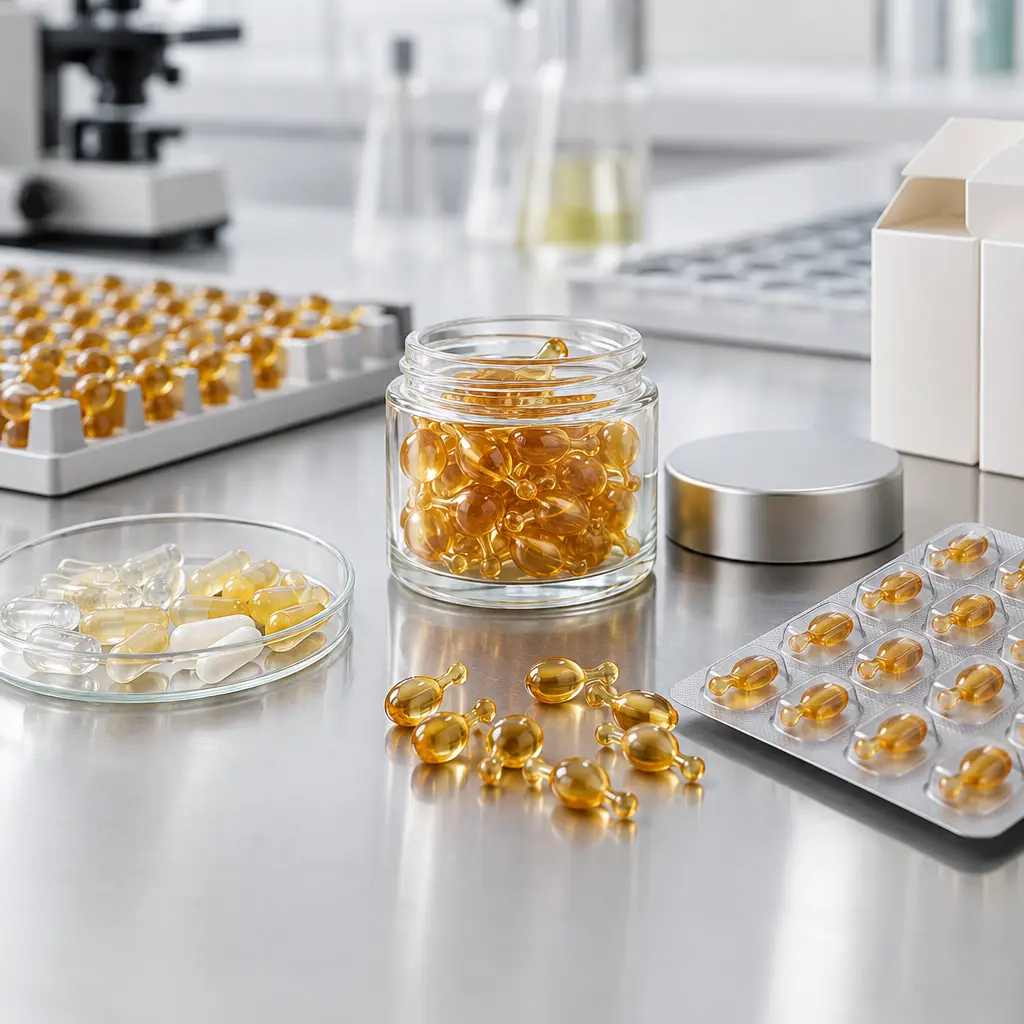
Blisters provide unit separation and can strengthen oxygen, moisture, and handling protection when the selected film and lidding structure are validated. Jars simplify the component set but expose remaining capsules whenever the container is opened. Jar qualification should cover headspace, closure torque, liner compatibility, desiccant requirements, capsule-to-capsule adhesion, and consumer access. Buyers can review the practical sampling questions in this guide to blister packaging decisions for skincare capsules.
Both formats require stability in the exact commercial materials, including decoration and closure components. The protocol should represent expected heat and humidity exposure, light conditions, warehouse dwell, and transport. Shipment cartons, pallet configuration, and temperature controls should be defined before scale-up, not after the first deformation complaint. These controls apply equally to private label skincare capsules beyond retinol.

Decision Framework Table
| Factor | What to Check | Why It Matters | ODM Buyer Note |
|---|---|---|---|
| Active system | Retinol or retinal identity, assay, carrier, antioxidants | Controls potency retention and claim accuracy | Lock the same formula for sample and mass production |
| Fill behavior | Viscosity window, target fill weight, dosing variation | Affects dose consistency and seam exposure | Review in-process and finished-product records |
| Shell | Gelatin or vegan material, moisture response, plasticizer | Influences brittleness, tackiness, and leakage | Do not transfer stability conclusions across shell types |
| Mold | Geometry, opening action, cavity consistency, ownership | Changes usability and production repeatability | Use a standard mold unless differentiation has a clear business case |
| Primary pack | Blister barrier or jar closure, liner, headspace | Controls oxygen, humidity, and handling exposure | Test fully decorated commercial components |
| Stability | Assay, appearance, odor, shell aging, leakage | Confirms formula-pack compatibility | Set release gates before purchase commitment |
| Market readiness | Label file, safety support, traceability, shipment conditions | Reduces registration and launch disruption | Map requirements by destination and channel |
For strategic sourcing, the preferred route is the configuration with the strongest documented control plan, not merely the most distinctive capsule appearance. Procurement, R&D, QA, regulatory, and logistics should approve one technical dossier before the retinol serum capsules route advances to commercial validation.
ODM Manufacturing Considerations
Begin ODM development with a written sample-confirmation standard rather than approval based only on appearance. The standard should identify the signed-off formula revision, capsule dimensions, shell type, color, fragrance, nominal fill mass, acceptable weight variation, twist-off behavior, and final packaging components. Keep retained samples from the approved round so production batches can be compared against a physical benchmark.
Formula customization should account for retinol concentration, antioxidant strategy, facial feel, fragrance level, and the flow behavior needed for accurate encapsulation. Ask the manufacturer to disclose whether suspended ingredients may settle, whether the serum changes color during storage, and how oxygen and light exposure are controlled during compounding and filling. If the range may later expand into retinal, eye serum, cleansing oil, or hair oil capsules, each formula requires its own encapsulation assessment rather than a simple ingredient substitution. Buyers can review related development routes for retinol capsules and vegan skincare capsules.
Shell selection normally involves conventional gelatin or a plant-derived alternative. The decision affects moisture response, elasticity, sealing behavior, and storage performance. Mold selection should then address capsule volume, fill dose, opening method, wall thickness, and whether the shape runs reliably on the intended line. A distinctive custom mold can strengthen a series identity, but it may add tooling, trial, and scale-up requirements. Colorcon notes that softgel performance depends on interactions among the fill, shell, and package, making these decisions interdependent rather than cosmetic alone.
Packaging approval should use actual production-intent capsules and components. For jars, observe sticking, scuffing, odor transfer, and deformation after repeated opening. For blisters, verify cavity dimensions, seal quality, capsule removal force, and barrier properties. Samples should also be held under elevated temperature and moisture conditions, with checks for leakage, brittleness, discoloration, fill separation, and potency change. Guidance on early blister decisions is available in this serum-capsule blister packaging review.
MOQ must be defined by formula, capsule color, mold, and packaging format, not merely by total order quantity. Confirm what the sampling fee covers and whether scale-up, tooling, printed components, and stability work are separate. The document package should include the ingredient list, specifications, certificate of analysis format, safety data where applicable, allergen or fragrance declarations, batch coding plan, artwork approval record, and market-specific labeling support. Saudi-bound products may also require an access review through the SABER conformity certification platform. Before dispatch, agree on carton configuration, pallet pattern, temperature expectations, transit duration, container exposure, and handling of damaged cases.

Common Problems or Failure Cases
Shell brittleness or sticking: A shell that loses moisture may crack when twisted, while excessive moisture can cause capsules to adhere or deform. The buyer should compare retained units across storage conditions and examine whether the jar, blister, desiccant, or secondary carton changes the result.
Fill separation or leakage: Pigments, botanical fractions, or incompatible oil blends can separate, creating inconsistent appearance and dose. Leakage may originate from unsuitable serum viscosity, overloaded capsules, weak seams, or mechanical pressure from an undersized blister cavity. Inspect individual capsule mass, seam condition, and pack dimensions rather than treating oil residue as a purely cosmetic defect.
Fragrance or packaging sensitivity: Fragrance components can migrate into the shell or become more pronounced in a sealed jar. Capsule color may also shift if the formula oxidizes or interacts with light. Plastic jars and blister materials can warp during warm transport, placing pressure on soft capsules. These failures are easier to detect when the final formula, shell, and presentation are evaluated together.

Supplier Checklist
Use the following points to compare a serum-capsule OEM/ODM supplier:
- Identify shell composition, colorants, plasticizers, and animal or plant origin.
- Record formula revision, retinol grade, antioxidant system, fragrance level, and target viscosity.
- Set nominal fill mass, tolerance, sampling frequency, and response to out-of-range results.
- Review capsule dimensions, mold ownership, tooling maintenance, and twist-off usability.
- Request leakage, deformation, brittleness, sticking, separation, and oxidation acceptance criteria.
- Evaluate the capsule inside the selected jar or blister, not only in bulk bags.
- Define sample stages, MOQ by SKU, lead time assumptions, and change-control responsibilities.
- Check ingredient, specification, batch, label, claims, and destination-market documents.
- Confirm transport cartons, palletization, storage limits, route risks, and damaged-goods procedures.
- Review deviation records, complaint investigation methods, recall readiness, and traceability.
For independent analytical or compliance support, buyers may compare proposed work with SGS cosmetic compliance and stability testing services.
FAQ
When is an ODM sample ready for formal approval?
Approve it only after the formula revision, shell, mold, fill mass, opening experience, and intended jar or blister are fixed. Record measurable criteria and retain signed samples; visual approval alone is insufficient.
Can a supplier guarantee that our core formula will never leak?
No responsible supplier can promise absolute security. Request role-based system access, separated customer files, controlled formula downloads, restricted weighing areas, visitor logs, confidentiality agreements, and auditable access records. Clarify ownership of custom formulas and molds in the manufacturing contract.
How should buyers plan for retinol or shell-material shortages?
Ask for approved alternate sources, safety-stock rules, allocation terms, supplier lead-time monitoring, and written change notification. Strategic-customer priority should be supported by a supply agreement and inventory evidence; verbal assurances do not guarantee availability during a global shortage.
How can environmental and worker-treatment claims be verified?
Review current discharge permits, waste records, greenhouse-gas methodology, utility data, and independent audit findings. Labor checks should include age verification, payroll and time records, overtime controls, grievance channels, and corrective-action closure. Allow contractual access to relevant records rather than relying on policy statements.
Should a jar and blister use the same stability evidence?
No. Each presentation creates different moisture, oxygen, light, friction, and compression conditions. Generate evidence with the actual capsule and market-ready components, especially when changing cavity size, jar resin, liner, or capsule count.
What should happen if the incumbent capsule supplier has a major quality or capacity failure?
Maintain a qualified secondary route with matched specifications, retained references, document readiness, and packaging fit records. A transfer still requires comparison batches because identical ingredient lists do not ensure identical shell behavior, fill flow, or leakage performance.