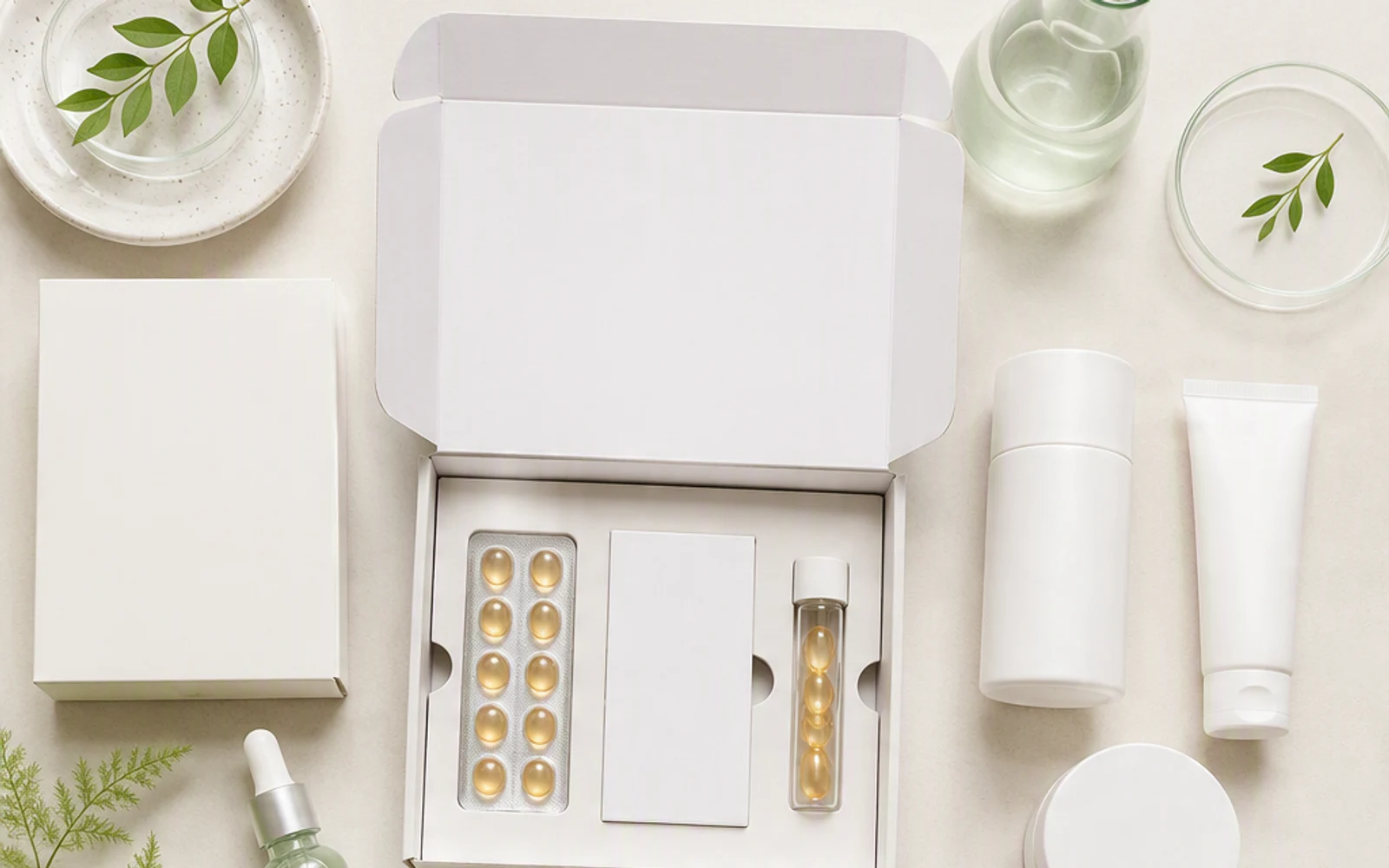
Direct answer: approve a capsule skincare sample only when it is tied to a named configuration: formula version, shell direction, mold, fill amount, package route and review purpose. A sample is not just something to feel or photograph. It is a decision object that should tell the buyer what can move forward, what needs revision and what still requires technical, packaging or quality review.
Buyer decision summary
- Request samples from a written brief, not from a vague catalogue preference.
- Record formula, shell, mold, fill amount, package and sample date for every version.
- Separate consumer-experience feedback from packaging feedback and technical follow-up.
- Do not use a development sample as proof of final shelf life, market compliance or production release.
- End each review with an approval status, open-question list and next action owner.
Sampling is where a capsule skincare concept becomes real enough to touch, open, apply, smell and package. It is also where many projects lose control. A team may love the feel of a sample without knowing which formula version it represents. A buyer may approve a capsule shape without checking whether the fill amount matches the intended use. A brand may photograph a sample pack before confirming whether the final packaging route is technically and commercially suitable. The result is enthusiasm without traceability.
This checklist is designed for B2B buyers preparing private-label facial oil capsules, retinol capsules, eye serum capsules, hair oil capsules, cleansing oil capsules and related single-dose skincare products. Use it before requesting samples, during the review meeting and before asking for a production quote.
Prepare the brief before samples are made
A good sample starts before the factory makes anything. The buyer should describe the commercial goal, intended consumer, target market, product route, formula direction, shell preference, mold direction, pack idea, quantity range and launch timing. This does not mean every decision must be final. It means the supplier knows which questions the sample is meant to answer.
For example, a sample for a 10-count retinol trial pack should be reviewed differently from a loose facial oil capsule sample for early concept exploration. A vegan shell comparison should be reviewed differently from a stock-mold fill-weight comparison. A sample for packaging photography should be clearly distinguished from a sample intended for technical review. When the purpose is unclear, the buyer may draw the wrong conclusion from the sample.
| Brief item | What to write before sampling | Why it matters |
|---|---|---|
| Product route | Eye capsule, facial oil capsule, retinol capsule, cleansing capsule, hair oil capsule or other route. | The use case affects fill amount, shell, mold and package review. |
| Consumer routine | Where it is applied, how often, one capsule or multiple capsules, and expected texture. | The sample should be judged against the actual application moment. |
| Target market | Countries, channels and claims that may need review. | Documentation and label questions depend on market context. |
| Formula direction | Hero ingredients, ingredients to avoid, fragrance direction and sensory target. | The sample team can avoid testing a concept that conflicts with brand requirements. |
| Package idea | 7-count, 10-count, 30-count, blister, jar, tray, carton or undecided. | Packaging affects how the capsule is presented and protected. |
Use the sample identity sheet
The sample identity sheet is our own project-control tool, not an industry standard. Its purpose is simple: nobody should review a capsule sample without knowing what it is. The sheet can be short, but it should stay with the sample through the review process. If the buyer receives several versions, each one needs a unique identifier.
A useful identity sheet includes product name or project code, formula version, shell direction, mold reference, target fill amount, package direction, sample date, sample purpose, reviewer names and known limitations. If a sample is exploratory, mark it exploratory. If a package is representative but not final, mark that clearly. This honesty prevents later teams from treating early feedback as final approval.
| Sample identity field | Example entry | Common mistake |
|---|---|---|
| Formula version | Face oil base V2, fragrance-free direction. | Calling it only “facial oil sample”. |
| Shell direction | Vegan shell trial, compatibility still under review. | Writing “vegan” as if claim review is complete. |
| Mold reference | Stock oval mold candidate for one-use facial application. | Selecting shape from a photo without dose review. |
| Package direction | 10-count trial box concept; final carton not yet approved. | Photographing a mockup as if it is the launch pack. |
| Sample purpose | Consumer feel and fill amount review, not final stability evidence. | Using an early sample to support broad product claims. |
Check the capsule as a consumer will use it
A capsule should be reviewed in the hands, not only in a tray. Look at the capsule before opening, while removing it from the package, while opening it and after the fill is released. Does the shell feel appropriate? Does the opening method make sense? Does the amount released match the application area? Does the fill spread as expected? Does the capsule leave too much product behind? Does the user need one capsule or more than one?
For eye-area products, small differences in amount can change user perception. For facial oil capsules, spread and finish matter. For hair oil capsules, hair length and use location can change whether one capsule feels sufficient. For cleansing oil capsules, the makeup-removal and water-contact routine must be considered. The sample should be judged against the product route, not against a generic idea of what a capsule “should” feel like.
If the amount is not yet defined, use the fill-weight selection guide before approving the sample for quote or production discussion.
Review packaging before it becomes artwork
Packaging should enter the sample conversation early. A capsule that looks good loose may behave differently inside a blister, jar, tray or carton. Capsules may move, scuff, stick, look crowded, look too sparse or become difficult to access depending on the package. Pack count also changes the product story. A 7-count pack may read as a discovery set, a 10-count pack as a trial or short program, and a 30-count pack as a daily-use SKU.
Before artwork begins, ask whether the sample package represents the intended final route. If it is only a placeholder, record the gap. Confirm whether the package supports label information, instructions, coding, retail display, shipping and storage assumptions. This is especially important when the product uses sensitive ingredients, a new shell route or a premium presentation that depends heavily on the capsule’s appearance.
| Packaging check | Question to ask | Decision consequence |
|---|---|---|
| Count | Does the number of capsules match the intended routine? | Changes to count can affect carton size, unit economics and consumer communication. |
| Access | Can the consumer remove and open the capsule easily? | A beautiful pack may fail if the use experience is awkward. |
| Protection | Does the route need review for light, oxygen, moisture, movement or handling assumptions? | Package choice may influence stability and compatibility review. |
| Information space | Is there room for instructions, claims, warnings, coding and market text? | Artwork may need to change before launch. |
| Photography | Does the package represent the final product or only a concept mockup? | Marketing materials should not overstate sample readiness. |
For count strategy, pair this sample review with the 7-, 10- and 30-count packaging guide.
Separate consumer, brand and technical feedback
One of the simplest ways to improve sampling is to separate comments into three columns. Consumer-experience feedback covers opening, amount, spread, feel, fragrance and routine. Brand and packaging feedback covers shape, color, visual identity, pack count, carton and channel fit. Technical or compliance follow-up covers formula-shell compatibility, stability review, claim support, documentation and market questions. If these are mixed together, a subjective preference may be mistaken for a technical problem, or a technical issue may be buried under design comments.
Three-column sample review
- Consumer experience: opening method, fill amount, spread, texture, fragrance direction and application routine.
- Brand and packaging: capsule shape, color, pack count, retail presentation, photography, carton and channel fit.
- Technical follow-up: shell-fill compatibility, package assumptions, stability review, documentation, market claims and quality questions.
Assign an owner to each open item. The product team may own sensory decisions. The packaging team may own carton and artwork questions. The manufacturer may own technical feasibility notes. The buyer may own target market, claim and channel decisions. Sampling becomes useful when feedback creates actions rather than a long comment thread.
Know what the sample cannot prove
A sample can demonstrate concept direction, visual appearance, opening experience, fill feel and packaging possibility. It cannot automatically prove shelf life, market compliance, final claim support, production repeatability or finished-goods release. Those require the appropriate review for the final formula and package. This distinction is especially important for retinol capsules, vegan shell routes, new packaging formats and products with strong consumer claims.
Do not write product copy that says or implies more than the sample supports. If the sample was produced to compare texture, do not treat it as final stability evidence. If the package was a mockup, do not treat it as a packaging validation. If the shell was exploratory, do not finalize vegan or related claims until responsible review is complete. A careful sample record protects the brand from over-promising.
When stability is part of the next decision, use the capsule stability review checklist to define the formula, shell, package, storage assumptions and acceptance criteria.
Turn sample feedback into a quote-ready specification
The end of a sample review should produce one of three outcomes: approved as presented, approved subject to listed changes, or not approved. Avoid vague outcomes such as “looks good” or “needs improvement” without the details needed for action. If the sample is approved, state which configuration is approved. If revisions are needed, specify which part changes: formula, shell, mold, fill amount, pack, artwork or documentation. If the sample is rejected, state the reason and whether the route should be changed or stopped.
A quote-ready specification does not need to be perfect, but it must be clear enough for the manufacturer to price the right route. It should state product type, formula version or direction, shell, mold, target fill amount, packaging route, pack count, decoration assumptions, document requirements, quantity range and timing. If open questions remain, list them in the quotation request rather than hiding them.
Prepare the RFQ packet after sample review
Once the sample review is complete, organize the information into an RFQ packet. This packet can be short, but it should save both sides from reinterpreting the project. Include photos only as supporting material; the written specification is more important. If the sample was created by PZIK, use the sample identity and feedback record as the starting point for the next discussion.
Quote-ready sampling packet
- Approved or revised product route with product category and target market.
- Formula version or development direction, including ingredients to avoid and sensory target.
- Shell direction and any vegan, gelatin, halal or market-positioning questions.
- Mold reference, target fill amount and consumer application notes.
- Packaging route, pack count, carton, label, artwork status and coding requirements.
- Sample review decision, open questions, responsible owners and target dates.
- First order estimate, sample quantity needs, launch timing and reorder expectations.
FAQ
How many capsule skincare samples should a buyer review?
There is no universal number. Review enough versions to answer the specific project question without creating confusion. A formula comparison, shell comparison and packaging comparison should be named separately so the team knows what each sample is meant to decide.
Can I approve a capsule sample before packaging is final?
You can approve a development direction, but you should not treat it as final production approval if the packaging can affect protection, count, consumer access or presentation. Record what is approved and what remains representative or undecided.
What is the biggest sampling mistake in capsule skincare?
The biggest mistake is approving a sample without a version record. If the team cannot identify formula, shell, mold, fill amount and package direction, it may not know what was actually approved when the project moves to quote or production.
Should sample feedback include marketing comments?
Yes, but keep them separate from technical comments. Marketing may evaluate visual fit, story and channel appeal. Technical review should address shell, fill, package, stability questions and documentation. Mixing the two creates poor decisions.
When should a sample move to stability review?
Move toward stability review when the formula, shell, capsule format and package direction are clear enough to define what is being evaluated. Early exploratory samples can inform the plan, but they should not be treated as final technical evidence.
Request sample review support
If you already have capsule skincare samples or want PZIK to prepare a first sample direction, send the product route, target market, formula intent, shell preference, pack idea and questions you want the sample to answer. We can help organize the review into consumer, packaging and technical decision points. Request capsule skincare sampling support.
About this guide
This guide is written for private-label and OEM/ODM capsule skincare buyers who need samples to support a business decision. It is based on manufacturer-side project control logic and the current PZIK capsule skincare site structure. It does not replace final formula, quality, regulatory or market review for a specific finished product.
Related articles
- How to Choose Capsule Fill Weight for Eye, Face and Hair Care – use this before approving the amount in one capsule.
- What to Confirm Before a Capsule Stability Review – prepare the technical review packet after sample selection.
- How to Evaluate a Capsule Skincare Manufacturer – check whether a supplier can control the sample-to-production handoff.
- PZIK OEM/ODM Services – move from sample review to a structured project route.