Category: Launch Guides

  • How to Scope Hair Oil Capsule Development Before Choosing a Capsule Skincare Manufacturer

    How to Scope Hair Oil Capsule Development Before Choosing a Capsule Skincare Manufacturer

    Direct Answer

    Before selecting a serum capsules manufacturer, define the hair oil capsule as a controlled delivery system rather than simply an oil formula inside a shell. This hair oil capsules private label buyer guide recommends locking eight variables before supplier nomination: intended use, fill composition, viscosity at filling temperature, target fill weight, shell chemistry, mold geometry, package format, and route-specific stability requirements. The buyer should also establish measurable acceptance criteria for leakage, oxidation, weight variation, heat and humidity exposure, and dispensing performance.

    Supplier selection should begin only after these parameters are documented in a technical brief. Otherwise, quotations will compare materially different products, and an apparently faster launch may conceal shell incompatibility, packaging rework, or mass-production variability. For multinational procurement teams, ISO 22716 status is necessary but insufficient; auditability, change control, material traceability, intellectual-property segregation, ESG evidence, and contingency capacity must be evaluated alongside capsule performance.

    Key Takeaways for Private Label Buyers

    • Scope the application first. A single-use hair-length serum, a leave-on scalp oil, and a conditioner booster require different safety, dose, labeling, and sensory assessments.
    • Qualify fill and shell together. Oil polarity, fragrance load, oxidation sensitivity, and residual moisture can alter seam strength, brittleness, or leakage over time.
    • Specify the dose statistically. Define nominal fill weight, permitted variation, sampling method, and release criteria before reviewing skincare capsule product lines.
    • Select packaging through stability data. A bottle or jar may provide strong shelf presentation but weaker unit protection than a blister under humid distribution conditions.
    • Separate pilot approval from launch approval. Samples should use production-intent shell material, mold, fill process, and primary packaging rather than laboratory substitutes.
    • Require a documented regulatory pathway. Ingredient nomenclature, claims, artwork, market notifications, and shipment conditions should be assigned to named owners.

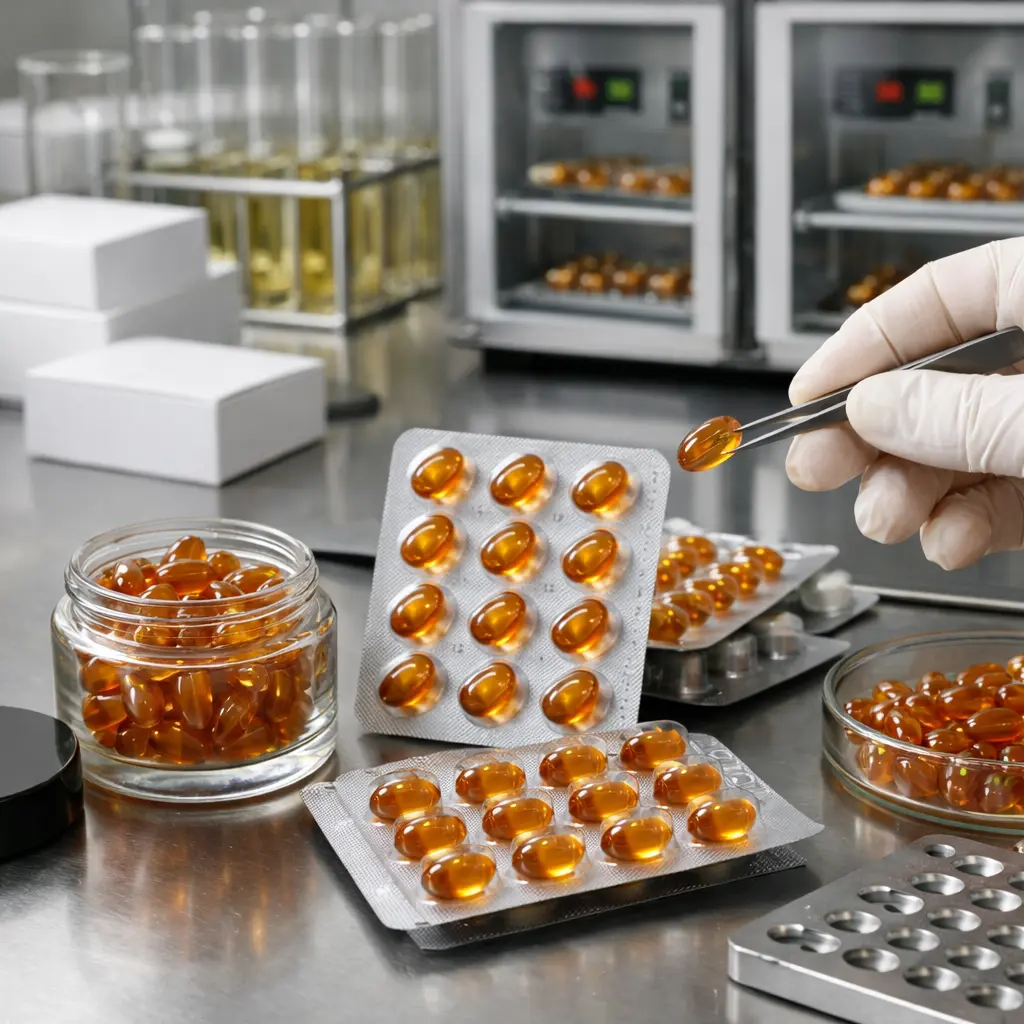
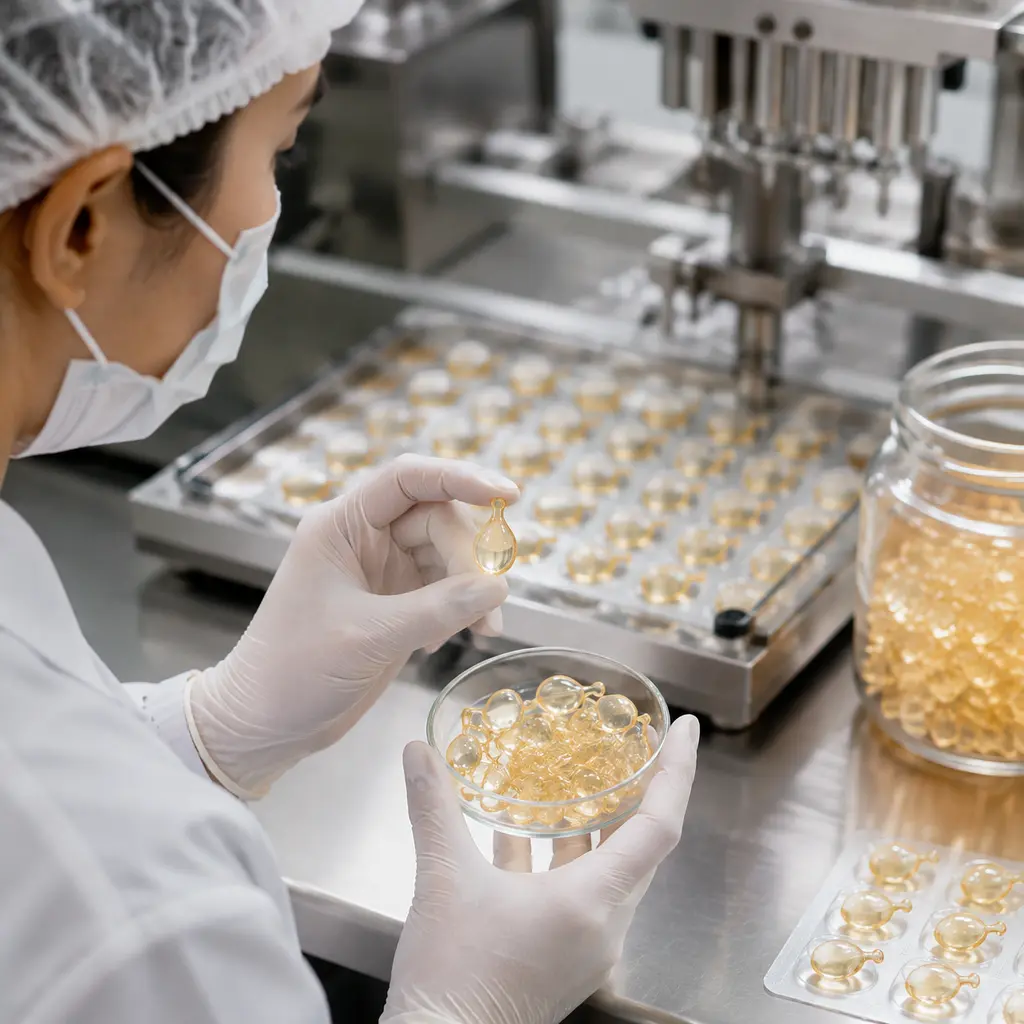
    Hair oil capsule shell inspection during private label quality control
    Hair oil capsule shell inspection during private label quality control

    Buyer Context

    Capsule skincare compresses formulation, primary packaging, and dose control into one system. A defect in any component can compromise the finished SKU. This is particularly relevant when procurement is responding to an incumbent quality incident, sudden capacity interruption, or a corporate requirement to add geographically diversified production. The qualification objective is not merely to reproduce an attractive sample; it is to demonstrate repeatable output under approved materials, equipment, controls, and distribution conditions.

    The risk profile also varies by category. Retinol capsules place greater emphasis on light and oxidation control. Facial oil and cleansing oil capsules require shell compatibility with esters, surfactants, fragrance, and botanical oils. Eye serum capsules demand tight dose and dispensing control. Hair oil capsules may contain silicones, hydrocarbons, esters, or natural oils whose migration behavior differs materially. Vegan shells can support brand policy, but carrageenan-, starch-, or other plant-derived systems are not automatic substitutes for gelatin; machinability, moisture response, seam formation, and long-term texture must be validated.

    A mature sourcing team should therefore compare suppliers through a common design dossier. Review the broader private label skincare capsules portfolio for evidence of relevant process capability, not as proof that one validated capsule platform transfers automatically to another. Likewise, a skincare capsules OEM claiming pilot runs from 1,000 units and scale-up without reformulation should provide batch records, equipment equivalence, deviation history, and change-control evidence supporting that claim.

    Regulatory review should start with the intended markets. Ingredient names can be cross-checked against the INCI ingredient nomenclature database, while final nomenclature remains subject to applicable law and expert review. United States artwork should be assessed against the FDA Cosmetics Labeling Guidethe SABER conformity certification platform. Technical teams can also monitor peer-reviewed work in the International Journal of Cosmetic Science, without treating published research as finished-product substantiation.

    Capsule Formula, Shell, Mold, and Packaging Factors

    Fill Formula and Oxidation Control

    The formulation brief should identify every oil, silicone, antioxidant, fragrance component, colorant, and processing aid, including supplier grade and permitted alternatives. Record viscosity at a stated temperature because filling behavior can change with seasonal plant conditions. Establish incoming limits for oxidation-sensitive oils and finished-fill limits for relevant indicators such as peroxide value, odor, color, and assay where applicable. Nitrogen blanketing, minimized bulk hold time, opaque handling vessels, and oxygen-barrier packaging should be evaluated as a connected control strategy.

    Water-containing serum or cream fills require additional scrutiny. Many softgel systems are designed for anhydrous or tightly controlled fills; free water can migrate into the shell and destabilize the seam. Buyers moving from encapsulated retinol skincare to hair oil should not assume that an existing shell specification remains compatible with a new solvent or fragrance system.

    Shell, Fill Weight, and Mold Geometry

    Request the full shell composition, color system, plasticizer, animal-origin status, allergen statement, and supporting vegan documentation where claimed. The specification should define shell appearance, seam integrity, moisture range, rupture or twist-off behavior, and aging criteria. Fill weight should be tied to the consumer dose and manufacturing capability. A nominal value alone is inadequate; procurement needs an agreed tolerance, in-process sampling frequency, and disposition rule for outliers.

    Mold geometry affects more than appearance. Tail dimensions influence opening force and directional dispensing; wall thickness and seam location affect leakage risk; capsule footprint determines blister cavity and jar count. Custom molds also introduce tooling ownership, maintenance, replacement, and IP-control questions. Review comparable cosmetic softgel capsule factory output, then require production-intent samples from the proposed mold.

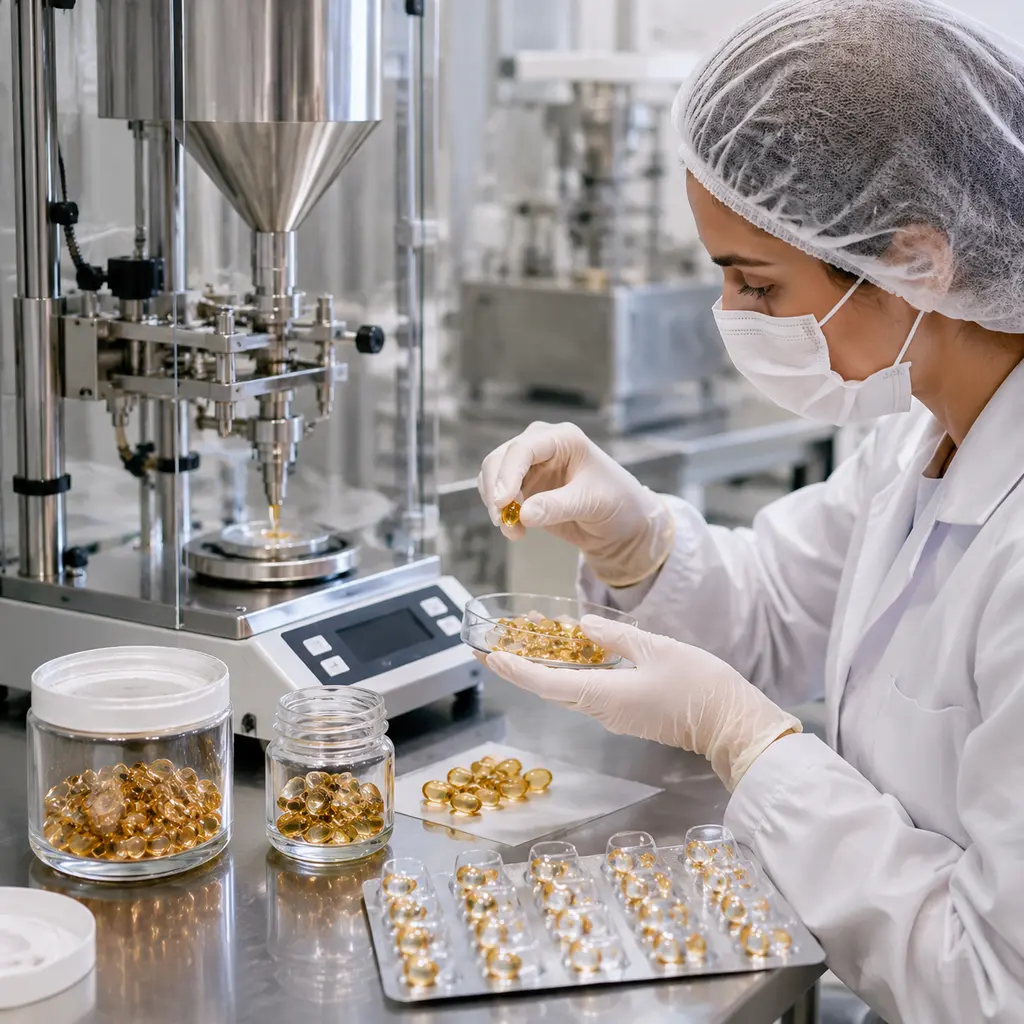
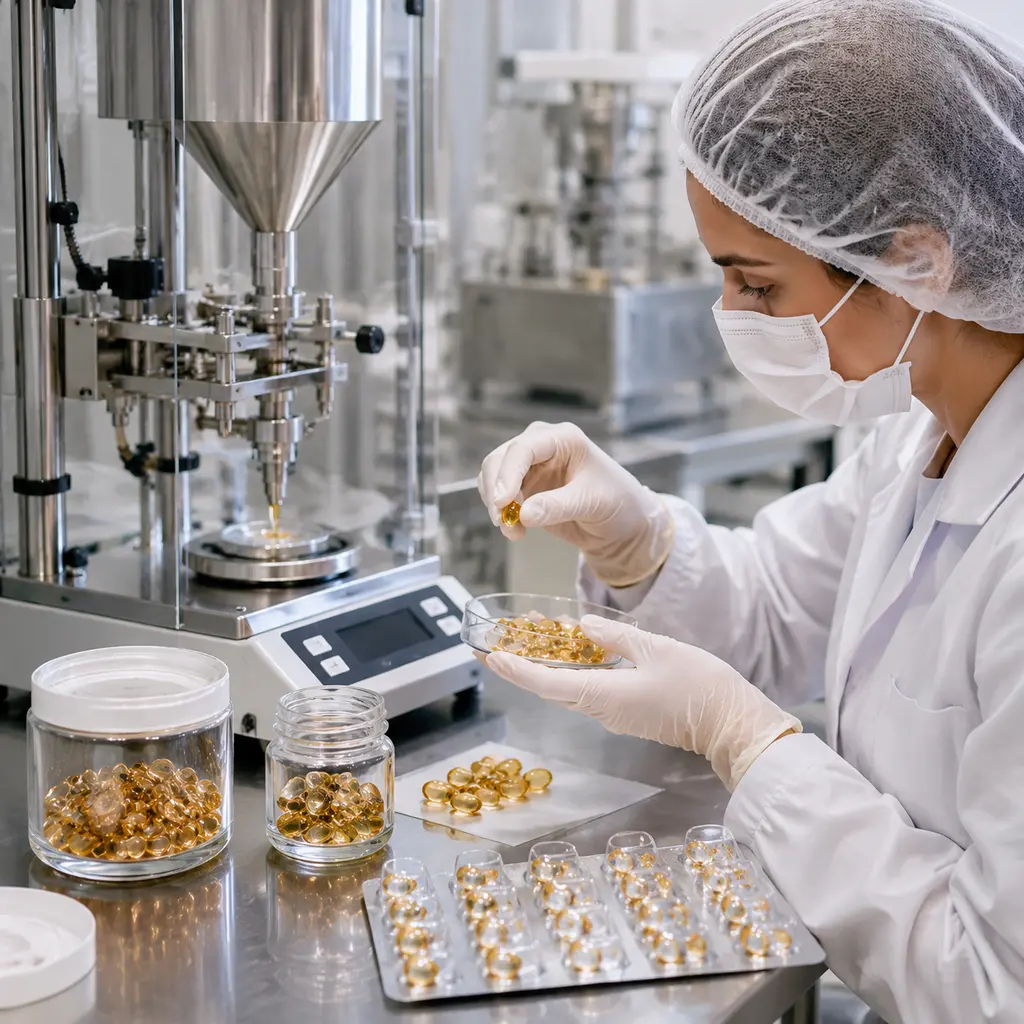
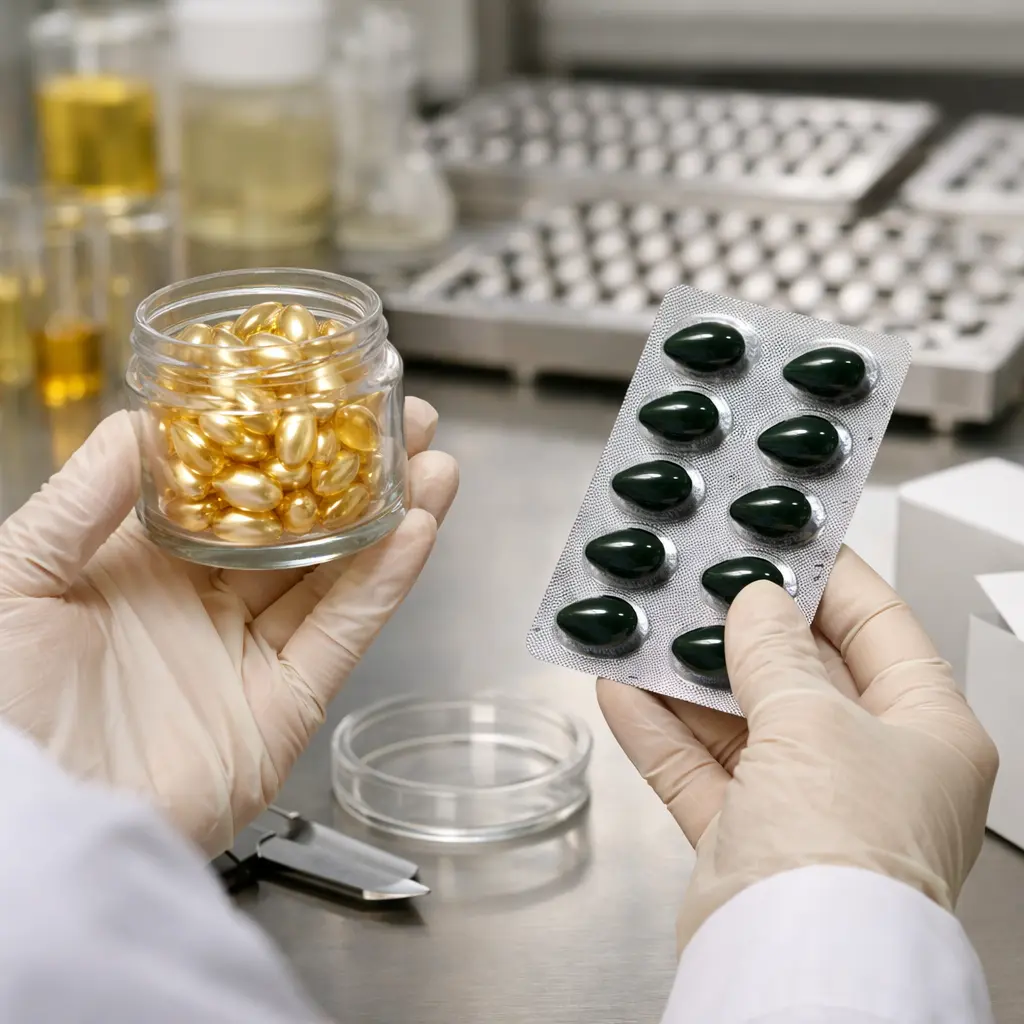
    Hair oil capsule fill-weight sampling on an OEM production line
    Hair oil capsule fill-weight sampling on an OEM production line

    Packaging, Storage, and Stability

    Blisters provide individual barrier protection and stronger tamper evidence but increase component complexity and artwork coordination. Jars and bottles simplify consumer access, yet repeated opening can expose capsules to oxygen, heat, and humidity. Compatibility testing should include capsule-to-capsule adhesion, deformation, color transfer, odor retention, closure performance, liner interaction, and dispensing damage.

    A defensible protocol normally combines long-term storage, accelerated exposure, low-temperature review, and transport simulation. Conditions such as 25°C at 60% relative humidity, 40°C at 75% relative humidity, and 5°C may be useful starting points, but they are not universal pass conditions. Duration, test intervals, and acceptance limits must reflect formula risk, packaging barrier, target shelf life, and shipping lanes. Pilot samples should be evaluated in final primary packaging before commercialization of any serum capsule products.

    Decision Framework Table

    Factor What to Check Why It Matters ODM Buyer Note
    Intended use Hair lengths, ends, scalp, rinse-off, or leave-on Changes dose, claims, safety review, and directions Freeze intended use before formula approval
    Fill system INCI, grades, viscosity, oxidation markers, fragrance load Determines filling control and shelf-life risk Prohibit substitutions without written change approval
    Shell Material, plasticizer, moisture response, seam integrity Controls leakage, brittleness, and dispensing Verify vegan or animal-origin evidence separately
    Fill weight Nominal dose, tolerance, sampling plan, outlier rules Protects dose consistency and pack count economics Review capability data from production equipment
    Mold Geometry, tail opening, tooling ownership, maintenance Affects usability, differentiation, and continuity Document custody and replacement lead time
    Primary pack Blister barrier or jar and bottle closure compatibility Controls humidity, oxygen exposure, and transport damage Approve only with production-intent components
    Stability Heat, humidity, low temperature, transport, test intervals Connects laboratory approval to real distribution risk Define failure escalation and investigation ownership
    Supplier governance ISO 22716, ESG audits, traceability, IP controls, contingency plans Reduces recall, disruption, and disclosure exposure Verify evidence through audit rather than questionnaire alone

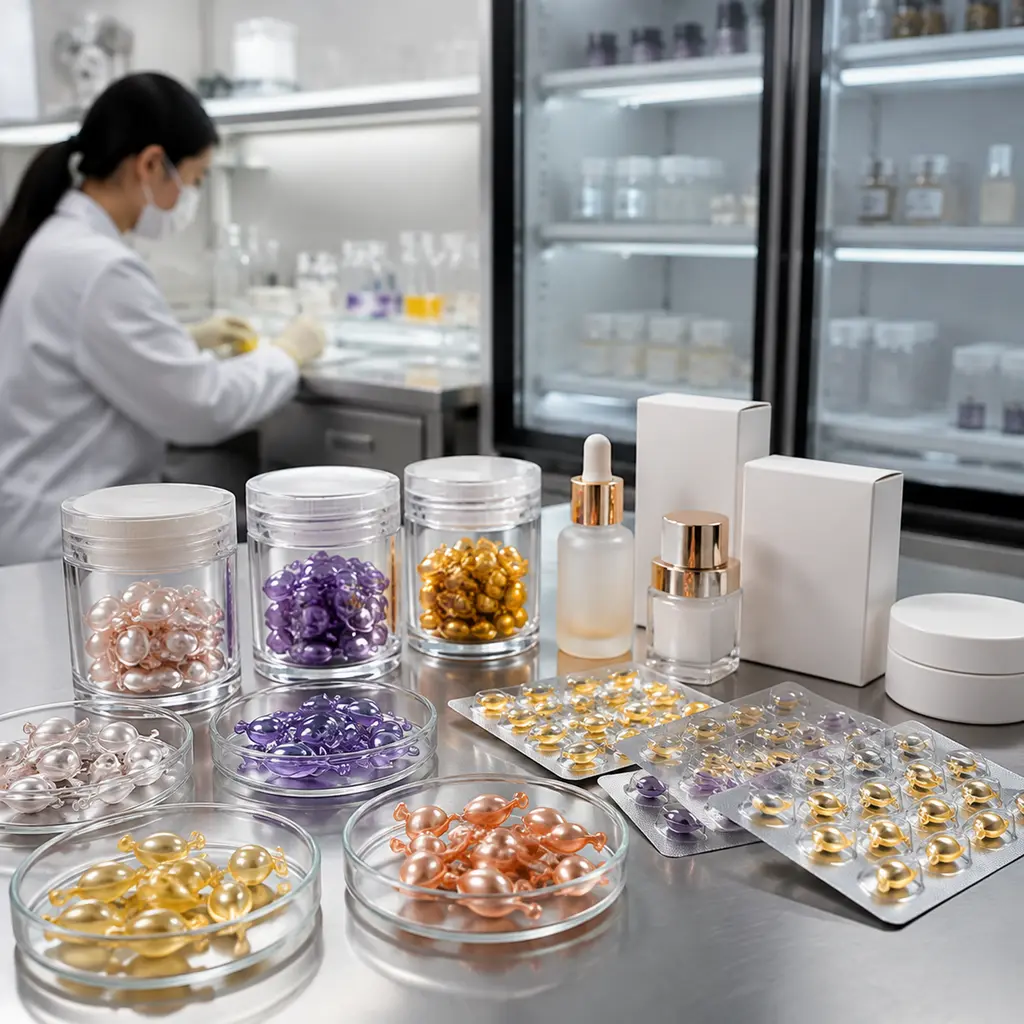
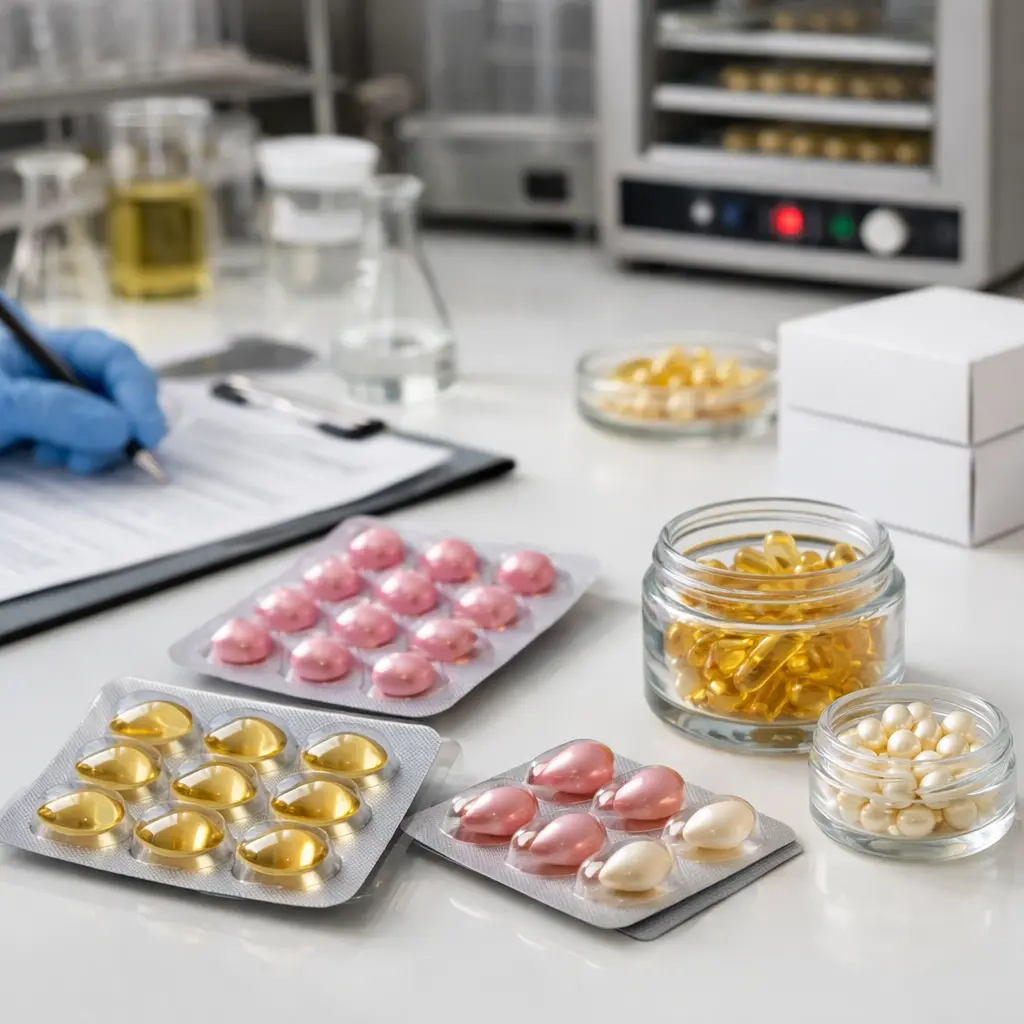
    Hair oil capsule blister and jar compatibility stability review
    Hair oil capsule blister and jar compatibility stability review

    ODM Manufacturing Considerations

    A practical hair oil capsules private label buyer guide should convert the product concept into measurable approval criteria. This becomes especially important when a brand is qualifying backup capacity after a supplier disruption or adding a capsule format that its current factory cannot manufacture.

    Sample confirmation should proceed in defined stages. First, approve the fill for appearance, odor, spread, absorption, and compatibility with the intended hair or scalp use. Next, evaluate filled capsules for opening behavior, residue, seal consistency, and dose uniformity. Finally, review the capsules inside the proposed retail pack. A loose sample presented in a laboratory pouch does not confirm how the finished product will perform in a bottle, jar, or blister.

    For fill customization, provide an ingredient policy, target sensory profile, prohibited materials, fragrance limits, and desired claims territory. Confirm whether the fill is an anhydrous oil blend or contains suspended materials that could settle. Record the approved viscosity range and nominal fill weight rather than relying on a descriptive formula alone. Buyers can use the INCI ingredient nomenclature database as a preliminary terminology resource, but the supplier remains responsible for an accurate ingredient declaration and supporting specifications.

    Shell selection should document the polymer system, plasticizer, colorants, opacity, and animal-derived or vegan status. Different shells respond differently to the fill and storage environment. Review available vegan skincare capsule options if a plant-based positioning is required. Mold selection should consider dose capacity, twist-off handling, wall thickness, decorative complexity, and whether an existing shape can meet the brief. A highly detailed custom shape may add tooling work and create narrower operating tolerances than a standard oval or teardrop capsule.

    Packaging approval must use the proposed capsule count, pack material, closure, insert, and secondary carton. Ask whether headspace, capsule movement, or pack contact could affect appearance during distribution. Stability review should include scheduled observations of color, odor, shell texture, seal integrity, dose mass, and pack condition. Oxidative change should be assessed through suitable chemical or sensory indicators agreed for the formula rather than appearance alone.

    MOQ discussions should separate formula batching, capsule conversion, color preparation, packaging components, and final assembly. The highest component minimum may determine the commercial order quantity. Also request a complete labeling file: ingredient declaration, product identity, nominal contents, batch coding format, responsible-party details, country-of-origin information where applicable, cautions, and available claim support. For US planning, the FDA Cosmetics Labeling Guide provides a useful regulatory starting point.

    Shipment conditions belong in the specification. Define carton configuration, palletization, acceptable transit exposure, data-logger expectations for sensitive lanes, and inspection steps after arrival. Saudi-bound programs should separately verify applicable requirements through the SABER conformity certification platform and qualified local regulatory advice.

    Hair oil capsule shell and bottle compatibility review in an OEM laboratory
    Hair oil capsule shell and bottle compatibility review in an OEM laboratory

    Common Problems or Failure Cases

    Shell brittleness: Capsules may crack during packing or consumer opening when shell moisture balance, shell composition, fill interaction, or storage exposure moves outside the validated range. Inspect retained units at multiple ages and record fracture behavior, not merely visual appearance.

    Sticking or deformation: Capsules can adhere to one another, flatten against a jar wall, or lose shape under elevated temperature and compression. Excessive pack count, unsuitable pack surfaces, and long transit dwell times can compound the problem.

    Fill separation: Pigments, powders, or incompatible oil fractions may settle or form visible gradients. Compare top, middle, and bottom samples from the batch and verify that individual capsules deliver a consistent composition.

    Leakage: Weak seals, inconsistent shell thickness, mechanical abrasion, or fill migration can produce oily residue. Buyers should distinguish isolated handling damage from a systematic failure by mapping defects across trays, cartons, and production time.

    Fragrance sensitivity: Fragrance components can alter shell texture, increase odor loss, or accelerate color change. A fragrance accepted in a bottle-based hair serum should not be assumed suitable for a capsule.

    Packaging deformation: A closure, liner, or insert can warp, transfer odor, or place pressure on the capsules. This is why packed samples must be assessed alongside loose capsules. Related formats such as facial oil capsules may offer useful precedents, but evidence should match the selected hair oil fill and pack.

    QC inspection of serum capsules for deformation, sticking, and leakage
    QC inspection of serum capsules for deformation, sticking, and leakage

    Supplier Checklist

    • Obtain the shell composition, fill specification, nominal fill weight, tolerances, viscosity range, and acceptance methods.
    • Confirm the mold identifier, ownership or access terms, expected cavity life, replacement responsibility, and approved capsule dimensions.
    • Review batch records showing seal checks, weight results, visual defect classification, and traceability from raw materials to packed goods.
    • Require samples covering formula approval, filled-capsule approval, and the complete retail package.
    • Compare formula batch minimums with shell color, tooling, bottle or blister, carton, and assembly minimums.
    • Request shelf-life rationale, retained-sample procedures, deviation handling, and the protocol for investigating leakage or deformation.
    • Verify labeling documents for every destination market and ensure artwork approval responsibilities are written.
    • Specify shipment route, seasonal risks, pallet pattern, carton strength, arrival inspection, and responsibility for damaged goods.
    • Audit information security, raw-material continuity, worker welfare, environmental records, and business insurance instead of treating factory certification as the sole qualification test.
    • If headquarters has a carbon-neutral supplier target, request the reporting boundary, calculation method, source records, reduction plan, and independent assurance status.

    Procurement teams can compare these records against the supplier’s stated OEM and ODM service scope before commercial nomination.

    FAQ

    Can a factory guarantee that our core formula will never be disclosed?

    No credible supplier can promise absolute zero risk. Ask for role-based system permissions, segregated formula records, restricted physical access, confidentiality obligations, access logs, backup controls, and incident-response procedures. Confirm which employees and subcontractors can view the complete formula, then test those controls during an audit.

    How can a strategic buyer secure supply during a global raw-material shortage?

    Priority status should be contractual and operational, not verbal. Review allocation rules, forecast commitments, reserved inventory, dual-source status, lead-time triggers, and escalation contacts. Any alternate ingredient should require the buyer’s written approval and a documented assessment of capsule performance and labeling impact.

    How do we check whether factory workers are treated fairly?

    Review age-verification records, payroll and time records, overtime consent, grievance channels, worker interviews, dormitory conditions where relevant, and corrective-action closure. A scheduled social audit alone may not reveal recruitment fees, withheld wages, or excessive working hours.

    Should the brand approve the formula before selecting the mold?

    Usually, formula feasibility and approximate dose should come first. The final mold can then be selected around fill volume, opening experience, shell behavior, and pack dimensions. Developing an elaborate mold too early can create avoidable rework.

    Can the same packaging be used for hair oil capsules and retinol capsules?

    Not automatically. Fill chemistry, light sensitivity, odor migration, shell behavior, capsule count, and expected storage conditions may differ. Each formula and packaging combination needs its own documented review.

    What should be included in an approved commercial sample?

    It should identify the exact fill revision, shell system, color, shape, dose, fragrance, packaging components, capsule count, coding approach, and approval date. Any permissible visual or dimensional variation should be recorded so the sample functions as a clear production reference.


    References

  • Vegan Cosmetic Capsules Buyer Guide: Portfolio Scoping Before ODM Selection

    Vegan Cosmetic Capsules Buyer Guide: Portfolio Scoping Before ODM Selection

    Direct Answer

    A disciplined vegan cosmetic capsules buyer guide should begin with portfolio architecture, not manufacturer comparison. Before issuing an RFQ, define each SKU by fill chemistry, vegan shell composition, target fill weight, capsule geometry, primary packaging, sales markets, stability protocol, and shipment conditions. These variables are interdependent: a retinol serum that performs in a high-barrier blister may oxidize in a clear jar, while an HPMC-based shell that supports a vegan claim may become brittle or deform when exposed to an incompatible fill or uncontrolled humidity.

    The procurement objective is therefore to establish a qualification envelope that separates non-negotiable requirements from variables the ODM may optimize. This prevents suppliers from quoting materially different product systems under apparently comparable specifications. It also gives R&D, QA, regulatory, procurement, and ESG teams a common decision record before they assess a serum capsules manufacturer, request samples, or authorize production tooling.

    Key Takeaways for Private Label Buyers

    • Lock the fill, shell, mold, and pack as one product system; do not qualify them as independent components.
    • Require full shell composition and processing-aid disclosure rather than accepting a vegan declaration at face value.
    • Set fill-weight tolerance, seam integrity, leakage, oxidation, and appearance criteria before comparing commercial proposals.
    • Test capsules in the intended blister or jar under accelerated, ambient, transport, heat, and humidity conditions.
    • Align sample scope with the final manufacturing route so scale-up does not introduce a different shell, mold, or filling process.

    Vegan serum capsule shell inspection during private label sourcing review
    Vegan serum capsule shell inspection during private label sourcing review

    Buyer Context

    Serum capsules are exposed to coupled failure risks that conventional bottled serums do not face. The fill formula can migrate into the shell, volatile components can escape, oxygen can enter through the package, and temperature excursions can change both viscosity and seam behavior. These interactions matter across serum capsule products, including facial oil capsules, eye serum capsules, cleansing oil capsules, and hair oil capsules.

    The risk is more material for retinol capsules and other oxidation-sensitive systems. A buyer must evaluate antioxidant strategy, light protection, headspace, oxygen transmission, and package barrier performance without converting cosmetic positioning into unsupported therapeutic claims. U.S. artwork should be reviewed against the FDA Cosmetics Labeling Guide. Pigmentation-related positioning should also be screened against the distinction between cosmetic appearance claims and treatment claims reflected in AAD guidance on hyperpigmentation.

    For multinational portfolios, market access must be included in the initial brief. Gulf launches may require review against the Gulf Standardization Organization framework and UAE MoIAT industrial standards. Delaying this review until artwork approval creates avoidable relabeling and launch risk.

    This discipline becomes especially important when a current supplier has suffered a quality incident, capacity interruption, or serious social-audit nonconformity. It also supports new group-level ESG mandates: procurement can trace shell inputs, colorants, labor controls, packaging materials, and shipment routes before transferring strategic volume to a new cosmetic softgel capsule factory.

    Retinol serum capsule fill-weight sampling during quality control
    Retinol serum capsule fill-weight sampling during quality control

    Capsule Formula, Shell, Mold, and Packaging Factors

    Fill Formula and Shell System

    Start with the intended consumer dose and dispensing behavior. Record nominal fill weight, acceptable tolerance, fill viscosity at the filling temperature, active concentration, carrier oils, suspended solids, fragrance, antioxidants, and water activity. A laboratory formula is not production-ready evidence unless the ODM demonstrates that it can be pumped, metered, sealed, and cooled without active settling or fill-weight drift.

    The shell specification should identify every constituent, including polymer, plasticizer, colorant, opacifier, and processing aid. HPMC, starch, or carrageenan systems may support vegan positioning, but plant-derived polymer alone does not establish claim integrity. Buyers should request supplier declarations, animal-origin statements, allergen information, country of origin, change-notification commitments, and lot traceability. These records should be reviewed alongside physical tests for elasticity, seam strength, brittleness, tackiness, deformation, and leakage.

    Compatibility must be tested with the actual fill. Hygroscopic ingredients may move moisture across the shell interface; solvents and essential-oil components may soften the shell; low-viscosity facial oils may expose marginal seams. For encapsulated retinol skincare, the test plan should also monitor potency, color, odor, peroxide development, and capsule appearance over time.

    Mold, Packaging, Storage, and Performance

    Custom mold selection affects more than aesthetics. Capsule volume, wall distribution, seam length, twist-off geometry, cavity orientation, and tooling condition influence dose accuracy and leakage risk. Procurement should confirm ownership of custom tooling, maintenance responsibility, approved backup molds, replacement lead time, and whether samples are produced on the same mold family proposed for mass production.

    Packaging is part of the stability system. Unit-dose blisters can provide stronger moisture, oxygen, and handling protection, while jars may simplify presentation but expose multiple capsules whenever the container is opened. Jar evaluations should cover closure torque, liner compatibility, headspace, capsule-to-capsule adhesion, and the effect of any desiccant. Excessive moisture removal can make some shells brittle, so a desiccant should never be added without package-level testing.

    A credible private label skincare capsules program should test the final capsule and pack together at ambient and accelerated conditions. An illustrative accelerated condition is 40°C and 75% relative humidity, but the approved protocol must reflect formula risk, package barrier, intended shelf life, destination market, and applicable company standards. Add light exposure where relevant, freeze-thaw assessment where distribution routes justify it, and transport simulation for compression, vibration, and temperature excursions. Scale-up evidence should ideally cover three production-equivalent lots before strategic launch approval.

    Vegan serum capsule blister and jar packaging stability review
    Vegan serum capsule blister and jar packaging stability review

    Decision Framework Table

    Factor What to Check Why It Matters ODM Buyer Note
    Fill formula Viscosity, water activity, oxidation sensitivity, settling, and filling temperature Determines metering accuracy, shell compatibility, and shelf-life risk Request production-route samples, not hand-filled laboratory capsules
    Vegan shell Polymer, plasticizer, colorants, processing aids, and origin declarations Supports claim substantiation and prevents hidden animal-derived inputs Require change control for every shell constituent
    Fill weight Nominal dose, tolerance, sampling method, and batch records Controls consumer dose consistency and formula cost variance Review capability data across multiple production lots
    Mold system Geometry, seam design, tooling ownership, backup mold, and maintenance Affects leakage, opening behavior, appearance, and continuity of supply Confirm that approval samples represent commercial tooling
    Primary pack Blister barrier or jar closure, liner, headspace, light protection, and adhesion The pack controls oxygen, moisture, handling, and deformation exposure Qualify the complete capsule-pack configuration
    Stability Ambient, accelerated, light, transport, and relevant excursion conditions Reveals leakage, oxidation, brittleness, discoloration, and potency loss Predefine acceptance criteria and investigation ownership
    Manufacturing governance ISO 22716 controls, traceability, IP separation, ESG evidence, and continuity plans Reduces recall, disclosure, audit, and supply-interruption exposure Assess documentation depth before qualifying a skincare capsules OEM

    ODM Manufacturing Considerations

    Begin ODM development with a written sample brief rather than a general request for vegan serum capsules. Define the intended capsule format, target fill mass, active system, sensory profile, shell color, capsule dimensions, opening behavior, pack type, target markets, and expected annual volume. The approved sample should become a signed reference standard supported by measurable specifications, not merely a visual benchmark.

    Formula customization should start with the compatibility of the oil or serum concentrate with the encapsulation process. Ask the formulator to disclose the working viscosity range, phase behavior, processing limits, antioxidant strategy, fragrance level, and any suspended materials. A retinol capsule, facial oil capsule, and cleansing oil capsule may require different controls even when they share a similar exterior shape. Review relevant retinol capsule, facial oil capsule, or cleansing oil capsule routes before consolidating products into one manufacturing program.

    For the shell, request the full material declaration and confirmation that colorants, plasticizers, processing aids, and incidental ingredients support the intended vegan positioning. Plant-derived systems can behave differently during forming, drying, storage, and consumer opening. HPMC may be relevant to certain capsule constructions, but buyers should not assume that every HPMC system is suitable for rotary-formed serum softgels. The supplier should identify the actual shell platform and explain its commercial production history.

    Mold selection affects dose, appearance, line output, and ease of use. Compare an established mold with a custom shape by reviewing cavity dimensions, tip geometry, embossed-detail clarity, demolding performance, and the amount of fill the shape can hold consistently. A distinctive silhouette may support brand recognition but can increase tooling lead time and complicate secondary packaging. See available capsule mold options before approving artwork or carton dimensions.

    Packaging evaluation should use production-intent capsules and components. Confirm how capsules settle in a jar, whether a blister pocket creates pressure points, whether oils affect liners or seals, and whether the carton protects the primary pack during distribution. For each SKU, document the formula batch minimum, shell-color minimum, tooling requirement, packaging minimum, pilot quantity, and reorder threshold. These figures may differ, so a single headline MOQ can be misleading.

    Labeling files should include an ingredient declaration using accepted cosmetic nomenclature, net contents, batch coding format, responsible company details, country-of-origin information where applicable, directions, warnings, and substantiation for cosmetic claims. US-bound projects should be checked against the FDA Cosmetics Labeling Guide. Gulf projects may require separate review under the Gulf Standardization Organization framework and applicable UAE MoIAT industrial standards.

    Before shipment, agree on carton configuration, pallet pattern, acceptable transit range, maximum staging time, batch-document release, and receiving inspection. If a current manufacturer has suffered a serious production interruption, approve the alternative route only after confirming that its commercial materials, equipment, and packaging match the authorized sample and specification.

    Vegan serum capsule sample confirmation and packaging compatibility review in a cosmetic laboratory
    Vegan serum capsule sample confirmation and packaging compatibility review in a cosmetic laboratory

    Common Problems or Failure Cases

    Shell brittleness: Capsules crack during packing or consumer opening when shell moisture balance moves outside the functional range. Investigate warehouse conditions, drying parameters, primary-pack closure, and storage duration rather than treating the symptom as a cosmetic defect.

    Sticking or deformation: Capsules may clump in a jar or lose their intended profile when the shell surface remains tacky, the drying cycle is inconsistent, or compression occurs in transit. Review pack count, headspace, capsule curing records, and packed-product stacking pressure.

    Fill separation: A serum containing waxes, powders, or multiple oil phases can develop sediment, crystals, or dose variation. The buyer should establish acceptable appearance and composition limits at both release and end of shelf life.

    Leakage: Oil on the shell surface can result from forming contamination, insufficient closure strength, sharp mold geometry, or pressure from the pack. Record defect rates by batch and by packaging station so the root cause is not hidden through manual sorting.

    Fragrance sensitivity: Some aromatic components can soften the shell, migrate into packaging, or change odor over time. Evaluate the fragranced formula rather than relying on results from an unfragranced base.

    Packaging deformation: Facial oil or cleansing oil residues can affect certain liners, trays, or plastic components. Visible swelling, warping, print damage, or loss of closure performance requires a component or formula review.

    QC inspection of serum capsules for leakage, sticking, and shell deformation
    QC inspection of serum capsules for leakage, sticking, and shell deformation

    Supplier Checklist

    • Obtain the complete vegan shell material statement, including processing aids, colorants, and cross-contact controls.
    • Record the formula’s viscosity range, processing limits, active assay targets, fragrance content, and phase-uniformity criteria.
    • Define nominal fill mass, in-process sampling frequency, release limits, and the method used to reconcile filled output.
    • Review mold identity, cavity dimensions, dose capacity, tooling lead time, and maintenance responsibility.
    • Approve a physical reference sample with color, odor, dimensions, opening behavior, surface finish, and defect criteria.
    • Test the exact blister, jar, liner, closure, label, and carton intended for launch.
    • Request stability reports that identify batch, pack configuration, test interval, methods, results, deviations, and conclusions.
    • Separate minimums for bulk formula, shell production, custom color, printed components, and finished capsules.
    • Confirm ingredient list, claim support, safety assessment inputs, batch coding, certificates of analysis, and market-specific label review.
    • Document shipment range, palletization, carton protection, release records, and arrival inspection procedures.
    • Assess change-control rules for raw materials, production sites, shell systems, molds, and packaging components.
    • Review capacity allocation, labor practices, confidentiality controls, and business-continuity evidence before supplier approval.

    FAQ

    How can a buyer confirm that capsules are genuinely vegan?

    Request a signed composition statement covering the formula, shell, colors, processing aids, and relevant production controls. A gelatin-free shell alone does not establish that the complete cosmetic capsule supports a vegan claim. Certification may help, but it should be matched to the actual SKU and manufacturing site.

    Can a factory guarantee that a confidential formula will never leak?

    No supplier can credibly promise absolute immunity from every human or cyber risk. Buyers should instead verify role-based system access, separation of customer files, controlled sample rooms, download logs, confidentiality agreements, employee exit procedures, and restrictions on subcontracting. The manufacturing agreement should define ownership, permitted use, breach notification, and remedies.

    How should priority supply be secured during a global raw-material shortage?

    Use a written allocation plan tied to rolling forecasts, reserved capacity, approved substitute materials, safety-stock responsibilities, and escalation rules. Ask for evidence that critical shell and serum inputs have qualified secondary sources. Strategic-customer status has little value unless allocation rights and forecast obligations are documented.

    How can worker treatment be evaluated during supplier qualification?

    Review recent independent social-audit findings, age-verification procedures, payroll records, working-hour records, overtime consent, grievance channels, and corrective-action closure. Interviews should include production workers involved in capsule forming, inspection, filling, and packing rather than management alone.

    Should buyers accept the supplier’s standard capsule MOQ?

    Only after the MOQ is broken into its components. Formula manufacture, vegan shell preparation, custom color, mold setup, blister or jar procurement, and printed cartons may each have different thresholds. Pilot and commercial quantities should be quoted separately.

    What should be approved before placing the first commercial order?

    Approve the final formula, shell declaration, mold reference, fill-mass specification, physical sample, packaging set, stability conclusion, label files, release tests, defect limits, shipment conditions, and change-control procedure. For custom development, align these records with the supplier’s documented OEM and ODM service route.

    References

  • Capsule Carton and Pouch Route: Technical Decisions Before Formula and Shell Development

    Capsule Carton and Pouch Route: Technical Decisions Before Formula and Shell Development

    Direct Answer

    The essential skincare capsule carton packaging technical requirements should be defined before formula and shell development reaches design lock. The carton is normally a secondary package; the pouch, blister, or jar is the component that must control oxygen, moisture, light, seal integrity, and capsule-to-package interaction. Procurement teams should therefore approve a provisional packaging architecture covering capsule count, nominal fill weight, shell material, mold geometry, pouch barrier specification, sealant layer, headspace strategy, carton dimensions, labeling space, and shipment conditions. Formula, shell, and package qualification should then proceed as one compatibility program rather than as separate workstreams.

    This sequence is particularly important for oxidation-sensitive retinol capsules, facial oil capsules containing volatile ingredients, eye serum capsules requiring controlled dispensing, and vegan shells that may respond differently to humidity. A package selected after the capsule has been finalized can force changes to fill viscosity, shell plasticization, mold size, or stability claims, creating avoidable revalidation and launch risk.

    Serum capsule pouch and carton packaging compatibility review
    Serum capsule pouch and carton packaging compatibility review

    Key Takeaways for Private Label Buyers

    • Treat the pouch as a direct-contact component. Request its full laminate structure, sealant identity, oxygen and moisture barrier data, migration declarations, and cosmetic-contact compliance documentation.
    • Set fill weight, capsule count, mold geometry, and pouch dimensions together. A late change in capsule size can alter sealing clearance, carton dimensions, line speed, and transport behavior.
    • Screen the fill formula against the shell before appearance approval. Oils, solvents, fragrances, surfactants, suspended ingredients, and water activity can affect seam strength, brittleness, swelling, or leakage.
    • Run stability in production-equivalent capsules and final packaging. Bulk formula stability alone does not establish shelf-life suitability for a unit-dose capsule system.
    • Define heat, humidity, light, compression, and distribution tests by destination market and shipping lane. Warehouse data without transit simulation leaves a material qualification gap.
    • Require controlled artwork, ingredient nomenclature, lot coding, net contents, responsible-person details, and market-specific substantiation before carton print release.

    Buyer Context

    For established cosmetics groups, a carton-and-pouch project is not primarily a graphic design exercise. It is a cross-functional control point involving procurement, research and development, quality assurance, regulatory affairs, operations, and legal review. It becomes more consequential when a brand is qualifying alternative capacity after a supplier quality incident, protecting continuity after a capacity interruption, or implementing a new group-level packaging and ESG requirement.

    The risk profile also varies by product. Retinol capsules need disciplined oxygen and light management. Facial oil capsules may contain fragrance components or botanical oils that interact with shell plasticizers. Eye serum capsules require a tip geometry and opening force appropriate for controlled periorbital application, with safety considerations informed by the American Academy of Ophthalmology periorbital safety guidance. Cleansing oil capsules can present a different compatibility challenge because surfactant systems may soften or stress the capsule shell. Hair oil capsules may require larger fill weights and molds, which change pouch volume and secondary carton utilization.

    Vegan capsule shells add another decision layer. Plant-derived shell systems are not interchangeable merely because they support the same cosmetic positioning. Polymer type, plasticizer system, moisture response, seam behavior, color stability, and machinability must be reviewed with the actual fill. Buyers comparing a cosmetic softgel capsule factory and broader skincare capsule product lines should request platform-specific evidence rather than generic packaging declarations.

    Label control is equally material. The carton must accommodate the applicable identity statement, net contents, ingredient declaration, business information, warnings, and traceability coding. Teams entering the United States should reconcile artwork against the FDA summary of cosmetics labeling requirements. Operational interpretation can also be compared with current cosmetic labeling workflow guidance, while final decisions remain subject to qualified regulatory review.

    Retinol capsule shell inspection and fill-weight sampling
    Retinol capsule shell inspection and fill-weight sampling

    Capsule Formula, Shell, Mold, and Packaging Factors

    Fill Formula and Shell Compatibility

    The ODM should document fill viscosity at the intended encapsulation temperature, density used for weight control, suspended-particle behavior, oxidation sensitivity, and any volatile fraction. These variables affect pumping, dosing consistency, seam contamination, and actual fill weight. For encapsulated retinol skincare, antioxidant strategy and package headspace should be assessed as part of the same system. A passing bulk formula result does not predict oxygen exposure after encapsulation or repeated pouch opening.

    Shell selection should identify the polymer or gelatin source, plasticizer, color system, opacity, residual moisture target, and relevant declarations. The buyer should review whether the shell becomes brittle under dry storage, tacky under humid conditions, or permeable to components in the fill. This evidence should be generated for the proposed skincare capsules OEM configuration, not inferred from another formula.

    Mold, Fill Weight, and Dispensing Performance

    Mold geometry controls more than visual identity. Cavity volume, body shape, seam position, wall distribution, and twist-off tip geometry influence dose delivery, leakage resistance, packaging density, and consumer handling. A custom mold can support differentiation, but it also introduces tooling approval, dimensional qualification, spare-part control, and change-management obligations. Existing molds may reduce validation complexity if their capacity and dispensing performance fit the product brief.

    Nominal fill weight and acceptance tolerances must be linked to formula density and capsule cavity capacity. Buyers should ask how fill weight is sampled during manufacturing, how nonconforming units are segregated, and whether inspection detects seam contamination, malformed tips, air pockets, and surface oil. These controls should be visible in the batch record for each run of cosmetic softgel products.

    Pouch and Carton Architecture

    The pouch specification should state each material layer, barrier function, sealant chemistry, thickness control, print system, and supplier change-notification requirement. Procurement should also define capsule count, pouch headspace, opening and reclosing behavior, seal width, burst or leak test method, and whether capsules can abrade each other during transit. For oxidation-sensitive fills, the ODM should justify any inert-gas or oxygen-control approach with package-level data.

    The carton must protect the pouch from compression and puncture while supporting traceability and regulatory text. Board source, recycled content claims, coatings, adhesives, tamper evidence, coding area, and recycling statements require substantiation. Carton compression performance should be evaluated with the actual pouch count and case pack, especially for global distribution. Market commentary such as Business of Fashion beauty intelligence may inform commercial context, but it does not replace component qualification or controlled stability evidence.

    Storage and Stability

    Stability protocols should include the filled capsule inside the final pouch and carton, using production-representative components. Reviews should cover appearance, odor, fill weight, leakage, shell hardness or flexibility, seam integrity, active or marker retention where applicable, and package seal performance. Heat and humidity exposure should be supplemented by light assessment and distribution simulation based on actual shipment conditions.

    A qualified serum capsules manufacturer should preserve component lot traceability and retain samples across the defined shelf-life program. Buyers reviewing serum capsule products should also confirm that pilot and commercial batches use the same approved formula, shell system, mold, pouch construction, and critical process controls.

    Decision Framework Table

    Factor What to Check Why It Matters ODM Buyer Note
    Fill formula Viscosity, density, oxidation sensitivity, volatiles, surfactants, and suspended ingredients Controls dosing, shell interaction, leakage, and active retention Review data at encapsulation and storage conditions
    Shell material Polymer source, plasticizer, moisture response, opacity, and declarations Determines mechanical stability and compatibility Qualify the actual fill-shell combination
    Mold and fill weight Cavity capacity, seam, tip geometry, tolerances, and inspection method Affects dose delivery, pack size, and defect risk Freeze dimensions before packaging tooling release
    Pouch Laminate structure, barrier data, sealant, headspace, and seal testing Provides the principal environmental barrier Require supplier change notification
    Carton Board, coating, compression, coding, labeling area, and case-pack fit Protects the pouch and carries regulated information Approve artwork only after regulatory review
    Stability and shipment Heat, humidity, light, leakage, compression, and distribution simulation Tests the complete commercial system Use production-equivalent components and documented acceptance criteria

    Serum capsule packaging and lab stability review
    Serum capsule packaging and lab stability review

    ODM Manufacturing Considerations

    ODM development should begin with a written sample brief that defines the target capsule format, nominal fill weight, acceptable weight range, intended application, shell preference, fragrance limits, color expectations, primary pack, destination markets, and expected storage conditions. The approval sample should be identified by formula code, shell batch, mold reference, packaging specification, and date. A visually similar laboratory sample is not sufficient if the production formula, capsule tooling, or package components will change afterward.

    Fill formula customization affects more than the ingredient list. The supplier should document the oil system, suspended materials, antioxidant strategy, fragrance level, colorants, and any ingredients that may migrate into or soften the shell. Buyers should compare viscosity and density at defined temperatures because both influence dosing and capsule opening behavior. For retinol projects, review the available retinol capsule formats and request assay limits at release and after storage. Facial oils and cleansing oils may require different shell and dispensing decisions; relevant starting points include facial oil capsules and cleansing oil capsules.

    Shell selection should cover animal-derived and vegan skincare capsule options, moisture behavior, color system, opacity, twist-off geometry, and compatibility with the fill. Mold selection should be based on target dose, consumer grip, tail strength, filling tolerances, and line capability rather than appearance alone. Custom molds can add tooling cost, qualification time, maintenance responsibilities, and a higher minimum production commitment. Ownership and permitted use of custom tooling should be stated in the manufacturing agreement.

    Packaging compatibility must be reviewed across the complete commercial configuration. A pouch may provide useful moisture and oxygen protection, while a carton carries mandatory information and protects the pouch during distribution. If the market also uses jars or blisters, confirm that capsule surfaces do not stick to the jar, react with liners, become difficult to remove from cavities, or receive excessive compression. Printed films, adhesives, inks, and carton coatings should remain stable under the intended temperature and humidity range.

    The development plan should identify review intervals, measured attributes, acceptance criteria, and responsibility for any reformulation. At minimum, monitor appearance, odor, shell flexibility, opening force, fill uniformity, separation, leakage, and active-content retention where applicable. MOQ discussions should separate laboratory samples, pilot quantities, formula bulk, shells, printed pouches, cartons, and final assembly because each component may have a different minimum. Buyers should also establish what happens to unused printed material after a formula or artwork revision.

    Before release, obtain the approved ingredient declaration, product specification, batch record format, certificate-of-analysis template, safety substantiation file, packaging specifications, artwork approval, and market-specific labeling review. For the United States, the FDA summary of cosmetic labeling requirements outlines core labeling responsibilities. Shipment instructions should define pallet pattern, case count, pouch and carton orientation, temperature precautions, humidity controls when needed, container loading limits, lot traceability, and rules for mixed production lots.

    Serum capsule pouch, carton, jar, and blister packaging compatibility review
    Serum capsule pouch, carton, jar, and blister packaging compatibility review

    Common Problems or Failure Cases

    Shell brittleness: Capsules may crack during packing or consumer handling when the shell loses too much moisture or when the fill extracts shell components. Investigate shell composition, storage history, opening-force results, and moisture exposure rather than treating breakage as a carton-only issue.

    Sticking or deformation: High humidity, elevated temperature, fill migration, or excessive pressure inside a pouch or jar can cause capsules to adhere or flatten. A pack that performs well with a small sample may behave differently after prolonged stacking or international freight.

    Fill separation: Pigments, powders, botanical fractions, or incompatible oil phases can settle or create dose variation. Buyers should define an acceptable appearance and assay range, then confirm whether agitation is possible before filling and whether the commercial process maintains uniformity.

    Leakage after opening or storage: Weak tails, inconsistent seals, internal pressure, sharp capsule-to-capsule contact, or package compression can release serum into the pouch. Leakage limits should distinguish cosmetic surface oil from a genuinely failed capsule and specify how defects are counted.

    Fragrance sensitivity: Fragrance materials can alter shell feel, odor perception, or consumer tolerance, especially in eye serum capsules. For products intended near the eye, review directions, warnings, and exposure assumptions in light of the American Academy of Ophthalmology guidance on cosmetics and eye safety.

    Packaging deformation: Pouches can wrinkle, seals can curl, and cartons can bow when component dimensions, capsule count, headspace, or transport climate are poorly matched. Confirm the final count and all inserts before approving dimensions.

    Quality-control inspection of serum capsules for shell deformation and leakage
    Quality-control inspection of serum capsules for shell deformation and leakage

    Supplier Checklist

    • Identify the legal manufacturer, filling site, shell source, packaging site, and any subcontracted operation.
    • Request shell composition, origin statements, allergen information, colorant details, and moisture specifications.
    • Record formula viscosity and density ranges, target fill weight, permitted variation, and sampling method.
    • Review leakage, deformation, opening force, oxidation, and heat and humidity acceptance criteria.
    • Confirm mold reference, cavity ownership, maintenance responsibility, expected output, and replacement lead time.
    • Evaluate pouch, carton, blister, and jar materials against the actual capsule and intended storage period.
    • Separate MOQs and lead times for formula bulk, shells, printed components, assembly, and pilot samples.
    • Verify ingredient lists, specifications, certificates, traceability records, artwork controls, and destination-market labeling documents.
    • Define shipment temperature, humidity precautions, pallet configuration, case limits, and lot segregation.
    • Review business continuity for sudden capacity loss, failed supplier audits, raw-material shortages, and alternate qualified sources.
    • Request auditable environmental, labor, data-security, and insurance evidence when these are group procurement requirements.
    • Document change-notification periods for ingredients, shell material, manufacturing location, tooling, and packaging.

    FAQ

    How can a buyer protect a proprietary serum formula?

    Use access-controlled formula codes, role-based system permissions, restricted physical sample storage, confidentiality terms covering subcontractors, and logs for downloads or specification changes. No supplier can credibly promise absolute secrecy, so buyers should audit controls, define breach reporting, and limit access to the minimum necessary personnel.

    How should supply priority be handled during a major raw-material shortage?

    Contractual allocation rules should identify forecast commitments, reserved capacity, safety-stock ownership, alternate approved ingredients, and escalation contacts. Ask for evidence that backup sources are technically qualified before a shortage occurs; a verbal strategic-customer promise is not a continuity plan.

    What evidence supports environmental and labor claims?

    Request permits, discharge monitoring records, energy and carbon data boundaries, corrective-action histories, payroll and working-hour samples, age-verification procedures, and independent audit reports. The contract should permit follow-up investigation and require closure evidence for serious findings, particularly when headquarters has a supplier carbon-neutrality deadline.

    What insurance should cover a major quality complaint?

    Review product liability, product recall, territorial coverage, exclusions, per-occurrence limits, aggregate limits, and whether the buyer can be named as an additional insured where appropriate. Confirm the insurer and policy validity directly rather than relying only on a certificate image.

    Can one approved sample cover every capsule package?

    No. A pouch, jar, blister, and carton system creates different moisture, pressure, friction, and oxygen conditions. Each intended commercial configuration should have its own documented compatibility evidence and approved component specifications.

    What should be fixed before confirming MOQ?

    Fix the formula code, shell type, mold, fill weight, capsule count, primary package, artwork version, market, and sample scope. Otherwise, the quoted MOQ may exclude custom shells, printed material, or final packing and may not represent the actual manufacturing commitment.

    References

  • US Cosmetic Capsule Private Label Quality Checklist for Launch Readiness

    US Cosmetic Capsule Private Label Quality Checklist for Launch Readiness

    Direct Answer

    A defensible US cosmetic capsule private label quality checklist should verify four control layers before purchase approval: formula and shell compatibility, repeatable capsule geometry and fill weight, packaging and distribution stability, and US regulatory documentation. Buyers should not release a serum capsule SKU based only on an approved appearance sample. The ODM must demonstrate that the commercial batch will use the same formula, shell system, mold, filling process, component suppliers, and acceptance criteria evaluated during sampling.

    For US launch readiness, require an ISO 22716 audit package, MoCRA facility registration and product-listing support, safety substantiation records, ingredient and color-additive screening, label review, batch traceability, and a defined adverse-event escalation process. FDA alignment does not mean FDA preapproval of a cosmetic. It means the responsible person and manufacturer can substantiate safety, maintain required records, and execute corrective action. Buyers evaluating a serum capsules manufacturer should treat these records as release gates rather than post-order paperwork.

    Key Takeaways for Private Label Buyers

    • Source the system, not only the serum. Audit the fill formula, capsule shell, mold, primary packaging, secondary packaging, and shipment configuration as one stability system.
    • Lock the commercial specification before the purchase order. Fill weight, shell dimensions, appearance, seam integrity, leakage, oxidation indicators, and microbiological limits require written acceptance criteria.
    • Separate cosmetic capsules from ingestible products. Presentation, claims, labeling, and pack architecture should minimize consumer confusion with a supplement.
    • Test the final market pack. Jar, blister, pouch, liner, desiccant, headspace, and closure changes can invalidate conclusions from bulk-capsule testing.
    • Make change control contractual. No substitution of oils, antioxidants, pigments, shell polymers, molds, or packaging components should occur without documented buyer approval.
    • Align launch timing with evidence maturity. A pilot starting at 1,000 units or a development target under 30 days can support schedule compression, but neither replaces stability review and QA release.

    serum capsule fill-weight sampling during quality control
    serum capsule fill-weight sampling during quality control

    Buyer Context

    Serum capsules concentrate multiple supply-chain risks into a small unit. The fill may oxidize, migrate into the shell, soften the seam, or change viscosity during storage. The shell may become brittle under low humidity, tacky under high humidity, or incompatible with a volatile fragrance component. A visually acceptable sample can therefore fail after filling, packing, ocean transit, or warehouse exposure.

    The risk profile also varies by application. retinol serum capsules require disciplined light and oxygen control. Facial oil capsules need oxidation management and controlled opening performance. Eye serum capsules require precise unit dosing and close scrutiny of ingredients used near the eye area. Cleansing oil and hair oil capsules may use higher fill volumes or different rheology, which affects sealing and user dispensing. Vegan shells require evidence identifying the polymer system, plasticizers, processing aids, and animal-origin controls rather than a marketing declaration alone.

    This matters most when an incumbent supplier has experienced a quality event, labor disruption, or abrupt capacity loss. Under those conditions, management pressure often favors rapid supplier transfer. The correct response is not to omit qualification; it is to run formulation, packaging, documentation, and capacity workstreams in parallel. A prospective capsule skincare product line should be compared against the incumbent specification, retained samples, known deviations, and distribution profile.

    Large brands also need evidence that a fast development model can operate within formal governance. Claims such as pilot-scale production, no reformulation between sample and mass production, and ISO 22716 controls should be tested through batch records, line-clearance procedures, deviation files, supplier approvals, and traceability exercises. Review the FDA Cosmetics Labeling Guide, the FDA color additive permitted-use database, and Australia’s TGA cosmetic-therapeutic boundary guidance when one global artwork system may cross jurisdictions.

    retinol capsule packaging review in a stability lab
    retinol capsule packaging review in a stability lab

    Capsule Formula, Shell, Mold, and Packaging Factors

    Fill Formula and Oxidation Control

    Request the quantitative formula under confidentiality controls, not merely an ingredient list. Confirm the oil phase, active concentration, antioxidant strategy, fragrance or essential-oil content, color additives, and residual water risk. Fill viscosity should be measured at a stated temperature because it influences pump accuracy, seam contamination, fill-weight variability, and capsule emptying. For oxidation-sensitive encapsulated retinol skincare, ask how raw-material assay, peroxide value or another justified oxidation marker, nitrogen management, bulk hold time, and light exposure are controlled.

    Clinical or instrumental literature can inform test design, but it does not validate the buyer’s finished SKU. Research published through the International Journal of Cosmetic Science may support ingredient or methodology review; finished-product claims still require evidence tied to the final formulation, dose, packaging, and intended use.

    Shell Material and Aging Behavior

    Identify whether the shell is gelatin-based or uses a plant-derived polysaccharide system. Require the complete material specification, origin statement, allergen position, plasticizer information, colorant compliance, and evidence supporting vegan claims where applicable. The ODM should evaluate shell-fill interaction over time, including swelling, brittleness, tackiness, discoloration, odor transfer, seam weakness, and opening force. Compare candidate systems within the relevant cosmetic softgel products, rather than assuming one shell platform performs equally across every serum.

    Mold, Fill Weight, and Commercial Reproducibility

    Custom mold decisions affect tooling ownership, dose, appearance, line speed, opening behavior, and defect risk. Confirm cavity geometry, nominal dimensions, mold identification, ownership rights, maintenance responsibility, and replacement lead time. Fill weight must have an approved target, tolerance, sampling plan, calibrated measurement method, and investigation threshold. Ask the factory to compare pilot and commercial process capability using actual batch data from related private label serum capsules.

    Packaging, Storage, and Shipment

    Blisters generally provide stronger unit-level barriers and tamper evidence, while jars may support simpler consumer handling but expose capsules repeatedly to headspace oxygen and ambient humidity. Evaluate barrier properties, liner compatibility, closure torque, capsule-to-capsule adhesion, desiccant suitability, and the potential for extractables, odor transfer, or staining. Stability should use the final decorated pack and include protocol-defined long-term and accelerated conditions, such as 25°C at 60% relative humidity and 40°C at 75% relative humidity when scientifically appropriate. Add transport simulation and temperature-excursion assessment for the planned route.

    For a capsule skincare collection, approve blister and jar formats independently. Packaging equivalence should not be assumed. Shipment release documentation should identify batch numbers, quantities, manufacturing and expiry information, storage requirements, pallet configuration, and excursion-response responsibilities.

    vegan capsule shell and seam integrity inspection
    vegan capsule shell and seam integrity inspection

    Decision Framework Table

    Factor What to Check Why It Matters ODM Buyer Note
    Fill formula Quantitative composition, viscosity test temperature, active assay, oxidation controls, and bulk hold time Controls dosing, filling consistency, stability, and claim support Prohibit substitutions without written change approval
    Capsule shell Polymer source, plasticizer, colorant status, seam integrity, and aging behavior Shell failure can cause leakage, tackiness, brittleness, or consumer-use defects Request supplier specifications and lot traceability
    Mold and fill weight Geometry, ownership, nominal dose, tolerance, sampling plan, and process capability Links visual identity to repeatable unit dosing and line performance Retain approved samples and controlled drawings
    Packaging compatibility Blister barrier or jar closure, liner, desiccant, headspace, and component interaction The pack determines moisture, oxygen, light, and transit exposure Test every intended market pack separately
    Stability and shipment Final-pack stability, leakage, oxidation, appearance, microbiology, transport simulation, and excursions Reduces warehouse, launch, and recall exposure Define failure criteria and investigation ownership before production
    US documentation MoCRA roles, safety substantiation, ingredient review, label file, batch record, and complaint procedure Supports lawful placement, traceability, and post-market response Validate records during supplier qualification, not after shipment

    A qualified skincare capsules OEM should be able to populate this framework with controlled documents, named owners, and batch-level evidence. A presentation deck or generic certificate is not an adequate substitute for auditable records.

    ODM Manufacturing Considerations

    ODM manufacturing should be managed as a controlled handoff from formulation to filled capsule and final pack. A buyer evaluating OEM/ODM services should require one approval record connecting the formula version, shell, mold, packaging, release documents, and shipment instructions.

    Confirm the reference sample

    Start with an approved reference sample that identifies the formula code, target net fill, capsule dimensions, shell material, color, opacity, seam appearance, odor, and intended package. The supplier should define acceptance limits for appearance and handling, then keep a retained sample for comparison when the formula, shell, or component changes. This is especially important for retinol capsules, facial oil capsules, eye serum capsules, and hair oil capsules, where small changes can affect consumer perception.

    Customize the formula and shell as one system

    Formula customization should be documented at the ingredient and process level. Ask the formulator to state which variables may change, including oil or ester selection, active level, fragrance, color, and ingredients with strong odor. The record should explain how each change may affect shell contact, appearance, odor, and use feel. Shell options should be compared through material specifications, including gelatin or plant-derived composition, plasticizer and moisture range, dimensions, opacity, and storage behavior. For vegan skincare capsules, request lot traceability and compatibility information from the shell source.

    Review the mold and package together

    Match mold selection to the intended dose, silhouette, seam geometry, and packing format. Review the mold drawing, cavity layout, ownership, maintenance, and replacement terms. The supplier’s capsule technology and mold options materials can help frame these questions. Test filled units in the proposed blister film or jar and liner combination, including cap fit and headspace. A component that works with an empty capsule may create pressure, sticking, or deformation after filling.

    Close the stability, MOQ, document, and shipment file

    Before approval, request a filled-pack aging plan with defined checks for shell appearance, leakage, fill odor and color, package deformation, and label legibility. Confirm how retain samples are stored, when results are reviewed, and how out-of-specification findings are escalated. Confirm MOQ separately for capsules, custom molds, printed components, and finished packaging; the sample scope should state which formula, shell, mold, and pack are included. For a US launch, obtain the INCI ingredient declaration, net contents, lot or batch coding, ingredient specifications, applicable colorant support, label proof, and batch release records. Shipment instructions should state acceptable temperature exposure, pallet configuration, protective packaging, and the disposition process after a transport excursion.

    OEM ODM technician comparing approved serum capsule samples beside filled packaging
    OEM ODM technician comparing approved serum capsule samples beside filled packaging

    Common Problems or Failure Cases

    Most serum-capsule failures occur at the interface between formula, shell, mold, and packaging. Ask the supplier to identify the suspected cause and corrective action rather than treating every issue as a simple production defect.

    • Shell brittleness: A capsule may crack during handling when shell composition, moisture balance, or storage exposure is unsuitable. Compare units from different production lots and review how they were stored before testing.
    • Sticking or shell deformation: Units can stick to trays or each other when surface moisture, residual heat, or compression is not controlled. Check release from the mold, separation inside the pack, and shape after storage.
    • Fill separation: Oil phases, color, or fragrance can separate during holding or storage. Review mixing sequence, hold time, visual uniformity, and whether the filled capsule returns to the approved appearance.
    • Capsule leakage: A seam, pinhole, puncture, or excessive closure pressure can release facial oil or eye serum into the package. Inspect the capsule and the pack together, including contact points and movement during shipment.
    • Fragrance sensitivity: Fragrance may migrate into a liner or create an unexpectedly strong odor in a closed jar. Compare fragrance-free or reduced-fragrance versions and retain the filled package for odor review.
    • Packaging deformation: Blister pockets may collapse, jar liners may swell, or lids may distort under heat and compression. Evaluate the filled configuration rather than approving empty components alone.

    Quality control inspection of serum capsule shells filled units and blister packaging
    Quality control inspection of serum capsule shells filled units and blister packaging

    Supplier Checklist

    Use this checklist before approving a serum-capsule OEM/ODM supplier:

    • Obtain a signed reference sample with formula, shell, mold, appearance, and net-fill identifiers.
    • Request shell specifications, lot traceability, storage guidance, and colorant documentation.
    • Verify the formula version, INCI list, ingredient specifications, and change-control process.
    • Review the mold drawing, cavity records, ownership terms, maintenance plan, and replacement process.
    • Check net-fill targets, batch records, release criteria, and deviation handling.
    • Test the intended blister or jar configuration with filled capsules and closure components.
    • Review the aging plan, retained-sample process, shipment conditions, and excursion procedure.
    • Confirm MOQ and sample scope for capsules, molds, printed parts, and finished packaging.
    • Assess data access controls, subcontractor restrictions, supply allocation rules, and social-compliance evidence.

    FAQ

    Can an OEM guarantee that our core formula will never be disclosed?

    No supplier can credibly promise absolute secrecy. Require an NDA, role-based system access, access logs, physical separation of sensitive development work, controlled sample disposal, and restrictions on subcontractors. Contractual audit rights and a documented breach process provide stronger evidence than a verbal assurance.

    How can we protect supply when shell or packaging materials become scarce?

    Ask for a written allocation policy covering strategic customers, reserved production or material capacity, approved alternate shell and packaging sources, and notice before substitutions. The supplier should explain how formula, shell, and appearance changes are approved so priority supply does not create an uncontrolled specification change.

    How can we verify that factory workers are treated fairly?

    Request the latest social-compliance audit, corrective-action record, age-verification process, payroll and timekeeping controls, overtime records, and worker grievance channel. Where possible, include private worker interviews and review of subcontractor practices. A supplier should be willing to explain unresolved findings instead of presenting only a pass result.

    What must be approved before a custom capsule formula moves to packaging?

    Approve the versioned formula, shell material, mold drawing, target net fill, appearance limits, fragrance level, and intended packaging components. Review filled samples from the proposed production route and record who can authorize changes after sample sign-off.

    Which documents should accompany a US cosmetic capsule launch?

    Request the INCI declaration, net quantity statement, business information, lot coding method, applicable warnings, colorant support, packaging specifications, batch release records, and shipment instructions. Keep the label language within cosmetic scope and ensure the final proof matches the approved formula and package.

    References

  • Capsule Evidence and Factory Due Diligence: Product Routes for a Private-Label Skincare Launch

    Capsule Evidence and Factory Due Diligence: Product Routes for a Private-Label Skincare Launch

    Direct Answer

    For a private-label skincare launch, cosmetic softgel factory due diligence should begin with evidence that connects the capsule formula, shell, mold, filling process, packaging, and release controls into one stable manufacturing route. A factory is not adequately qualified because it can produce attractive serum capsules or provide an ISO certificate. The buyer should verify whether the proposed line can reproduce fill weight, viscosity, seal integrity, oxidation control, and labeling documentation at the intended commercial scale.

    The practical decision is to approve a product route only when the supplier can demonstrate traceable raw materials, validated filling parameters, compatible blister or jar packaging, stability data relevant to the target market, and controlled change management from sample to mass production. This is especially important when a global launch depends on retinol capsules, facial oil capsules, eye serum capsules, or vegan capsule shells. The appropriate evidence package should be reviewed jointly by procurement, formulation, QA, regulatory, and packaging teams.

    For regulatory context, buyers should align the project with the Modernization of Cosmetics Regulation Act of 2022 and assess manufacturing controls against the ISO 22716 cosmetic GMP standard. Scientific substantiation should be assessed through relevant literature, including the International Journal of Cosmetic Science.

    Key Takeaways for Private Label Buyers

    • Approve the manufacturing route only after the factory links its formula, shell material, mold, fill weight, packaging, and release testing in one documented control plan.
    • Require pilot samples from the same production architecture intended for scale-up. A laboratory sample that bypasses commercial filling equipment does not establish production equivalence.
    • Match the serum base to the capsule shell. Oil polarity, active concentration, viscosity, water activity, and volatile content can affect leakage, brittleness, and oxidation.
    • Test the capsule and its final pack together under heat, humidity, transport vibration, and orientation stress. Packaging compatibility is a system property, not a packaging-only decision.
    • Require batch records, specifications, certificates of analysis, allergen statements, vegan or animal-origin declarations, stability protocols, and deviation records before commercial approval.
    • Use a gated launch decision: formulation approval, packaging approval, stability review, regulatory file completion, and shipment release should have named owners and objective acceptance criteria.

    Buyer Context

    Serum capsules appear simple to the consumer but represent a tightly coupled supply-chain system. A retinol serum capsule may require light protection and strict oxidation controls. A facial oil capsule may require a shell with sufficient flexibility and a seal that remains intact during shipment. Eye serum capsules demand consistent dosing and a clean opening experience because the application area is sensitive. Cleansing oil capsules and hair oil capsules can impose different viscosity, fragrance, and fill-volume requirements.

    Shell selection also changes the procurement and compliance profile. Gelatin may provide established forming performance, while vegan capsule shells based on materials such as modified starch or hydroxypropyl methylcellulose may support a different brand brief but require separate evaluation for moisture sensitivity, mechanical strength, and sealing behavior. The buyer should request a documented declaration of shell composition and processing aids rather than relying on a marketing statement.

    Custom softgel molds create another decision point. A proprietary shape can improve product recognition, but it may increase tooling lead time, line adjustment requirements, inspection complexity, and spare-part dependency. Standard molds usually simplify qualification and replacement planning. When a core supplier has recently experienced a serious quality event, a labor disruption, or a capacity interruption, a second qualified capsule route can reduce concentration risk. The same logic applies when a group is preparing simultaneous launches across multiple markets and cannot tolerate a late packaging or filling qualification.

    Buyers should therefore treat capsule manufacturing as a controlled technology transfer. The required evidence is not limited to a finished sample. It includes formula specifications, approved suppliers, in-process controls, fill-weight records, shell aging results, packaging drawings, transport assumptions, and a formal process for managing any change to ingredients, equipment, or pack components.

    Relevant product-route references include serum capsules manufacturer, skincare capsules OEM, serum capsule products, private label skincare capsules, retinol capsules, encapsulated retinol skincare, retinol softgel capsules, and cosmetic softgel capsule factory.

    Capsule Formula, Shell, Mold, and Packaging Factors

    Formula and fill behavior. The factory should define the target viscosity range, density, fill temperature, active concentration, and allowable fill-weight tolerance. A highly viscous facial oil, a volatile cleansing oil, and a retinol emulsion may require different pump, hopper, and filling controls. Ask for representative fill-weight sampling across the start, middle, and end of a batch, together with reconciliation of theoretical and actual yield. Single-use capsule dosing is only credible when the fill system remains consistent throughout the run.

    Shell material and seal integrity. Request the shell specification, moisture range, plasticizer information, colorant declaration, and animal-origin status. Review tensile behavior, brittleness after storage, and seal performance after exposure to the intended temperature and humidity profile. Leakage risk should be assessed after filling, cartoning, vibration, and aging. A capsule can pass an initial visual inspection while developing microleaks later because the formula migrates into the shell or the seal loses strength.

    Mold and geometry. The mold drawing should identify dimensions, cavity count, neck or tip geometry, and acceptable dimensional variation. Custom geometry needs an inspection method that quality teams can reproduce. Confirm whether the mold is owned by the brand, the ODM, or a shared tooling pool, and document access, maintenance, and replacement rights. This is an IP and continuity issue as much as a design issue.

    Packaging compatibility. Test the filled capsule in the final blister, sachet, jar, or tray rather than in a generic laboratory container. Check cavity dimensions, compression points, headspace, extraction force, label contact, and interaction with adhesives or inks. Blister packaging may improve unit separation and light control, while a jar may simplify presentation but increase exposure to repeated handling and humidity. The chosen pack must protect the capsule without creating a new opening or leakage failure.

    Storage, stability, and shipment. The stability plan should reflect the target distribution markets and include appearance, odor, fill weight, shell condition, seal integrity, active assay where relevant, and microbial controls appropriate to the formula. Heat and humidity exposure should be paired with transport simulation and orientation checks. Ask whether stability samples are taken from the same batch and packaging configuration proposed for release. Shipment conditions should specify temperature limits, pallet configuration, moisture protection, data logging, and action thresholds for excursions.

    Decision Framework Table

    Factor What to Check Why It Matters ODM Buyer Note
    Formula Viscosity, density, oxidation sensitivity, active specification, fill temperature Determines dosing consistency and equipment suitability Approve the commercial fill route, not only a hand-filled sample
    Shell Material declaration, moisture range, plasticizer, seal strength, aging behavior Controls brittleness, leakage, compatibility, and claims support Obtain vegan or animal-origin documentation where applicable
    Fill weight Sampling plan, tolerance, start-to-end batch records, yield reconciliation Protects dose consistency and commercial quantity compliance Review raw records and retained samples before sign-off
    Mold Geometry, cavity count, ownership, maintenance, dimensional inspection Affects identity, throughput, replacement risk, and IP control Document tooling rights and business-continuity access
    Packaging Blister or jar fit, light barrier, extraction force, compression, seal interaction Prevents damage during storage, use, and distribution Test final pack components with filled capsules
    Stability Heat, humidity, vibration, orientation, assay, odor, appearance, leakage Shows whether the product remains acceptable through its route to market Require market-specific protocols and excursion procedures
    Documentation Batch records, certificates, specifications, deviations, change control, shipment data Enables auditability, release decisions, and regulatory response Assign review owners across QA, regulatory, procurement, and legal

    A disciplined route review should end with a written gap register. Each gap needs an owner, evidence requirement, target date, and launch impact. For a mature brand, the central question is not whether a factory can make one acceptable capsule. It is whether the factory can reproduce the same compliant result across batches, markets, packaging formats, and disruption scenarios while preserving formula confidentiality and supply continuity.

    Cosmetic softgel capsule shell inspection during serum capsule manufacturing
    Cosmetic softgel capsule shell inspection during serum capsule manufacturing

    Serum capsule fill-weight sampling in a cosmetic manufacturing laboratory
    Serum capsule fill-weight sampling in a cosmetic manufacturing laboratory

    Retinol capsule blister packaging compatibility and stability review
    Retinol capsule blister packaging compatibility and stability review

    ODM Manufacturing Considerations

    A credible ODM route begins with a controlled sample-confirmation process. Ask the factory to document the capsule shell material, shell color, dimensions, fill formula, target fill weight, fragrance level, and intended packaging before approval. The retained reference sample should be sealed, coded, and linked to a signed specification. This prevents later substitutions in the face formula, capsule shell, or fragrance profile.

    Fill customization should be assessed against viscosity, oil polarity, active concentration, and storage conditions. A retinol capsule may require a different oxygen-control approach from a facial oil capsule, while an eye serum capsule may need a smaller dose and a milder fragrance profile. Request a written formula brief showing the permitted raw materials, allergen declarations, preservative approach where applicable, and acceptance limits for fill weight and appearance. For a new formula, review both a laboratory sample and a production-representative sample.

    Shell selection is a commercial and technical decision. Ask whether the capsule uses gelatin or a vegan shell material, what plasticizer system is used, and how shell moisture is controlled. A vegan capsule shell may support a specific brand positioning, but it can react differently to humidity, oils, and prolonged storage. The factory should provide shell specifications, compatibility observations, and recommended temperature and humidity ranges rather than relying on a generic capsule statement.

    Mold selection also affects dosing, appearance, tooling ownership, and future continuity. Confirm capsule length, shape, seam location, surface finish, and the number of cavities in the mold. The contract should state who owns custom tooling, who may authorize modifications, and how the factory will protect the approved geometry if production is transferred. Buyers can compare available capsule technology and mold options against the actual formula and package.

    Packaging compatibility must be checked with the filled capsule, not only with empty shells. Review blister cavities, lidding material, jar liners, inner trays, and closure torque. Examine whether the fill migrates into a seal, whether capsules rub against one another, and whether the package distorts during storage or transport. A facial oil capsule in a jar may need a different headspace and insert design from a retinol capsule in a blister.

    Stability review should cover appearance, odor, fill separation, shell integrity, leakage, weight change, and active-sensitive observations under the proposed storage conditions. Request a protocol, test intervals, sample quantities, and a report that identifies the actual package tested. Labeling documents should include the ingredient list using the destination market naming convention, net contents, batch coding method, shelf-life or period-after-opening basis, storage wording, allergen information, and any required manufacturer details. For United States distribution, buyers should map responsibilities against the Modernization of Cosmetics Regulation Act of 2022.

    MOQ should be evaluated together with sample scope and change control. Ask whether the quoted minimum applies per formula, per capsule color, per mold, per package, or per finished SKU. Confirm the charge and lead time for pilot samples, artwork revisions, formula changes, and a second validation round. Shipment conditions should specify carton configuration, pallet requirements, temperature limits, humidity protection, freight responsibility, and what evidence is supplied if a shipment experiences a temperature excursion.

    OEM ODM laboratory review of filled serum capsules, shell samples, and packaging compatibility
    OEM ODM laboratory review of filled serum capsules, shell samples, and packaging compatibility

    Common Problems or Failure Cases

    Capsule shell brittleness: Low or unstable shell moisture can make capsules crack during filling, packing, or transit. The buyer should compare shell condition at release with condition after storage and request a documented moisture-control range.

    Sticking or deformation: Capsules can adhere to one another when surface moisture, residual oil, or warehouse humidity is poorly controlled. Heat can soften the shell and create flattened surfaces or seam distortion. Inspect capsules at the bottom, center, and top of shipping cartons, not just from a retained laboratory sample.

    Fill separation: An oil-based serum may separate after temperature cycling even when it looks uniform immediately after manufacture. Ask for a mixing sequence, homogenization record where relevant, and acceptance criteria for visible layers, sediment, or color shift.

    Leakage: Leakage can result from an incomplete seam, excessive fill volume, incompatible ingredients, or pressure inside a blister cavity. The investigation should identify the failure location and distinguish manufacturing leakage from package compression or transport damage.

    Fragrance sensitivity: A fragrance that performs well in a bottle may become more noticeable after confinement inside a capsule shell or blister. Review fragrance concentration, allergen documentation, odor after storage, and a sensory comparison against the approved sample. For eye serum capsules, a low-odor or fragrance-free route may reduce consumer complaints.

    Packaging deformation: A blister can warp under heat, while a jar insert can press against capsules and cause abrasion. Request package samples filled with the final capsule dimensions and test them through storage and shipment handling before artwork is finalized.

    Supplier Checklist

    • Verify the legal manufacturing entity, site address, production scope, quality contact, and subcontracted operations.
    • Obtain shell specifications for gelatin and vegan options, including moisture range, plasticizer information, colorants, and storage requirements.
    • Require a formula brief covering viscosity, fill weight, fragrance, oxidation controls, ingredient restrictions, and acceptance limits.
    • Confirm mold dimensions, cavity configuration, tooling ownership, change approval, and continuity arrangements.
    • Review sample records showing capsule appearance, seam quality, weight variation, leakage inspection, and package interaction.
    • Ask for stability documentation using the proposed blister, jar, insert, or other final package.
    • Define MOQ by formula, mold, shell type, color, and finished package; document all sample and revision charges.
    • Check labeling files, ingredient nomenclature, batch traceability, storage wording, country-of-origin data, and destination-market compliance support.
    • Review shipment specifications for carton strength, palletization, temperature exposure, humidity protection, and claims evidence.
    • Assess information security, raw-material allocation, environmental records, insurance coverage, and labor practices through records and independent audits.

    FAQ

    Can the factory guarantee that our capsule formula will never be disclosed?

    No supplier can credibly promise an absolute guarantee. Buyers should require role-based system access, physical segregation of formula records, controlled sample rooms, confidentiality agreements, audit logs, and a defined process for destroying obsolete documents and samples. Ask whether formula files are stored on shared systems and whether subcontractors receive only the minimum information needed.

    How can a buyer protect supply during a global raw-material shortage?

    Request a raw-material continuity plan identifying critical oils, antioxidants, shell materials, colors, and packaging components. The plan should show approved alternatives, allocation rules, safety stock policy, supplier qualification, and notification timing. Strategic buyers should also clarify whether reserved capacity and raw-material allocation are contractual or merely informal assurances.

    What environmental evidence should an international buyer request?

    Ask for current wastewater permits, discharge records, waste-transfer documents, energy data, and carbon-accounting boundaries. Confirm whether records cover the actual manufacturing site and whether an independent auditor can trace the data to source documents. A certificate alone is not a substitute for site-level evidence, especially when a group operates multiple facilities.

    What protection exists if a major capsule quality complaint creates a commercial loss?

    Review product liability and product recall insurance, territorial coverage, exclusions, policy limits, deductibles, and the claims process. The manufacturing agreement should define investigation costs, retained samples, notification duties, recall decisions, and responsibility for affected inventory. Insurance should supplement, not replace, batch traceability and documented release controls.

    How should a buyer assess labor conditions at the factory?

    Request labor policies, payroll and working-hour records, age-verification procedures, grievance channels, and recent social-audit findings. A credible review should include worker interviews and access to production areas, not only management documents. Any use of recruitment fees, withheld identity documents, forced overtime, or underage labor should be treated as a material supplier risk.

    Which technical evidence matters most before approving a production order?

    Prioritize a signed formula and capsule specification, production-representative samples, fill-weight results, seam and leakage checks, final-package compatibility, stability observations, labeling files, and shipment instructions. The evidence should identify the tested lot and package so the buyer can verify that the approved sample represents the intended production route.

    References

    For cosmetic GMP terminology and quality-system expectations, see the ISO 22716 cosmetic GMP standard. For research context on cosmetic formulation, product testing, and skin-care science, consult the International Journal of Cosmetic Science. United States regulatory responsibilities are outlined by the FDA in its guidance on FDA authority over cosmetics.

    Technician inspecting serum capsule seams, fill appearance, and packaging condition
    Technician inspecting serum capsule seams, fill appearance, and packaging condition

  • Retinol Capsule Product Line: Product Routes for a Private-Label Skincare Launch

    Retinol Capsule Product Line: Product Routes for a Private-Label Skincare Launch

    Direct Answer

    The right retinol serum capsules private label product route is determined less by the retinol percentage than by the interaction between active format, capsule shell, fill weight, mold geometry, packaging, and stability evidence. For a mature brand, the preferred route is usually a pre-validated softgel platform that can be customized within controlled parameters, rather than a fully bespoke formula that introduces avoidable qualification risk. The supplier should demonstrate compatibility between the retinol serum, shell material, blister or jar format, and intended distribution conditions before commercial approval. It should also provide batch traceability, ISO 22716 controls, stability protocols, labeling documentation, and a documented change-control process. A practical evaluation therefore compares not only formulation performance, but also production continuity, raw-material resilience, data integrity, and the supplier’s ability to scale the approved sample into repeatable global production.

    Key Takeaways for Private Label Buyers

    • Source the platform, not only the ingredient. Confirm whether the retinol capsule formula is already supported by compatibility and stability evidence.
    • Control shell and fill variables together. Shell composition, fill viscosity, fill weight, and seal integrity directly influence leakage, oxidation, and consumer dosing.
    • Qualify packaging before artwork approval. A blister, jar, or travel format must protect the capsule through filling, transport, warehouse storage, and consumer handling.
    • Separate customization from re-engineering. Changes to retinol level, oil phase, shell color, mold, or preservative strategy may trigger new testing and regulatory review.
    • Require launch-ready documentation. The technical file should include specifications, certificates of analysis, ingredient and allergen statements where applicable, stability records, batch records, and labeling support.
    • Evaluate continuity as a quality parameter. Dual-source planning for critical oils, shell materials, and packaging components should be assessed before the first purchase order.

    Buyer Context

    Capsule skincare is often evaluated as a packaging innovation, but procurement risk sits across the entire system. Retinol capsules can deliver a measured facial treatment format while limiting repeated exposure of the bulk formula to air and light. The same logic applies to facial oil capsules, eye serum capsules, cleansing oil capsules, and hair oil capsules. However, each route has a different viscosity profile, dosing expectation, and packaging burden.

    This matters particularly when a group is adding a secondary manufacturing source after a quality incident, an unexpected labor interruption, or a failed third-party audit at an incumbent supplier. A replacement facility may appear technically capable but still lack validated mold control, capsule-shell traceability, or sufficient documentation for a multi-market launch. The risk is amplified when a brand is entering a new category, such as moving from facial cream into softgel serum production, and the existing supplier does not have the required filling and sealing equipment.

    For international procurement teams, the decision should be treated as a controlled supplier qualification exercise. Commercial speed is useful only when it does not create a later hold at quality release, customs clearance, or regional notification. Market signals can be reviewed through Mintel global beauty market reports and Business of Fashion beauty intelligence, but those sources do not replace product-specific manufacturing evidence. The buyer still needs to review a serum capsules manufacturer against the brand’s internal quality, ESG, and information-security standards.

    Capsule Formula, Shell, Mold, and Packaging Factors

    Formula and fill behavior

    Retinol is sensitive to oxidation, light, heat, and formulation conditions. The buyer should request the complete fill specification, including retinol form, oil-phase composition, antioxidant system, target viscosity, fill weight, and container-closure assumptions. A low-viscosity serum may fill efficiently but can increase seepage risk if the seal design or shell plasticization is not correctly matched. A higher-viscosity facial oil may reduce migration during storage, but it can create filling variation or incomplete discharge if the mold and nozzle are not selected accordingly.

    Fill-weight sampling should be defined at the beginning, middle, and end of a production run, with acceptance limits agreed in the quality agreement. The supplier should explain how temperature control, deaeration, mixing time, and hold time are managed before encapsulation. These details are particularly important when the product is positioned as a measured daily dose. A supplier’s serum capsule products portfolio can demonstrate technical range, but the buyer must confirm that the selected retinol serum route has product-specific evidence.

    Shell material and mold selection

    Shell options may include conventional gelatin or vegan capsule shells based on hydrocolloid systems. The decision affects moisture exchange, mechanical strength, seal behavior, appearance, and storage requirements. Vegan shells can support a plant-based positioning, but they should not be accepted solely on declaration. Request shell specifications, source documentation, microbial controls, residual-moisture targets, and aging data. Review whether the shell remains flexible without tackiness or brittleness under the planned heat and humidity profile.

    Custom molds influence capsule shape, surface area, fill capacity, consumer opening behavior, and packaging utilization. A small eye serum capsule may require a different geometry from a facial oil capsule intended for a larger daily application. Before approving a custom mold, obtain dimensional drawings, cavity tolerance information, tooling ownership terms, and a physical sample from the production-equivalent line. Buyers assessing broader private label skincare capsules should ensure that any mold change is subject to formal change control rather than informal production adjustment.

    Packaging compatibility and storage

    Blister packaging provides unit separation and can limit repeated exposure to air, but the forming material, lidding foil, seal temperature, and cavity dimensions must be validated against the shell. A jar format may simplify consumer presentation, yet it can expose capsules to more headspace, handling, and humidity after opening. The buyer should conduct leakage, compression, abrasion, and transport checks for the final pack rather than relying on an empty-shell demonstration.

    Storage conditions should reflect the intended supply chain, including warehouse heat, humidity excursions, ocean shipment duration, and regional distribution. Stability testing should examine appearance, odor, shell integrity, fill-weight change, retinol assay or other agreed quality attributes, oxidation indicators, and package interaction. A supplier offering retinol capsules should be able to distinguish data from the exact formula and pack from data generated on a related capsule platform. For broader route comparison, buyers may also review encapsulated retinol skincare and the technical scope of skincare capsules OEM services.

    Regulatory interpretation must remain market-specific. A cross-market overview such as FDA and EU cosmetic launch guidance can help structure the review, but the brand’s regulatory counsel should confirm claims, ingredient status, notification obligations, and labeling language for each destination.

    Retinol capsule shell inspection and fill-weight sampling in a skincare manufacturing laboratory
    Retinol capsule shell inspection and fill-weight sampling in a skincare manufacturing laboratory

    Decision Framework Table

    Factor What to Check Why It Matters ODM Buyer Note
    Fill formula Retinol form, oil phase, viscosity, antioxidant system, fill weight, and hold-time controls Determines oxidation control, dosing consistency, and filling performance Request the production formula and a sample filled on the intended line
    Shell material Gelatin or vegan composition, moisture profile, mechanical strength, seal behavior, and supplier traceability Influences leakage, brittleness, consumer opening, and storage performance Require shell specifications and aging evidence for the selected material
    Mold geometry Dimensions, cavity tolerance, tooling ownership, and compatibility with filling equipment Affects fill capacity, package fit, and production repeatability Approve a production-equivalent sample before tooling release
    Packaging Blister or jar compatibility, seal parameters, headspace, barrier properties, and transport protection Controls exposure to air, light, humidity, compression, and handling Test the final commercial pack, not only the capsule shell
    Stability Heat and humidity conditions, assay plan, appearance, leakage, odor, and package interaction Supports shelf-life decisions and reduces regional release risk Confirm whether evidence covers the exact formula, shell, mold, and pack
    Production continuity Critical-material sourcing, backup suppliers, batch records, release testing, and escalation procedures Protects launch timing and reduces interruption exposure Include continuity commitments and change notification in the quality agreement

    For procurement teams requiring a broader comparison, the relevant capsule skincare product lines should be mapped against the same criteria. The objective is not to select the most elaborate capsule; it is to select the route that can pass technical qualification, survive the intended logistics environment, and remain repeatable across commercial batches.

    Retinol capsule packaging review with blister compatibility and seal inspection
    Retinol capsule packaging review with blister compatibility and seal inspection

    Serum capsule stability testing for heat, humidity, oxidation, and packaging compatibility
    Serum capsule stability testing for heat, humidity, oxidation, and packaging compatibility

    ODM Manufacturing Considerations

    An effective ODM project begins with a controlled sample confirmation process. The buyer should receive a written sample brief covering the retinol concentration range, serum or facial oil base, target fill weight, capsule dimensions, shell material, fragrance profile, color, intended market, and primary packaging. A retained sample should be assigned a reference code, with the approved appearance, odor, texture, and capsule weight recorded before production planning. This prevents later disputes when a natural oil color or retinol-compatible antioxidant system varies slightly between batches.

    Formula customization should be evaluated through the behavior of the fill, not only through an ingredient list. Ask the manufacturer to show whether the proposed serum remains uniform during storage, whether the viscosity supports accurate dosing into the selected capsule, and whether oil-soluble retinol remains compatible with the carrier oils, fragrance, and antioxidant system. For facial oil capsules, cleansing oil capsules, and hair oil capsules, the buyer should review spreading feel and residue as well as fill separation. Eye serum capsules require particular attention to fragrance sensitivity and user tolerance, while retinol capsules should use claims and directions that remain within the cosmetic rules of the destination market.

    Shell selection is a commercial and technical decision. Gelatin softgels may provide a familiar production route, while vegan capsule shells can support a different brand positioning but may respond differently to moisture, temperature, and storage time. Request shell specifications, colorant details, allergen information where applicable, and aging or conditioning records. The mold should be selected with the fill volume, opening method, capsule shape, tooling ownership, and future SKU extensions in mind. A custom mold can create a distinctive product, but it also creates an additional approval and replacement-planning requirement.

    Packaging compatibility should be confirmed with the actual capsule and the intended pack format. Blisters can protect individual serum doses, but the sealing layer, cavity depth, and compression during cartoning must be reviewed. Jars offer a different user experience and require an insert, closure, and headspace strategy that limits oxidation and capsule abrasion. Ask for package samples filled with production-equivalent capsules, then inspect sticking, deformation, odor transfer, leakage, and ease of removal. Packaging should also be reviewed for the shipment route, including vibration, compression, temperature exposure, and the time expected in distribution.

    Stability review should match the formula, shell, and pack rather than rely on a generic report. The buyer should receive a schedule identifying test conditions, inspection intervals, acceptance criteria, and the measured attributes, such as retinol assay where applicable, appearance, odor, fill uniformity, shell integrity, and package seal performance. The manufacturing partner should also explain what happens when a sample falls outside specification and whether a reformulation, shell change, or packaging change is proposed.

    MOQ should be quoted separately for a stock formula, a modified formula, a new shell color, and a new mold. Confirm whether the MOQ applies to one SKU, one fragrance, one capsule color, or the full purchase order. The documentation package should identify the formula INCI list, batch specifications, certificate of analysis format, safety or product information documents required for the target market, allergen or fragrance disclosure, packaging specifications, and labeling review responsibility. Shipment conditions should state carton configuration, temperature precautions, pallet or case protection, lot coding, shelf-life dating, and the records supplied at dispatch. Related routes can be compared through the supplier’s OEM/ODM services, retinol capsule options, and vegan skincare capsule specifications.

    Retinol serum capsule packaging compatibility review with blister and jar samples
    Retinol serum capsule packaging compatibility review with blister and jar samples

    Common Problems or Failure Cases

    Capsule shell brittleness is often linked to an unsuitable moisture balance, excessive storage heat, or a shell formulation that does not match the distribution environment. Brittle capsules may crack during counting, packing, or removal from a blister. The buyer should inspect samples after storage and handling, not only immediately after filling, and should request a defined shell integrity limit.

    Sticking and shell deformation can occur when capsules are packed before the surface has conditioned adequately, when the package cavity is too tight, or when capsules experience heat and compression in transit. Sticking can make individual doses difficult to remove and may damage the shell. Check both loose capsules in a jar and sealed capsules in a blister, because the failure mechanism can differ between formats.

    Fill separation is a concern for serum blends containing oils with different densities, suspended materials, or incompatible additives. A capsule can appear acceptable while delivering a nonuniform dose if the fill is not sufficiently homogeneous during the filling window. Ask for a mixing and hold-time specification, along with visual inspection criteria for sediment, clouding, or phase separation.

    Leakage may result from an incomplete seal, excessive fill volume, sharp mold geometry, shell damage, or interaction between the fill and the shell. Leakage review should include upright and inverted samples, package contact surfaces, and transport simulation. Fragrance can also create problems: a strong aromatic component may soften the shell, migrate into packaging, or become unpleasant after storage. Fragrance-free and lightly fragranced versions should be assessed separately.

    Packaging deformation is another practical failure case. A blister cavity may collapse under compression, while a jar insert may press against capsules and cause scuffing or rupture. Review the complete pack in its shipping carton, including closure torque, stacking pressure, and the condition of capsules after unpacking. These checks are especially important when a brand changes from standard capsule technology to a custom mold or unusual presentation.

    Supplier Checklist

    • Confirm the shell material, shell color, allergen position, moisture specifications, and suitability for the destination climate.
    • Request fill viscosity, density, target fill weight, acceptable variation, mixing controls, and retinol or oil compatibility records.
    • Review sample scope: formula sample, shell sample, mold sample, filled package sample, and the approval record for each version.
    • Check whether the supplier can produce softgel retinol, facial oil, eye serum, cleansing oil, and hair oil capsules using documented process controls.
    • Clarify mold ownership, tooling charges, dimensional tolerances, replacement timing, and rights to use the approved custom shape.
    • Test blister and jar compatibility with filled capsules, including seal integrity, abrasion, sticking, odor transfer, and removal performance.
    • Obtain a stability protocol and reports covering shell condition, fill uniformity, appearance, odor, packaging, and relevant formula attributes.
    • Verify MOQ by SKU and by customization level, plus the sample lead time, approval gates, production schedule, and change-control procedure.
    • Request labeling documents, INCI information, batch coding rules, certificate of analysis format, fragrance disclosure, and market-specific compliance support.
    • Document shipment conditions, carton protection, temperature limits, storage instructions, insurance responsibility, and the procedure for transit damage or quality claims.
    • Ask how confidential formulas, customer files, molds, and samples are access-controlled, backed up, and separated from other customer projects.
    • Review labor, environmental, and quality audit records, including corrective actions and the right to conduct or commission an independent audit.

    FAQ

    Can the supplier protect a proprietary retinol capsule formula from internal or external disclosure?

    Ask for a confidentiality agreement, role-based access controls, customer-file segregation, sample coding, mold custody records, and a documented approval trail. No information system can honestly promise absolute secrecy, so the practical test is whether access is limited, monitored, and supported by enforceable contractual obligations.

    How can a brand secure supply when raw materials are constrained?

    Request a written allocation policy for strategic materials, approved alternative sources, minimum safety-stock expectations, and advance notification of shortages. The supplier should explain how priority is assigned among customers and whether the approved retinol, carrier oils, shell components, and packaging materials can be reserved against a forecast.

    What documents should be available before a private-label launch?

    At minimum, request the formula INCI list, product specification, batch release documents, certificate of analysis format, packaging specification, labeling review, fragrance or allergen information, shelf-life basis, and shipment records. The exact regulatory package depends on the destination market and the product claims.

    How should a buyer evaluate a vegan capsule shell?

    Compare shell integrity, moisture response, deformation, fill compatibility, appearance, and removal performance against the intended pack. A vegan shell should be evaluated in the actual retinol serum or facial oil formula, since shell performance cannot be inferred from the shell description alone.

    What should happen after a major quality complaint?

    The supplier should provide a complaint procedure covering lot traceability, retained samples, investigation timing, root-cause analysis, corrective action, and communication responsibilities. Ask for evidence of product-liability insurance and clarify geographic coverage, exclusions, claim limits, and responsibility for recall or replacement costs.

    How can a buyer check whether factory workers are treated fairly?

    Request recent social-compliance audits, payroll and working-hour records in a suitably redacted form, grievance procedures, age-verification controls, and corrective-action reports. Independent audits should be permitted, especially when the supplier is being considered after a serious incident or a failed third-party inspection.

    References

    For broader category context, see Mintel global beauty market reports. For a general comparison of cosmetic market obligations and product launch considerations, review the FDA and EU cosmetic launch guide. These sources provide market or regulatory context; capsule specifications, formula performance, and packaging acceptance should still be confirmed directly through the supplier’s technical documentation.

    Quality inspection of retinol serum capsule shells and filled skincare capsules
    Quality inspection of retinol serum capsule shells and filled skincare capsules

  • Cosmetic Capsule Documentation Buyer Guide: Scoping Traceability Before Manufacturer Selection

    Cosmetic Capsule Documentation Buyer Guide: Scoping Traceability Before Manufacturer Selection

    Direct Answer

    A cosmetic capsule documentation buyer guide should begin with one operating principle: approve the documentation architecture before approving the manufacturer. For serum capsules, the relevant evidence must connect the finished unit to its fill formula, shell composition, mold specification, packaging components, raw-material lots, production batch, release tests, storage conditions, and shipment record. A certificate package is insufficient if those records cannot be reconciled through consistent batch identifiers.

    Before nomination, require the ODM to demonstrate traceability using a representative batch record rather than a blank template. Procurement, R&D, regulatory, QA, and legal teams should test whether the record supports ingredient verification, deviation investigation, leakage analysis, oxidation review, packaging reconciliation, and targeted recall. The control model should also identify who owns each document, how revisions are approved, how long records remain retrievable, and which evidence follows the product into each destination market. This review should precede commercial negotiation because traceability gaps become expensive after formula, tooling, and packaging have been committed.

    Key Takeaways for Private Label Buyers

    • Source records must be batch-linked. Require supplier identity, ingredient lot, specification, certificate of analysis, receipt status, and release decision for both the fill and capsule shell.
    • Formulation control must extend beyond the ingredient list. Confirm fill viscosity, oxygen and light sensitivity, process temperature, fill-weight target, and approved manufacturing instructions.
    • Shell and mold are controlled specifications. Material grade, colorants, seam geometry, capsule dimensions, and cavity ownership should be documented before sampling.
    • Packaging qualification must use the commercial configuration. Jar, blister, liner, desiccant, headspace, and closure choices can change leakage, deformation, and oxidation outcomes.
    • Testing must reflect the distribution route. Stability protocols should cover intended heat, humidity, light, handling, and shipment conditions, with predefined acceptance criteria.
    • Launch approval requires document readiness. Label support, claims substantiation, market files, batch-release evidence, and change-control responsibilities should be closed before the first purchase order.

    Capsule shell inspection with batch documentation in a cosmetic quality laboratory
    Capsule shell inspection with batch documentation in a cosmetic quality laboratory

    Buyer Context

    Capsule skincare concentrates several interdependent risks into a small dose format. A retinol fill may remain chemically acceptable while the shell becomes brittle. A facial oil capsule may pass bulk testing but leak after contact with a packaging liner. An eye serum capsule may meet fill-weight requirements yet become difficult to open if the neck geometry changes between the approved sample and mass production. These are system failures involving formula, shell, mold, process, and package, not isolated cosmetic defects.

    This matters when an established brand is qualifying alternative capacity after a quality event, labor disruption, failed audit, or unexpected loss of output at an incumbent site. Accelerated onboarding cannot mean reduced evidence. A prospective serum capsules manufacturer should show that pilot and commercial records operate under the same quality system and that scale-up does not introduce an undocumented supplier, line, or tooling transfer. Buyers comparing broader skincare capsule product lines should also separate platform-level evidence from SKU-specific validation.

    Market access adds another layer. United States artwork should be checked against the FDA Cosmetics Labeling Guide, while Canadian screening should consider Health Canada cosmetic requirements and ingredient restrictions. Middle East launch plans may require evidence aligned with the Dubai Municipality Montaji registration system and SASO conformity assessment standards. These authorities do not replace manufacturer controls; they define destination requirements that the technical file must support.

    Capsule Formula, Shell, Mold, and Packaging Factors

    Fill Formula and Process Controls

    Begin with the qualitative and quantitative formula, ingredient specifications, allergen or restricted-substance statements where applicable, and the manufacturing instruction used for the sample. For an oil-based capsule, document viscosity at the defined filling condition, mixing sequence, temperature limits, filtration, hold time, and oxidation controls. Sensitive ingredients may require nitrogen management, reduced light exposure, antioxidant strategy, or controlled headspace. The buyer should be able to reconcile theoretical batch yield, actual yield, filled-unit count, rejects, and retained samples.

    Fill weight is both a dosing and manufacturing-control variable. Request the target, tolerance, sampling frequency, measuring method, and disposition rule for out-of-limit units. For encapsulated retinol skincare, assay and degradation monitoring should be connected to the fill process and commercial package, not supported only by a generic ingredient certificate. When reviewing other cosmetic softgel products, verify whether each formula has its own compatibility evidence or merely inherits a platform assumption.

    Shell Material and Mold Governance

    The shell file should identify polymer system, plasticizer, water-related controls, pigments or opacifiers, processing aids, ingredient origin, and supplier lot. Vegan capsule shells require evidence supporting the declared material route; a marketing statement alone is not an adequate specification. Ask how incoming shell ingredients are released, how shell mass is prepared, and how aging is monitored under different humidity conditions.

    Custom mold documentation should define cavity geometry, nominal capsule dimensions, neck or twist-off features, seam characteristics, tooling identification, maintenance history, approved drawing, and ownership. A custom project also needs a controlled golden sample and a change process that prevents tooling adjustment without buyer review. This is especially important when private label serum capsules must remain visually and functionally consistent across multiple production campaigns.

    Fill-weight sampling for serum capsules during cosmetic manufacturing
    Fill-weight sampling for serum capsules during cosmetic manufacturing

    Packaging, Storage, and Stability

    Packaging qualification should test the capsule inside the intended blister or jar, using production-representative liners, closures, desiccants, labels, and secondary packs. Review moisture transfer, oxygen exposure, capsule-to-component interaction, crushing, abrasion, blocking, odor migration, and opening performance. A blister may offer stronger unit isolation but creates forming, sealing, and material-control requirements. A jar may simplify consumer use but increases repeated exposure to heat, humidity, oxygen, and handling.

    Stability protocols should state batch identity, package configuration, storage conditions, pull points, test methods, acceptance criteria, deviation handling, and final conclusion. Relevant observations include appearance, odor, shell deformation, brittleness, tackiness, leakage, fill-weight change, opening behavior, and formula-specific chemical or microbiological results. Shipment qualification should then address case configuration, pallet pattern, vibration, compression, temperature exposure, lane duration, and excursion review. Buyers assessing a cosmetic softgel capsule factory should confirm that retained samples and distribution records can support investigation by destination and batch.

    Decision Framework

    Factor What to Check Why It Matters ODM Buyer Note
    Fill formula Approved composition, viscosity condition, process limits, oxidation controls, and ingredient lots Links product performance to a reproducible manufacturing route Compare the sampled instruction with the proposed commercial master record
    Fill weight Target, tolerance, sampling plan, calibrated equipment, and rejection rule Controls dose consistency, yield, and capsule behavior Request actual in-process data from a representative run
    Shell system Material identity, plasticizer, color system, supplier evidence, and aging behavior Influences sealing, brittleness, tackiness, and ingredient compatibility For vegan claims, trace each shell input to supporting evidence
    Mold and tooling Controlled drawing, cavity ID, maintenance, ownership, and change approval Protects capsule geometry and continuity across batches Define transfer rights and replacement responsibility contractually
    Commercial package Blister or jar components, closure, liner, desiccant, and compatibility results Packaging can alter leakage and oxidation risk Do not approve based on bulk capsules or laboratory containers
    Stability and shipment Protocol, conditions, acceptance criteria, transport simulation, and excursions Tests whether the complete SKU can survive its intended market route Align testing with launch geography and distribution season
    Traceability Batch genealogy, reconciliation, deviations, retained samples, and record retrieval Determines investigation and recall precision Conduct a timed trace exercise before supplier approval
    Regulatory file Ingredient nomenclature, label support, claims evidence, and market-specific records Prevents artwork and registration delays near launch Evaluate document completeness for each destination, not only the manufacturing country

    A procurement team reviewing private label skincare capsules can use this framework as a document-index requirement at the request-for-information stage. For a technically sensitive SKU such as retinol serum capsules, the same framework should be expanded into a cross-functional approval matrix covering QA, regulatory, R&D, packaging, procurement, and legal ownership.

    Serum capsule blister and jar compatibility review during stability testing
    Serum capsule blister and jar compatibility review during stability testing

    ODM Manufacturing Considerations

    ODM scope should be defined as a sequence of approval gates rather than a single finished-sample decision. Ask the manufacturer to identify which sample is for appearance, which is made with the intended commercial ingredients and process, and which represents the proposed production specification. The confirmation record should cover capsule appearance, opening feel, serum spread, odor, net fill tolerance, shell composition, pack configuration, and approved comparison samples. It should also state whether a later ingredient substitution, color adjustment, or process change requires renewed buyer approval.

    For fill formula customization, establish the target ingredient list, restricted-substance requirements, sensory profile, and target markets before laboratory work begins. A facial oil capsule may tolerate a different flow profile than an eye serum capsule, while a retinol capsule may require tighter controls for light, oxygen, and ingredient interactions. Buyers should request the formula version, raw-material naming convention, theoretical percentages or agreed disclosure level, and the test methods used for release. The supplier should also identify any ingredients that have variable origins, long lead times, or single-source exposure.

    Shell options must be connected to the formula rather than selected only from a marketing description. Confirm the shell polymer or gelling system, plasticizer components, colorants, opacity, allergen position, and supporting vegan documentation where relevant. Request comparative samples when changing shell type because puncture behavior, moisture response, and storage performance may differ. Background information on capsule technology and vegan skincare capsules can help buyers prepare the initial specification.

    Mold selection should document capsule shape, nominal capacity, dimensional tolerances, embossing details, tooling availability, and the party responsible for maintenance. Standard tooling can shorten development, while a custom shape can improve product distinction but adds validation work and replacement risk. Buyers comparing options can review capsule mold options before requesting engineering drawings and pilot output.

    Packaging evaluation should use the intended capsule count, decoration, insert, closure, and secondary carton. Examine whether capsules abrade, clump, become difficult to dispense, or transfer oil to pack surfaces. Confirm that the pack remains functional after realistic distribution vibration and temperature cycling. The stability protocol should define test intervals, acceptance criteria, analytical responsibilities, pack orientation, and treatment of out-of-specification results. Include both unopened packs and an in-use condition that reflects repeated consumer opening.

    MOQ discussions should separate laboratory samples, pilot quantities, bulk capsules, decorated packaging, and finished retail units. Record minimums and lead times for each component because the highest component minimum may determine the practical order quantity. Labeling deliverables should include the ingredient declaration, net contents basis, batch coding format, responsible-party details, warnings supported by the formula, and available substantiation. Requirements vary by destination; buyers should map documents against the intended launch markets rather than treating one artwork file as globally valid.

    Finally, define shipping conditions in the purchase specification. Record acceptable temperature and humidity exposure, carton stacking limits, pallet pattern, desiccant or thermal protection where justified, carrier data requirements, and the process for inspecting arrival damage. This becomes especially important when a brand is qualifying an alternate supplier after a capacity interruption or serious compliance finding at its current factory.

    Technician reviewing serum capsule samples, shell options, and packaging compatibility in a cosmetics laboratory
    Technician reviewing serum capsule samples, shell options, and packaging compatibility in a cosmetics laboratory

    Common Problems or Failure Cases

    Shell brittleness: Capsules crack during packing or consumer handling when the shell loses flexibility. Common contributors include unsuitable moisture conditions, shell-formula interactions, or prolonged exposure to an uncontrolled warehouse environment. Investigate fracture frequency by lot and location within the shipper, not only by inspecting a few retained units.

    Sticking or deformation: Capsules may adhere to each other, flatten under load, or retain impressions from adjacent units. Excess heat, pack compression, surface oil, and an incompatible shell system can produce similar symptoms. A corrective-action report should distinguish among manufacturing, packaging, warehousing, and transport causes.

    Fill separation: Pigments, suspended ingredients, or blended oils may become nonuniform, causing dose-to-dose appearance or composition differences. Request time-point observations and assay data where composition is critical. Sample preparation must represent the complete capsule contents rather than only the easiest liquid fraction to withdraw.

    Leakage: Seal defects can present as visible oil, gradual mass loss, stained cartons, or capsules that feel unusually soft. Buyers should define defect categories and inspection timing because slow leaks may not be apparent at factory release.

    Fragrance sensitivity: A fragrance component can alter odor over time or interact with shell and fill materials. A pleasing initial sample is insufficient evidence for commercial use. Review fragrance concentration, allergen declarations, oxidation behavior, and aged-pack sensory results.

    Packaging deformation: Jars, trays, or blisters may warp, loosen, or lose barrier performance under elevated temperatures. Evaluate the complete decorated pack because coatings, adhesives, and printing processes can change performance from an undecorated packaging sample.

    Supplier Checklist

    • Approved master specification linking formula version, shell system, capsule dimensions, fill target, visual limits, and finished pack.
    • Sample plan separating laboratory, pilot, and production-representative approvals, with change-control rules.
    • Ingredient documentation covering identity, origin, specifications, restricted substances, allergens, and alternate-source policy.
    • Defined in-process and release tests, sampling levels, defect classifications, and certificate-of-analysis content.
    • Stability protocol with test packs, intervals, storage conditions, analytical methods, and failure escalation.
    • Packaging evidence covering capsule count, closure function, barrier needs, decoration, transit exposure, and arrival inspection.
    • MOQ and lead-time schedule for fill materials, shells, tooling, primary packaging, cartons, and finished units.
    • Market-specific label document set, including ingredient names, warnings, net contents, coding, and responsible-party fields.
    • Quality agreement covering deviations, changes, complaints, investigation deadlines, records access, and product withdrawal responsibilities.
    • Business-continuity evidence for constrained ingredients, critical equipment, utilities, labor disruption, and alternate production capacity.

    Quality control inspection of facial oil capsule jars and blister packaging after stability storage
    Quality control inspection of facial oil capsule jars and blister packaging after stability storage

    FAQ

    Can a manufacturer guarantee that our core formula will never be disclosed?

    No system can support an absolute guarantee. Ask for evidence of role-based access, network and physical segregation, controlled formula issuance, removable-media rules, confidentiality obligations, access logs, backup controls, and employee departure procedures. The agreement should define formula ownership, authorized recipients, breach notification, subcontractor restrictions, and audit rights.

    How should supply priority be handled during a global raw-material shortage?

    Do not rely on a verbal promise of priority. Request the allocation policy, forecast commitments, safety-stock responsibilities, approved alternate sources, reserved-capacity terms, and escalation contacts. For strategic ingredients used in retinol or facial oil capsules, define which substitutions require testing and written approval before production.

    What environmental evidence should a buyer request?

    Request current permits, discharge monitoring records, waste-transfer documentation, energy and emissions methodology, corrective actions, and the scope of independent verification. If corporate policy requires supplier carbon targets, define the reporting boundary and baseline year. Records should be traceable to the capsule production site, not only summarized at group level.

    How can buyers assess worker-treatment risks?

    Review recent independent social audits, payroll and time records, age-verification controls, grievance channels, recruitment-fee policies, corrective actions, and evidence that excessive overtime is addressed. Confirm that temporary labor and subcontracted operations are included. A certificate alone does not show whether findings were closed effectively.

    Which sample should be treated as the final approval standard?

    Use a documented production-representative sample made with approved formula materials, shell type, tooling, process range, and intended packaging. A hand-prepared laboratory capsule can guide sensory development but should not become the sole acceptance reference for commercial output.

    Which labeling documents are needed for multiple markets?

    Prepare a market matrix covering ingredient nomenclature, language, net contents, responsible-party information, warnings, claims support, and notification or registration responsibilities. For the United States, consult the FDA Cosmetics Labeling Guide. Canadian review should include Health Canada cosmetic requirements and the Cosmetic Ingredient Hotlist. Saudi-bound projects should confirm applicable SASO conformity requirements.

    References

  • How to Scope Capsule Factory Project Onboarding Before Choosing a Capsule Skincare Manufacturer

    How to Scope Capsule Factory Project Onboarding Before Choosing a Capsule Skincare Manufacturer

    Direct Answer

    A capsule factory project onboarding buyer guide should define the evidence, controls, decision rights, and acceptance criteria required before a skincare capsule manufacturer enters commercial qualification. The scope should cover formula ownership, shell chemistry, fill-weight control, mold specifications, packaging compatibility, stability protocols, regulatory files, ethical sourcing, information security, business continuity, and shipment conditions. Buyers should evaluate these controls as one connected manufacturing system rather than approving an attractive sample in isolation.

    For an international brand, the central question is whether the supplier can reproduce an approved retinol, facial oil, eye serum, cleansing oil, or hair oil capsule across batches and markets without unapproved formulation changes. A stated pilot capability of 1,000 units or a development cycle of under 30 days may support an accelerated project, but neither replaces ISO 22716 evidence, batch records, validated specifications, social-compliance findings, or documented scale-up controls. Onboarding should therefore be structured as a gated risk review, not a purchasing formality.

    Serum capsule shell inspection during factory onboarding review
    Serum capsule shell inspection during factory onboarding review

    Key Takeaways for Private Label Buyers

    • Freeze the approved fill formula, capsule shell composition, color system, nominal fill weight, tolerances, and mold geometry in a controlled product specification.
    • Qualify the fill and shell as an interacting system; viscosity, active concentration, oxygen exposure, and shell plasticization can change leakage or aging performance.
    • Test the commercial capsule inside the intended blister, jar, sachet, or secondary carton under defined heat, humidity, light, and transport conditions.
    • Separate prototype approval from production authorization. Require pilot-batch records, in-process controls, deviation procedures, and retained samples before launch.
    • Map labeling and notification responsibilities by market, including evidence supporting cosmetic claims and the party accountable for regulatory submissions.
    • Confirm alternate raw-material sources, reserved capacity, labor standards, emissions records, insurance coverage, IP controls, and incident escalation before supplier nomination.

    Buyer Context

    Serum-capsule sourcing becomes strategically material when a brand is responding to a quality incident, a sudden capacity interruption, a failed social audit, or a planned move into a capsule format its incumbent factory cannot produce. Under those conditions, speed matters, but compressed onboarding can transfer hidden risk into global inventory. A technically credible serum capsules manufacturer must be assessed for repeatable process control and governance, not merely laboratory sample quality.

    The category also creates terminology risk. A cosmetic softgel contains a topical serum or oil and should not be treated as an ingestible supplement capsule. Procurement, regulatory, artwork, and claims teams should use a shared product classification from project initiation. Market pathways differ: buyers should review the FDA cosmetics guidance documents, the UK SCPN cosmetic notification protocol, and Australia’s TGA cosmetic-therapeutic boundary guidance against the intended claims and sales channels.

    Portfolio scope affects qualification depth. Standard serum capsule products may use an existing shell and mold platform, while custom skincare capsules OEM programs can introduce new tooling, pigments, vegan shell materials, or oxygen-sensitive actives. Retinoid programs require particular scrutiny of light and oxygen control; buyers comparing retinol capsules should request active-assay methods, packaging rationale, and stability data for the final commercial configuration.

    Retinol capsule fill-weight sampling and blister packaging review
    Retinol capsule fill-weight sampling and blister packaging review

    Capsule Formula, Shell, Mold, and Packaging Factors

    Fill Formula and Process Window

    Start with the fill’s complete INCI list, target active level, viscosity range, density, antioxidant system, and sensitivity to oxygen, water, heat, and light. The factory should identify which attributes are critical to filling accuracy and capsule sealing. Confirm how bulk serum is mixed, filtered, held, transferred, and protected before encapsulation. For salicylic-acid cosmetics, claims and concentration decisions should be reviewed against applicable market rules and safety evidence such as the CIR final report on salicylic acid in cosmetics.

    Nominal fill weight alone is insufficient. The specification should define the acceptable weight range, sampling frequency, measurement method, line-stop threshold, and disposition of out-of-specification capsules. Buyers should compare pilot and commercial equipment to determine whether scale-up changes shear, hold time, dosing accuracy, or oxidation exposure. Review comparable skincare capsule product lines for process relevance, but require evidence from the buyer’s own formula and package.

    Shell Material and Mold Control

    Request the shell’s full material declaration, including gelatin or vegan polymer, plasticizer, colorants, opacifiers, and relevant animal-origin or allergen statements. Vegan positioning requires documentary traceability, not only a supplier declaration. The onboarding protocol should test shell brittleness, tackiness, deformation, seam integrity, and compatibility with the fill over time.

    Mold geometry affects appearance, dose volume, drying behavior, sealing area, and packing efficiency. Define cavity dimensions, ownership of tooling, maintenance responsibility, approved replacement criteria, and controls preventing use for another customer. A qualified cosmetic softgel capsule factory should connect each mold revision to controlled drawings, inspection records, and change approval.

    Packaging, Stability, and Distribution

    Packaging must be qualified with the capsule, not selected after formula approval. Blisters can provide unit-dose protection but require compatible forming film, lidding material, and seal parameters. Jars may improve packing density but expose multiple capsules whenever opened and can create capsule-to-capsule pressure during shipping. The factory should test leakage, adhesion, odor change, discoloration, active loss, and package integrity in the final configuration.

    A defensible protocol normally includes real-time, accelerated, light-exposure, and transport assessments appropriate to the product. Conditions such as 25 degrees Celsius at 60 percent relative humidity and 40 degrees Celsius at 75 percent relative humidity may be considered, but the final design must reflect capsule chemistry, market climate, package barrier performance, and expected distribution. Buyers evaluating encapsulated retinol skincare should require data from the intended blister or jar rather than extrapolation from bulk formula testing. The broader private label skincare capsules portfolio can indicate platform experience, but it does not substitute for SKU-specific validation.

    Facial oil capsule jar and blister compatibility stability review
    Facial oil capsule jar and blister compatibility stability review

    Decision Framework Table

    Factor What to Check Why It Matters ODM Buyer Note
    Formula control Master formula, INCI, active assay, viscosity, bulk hold time, and change-control authority Prevents unapproved substitution or performance drift Make commercial production conditional on a signed specification
    Shell system Polymer source, plasticizer, pigments, traceability, and fill compatibility Shell-fill interaction can cause brittleness, tackiness, or leakage Require supplier notification before any shell-material change
    Fill weight Nominal value, tolerance, sampling plan, gauge calibration, and rejection rules Controls dose consistency, claims exposure, and pack count performance Review actual pilot-batch distribution, not only averages
    Mold and tooling Dimensions, ownership, maintenance, revision control, and segregation Geometry affects sealing, drying, appearance, and IP protection Record tooling rights and destruction obligations contractually
    Packaging Barrier properties, seal integrity, capsule pressure, opening exposure, and artwork files Package selection can alter oxidation and leakage risk Approve the complete saleable configuration
    Stability Protocols, chambers, time points, analytical methods, deviations, and retained samples Supports shelf-life and distribution decisions Define who owns data and investigates adverse trends
    Supply resilience Alternate sources, capacity allocation, incident response, ESG audits, and shipment controls Reduces disruption and reputational exposure Verify evidence through QA, compliance, legal, and procurement review

    ODM Manufacturing Considerations

    ODM onboarding should convert the commercial brief into measurable acceptance criteria before tooling, packaging procurement, or production scheduling begins. Buyers should approve a controlled sample that records the formula version, capsule shell material, mold reference, nominal fill weight, color, odor, surface finish, and primary packaging. Keep signed retention samples with both parties. A visual approval alone is insufficient because two serum capsules can look similar while differing in active concentration, fill behavior, or shell performance.

    For fill formula customization, provide target ingredients, excluded substances, desired sensory profile, market destinations, and intended cosmetic claims. Ask the formulator to disclose the workable viscosity range, ingredient tolerances, expected color or odor drift, and any interaction between the active system and shell. Oil-soluble retinol, botanical extracts, fragrances, and antioxidant systems require especially clear specifications. Buyers moving from supplements into cosmetics should not assume that oral-capsule materials, claims, or manufacturing records automatically fit topical serum capsules.

    Shell selection should compare animal-derived and vegan skincare capsule options against formula compatibility, appearance, storage behavior, and destination-market expectations. Mold decisions should define capsule shape, dimensions, seam geometry, cavity ownership, identification marks, and replacement responsibility. Review established capsule technology and mold options before authorizing a proprietary shape.

    Packaging must be evaluated as part of the product system. A jar may expose facial oil capsules to repeated opening, compression, and fragrance migration, while a blister can change unit protection and pack-out requirements. Request assembled samples using production-intent resin, liners, lidding material, labels, and cartons. The review should cover capsule appearance, pack deformation, odor transfer, closure performance, and dispensing throughout the proposed shelf life.

    Define the stability program by formula, shell, package, and destination climate. Agree on evaluation intervals and acceptance limits for appearance, odor, fill homogeneity, active content where relevant, capsule integrity, and package condition. The final scope should also state the sample quantity, minimum order quantity by color or mold, allowed production variance, excess-component policy, and whether the first order can use a standard shape.

    Labeling files should include an ingredient declaration using the required nomenclature, net-content basis, batch coding format, responsible-party details, warnings where applicable, and evidence supporting claims. Destination rules differ: buyers selling in Great Britain should review the UK SCPN cosmetic notification protocol, while Australian teams should assess Australia’s TGA cosmetic-therapeutic boundary guidance. Shipment specifications should define carton count, pallet pattern, temperature exposure limits, container loading, data-logger use when justified, and the process for handling delayed or visibly heat-affected deliveries.

    Serum capsule packaging compatibility review with jar and blister samples
    Serum capsule packaging compatibility review with jar and blister samples

    Common Problems or Failure Cases

    Shell brittleness: Capsules crack during packing or consumer handling when the shell loses flexibility or is incompatible with the storage environment. Investigate shell composition, moisture balance, warehouse controls, and compression inside the jar or blister rather than treating breakage as a purely cosmetic defect.

    Sticking or deformation: Capsules may adhere to one another, flatten, or develop surface marks after warm storage. Likely contributors include shell softening, residual surface material, excessive pack pressure, or migration from the fill or packaging. Confirm whether the defect is reversible and establish an objective release limit.

    Fill separation: Pigments, suspended actives, or mixed oils can stratify between filling and use. Compare top, middle, and bottom line samples and determine whether agitation controls preserve uniformity. A formula that is homogeneous in a laboratory beaker may behave differently during a longer manufacturing run.

    Capsule leakage: Wet capsules, oily cartons, or declining fill weight can indicate seam damage, pinholes, or shell-fill incompatibility. Trace the affected mold cavity and batch stage. Do not accept wiping or repacking as the sole corrective action without evidence that the underlying cause was contained.

    Fragrance sensitivity: Fragrance components can alter shell texture, odor perception, or color over time. Fragranced cleansing oil capsules and hair oil capsules should be compared with an unfragranced control when feasible, with explicit limits for odor change and surface condition.

    Packaging deformation: Jars, liners, or blister components may warp, loosen, or transmit odor after prolonged exposure to the formula and distribution environment. Test fully decorated packs because inks, adhesives, coatings, and secondary packaging can introduce failures absent from undecorated components.

    Supplier Checklist

    • Obtain the legal manufacturer name, production address, scope of cosmetic operations, audit history, and current corrective-action status.
    • Lock the fill formula version, ingredient sources, viscosity range, active specification, fragrance status, and change-notification period.
    • Record shell material, colorants, plasticizers where applicable, allergen declarations, and evidence of vegan status when claimed.
    • Approve mold drawings, capsule dimensions, cavity identification, fill-weight target and tolerance, tooling ownership, and maintenance responsibility.
    • Define sampling locations, test methods, defect categories, release criteria, retention quantity, and complaint-investigation records.
    • Evaluate leakage risk, oxidation controls, shell flexibility, fill uniformity, and performance after heat and humidity exposure.
    • Test production-intent jars or blisters with liners, closures, labels, cartons, and realistic product counts.
    • Confirm sample scope, MOQ by formula and component, lead-time assumptions, component overage, and rules for obsolete inventory.
    • Review ingredient lists, specifications, safety documentation, claims support, batch records, coding, and destination-market notification responsibilities.
    • Document shipment conditions, pallet protection, container loading, inspection at receipt, deviation reporting, and replacement responsibility.
    • Assess formula-access permissions, electronic record controls, backup practices, supplier continuity plans, labor standards, and insurance certificates.

    Vegan capsule shell and fill-weight QC inspection in a cosmetics laboratory
    Vegan capsule shell and fill-weight QC inspection in a cosmetics laboratory

    FAQ

    How can a buyer verify that its core formula will remain confidential?

    No factory can credibly promise absolute immunity from disclosure. Require role-based access, segregated project folders, controlled formula exports, confidentiality obligations for staff and subcontractors, access logs, backup controls, and a documented response to unauthorized access. During an audit, sample the records for one active project rather than accepting a policy statement alone.

    How should strategic supply priority be handled during a raw-material shortage?

    Ask for written allocation rules, approved alternate sources, safety-stock ownership, forecast commitments, and notice periods. Priority language should identify specific materials and capacity, not merely label the buyer strategic. Confirm that substitutions require written formula and regulatory approval.

    What labor evidence should be reviewed during supplier qualification?

    Review age-verification procedures, payroll and time records, overtime approvals, grievance channels, agency-worker controls, and recent independent social-audit findings. Interview a worker sample privately where audit rules permit. Contract terms should require corrective action and disclosure of material labor violations.

    What insurance evidence matters for a major quality complaint?

    Request current product-liability and recall certificates showing limits, territories, exclusions, insured entities, and policy dates. Verify the certificate with the broker or insurer and compare coverage with realistic recall, disposal, testing, logistics, and third-party claim exposure.

    Can one approved sample authorize commercial production?

    Only if the approval record identifies the exact formula, shell, mold, fill weight, and packaging configuration. For customized retinol capsules or eye serum capsules, buyers should also approve measurable specifications and production-line samples before routine release.

    Who is responsible for cosmetic notification and claim compliance?

    The contract should allocate dossier preparation, safety documentation, notification submission, label review, and post-market updates by destination. The brand or designated responsible party may retain legal duties even when the ODM prepares files. FDA cosmetic guidance also makes clear that cosmetics and therapeutic claims are governed differently.

    References

  • How to Scope Facial Oil Capsule Development Before Choosing a Capsule Skincare Manufacturer

    How to Scope Facial Oil Capsule Development Before Choosing a Capsule Skincare Manufacturer

    How to Scope Facial Oil Capsule Development Before Choosing a Capsule Skincare Manufacturer

    Direct Answer

    A facial oil capsules private label buyer guide should begin with one operating principle: qualify the product system, not merely the oil formula. Before selecting a manufacturer, procurement, R&D, QA, regulatory, and packaging teams should define the fill composition, target dose, shell material, capsule geometry, oxygen controls, stability protocol, primary pack, shipment conditions, and acceptable defect limits. These variables are interdependent. A facial oil that appears stable in bulk can soften a capsule shell, migrate through a seam, oxidize after filling, or fail inside a jar exposed to heat and humidity.

    The manufacturer should therefore demonstrate control from laboratory sample through commercial production using the intended shell, mold, fill weight, and packaging configuration. Evidence should include compatibility results, batch records, leakage and oxidation controls, labeling support, and change-control procedures. This systems-level scope is the appropriate basis for comparing a serum capsules manufacturer, especially when the product will launch across several regulatory markets.

    Facial oil capsule shell inspection during private label quality review
    Facial oil capsule shell inspection during private label quality review

    Key Takeaways for Private Label Buyers

    • Lock the product brief before requesting commercial quotations. Specify the oil system, active concentration, capsule shell, target dose, mold, color, finish, packaging format, destination markets, and annual demand scenarios.
    • Treat shell and fill compatibility as a critical quality attribute. Request evidence that the selected oils, antioxidants, fragrances, and active ingredients do not cause shell brittleness, swelling, discoloration, tackiness, or leakage.
    • Test the final pack, not an isolated capsule. Jar headspace, blister barrier properties, closure liners, desiccants, light exposure, and consumer handling can materially alter stability.
    • Separate sample approval from process validation. A visually acceptable bench sample does not establish fill-weight capability, seam integrity, oxidation control, or repeatability at production speed.
    • Align compliance work with formulation development. Ingredient review, claims substantiation, artwork, market notification, and labeling assessment should proceed in parallel under the applicable framework, including the FDA regulatory framework for cosmetics.
    • Define escalation and continuity controls. The supply agreement should address approved raw-material sources, substitutions, deviation reporting, reserve capacity, disaster recovery, and ownership of custom molds.

    Buyer Context

    Capsule skincare creates a compact, high-perceived-value dose format, but it also introduces interfaces that conventional bottled serum development does not have. The fill must remain compatible with the shell; the shell must survive forming, sealing, curing, packing, storage, and distribution; and the finished capsule must open predictably without leaking beforehand. These controls apply across skincare capsule product lines, including facial oil capsules, eye serum capsules, cleansing oil capsules, hair oil capsules, and anhydrous essence formats.

    The sourcing risk becomes more material when a group is qualifying replacement capacity after a quality incident, labor interruption, failed supplier audit, or sudden capacity constraint. It also arises when an established skincare supplier lacks the equipment or know-how for softgel production. In those situations, a supplier qualification based mainly on ISO certificates and a sample set is insufficient. Procurement needs line-level evidence covering material segregation, environmental controls, equipment maintenance, traceability, operator training, deviation management, and business continuity.

    Regulatory classification and labeling must also be resolved market by market. In the United States, buyers should review the FDA Cosmetics Labeling Guide alongside MoCRA responsibilities. Products entering Gulf markets require assessment against the Gulf Standardization Organization framework. A claim or ingredient position accepted in one market should not be assumed transferable to another. The ODM dossier should identify the responsible party, ingredient nomenclature, warnings, net contents, batch coding, and supporting records for each destination.

    Capsule Formula, Shell, Mold, and Packaging Factors

    Fill Formula and Oxidation Control

    Most facial oil capsule fills are anhydrous, but absence of water does not eliminate instability. Unsaturated botanical oils, retinoids, tocopherols, fragrances, and lipid-soluble actives can oxidize or interact with shell components. The brief should identify peroxide-sensitive materials, oxygen and light controls, mixing temperature limits, nitrogen use where justified, bulk hold time, and maximum exposure before encapsulation. For a retinol series, buyers should request assay and degradation evidence for the actual fill and pack rather than relying only on supplier literature. Existing encapsulated retinol skincare options can provide a baseline, but custom changes require renewed compatibility review.

    Viscosity affects pumping, dosing accuracy, air entrapment, and seam cleanliness. The ODM should test the formula at realistic processing and room temperatures and report how viscosity variation influences fill weight. Acceptance criteria should cover average dose, individual-unit variation, appearance, odor, and active content where relevant. This is central to comparing private label serum capsules on reproducible performance rather than sample appearance.

    Shell Material and Capsule Performance

    Shell selection should be linked to formulation chemistry, market claims, and storage conditions. Conventional gelatin and vegan capsule shells have different moisture behavior, mechanical properties, sealing windows, and aging profiles. A plant-derived shell cannot be treated as a direct substitution without testing. Buyers should verify the shell composition, plasticizer system, colorants, opacifiers, allergen status, animal-origin documentation where applicable, and supporting vegan or cruelty-free records.

    Required tests should include seam inspection, leakage, deformation, brittleness, tackiness, shell discoloration, rupture behavior, and moisture response. Results should be generated under defined ambient, accelerated, and transport-relevant conditions. For private label skincare capsules, retained samples should represent the approved formula, shell lot, mold, and final package.

    Fill-weight sampling for facial oil capsules in an ODM laboratory
    Fill-weight sampling for facial oil capsules in an ODM laboratory

    Mold, Fill Weight, and Scale-Up

    Capsule shape is both a brand asset and a manufacturing variable. Twist-off tips, narrow necks, complex contours, and small eye serum capsules can alter seam length, rupture force, tool wear, and usable fill range. Procurement should ask whether the mold is proprietary, shared, or buyer-owned; who maintains it; what replacement lead time applies; and whether an alternative line can run the same geometry during an outage.

    A custom mold should not be approved from rendering alone. Pilot units must be evaluated for dose evacuation, opening behavior, sharp edges, residual fill, and compatibility with automated counting and packing. A nominal 1,000-unit pilot run, where available under ISO 22716 controls, can support early assessment, but it does not replace commercial-scale qualification. The same concern applies when moving from a standard retinol serum capsule to a differentiated mold or higher fill weight.

    Packaging, Storage, and Distribution

    Blisters generally provide better unit-level separation and can deliver stronger oxygen, moisture, and light barriers when the material structure is appropriately specified. Jars can support efficient counting and consumer use, but capsule-to-capsule contact, headspace oxygen, closure integrity, and repeated opening require evaluation. Buyers should compare barrier specifications, seal integrity, liner compatibility, desiccant need, pack-out speed, and damage rates.

    Stability protocols should include the final decorated package and reflect intended shipment lanes. A common accelerated condition is 40 C and 75% relative humidity, but the complete program must be justified for the formula, pack, shelf-life claim, and destination markets. Shipment simulation should address vibration, compression, temperature excursions, and pallet configuration. These controls distinguish an auditable cosmetic softgel capsule factory from a supplier that evaluates capsules only under laboratory storage.

    Decision Framework

    Factor What to Check Why It Matters ODM Buyer Note
    Fill formula Oil identity, active level, viscosity, oxidation controls, and bulk hold time Determines dose consistency and chemical stability Freeze the commercial formula before final compatibility approval
    Shell system Material, plasticizer, moisture behavior, origin documents, and color stability Controls seam integrity, aging, and market claims Require change notification for shell suppliers and composition
    Fill weight Target dose, operating range, unit variation, and measurement method Affects consumer dose, cost, and leakage risk Review pilot and commercial capability data separately
    Mold Geometry, ownership, maintenance, line compatibility, and replacement lead time Creates IP, continuity, and scale-up dependencies Document custody and transfer rights contractually
    Primary pack Barrier properties, closure or seal integrity, headspace, and line damage Protects capsules from oxygen, humidity, light, and handling Approve the complete pack configuration, including liner and desiccant
    Stability Real-time, accelerated, transport, leakage, appearance, and active testing Supports shelf life and launch risk decisions Define failure criteria and investigation ownership in advance
    Compliance INCI, specifications, safety records, claims support, labels, and market files Reduces registration and recall exposure Map deliverables by market and responsible legal entity
    Continuity Backup equipment, qualified sources, reserve materials, and recovery procedures Limits disruption from outages or material shortages Test continuity assumptions during supplier qualification

    Facial oil capsule jar and blister packaging compatibility review
    Facial oil capsule jar and blister packaging compatibility review

    For mature brands, the selection decision should be gated by evidence from the intended product and process configuration. A broad capsule skincare collection can demonstrate platform breadth, while established retinol softgel capsules may reduce development uncertainty. Neither substitutes for formula-specific testing, quality-system review, ESG due diligence, information-security controls, and documented production continuity.

    ODM Manufacturing Considerations

    ODM development should begin with a written product brief and a controlled sample-confirmation process. Define the intended capsule type, target dose, fill appearance, application area, sensory profile, shell preference, pack format, sales markets, and expected shipment route. A facial oil capsules private label buyer guide is most useful when it turns these preferences into measurable acceptance criteria. Each sample round should have a code, date, formula version, capsule dimensions, nominal fill weight, packaging configuration, and signed comments. Retain approved samples so production teams and buyers are comparing the same physical reference.

    Formula customization can include the carrier oil blend, oil-soluble actives, antioxidants, color, and fragrance level. Buyers should ask whether the manufacturer is modifying an established serum base or developing a new fill. Confirm viscosity at an agreed temperature, actual dose variation, ingredient solubility, visible sediment, odor change, and fill separation over time. Retinol capsules require particular attention to light exposure and ingredient assay, while facial, eye serum, cleansing oil, and hair oil capsules may need different dose sizes and sensory targets. Fragrance-free and low-fragrance versions should be evaluated independently rather than treated as simple ingredient deletions.

    Shell selection affects handling, appearance, storage behavior, and positioning. Ask for the shell composition, plasticizer system, colorants, allergen or animal-origin statements, and supporting documents for conventional and vegan skincare capsules. Mold selection should follow the target dose and user experience. Review available capsule mold options, cavity dimensions, twist-off geometry, expected tolerances, tooling lead time, and whether future capacity can use the same shape. A custom mold should not be approved until the buyer understands tooling custody, replacement responsibilities, and scale-up constraints.

    Packaging must be assessed with the finished capsule rather than selected from appearance alone. For jars, confirm closure performance, headspace, liner suitability, capsule count, and deformation under stacking. For blisters, review cavity depth, lidding material, opening force, and capsule movement. Stability protocols should cover the intended pack, real-time storage, elevated temperature, humidity, light where relevant, and periodic checks for weight change, odor, color, sticking, cracking, and leakage. Place facial oil capsules in the exact primary and secondary packaging proposed for launch.

    MOQ discussions should separate formula batch size, capsule production quantity, packaging minimums, printed component minimums, and laboratory sample quantities. Also request the ingredient list in labeling order, specifications, certificates of analysis, safety assessment inputs, claims support, batch coding format, and market-specific label files. US-bound projects should be checked against the FDA’s regulatory framework for cosmetics and its Cosmetics Labeling Guide. Gulf-bound products may require review under the Gulf Standardization Organization framework. Before shipment, agree on carton configuration, pallet limits, temperature precautions, container loading method, release documents, and acceptance procedures for damaged or heat-exposed cargo.

    Lab technician reviewing coded facial oil capsule samples and fill-weight results
    Lab technician reviewing coded facial oil capsule samples and fill-weight results

    Common Problems or Failure Cases

    Shell brittleness often appears as cracking during handling or when the twist-off tip is opened. It can be associated with shell composition, moisture loss, storage conditions, or an unsuitable interaction between the fill and shell. At the opposite extreme, capsules may stick together or deform when exposed to heat, humidity, excessive pressure, or an incompatible jar environment. Buyers should inspect samples at multiple intervals and record the number of affected capsules instead of relying on a general visual pass.

    Fill separation may present as sediment, haze, color bands, or inconsistent delivery from capsule to capsule. This is particularly important when a custom serum includes several oils, suspended materials, or temperature-sensitive ingredients. Leakage can result from capsule damage, unstable shell behavior, dosing variation, or stress during packing and distribution. A useful investigation compares retained production capsules, packed goods, and shipment samples by batch and position within the carton.

    Fragrance sensitivity can create both consumer and technical problems. A fragrance may intensify during storage, mask oxidation-related odor, discolor the fill, or affect capsule performance. Packaging deformation is another frequent launch issue: jar walls may panel, closures may loosen, blister cavities may compress capsules, or labels may lift after environmental exposure. These failures become more likely when a brand changes pack components after approving the capsule sample. A major quality incident at an incumbent producer is a reason to qualify an alternate source, but accelerated onboarding should still preserve documented sample approval and production-release criteria.

    Supplier Checklist

    • Request the capsule shell composition, origin statements, colorant details, and available vegan documentation.
    • Define fill viscosity, appearance, odor, dose target, fill-weight tolerance, and test temperature.
    • Review capsule dimensions, opening behavior, mold status, tooling rights, and backup capacity.
    • Examine leakage, brittleness, sticking, deformation, and weight change using numbered samples.
    • Confirm controls for light-sensitive or oxygen-sensitive serum ingredients without relying only on added antioxidants.
    • Test the production-intent jar or blister with its closure, liner, lidding, label, carton, and capsule count.
    • Agree on stability checkpoints, failure limits, sample retention, investigation ownership, and change-control rules.
    • Separate capsule MOQ from raw-material, mold, printed packaging, and assembly minimums.
    • Verify ingredient nomenclature, label review responsibilities, batch records, release specifications, and export documents.
    • Document shipment temperature limits, pallet pattern, loading conditions, cargo inspection, and complaint sampling.
    • Audit information access, formula-file permissions, subcontracting controls, business continuity, labor practices, and insurance evidence.

    • When corporate strategy requires supplier carbon reductions, request facility-level emissions boundaries, reporting methods, and independently verifiable records.

    These checks can be included in an OEM/ODM services project brief so commercial quotations and technical proposals use the same scope.

    Quality inspection of serum capsules in jar and blister packaging
    Quality inspection of serum capsules in jar and blister packaging

    FAQ

    How can a buyer protect a proprietary capsule formula?

    No supplier can credibly promise absolute protection. Buyers should verify role-based system access, segregated formula records, download and print controls, physical access restrictions, confidentiality terms, employee obligations, subcontractor disclosure, and incident-response procedures. The audit should identify exactly who can view the complete formula and whether access logs can be produced.

    How should supply priority be handled during a global raw-material shortage?

    Ask for allocation rules, forecast commitments, reserved inventory terms, approved alternate sources, safety-stock ownership, and notification deadlines. Strategic-customer status should be written into the supply agreement with measurable obligations. Confirm that substitutions require buyer approval and a documented capsule performance review.

    What insurance evidence should be requested for a major quality complaint?

    Request current certificates and policy summaries for product liability, product recall where available, commercial general liability, geographic coverage, exclusions, limits, deductibles, and insurer rating. Confirm whether coverage extends to the buyer’s destination markets and whether consequential losses or recall expenses are excluded.

    How can buyers assess treatment of factory workers?

    Review independent social-audit reports, worker age verification, wage and time records, overtime controls, grievance channels, corrective actions, and recruitment practices. Interviews should include production workers without management present. A supplier policy alone does not establish that child-labor, wage-deduction, or excessive-overtime risks are controlled.

    Should the brand approve a lab sample or a packaged pilot sample?

    Approve both for different purposes. The lab sample establishes formula, capsule, dose, and sensory direction. The packaged sample verifies the selected jar or blister, printed components, assembly process, storage behavior, and opening experience before routine production.

    Can one capsule specification serve facial, eye, and hair serum products?

    Usually not without evaluation. Dose, fill viscosity, application area, opening force, oil composition, shell behavior, and packaging count may differ. Shared molds or shell materials can be considered, but each formula and finished pack needs its own acceptance criteria and supporting review.

    References

  • Spa and Professional Capsule Programs: How Channel and Market Choice Change the Project Brief

    Spa and Professional Capsule Programs: How Channel and Market Choice Change the Project Brief

    Direct Answer

    For a professional spa or clinic channel, the project brief for a professional skincare capsules market launch must be written around treatment protocols, dispensing control, regulatory claims, and repeatable supply rather than consumer packaging alone. The correct capsule format depends on the formula viscosity, active sensitivity, shell material, fill weight, opening method, and the storage conditions expected across treatment rooms, distributors, and international warehouses. A retinol capsule intended for supervised evening treatments has a different risk profile from a facial oil capsule used in a high-volume spa facial, even when both are single-dose formats.

    For mature brands, channel selection should therefore determine the technical brief from the first supplier discussion. The buyer should require documented compatibility testing, batch-level fill-weight controls, stability evidence, labeling files, quality agreements, and a capacity-continuity plan. An ODM partner should demonstrate that the pilot capsule, mold, filling process, and packaging system can be transferred to commercial production without reformulation or avoidable validation repetition.

    Relevant technology can be reviewed through this serum capsules manufacturer overview, while the broader serum capsule products range provides a useful reference for format selection.

    Key Takeaways for Private Label Buyers

    • Define the channel before defining the capsule: spa treatment rooms, professional retail, distributor resale, and home-use programs require different dose, opening, and packaging assumptions.
    • Approve the formula and shell as one system. Fill viscosity, oil polarity, active load, shell composition, and sealing conditions jointly determine leakage and shelf performance.
    • Specify fill-weight tolerance, capsule dimensions, mold cavities, and inspection frequency in the technical agreement rather than leaving them to informal sampling.
    • Validate blister, jar, sachet, or tray compatibility under heat and humidity exposure, including transport vibration and repeated handling by therapists.
    • Separate cosmetic claims from therapeutic positioning and align labels with the target market. The European Commission’s CosIng ingredient database can support ingredient and naming review for European-market files.
    • Require a launch-readiness package covering stability, specifications, certificates, batch records, artwork data, and business-continuity commitments before approving the first commercial order.

    Retinol capsules are a useful example of why these controls must be established before a market launch rather than after a complaint or listing review.

    Buyer Context

    Professional channels change the operating consequences of a capsule failure. In a direct-to-consumer program, a leaking unit may create a return, review, or retailer deduction. In a spa or clinic setting, the same failure can interrupt a scheduled treatment, contaminate a tray, compromise dosing consistency, and trigger retraining across multiple locations. A procurement director managing several markets must evaluate not only whether the capsule looks premium, but whether it performs consistently when stored, transported, opened, and applied by different operators.

    Retinol capsules require particular attention to oxidation control, light exposure, and claims discipline. Facial oil capsules require a close review of oil compatibility with the shell and seal, while eye serum capsules require controlled opening and a package that minimizes contamination around a sensitive application area. Cleansing oil capsules may need a larger usable dose and a shell or opening configuration that does not leave excessive residue. Hair oil capsules can require different viscosity assumptions and application instructions. Vegan capsule shells can support a defined brand policy, but the buyer must verify material composition, mechanical performance, sealing behavior, and aging data rather than treating the vegan designation as a complete technical specification.

    Channel choice also changes the commercial brief. A professional buyer may need single-use treatment units, case-level replenishment, tamper evidence, and multilingual operator documentation. A distributor may prioritize carton efficiency, pallet stability, and clear lot traceability. A mature global brand may need a second qualified source after a quality incident or an unexpected capacity interruption at an incumbent supplier. It may also need evidence that environmental records, worker standards, and emissions controls can withstand an independent audit. The Leaping Bunny cruelty-free certification standard is one external reference point for cruelty-free governance, but it does not replace a full social-compliance audit or supplier quality assessment.

    Capsule Formula, Shell, Mold, and Packaging Factors

    Formula and fill behavior. Start with the actual fill, not a generic capsule catalog. Record the active system, oil or water content, viscosity range, density, volatile components, and sensitivity to oxygen, light, and heat. Fill viscosity affects pump and hopper performance, dosing accuracy, seal integrity, and residual material at the seam. A retinol serum capsule may need stronger oxidation controls and opaque secondary packaging. A facial oil capsule may flow easily but create a higher migration or leakage concern if the shell and sealant are not chemically compatible.

    Shell material. Confirm whether the shell is gelatin-based, plant-derived, or another specified material, and request the full technical data sheet and supplier declaration. The buyer should review moisture content, mechanical strength, brittleness under dry storage, softening under humidity, colorant status, allergen declarations, and compatibility with the fill. Vegan shells may support a cruelty-free or plant-based positioning, but shell performance must be tested across the intended distribution climate.

    Fill weight and mold. The brief should define nominal fill weight, acceptable tolerance, capsule dimensions, visual standards, and in-process inspection frequency. Custom softgel molds can improve brand distinction or fit a professional dose protocol, but they can also affect tooling lead time, line speed, reject rates, and packaging cavity dimensions. A buyer should confirm whether the same mold and filling parameters will be used for the pilot and scale-up batches. PZIK’s micro-batch GMP architecture supports pilot runs from 1,000 units and scale-up to 500,000 or more units per SKU under the stated operating model, subject to technical approval and production planning.

    Packaging compatibility. Test the filled capsule in its final blister, jar, tray, or other primary pack. Check seal pressure, cavity clearance, abrasion, migration, oxygen exposure, and the effect of desiccants or oxygen absorbers. Blisters can provide strong unit separation and traceability, while jars may improve dispensing flexibility but expose remaining units to more frequent opening cycles. Packaging must also suit the spa workflow: a therapist should be able to open one dose cleanly without tools, excessive force, or contact between the capsule exterior and the treatment surface.

    Storage, stability, and shipment. Establish heat and humidity conditions for raw materials, bulk capsules, finished packs, and transport. Stability review should cover appearance, odor, fill integrity, active assay where relevant, shell condition, leakage, and package interaction. Shipment specifications should define carton orientation, pallet configuration, temperature exposure limits, lot coding, and deviation handling. For global programs, the technical file should also include market-specific labeling documents and a documented route for formula, artwork, and change control. The FDA authority over cosmetics explains why cosmetic products require regulatory discipline even though cosmetics are not generally FDA-approved before marketing. For Australia-bound programs, review Australia’s TGA cosmetic-therapeutic boundary guidance when claims or presentation could alter classification.

    QC inspection of serum capsule shell and seal integrity in a cosmetic laboratory
    QC inspection of serum capsule shell and seal integrity in a cosmetic laboratory

    Decision Framework Table

    Factor What to Check Why It Matters ODM Buyer Note
    Channel protocol Single-use dose, opening method, operator handling, replenishment cadence Determines usability and contamination exposure Write the spa workflow into the sample approval criteria
    Formula fill Viscosity, density, active sensitivity, oxidation and light exposure Controls fill accuracy, leakage risk, and product performance Request fill-weight records and formula-specific compatibility data
    Shell material Material origin, moisture response, strength, seal behavior, declarations Links vegan or compliance positioning to actual shelf stability Approve the shell only after fill-and-shell aging review
    Mold and dose Dimensions, nominal fill weight, tolerance, tooling ownership, scale-up continuity Protects dosing consistency and packaging fit Confirm pilot and commercial batches use controlled equivalent parameters
    Primary packaging Blister or jar compatibility, cavity clearance, oxygen control, lot coding Reduces damage, leakage, and traceability failures Test filled capsules in final artworked packaging conditions
    Launch governance Stability files, labels, claims, audit evidence, change control, shipment conditions Supports multi-market release and supplier qualification Include QA, regulatory, procurement, and legal sign-off gates

    Capsule skincare product lines can help frame the initial format review, but a global procurement team should qualify each formula, shell, mold, and package combination as its own manufacturing system. For a retinol-led program, compare against encapsulated retinol skincare; for a broader portfolio, use skincare capsules OEM, private label skincare capsules, cosmetic softgel capsule factory, and cosmetic softgel products as category references rather than substitutes for technical qualification.

    Technician checking serum capsule fill weight during cosmetic manufacturing QC
    Technician checking serum capsule fill weight during cosmetic manufacturing QC

    Serum capsule blister and jar packaging compatibility review
    Serum capsule blister and jar packaging compatibility review

    ODM Manufacturing Considerations

    A professional capsule program should move through documented sample gates rather than informal approval by appearance alone. The first sample should identify the serum or oil formula, target fill weight, capsule shell material, mold format, color, fragrance, primary package, and intended market. Ask the supplier to retain an approved reference sample and define which changes require renewed approval.

    Formula customization may involve viscosity, oil polarity, active concentration, fragrance level, color, and the intended single-dose ritual. A retinol capsule needs an oxidation-control review and a clear storage condition. Facial oil, cleansing oil, and hair oil capsules may require different viscosity ranges because a formula that fills cleanly may still dispense poorly or stress the shell during storage. Request the formula specification, ingredient list, allergen information where relevant, and a claim-support file before final artwork.

    Shell selection should be treated as a compatibility decision. Gelatin and vegan shell systems can differ in moisture response, flexibility, dissolution behavior, and aging performance. Confirm whether the shell contains plasticizers, colorants, or other processing aids that affect the target market or certification expectations. A supplier should provide shell specifications and explain how the selected shell performs with the proposed fill under heat, humidity, light, and transport conditions.

    Mold selection affects dose presentation, opening behavior, material use, and future continuity. Compare round, oval, elongated, and other available capsule profiles against the hand-feel expected in a spa treatment. For a custom mold, confirm ownership, revision control, sample timing, and whether the same tooling can support the planned production route. The buyer should also review dimensional tolerance because a small change in capsule geometry can affect blister pockets, jar loading, and label space.

    Packaging compatibility must be tested with the actual primary package, not an equivalent container. Check whether capsules stick to blister forming surfaces, deform under compression, or become difficult to remove with wet hands. For jars, confirm the inner diameter, headspace, closure pressure, liner, and the effect of repeated opening. Review capsule leakage, shell scuffing, fragrance transfer, and contact with printed materials. A packaging trial should include the proposed count, insert, tamper evidence, and shipping configuration.

    Stability review should reflect the markets and channels served. Ask for a protocol covering appearance, odor, fill separation, viscosity or flow, shell integrity, leakage, fill weight, and package condition at defined intervals. Heat and humidity exposure should be matched to the likely warehouse and distribution route. Shipment conditions should specify temperature limits, pallet or carton orientation, protection from direct light, maximum transit duration, and the process for investigating damage on receipt.

    MOQ and sampling terms need to be separated clearly. Establish the minimum for laboratory samples, pilot packaging, custom mold work, and commercial production. Confirm whether formula development, shell color, printed blisters, jars, and cartons have separate minimum quantities. Labeling documents should include the ingredient declaration in the required naming system, net contents, batch coding format, shelf-life or period-after-opening support, country-of-origin information, storage language, and any market-specific compliance review. For ingredient and cosmetic naming research, buyers can consult the European Commission’s CosIng ingredient database.

    Claims must remain aligned with cosmetic evidence. A capsule described as brightening, nourishing, smoothing, or conditioning should have a substantiation path that matches the formula and market language. Where a product may approach a therapeutic boundary, review the relevant market guidance, including Australia’s TGA cosmetic-therapeutic boundary guidance, before making packaging claims.

    OEM/ODM services should therefore be evaluated as a controlled sequence: brief, formula sample, shell and mold approval, package trial, stability evidence, artwork documents, and shipment release. This sequence gives spa groups and professional distributors a practical record for sign-off.

    Cosmetic laboratory reviewing serum capsule shell samples and blister packaging for an OEM ODM launch
    Cosmetic laboratory reviewing serum capsule shell samples and blister packaging for an OEM ODM launch

    Common Problems or Failure Cases

    Shell brittleness: A capsule may crack during filling, packing, or opening when moisture balance, plasticizer level, or storage exposure is unsuitable. Inspect samples after conditioning and after transport simulation. Record the force needed to open the capsule and check for fragments in the dose.

    Sticking and deformation: Capsules can adhere to one another or distort in a blister, jar, or carton when surface moisture, heat, pressure, or package headspace is poorly controlled. Review capsule spacing, inner package material, closure pressure, and warehouse temperature together. A visual check immediately after packing is insufficient; inspect after storage and shipment simulation.

    Fill separation or unstable flow: Oils and serum systems can separate, change viscosity, or release suspended ingredients. Ask for a mixing and homogenization specification, then compare top, middle, and bottom samples from a batch. Fill-weight checks should be paired with appearance and dispense testing because a capsule can meet weight while delivering an inconsistent user experience.

    Leakage: Leakage may result from an incomplete seal, shell-fill incompatibility, excessive fill volume, rough handling, or expansion during temperature change. Use a defined leak test and inspect seals under magnification where appropriate. Check outer cartons for odor or oil staining and establish a documented disposition process for affected lots.

    Fragrance sensitivity: Fragrance can migrate into packaging, intensify during heat exposure, or create complaints even when the formula remains physically stable. Compare fragranced and fragrance-free samples in the final package. Review allergen declarations and ensure that fragrance changes are treated as a formula revision rather than a minor artwork update.

    Packaging deformation: Blister cavities, jar closures, liners, and cartons may deform under heat, compression, or pallet loading. Confirm that the capsule remains removable and that the package protects it without excessive pressure. For professional use, test opening with dry and damp hands, since spa treatment conditions often differ from a home bathroom.

    Supplier Checklist

    • Confirm shell material, shell specification, colorants, plasticizers, and market or certification requirements.
    • Document formula viscosity, fill weight, active and fragrance details, separation risk, and oxidation-control measures.
    • Approve the capsule profile and mold drawings, including tooling ownership, revision control, and continuity after launch.
    • Test the actual blister or jar for sticking, leakage, deformation, removal force, odor transfer, and closure compatibility.
    • Request stability data or a defined stability protocol covering shell integrity, fill behavior, package condition, heat, humidity, and light.
    • Define sample scope, MOQ by stage, commercial batch size, retained samples, change-control rules, and complaint response timing.
    • Verify ingredient declarations, labeling documents, batch coding, storage language, shelf-life support, and claim substantiation.
    • Require shipment instructions for temperature, light, orientation, carton protection, transit duration, and receipt inspection.
    • Review information-security controls, access permissions, formula document handling, confidentiality terms, and incident notification.
    • Request social-compliance records covering age verification, wage payment, working hours, grievance channels, and independent audit access.

    A supplier that cannot explain these points in records, specifications, or test reports creates avoidable uncertainty for a professional launch. The checklist should be completed before commercial artwork and purchase-order release.

    FAQ

    Can the factory’s information system and physical controls protect a proprietary capsule formula?

    No supplier should promise absolute secrecy. A buyer should verify role-based system access, production-area access control, document permissions, backups, visitor logs, confidentiality agreements, and an incident-reporting process. Ask how formula files, sample labels, mold drawings, and test results are separated from unrelated customer data. Independent audits or security evidence are more useful than a general confidentiality statement.

    How can a strategic customer receive priority supply during a global raw-material shortage?

    Priority should be defined contractually and operationally. Review approved alternative ingredients, dual-source plans, safety-stock ownership, allocation rules, forecast commitments, and escalation contacts. The supplier should explain which shell and fill materials are single-source risks and how substitutions would affect formula approval, labeling, stability, and capsule performance.

    What evidence should a buyer request about worker treatment?

    Request current social-compliance audits, age-verification procedures, payroll and working-hour controls, grievance mechanisms, and corrective-action records. Confirm whether temporary and contracted workers are included. A responsible review also checks overtime approval, wage payment, freedom from recruitment fees, and whether the supplier permits independent follow-up audits.

    What should be approved before a spa or professional capsule launch?

    Approve the formula sample, shell material, fill weight, capsule dimensions, opening behavior, primary package, artwork documents, stability plan, shipment conditions, and retained-sample procedure. The approval record should identify the exact version of every item and state which changes require a new review.

    How should a buyer handle a capsule leakage complaint?

    Quarantine the affected lot and preserve unopened units, opened units, outer packaging, carton labels, and shipment information. Compare the complaint sample with retained samples, review seal and fill-weight records, inspect transport exposure, and determine whether the problem is isolated or systemic. Release or replacement decisions should follow a documented investigation rather than a visual assumption.

    Is a vegan capsule shell automatically suitable for every serum or oil?

    No. Vegan shell systems can have different moisture, flexibility, and aging behavior from gelatin systems. Compatibility must be demonstrated with the actual fill formula, fragrance, mold, package, and storage profile. Review shell documentation and stability results before making a vegan claim or committing to a long commercial run.

    References

    For cruelty-free program requirements, consult the Leaping Bunny cruelty-free certification standard. Cosmetic ingredient and market-boundary references should be checked against the applicable authority and the final product claims. Additional regulatory context is available from the FDA authority over cosmetics and cosmetic regulation guidance.

    Quality-control inspection of serum capsules, jar compatibility, and sealed cosmetic cartons
    Quality-control inspection of serum capsules, jar compatibility, and sealed cosmetic cartons