
Category: Launch Guides

  • European Capsule Launch Brief: Packaging and Mold Questions to Settle Before Sampling

    European Capsule Launch Brief: Packaging and Mold Questions to Settle Before Sampling

    Direct Answer: Which Packaging and Mold Questions Must Be Settled Before Sampling

    The short answer is that six decisions must be closed before a single capsule is filled: shell material and its vegan documentation, fill viscosity and water content against the shell seam, nominal fill weight and tolerance band, mold geometry relative to the dose the label promises, primary packaging format and its compatibility with the shell, and the stability protocol that will prove all of the above under European transport and storage conditions. EU skincare capsules private label packaging options are not a procurement afterthought appended to a formulation brief. They determine whether your CPNP notification, your on-pack claims, and your regional launch calendar stay aligned. In practice, capsule launches rarely slip because the formulation failed. They slip because the mold was selected after the fill was locked, or because the primary pack was validated after the stability study had already started running. The sequence below is structured so that neither error can occur.

    Key Takeaways for Private Label Buyers

    • Settle shell material before mold tooling. Gelatin and HPMC behave differently under the same fill, and switching later invalidates both the stability data and the claim substantiation.
    • Treat fill weight tolerance as a label compliance issue, not a production metric. State the nominal milligram dose and the acceptable variance band in the sampling agreement.
    • Validate the actual primary pack. A retinol capsule that performs in an aluminum blister can still oxidize in a jar with an inadequate seal.
    • Run accelerated and real-time stability in parallel with packaging compatibility, not after it, so the shelf-life claim and the pack decision converge on one date.
    • Confirm that the sample batch and the mass-production batch use the same line, same shell supplier, and same cavity tool. A texture or leakage drift between pilot and scale is a recall risk, not a quality inconvenience.
    • Request documentary evidence for each claim, including vegan shell certification, CPSR reference, and label artwork sign-off, at the sampling stage rather than at the PO stage.

    Technician inspecting serum capsule shell clarity and seam integrity before sampling
    Technician inspecting serum capsule shell clarity and seam integrity before sampling

    Buyer Context: Why Capsule Packaging Decisions Move Up the Critical Path

    For a mature international brand, the capsule format is usually a line extension rather than a standalone bet. A facial serum franchise with an established European retail presence adds a single-dose capsule SKU to capture travel retail, sampling programs, and refill-resistant positioning. That context changes the risk profile entirely. The parent brand already carries a quality reputation across markets, so a leakage complaint on a capsule is not absorbed as a minor defect; it escalates to market surveillance attention. Procurement teams consolidating a supplier pool after a quality event at an incumbent vendor also read capsule capability as a stress test of the new partner, because a softgel line exposes filling precision, shell handling, and packaging compatibility in one short run. Add a group-level NPD calendar with fixed launch windows across three or four European markets, and the packaging decision becomes a schedule dependency rather than a design preference. The same logic applies whether the brief covers retinol capsules, facial oil capsules, eye serum capsules, cleansing oil capsules, or hair oil capsules for the professional channel. Each carries a different fill chemistry, and each therefore narrows the viable packaging set earlier than most launch teams assume.

    Capsule Formula, Shell, Mold, and Packaging Factors

    Fill Formulation and Dose Consistency

    The fill drives everything downstream. Water content is the first constraint: softgel shells are moisture-sensitive, and a high-water fill will plasticize the shell, soften the seam, and accelerate leakage across the shelf life. Anhydrous and low-water systems are therefore the default for encapsulated retinol skincare and for oil-based facial and hair formats. Viscosity at fill temperature governs cavity filling accuracy and the risk of seam contamination. Actives with oxidation sensitivity, retinol being the obvious case, require an oxygen-barrier decision at the packaging stage rather than a formulation fix. Ask the manufacturer for a written fill compatibility memo covering water content, pH where relevant, viscosity range, and active loading, expressed against the specific shell specification. A verbal assurance is not a substitute, and a cosmetic softgel capsule factory that cannot produce this document on request is telling you something about its documentation culture.

    Shell Material, Vegan Claims, and Seam Integrity

    Shell selection is a claim decision as much as an engineering one. Gelatin offers well-characterized elasticity and a long manufacturing history. HPMC and other plant-derived shells support vegan positioning, which for a European retail listing is often a shelf-access requirement rather than a marketing preference. The two behave differently in moisture uptake, seam strength, and print adhesion, so the shell choice should be settled with the finished pack in mind. Request shell moisture content, plasticizer system, seam thickness, and any migration data for the intended fill. If the brand carries a vegan claim, the certification must attach to the specific shell grade, not to the capsule category in general.
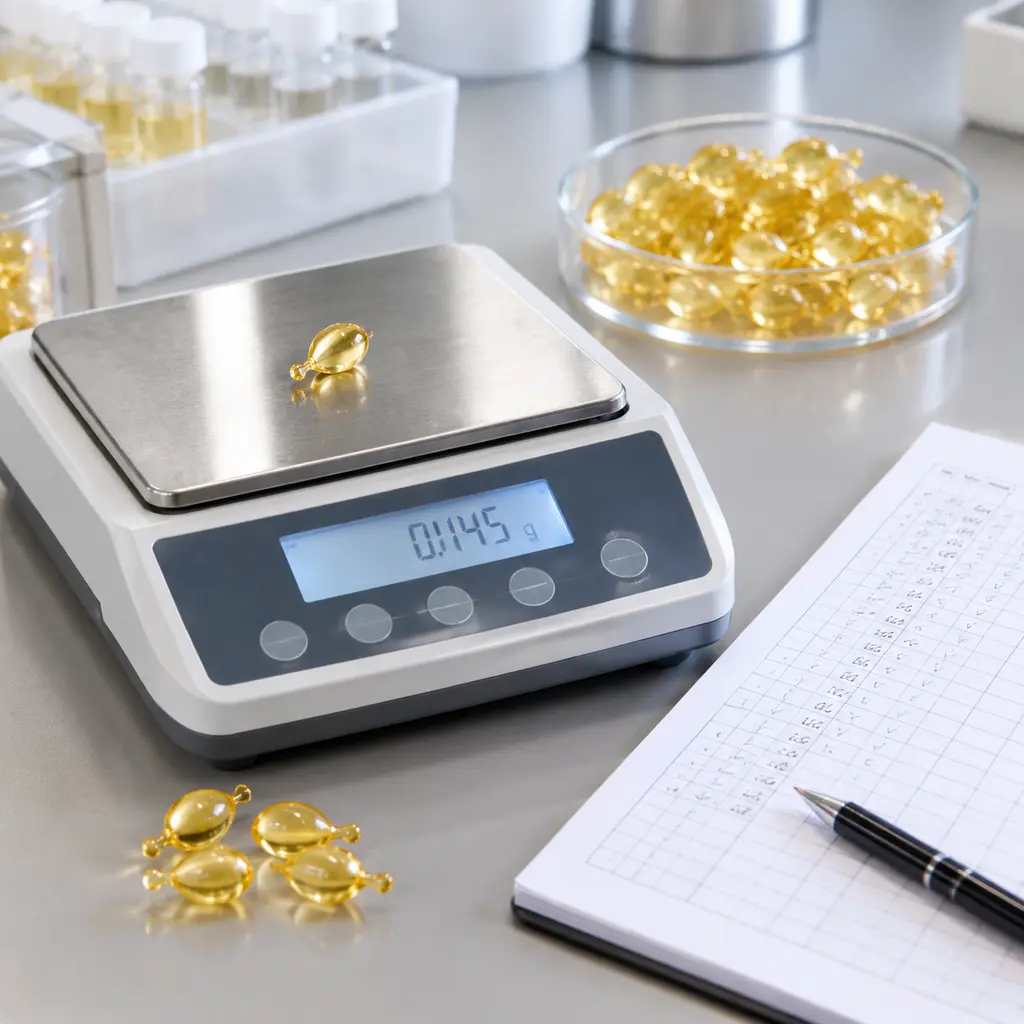
    Individual facial oil capsules being weighed on a digital scale during fill-weight sampling
    Individual facial oil capsules being weighed on a digital scale during fill-weight sampling

    Mold Geometry and Fill Weight

    Mold geometry sets the perceived dose. A 300 mg capsule and a 600 mg capsule carry the same ingredient list but different consumer expectations, and the shape constrains blister nesting, carton dimensions, and available print area. Fill weight should be specified as a nominal milligram figure with an agreed tolerance band, and the sampling protocol should record cavity-to-cavity variance across the run rather than a single average. Molds are a tooling commitment with a lead time; confirm cavity count, change-part availability, and whether the pilot and the volume run will use the identical tool.

    Packaging Compatibility, Storage, and Stability

    Primary packaging is where most capsule programs lose time. Blister films, jars with desiccant, and dropper bottles present different moisture and oxygen ingress profiles, and each must be tested with the production shell and fill, not a proxy. Environmental conditions in European distribution include heated retail floors and unheated transport, so the stability protocol should combine accelerated conditions with real-time data and a freeze-thaw or transport simulation. Leakage deserves a dedicated check: dye penetration or vacuum testing at the start, midpoint, and end of the stability window. Full GMP expectations are set out in the ISO 22716 cosmetic GMP standard, and third-party verification against it is available through Intertek’s regulatory testing and certification services. Label artwork itself is a compliance artifact in both jurisdictions; the US requirements are summarized in the FDA cosmetics labeling guide, and EU artwork must reconcile with the CPSR and CPNP entry before print.

    Decision Framework: A Pre-Sampling Table for ODM Buyers

    Use the table below as the agenda for the technical kickoff. Each row should be closed in writing before the first pilot batch is scheduled.

    Factor What to Check Why It Matters ODM Buyer Note
    Shell material Gelatin versus HPMC grade, plasticizer system, shell moisture content, seam thickness Determines vegan claim validity, elasticity, and leakage resistance Request the shell specification sheet and migration data before mold sign-off
    Fill formulation Water content, viscosity at fill temperature, active loading, oxidation sensitivity High-water fills plasticize the shell and shorten usable shelf life Insist on a written compatibility memo, not a verbal assurance
    Fill weight and tolerance Nominal milligram dose, agreed variance band, cavity-to-cavity spread Directly supports on-pack dose claims and the product information file Record weights across the sampling run, not a single average
    Mold geometry Shape, seam orientation, print or emboss area, cavity count Sets perceived dose, blister nesting, and carton economics Confirm the pilot and volume run share the identical tool
    Primary packaging Blister film type, jar seal and desiccant, bottle and dropper fit Moisture and oxygen ingress drive retinol oxidation and leakage complaints Test the production pack with the production fill, never a proxy
    Stability and transport Accelerated plus real-time protocols, freeze-thaw, vibration, dye penetration Substantiates shelf life and supports market surveillance response Run packaging compatibility in parallel, not sequentially
    Documentation CPSR reference, CPNP entry, labeling artwork, batch records Market access gate for EU placement and for parallel Gulf or US launch Reconcile artwork and notification before print approval

    Two external gates are worth scheduling early if the launch reaches beyond the EU. A Gulf entry through the SABER conformity certification platform requires documentation that often mirrors the EU file, and parallel submission avoids a second critical path. For buyers assessing a private label skincare capsules program, the practical test is whether the supplier can hand you this table already populated, with evidence attached, on the day of the technical kickoff. A partner that can is a manufacturing resource; one that cannot is a schedule risk.

    Retinol capsule blister packs and jar in a stability chamber during packaging compatibility review
    Retinol capsule blister packs and jar in a stability chamber during packaging compatibility review

    ODM Manufacturing Considerations: What Gets Confirmed Between Sampling and Scale

    EU skincare capsules private label packaging options are rarely the bottleneck by themselves. What slows a launch is the gap between a promising pilot batch and a reproducible production run, and that gap is closed with documents and defined boundaries rather than assurances. The considerations below are the ones that most often decide whether a capsule program reaches its ship date intact.

    Technician inspecting a pilot batch of serum capsules beside a digital scale in a cosmetic manufacturing cleanroom
    Technician inspecting a pilot batch of serum capsules beside a digital scale in a cosmetic manufacturing cleanroom

    Sample Confirmation and the Signed Standard

    A sample is only useful once it becomes a reference. Ask the ODM to issue a signed standard sample card for each SKU: measured capsule weight, shell color reference, seam appearance assessed under a defined light source, and the primary packaging that will be used in the commercial run. Both parties keep a sealed unit, and the card should record the storage condition and review interval for the retained set. When a complaint lands eighteen months after launch, that card settles the conversation; a phone photograph does not.

    Fill Formula Customization Boundaries

    Customization has edges worth mapping before the brief is written. Most ODMs can adjust carrier oil ratio, viscosity, and minor excipients inside an approved formula family without restarting regulatory work. Raising an active to a materially higher load, switching to a different lipid class, or adding a fragrance usually does trigger fresh compatibility and stability work, because the fill now behaves differently against the shell and against the container. Ask in advance which changes stay within the family and which reset validation, and get the answer in writing.

    Capsule Shell Options

    Gelatin and HPMC remain the two practical choices for serum capsules. Within each, buyers specify colorant system, opacity, surface finish, and size. Two points carry commercial weight: the documentation chain behind a vegan claim, and whether the supplier can hold an identical shell specification across more than one production site. If your positioning depends on a plant-based shell, review the certification trail for vegan skincare capsules before the artwork is approved, not after.

    Mold Selection and Tooling Ownership

    Cavity count, capsule shape, and seam geometry are fixed by tooling, and tooling is where ownership questions tend to hide. Confirm whether the project runs on dedicated or shared molds, who holds title to the tool, what the maintenance interval is, and under what conditions it could be transferred to another site. A buyer who cannot answer those four questions does not control the shape of their own product.

    Packaging Compatibility

    The primary container is part of the formulation, not an afterthought. Blister film, glass bottle, and jar each create a different moisture and oxygen environment, and each demands its own compatibility run. Confirm liner material, desiccant presence, headspace allowance, label substrate, and how the closure performs after repeated opening. Label adhesion on frosted glass and soft-touch tubes is a frequent late-stage surprise in humid markets, so test it on the actual substrate rather than on a paper proof.

    Stability Review Scope

    Establish which batches enter the stability program, under which conditions, and which attributes are measured. Appearance alone is not a program; weight change, seam integrity, and active assay belong in the protocol. Also settle who funds the work and what happens if a batch fails mid-program, since the answer determines whether the supplier repeats the run or renegotiates the order.

    MOQ, Documentation, and Shipment

    MOQ is usually quoted per SKU, but shell color, capsule size, and packaging format each multiply the real minimum. Ask for the MOQ at the combination level you actually intend to order. Documentation should include a certificate of analysis per batch, safety data sheets, GMP certification, allergen and heavy metal statements, and the vegan or halal certificates if claimed. Labeling must carry the INCI list, the EU responsible person address, batch coding, and the period-after-opening symbol where applicable. Shipment terms should specify container type, temperature range, pallet configuration, and the inspection point before release.

    Common Failure Cases and What They Signal

    Most capsule complaints trace back to a short list of physical failures. Each one points to a specific check.

    • Capsule shell brittleness. Usually over-dried shells combined with a low-humidity plant or cold transit. Review drying curves and shipping temperature history.
    • Sticking or shell deformation. Moisture migration between fill and shell, compounded by warm storage or compression in bulk containers. Check warehouse conditions and bulk packaging density.
    • Fill separation or crystallization. Incompatible lipid blends or an active sitting near its solubility limit. Ask for a temperature-cycling review of the finished fill.
    • Leakage at the seam. Fill contamination on the seam during closing, or viscosity too low for the machine speed. Request seam inspection records from the run.
    • Fragrance sensitivity. Volatile components migrating into the shell or reacting with the liner. Test the fragrance against shell and container together, not separately.
    • Packaging deformation. Thin-walled bottles warping under pallet load, or labels lifting in humid storage. Verify wall thickness and stack height with the actual filled weight.

    Quality control review of facial oil capsules next to blister packaging and a glass bottle on a lab bench
    Quality control review of facial oil capsules next to blister packaging and a glass bottle on a lab bench

    Supplier Checklist for a Serum-Capsule OEM/ODM Partner

    • Shell specification on file, with material grade, colorant system, and certification chain for any vegan claim
    • Tooling ownership, cavity count, and maintenance records available for review
    • Formula change policy stating which adjustments require re-validation
    • Stability protocol listing conditions, attributes, and batch selection logic
    • Packaging compatibility data for the specific container and closure you intend to use
    • Batch-level certificate of analysis, safety data sheets, and GMP certificate
    • Written MOQ at the SKU, shell color, and packaging combination level
    • Environmental permits, waste treatment records, and emissions data open to third-party verification
    • Social compliance audit report covering working hours, wage records, and minimum age verification
    • Liability insurance certificate with coverage limits stated in the contract
    • Shipment specification covering container type, temperature range, and pallet build

    Frequently Asked Questions

    How do we verify a supplier’s environmental permits and carbon records rather than accepting a brochure?

    Ask for the permit numbers, the issuing authority, and the last inspection date, then confirm them against the authority’s own register. Carbon figures should come with a stated methodology and boundary, whether that is a site-level inventory or a product-level footprint. Independent verification under a recognized scheme is the only version that survives a group-level sustainability review, and it is reasonable to make a 2030 carbon target a contractual milestone rather than a stated aspiration.

    What actually protects us if a serious quality complaint surfaces after launch?

    Three things, and they are separable. Retained samples held by both parties establish what was made. A contract clause defining liability, replacement, and recall cost allocation establishes who pays. A certificate of product liability insurance with the coverage limit written into the agreement establishes whether the money exists. Request the certificate directly and check the limit against your realistic worst-case exposure, not against the order value.

    How do we confirm fair labor conditions at the factory floor level?

    Ask for the most recent social compliance audit, including the corrective action log, and check whether the audit was announced or unannounced. Working-hour records, wage payment evidence, and age verification documents are the three areas that matter most. A supplier that can produce a current audit with a closed corrective loop is easier to work with than one that offers a certificate with no follow-up history.

    Can we secure supply priority when raw materials are tight?

    Priority is bought with commitments, not requests. A rolling forecast with a stated accuracy band, a shell material or film supplier named on the approved list, and an allocation clause in the contract do more than any verbal assurance. Ask how the supplier behaved during the last shortage of your key carrier oil or shell polymer, and request the name of a customer who can confirm it.

    How long should sampling take before we commit to a production slot?

    A pilot batch is quick; the compatibility and stability work behind it is not. Plan on the sampling phase covering shell trials, fill compatibility, and at least initial packaging checks, and hold the production slot until those results are reviewed. Compressing that window is the single most common reason a launch slips later.

    What documents should accompany the first commercial shipment?

    Batch certificate of analysis, safety data sheets, GMP certificate, allergen and heavy metal statements, the signed standard sample card, and a packing list matching the shipment specification. Missing paperwork at the port is a delivery problem, not an administrative one. For further detail on shell, mold, and fill options, see our capsule technology overview and OEM/ODM services pages.

    References

  • Private-Label Capsule Launch Planning: How Channel and Market Choice Change the Project Brief

    Private-Label Capsule Launch Planning: How Channel and Market Choice Change the Project Brief

    Direct Answer

    A private label skincare capsules market launch should be specified backward from the sales channel, destination market, and distribution environment rather than forward from a preferred serum formula. Channel choice determines pack format, capsule count, unit economics, parcel-resistance requirements, and the evidence needed to support customer-facing claims. Market choice determines ingredient restrictions, responsible-party obligations, labeling, notification, and stability conditions.

    For a multinational buyer, this is primarily a risk-allocation decision. A retinol capsule intended for US e-commerce, EU prestige retail, and a Middle East distributor may require the same core fill but different antioxidant controls, artwork, packaging barriers, and regulatory files. Those differences must be frozen before validation. A qualified serum capsules manufacturer should therefore translate the commercial route into one controlled product brief covering formula, shell, mold, primary pack, testing, release specifications, and shipment conditions. Custom tooling, unqualified claims, or late market additions can move even a nominally launch-ready project outside an accelerated schedule.

    Serum capsule shell inspection during private-label manufacturing review
    Serum capsule shell inspection during private-label manufacturing review

    Key Takeaways for Private Label Buyers

    • Source against a defined route to market. E-commerce parcels, prestige retail shelves, professional treatment rooms, and regional distribution create different leakage, presentation, and documentation risks.
    • Lock the formula and shell as one system. Fill oils, fragrances, solvents, antioxidants, colorants, and shell plasticizers can interact over time.
    • Treat packaging as part of stability. A passing bulk capsule is not evidence that a jar, blister, or sachet configuration will remain intact through storage and transport.
    • Specify dose performance. Fill weight, opening force, evacuation behavior, and residue after use should have measurable acceptance criteria.
    • Separate pilot speed from global rollout readiness. A 1,000-unit pilot can confirm manufacturability, but broader launch approval requires market-specific files, validated packaging, and scale controls.
    • Preserve change control. Shell material, oil supplier, antioxidant system, mold geometry, and packaging components should not change without documented assessment.

    Buyer Context

    Serum capsules appear operationally simple because each capsule delivers a single dose. In practice, the format concentrates several failure modes into a small product: shell embrittlement, oil migration, seam leakage, oxidation, capsules adhering inside a jar, and incomplete evacuation after the tip is opened. These risks become material when an incumbent supplier has suffered a quality interruption, failed a social-compliance audit, or cannot satisfy a new group-level ESG mandate.

    The commercial channel changes which risks dominate. Marketplace and DTC shipments require resistance to vibration, compression, temperature excursions, and repeated handling. Prestige retail places greater weight on capsule appearance, uniformity, jar clarity, secondary-pack finish, and shelf-life evidence. Spa and professional channels may prioritize hygienic single-dose use and controlled opening. Regional distributors need documentation that can survive local registration review and downstream relabeling controls.

    The destination market changes the governance path. US files should support MoCRA responsibilities without implying FDA preapproval of cosmetics. EU placement requires safety assessment, product information documentation, and CPNP notification. Middle East projects may involve the Dubai Municipality Montaji registration system or other country-specific portals. Independent providers such as Intertek regulatory testing and certification services can support testing or conformity work, but accountability for the finished product remains with the designated business entities.

    Portfolio architecture also matters. Buyers comparing serum capsule products should distinguish retinol capsules, facial oil capsules, eye serum capsules, cleansing oil capsules, and hair oil capsules by fill chemistry rather than by appearance alone. The development questions for retinol serum capsules are especially sensitive to oxygen, light, ingredient grade, and packaging barrier performance. Published capsule platforms such as CosmoPod beauty capsules also illustrate that capsule geometry and delivery experience are integral product decisions, not decorative afterthoughts.

    Fill-weight sampling for retinol serum capsules in a quality-control laboratory
    Fill-weight sampling for retinol serum capsules in a quality-control laboratory

    Capsule Formula, Shell, Mold, and Packaging Factors

    Fill Formula and Dose Control

    The brief should state the full ingredient list, supplier grades, target fill viscosity at a defined temperature, fill weight, allowable variation, oxidation controls, and restricted-substance criteria. Anhydrous facial oils are often compatible with softgel processing, but compatibility cannot be assumed. Fragrance components, essential oils, active concentrates, and certain solvents may soften or weaken the shell. For encapsulated retinol skincare, buyers should require assay methods, oxygen-management controls, light-protective handling, and stability data in the final pack.

    Scale-up controls must connect laboratory samples to production. The approved sample should identify formula version, raw-material source, mixing sequence, deaeration conditions, and filling parameters. Otherwise, a visually similar mass-production batch may not be technically equivalent. PZIK’s operating model supports ISO 22716-controlled pilot runs from 1,000 units and a formulation-to-shelf cycle of under 30 days for suitable prevalidated configurations. That timetable should be treated as scope-dependent: custom molds, novel ingredients, extended claims, or multiple registrations may require additional gates.

    Shell Material and Mold Selection

    Shell selection should distinguish conventional gelatin from plant-derived or vegan capsule shells and document plasticizer, colorant, opacity, allergen, and origin requirements. Vegan positioning requires more than a supplier statement; procurement should confirm composition, processing aids, cross-contact controls, and the wording permitted on the target label. Buyers evaluating a cosmetic softgel capsule factory should also review shell preparation controls, seam inspection, drying conditions, and retained-sample aging.

    Mold geometry affects dose perception and manufacturing reliability. Twist-off tips, narrow necks, decorative shapes, and small eye-serum formats alter seam stress, opening force, and residual fill. A standard mold can protect schedule certainty. A custom mold may strengthen brand differentiation but introduces tooling approval, dimensional qualification, and replacement-part dependencies. The product brief should define whether the logo or shape is shell-embossed, printed on packaging, or both.

    Packaging, Storage, and Shipment

    Jars offer strong shelf presence and efficient consumer access, but capsules can rub, compress, cluster, or absorb headspace moisture. Blisters isolate individual capsules and improve tamper evidence, although material selection, sealing parameters, pack size, and line speed require separate validation. The buyer should test the actual capsule count and final components, not a substitute container. Relevant comparisons are available across private label skincare capsules and the broader capsule skincare collection.

    Stability should cover appearance, odor, assay where applicable, shell integrity, leakage, brittleness, tackiness, fill-weight retention, and pack compatibility under intended heat and humidity conditions. Shipment qualification should reflect real lanes, carton loading, vibration, compression, and temperature exposure. A launch brief that omits these conditions transfers unresolved risk from development into commercial inventory.

    Facial oil capsule jar and blister packaging compatibility review
    Facial oil capsule jar and blister packaging compatibility review

    Decision Framework Table

    Factor What to Check Why It Matters ODM Buyer Note
    Sales channel Parcel handling, shelf display, treatment-room use, capsule count Determines pack strength, presentation, and dose format Approve one channel profile for each SKU before sampling
    Destination market Ingredient rules, notification, label language, responsible entity Late market additions can invalidate artwork and documentation Build a market matrix with regulatory ownership assigned
    Fill formula Viscosity, ingredient grades, oxidation control, active assay Controls filling accuracy, stability, and shell interaction Freeze suppliers and formula version with the approved sample
    Shell and mold Material origin, plasticizer, seam, geometry, opening force Affects leakage, claims, dose evacuation, and tooling lead time Require dimensional specifications and change control
    Primary packaging Jar or blister compatibility, barrier, seal, capsule movement Packaging can create failures not visible in bulk testing Run stability in production-intent components
    Release and logistics Fill weight, defects, leakage, storage, carton and lane conditions Links factory release to arrival quality Align certificate fields, inspection plan, and shipment limits

    For further route-specific scoping, the manufacturing questions summarized in product routes for a private-label skincare launch can be used as an initial cross-functional briefing document. The final specification, however, should be jointly approved by procurement, R&D, quality, regulatory, legal, and market operations.

    ODM Manufacturing Considerations

    For a private label skincare capsules market launch, sample approval should define more than appearance. The confirmation record should identify the formula version, nominal dose, acceptable mass tolerance, shell type, capsule color, mold geometry, scent, opening behavior, and primary pack. Buyers should receive samples from equipment and tooling representative of commercial production. Hand-prepared laboratory samples may help screen ingredients, but they do not demonstrate how the capsule will behave during filling, sorting, packing, or distribution.

    Formula customization begins with the intended use and channel. A facial oil capsule sold through a spa may prioritize glide and massage time, while a single-dose eye serum capsule for e-commerce may require a lighter sensory profile and tighter control of residual oil on the shell. Ask the ODM team to document ingredient compatibility, antioxidant strategy, fragrance or essential-oil concentration, expected dose, and any settling observed after storage. Where a brand starts from a ready base, confirm which ingredients, colorants, or sensory modifiers may be changed without restarting the full evaluation program.

    Shell selection should account for formula chemistry, market positioning, and storage conditions. Conventional and vegan capsule shells can differ in moisture response, elasticity, color behavior, and compatibility with certain oils. The supplier should identify the shell material in writing and explain whether the proposed formula has prior production history in that shell system. Mold selection should then consider target dose, face or eye application, logo feasibility, tip geometry, tooling ownership, and the number of cavities needed for forecast volume. Custom molds require an approval drawing and physical samples before production authorization.

    Packaging must be assessed as a system. Jars should limit capsule-to-capsule pressure and excessive headspace, while blister formats need cavities that do not crush or sharply bend the tip. Decoration, liners, closures, and secondary cartons should also tolerate oil transfer and expected warehouse conditions. The stability plan should cover defined climatic environments, light exposure where relevant, repeated package opening, and periodic checks for odor change, sweating, brittleness, deformation, and formula separation.

    MOQ should be stated separately for formula preparation, each shell color, each mold, and each packaging component. Buyers should also distinguish sampling quantities from commercial minimums. The document pack normally includes an ingredient list using INCI names, certificate of analysis, safety data where applicable, allergen or fragrance declarations, artwork specifications, batch coding format, and supporting files required by the destination market. For Dubai distribution, regulatory planning should account for the Dubai Municipality registration framework.

    Shipment instructions should define carton count, pallet pattern, maximum stacking, acceptable transit range, and responsibility for temperature excursions. This is particularly important when replacing a supplier after an unexpected quality event, strike, or capacity interruption. A rushed transfer should not bypass sample comparison, document review, or lane-specific transport assessment.

    Fill-weight sampling and capsule shell inspection for facial oil capsule packaging
    Fill-weight sampling and capsule shell inspection for facial oil capsule packaging

    Common Problems or Failure Cases

    Shell brittleness: Capsules can crack during packing or consumer handling when shell moisture moves outside its functional range. Buyers should compare samples at the beginning and end of the proposed shelf-life study and inspect tips, seams, and contact points inside the pack.

    Sticking or deformation: Soft capsules may adhere to one another or flatten when shell properties, surface oil, pack pressure, and storage climate are poorly matched. A jar that looks acceptable when upright may perform differently after prolonged side storage or repeated opening.

    Fill separation: Suspended ingredients, pigments, or complex oil blends can stratify, producing visible variation between capsules. The ODM brief should define whether the formula must remain homogeneous, whether gentle premixing is required before encapsulation, and what visual change is acceptable.

    Leakage or odor migration: Damage may originate at the seam, tip, or shell surface, but the root cause can involve formula-shell interaction or pressure from the package. Fragranced formulas also require careful review because aromatic materials may affect shell performance or create sensitivity concerns that require accurate declaration.

    Packaging deformation: Thin jars, blister trays, or closures may warp during storage or transit, changing the pressure applied to capsules. Production-equivalent packs should therefore be included in the evaluation rather than relying only on empty-package certificates.

    Lab stability review of serum capsules for sticking deformation and packaging compatibility
    Lab stability review of serum capsules for sticking deformation and packaging compatibility

    Supplier Checklist

    • Confirm the legal manufacturing site and which capsule operations are performed there.
    • Request the exact shell material, permitted colorants, and supporting composition documents.
    • Record formula version, rheology range, nominal dose, and acceptable capsule mass tolerance.
    • Review ingredient sourcing, substitute-material approval rules, and shortage allocation procedures.
    • Verify mold ownership, logo limitations, tip geometry, maintenance responsibility, and replacement lead time.
    • Approve commercial-equivalent capsules rather than appearance samples alone.
    • Inspect evidence covering cracking, sticking, deformation, oil migration, separation, and odor change.
    • Confirm jar or blister dimensions, capsule count, closure, liner, carton, and batch-code location.
    • Separate MOQs for formula, shell color, tooling, printed components, and repeat orders.
    • Check INCI files, certificates, declarations, artwork controls, and destination-market labeling support.
    • Define shipment range, pallet configuration, stacking limits, excursion handling, and claim procedures.
    • Review confidentiality controls, worker-audit records, environmental data, insurance, and business-continuity plans.

    A structured route comparison can also be informed by product routes for a private-label skincare launch.

    FAQ

    Can a factory guarantee that our core capsule formula will never be disclosed?

    No supplier can credibly promise absolute zero risk. Buyers should instead verify role-based system access, segregated project folders, controlled formula downloads, confidentiality agreements, visitor restrictions, restricted production records, and logs showing who accessed or changed the master formula. High-sensitivity projects may also require coded raw materials and physically separated sample handling.

    How should priority supply be handled during a global raw-material shortage?

    Ask for a written allocation policy, reserved inventory terms, approved alternate sources, forecast commitments, and escalation authority. Strategic status should be measurable rather than verbal. The buyer should know which capsule ingredients are single-source, how substitutions are approved, and whether safety stock is dedicated or shared.

    How can buyers assess worker treatment at a capsule manufacturing site?

    Review recent independent social-audit findings, corrective actions, age-verification procedures, payroll samples, working-hour records, grievance channels, and recruitment-fee policies. A clean summary is not enough if the supplier cannot provide traceable evidence that wages, overtime, and worker protections are consistently managed.

    What environmental evidence is relevant when headquarters requires lower-carbon suppliers?

    Request utility and emissions records with reporting boundaries, treatment-system operating logs, waste manifests, legal permits, and independent verification where available. Confirm whether carbon figures cover only the factory or also purchased electricity and key materials. This matters when a group adopts a 2030 carbon-neutral supplier policy.

    What insurance should cover a major capsule quality complaint?

    Coverage varies by policy and destination. Buyers should examine product-liability limits, territorial scope, exclusions, recall coverage, deductibles, insurer identity, and whether the named manufacturing entity is insured. The complaint procedure should also preserve batch samples, production records, shipment evidence, and investigation timelines.

    Which external testing support may be useful before launch?

    The required scope depends on formula, claims, channel, and market. Independent laboratories can support chemical, microbiological, packaging, safety, and regulatory work. Buyers can review Intertek cosmetic testing and certification services as an example of available third-party capabilities.

    References

  • Capsule Stability Review Inputs RFQ Checklist: What to Lock Before Samples

    Capsule Stability Review Inputs RFQ Checklist: What to Lock Before Samples

    Direct Answer

    The capsule stability review inputs RFQ checklist should be completed before any sample request because a visually acceptable lab sample does not establish manufacturability, shelf life, or packaging compatibility. Procurement should require a single, version-controlled input set covering intended markets, INCI composition, active ranges, fill viscosity, target fill weight and tolerances, shell chemistry, capsule geometry, color system, oxidation controls, primary packaging, storage and shipping profiles, claims, test protocols, acceptance criteria, and documentation ownership. The supplier should identify which elements are locked for scale-up and which remain provisional.

    For a mature brand, the decision is not whether one sample looks correct. It is whether the proposed private label serum capsules can withstand heat, humidity, oxygen, handling, and line transfer without leakage, deformation, color drift, active loss, or unapproved formulation changes. An RFQ is sample-ready only when QA, R&D, regulatory, procurement, and packaging teams can trace each requested test to a commercial risk and release criterion.

    Key Takeaways for Private Label Buyers

    • Freeze the fill formula, shell system, fill-weight range, capsule geometry, and primary pack before approving the commercial sample scope.
    • For oxidation-sensitive retinol capsules, require controls for raw-material exposure, mixing, filling, headspace oxygen, light, and packaging barrier performance.
    • Assess stability in the final blister or jar. Bulk capsule testing alone cannot establish market-pack performance.
    • Compare like-for-like architectures across the serum capsule products under review; different shell polymers and molds create different risk profiles.

    • Define sample quantity, pilot MOQ, test duration, acceptance limits, change-control rules, shipment conditions, and document deliverables before the launch schedule is committed.

    Buyer Context

    Serum-capsule qualification becomes material when a core supplier experiences a quality interruption, an audit exposes labor or environmental nonconformity, or a global NPD program requires additional qualified capacity. In these situations, speed without input control can create a false sense of readiness. A replacement skincare capsules OEM may reproduce color and shape while using a different plasticizer, antioxidant system, mold geometry, or packaging barrier. Those differences may not become visible until several weeks of storage or distribution exposure.

    Risk also varies by product family. Retinol serum capsules are primarily exposed to oxidation and light risk; facial and hair oil capsules may show fragrance migration or shell softening; eye serum capsules require tight control of opening behavior and fill weight; and cleansing oil capsules may contain surfactants that interact with the shell. Vegan systems require evidence for shell ingredients, processing aids, and cross-contamination controls. Buyers evaluating multiple skincare capsule product lines should not assume that supplement-capsule data can be transferred directly to topical cosmetic use. The general principles described in softgel stability science remain relevant, but the actual formulation, package, intended market, and shipping lane must be validated together.

    Lab technician inspecting serum capsule shells under neutral lighting
    Lab technician inspecting serum capsule shells under neutral lighting

    Capsule Formula, Shell, Mold, and Packaging Factors

    Fill Formula and Oxidation Control

    The RFQ should state the full INCI list, ingredient grades, active input ranges, antioxidant system, fragrance level, colorants, and target viscosity at the defined filling temperature. Anhydrous does not mean risk-free: hygroscopic ingredients, surfactants, solvents, and low-molecular-weight oils can migrate into the shell or alter seam integrity. For encapsulated retinol skincare, request assay methodology, oxygen and light controls, raw-material retest rules, and limits for odor or color change. If alpha hydroxy acids are proposed, ingredient safety substantiation such as the CIR final report on alpha hydroxy acids should support the safety review but should not be treated as product-specific stability evidence.

    Shell Material and Fill Weight

    Specify whether the shell is gelatin-based or plant-derived, together with polymer identity, plasticizer system, color system, moisture specification, and supplier traceability. A vegan declaration should cover processing aids and manufacturing segregation; cruelty-free positioning should be assessed against a defined program such as the Leaping Bunny cruelty-free certification standard. For colored shells, confirm permitted use in each target market and review the FDA color additive permitted-use database where the United States is in scope. The RFQ must also define nominal fill weight, tolerance, sampling plan, and rejection rules. Excess variation can alter consumer use, pack count economics, seam stress, and label accuracy across otherwise similar cosmetic softgel products.

    Mold and Opening Performance

    Custom molds require more than shape approval. Procurement should request cavity dimensions, seam location, wall-thickness targets, tail or twist-off geometry, tooling ownership, maintenance responsibility, dimensional tolerances, and change-control obligations. Decorative geometry may reduce filling efficiency or create localized stress during packing and shipment. The qualified serum capsules manufacturer should confirm that the approved mold can run on the intended commercial line without a new shell or fill formulation.

    Fill-weight sampling of retinol serum capsules on a laboratory balance
    Fill-weight sampling of retinol serum capsules on a laboratory balance

    Packaging, Storage, and Shipment Conditions

    Blisters generally provide unit-level protection, while jars expose the remaining capsules whenever the pack is opened. Neither format is inherently suitable without barrier and compatibility evidence. The review should cover moisture and oxygen transmission, light protection, seal integrity, closure torque, headspace, capsule-to-pack migration, pack count, desiccant use, and consumer opening conditions. A qualified cosmetic softgel capsule factory should test the exact commercial components rather than a laboratory substitute.

    An illustrative matrix may include 4°C cold storage, 25°C ambient storage, and 40°C/75% RH accelerated exposure for up to 12 weeks, supplemented by light or freeze-thaw testing when justified. These conditions are not universal shelf-life rules. The protocol must reflect the formulation, markets, pack, and shipping lanes. Buyers should also define maximum shipment excursions, pallet configuration, data-logger requirements, receiving inspection, and retention-sample conditions.

    Decision Framework Table

    The following table converts stability inputs into procurement gates that can be reviewed before samples are commissioned.

    Factor What to Check Why It Matters ODM Buyer Note
    Fill formula INCI, grade, active range, viscosity, antioxidants Controls migration, oxidation, and filling behavior Prohibit substitutions without written change approval
    Shell system Polymer, plasticizer, moisture, colorants, origin Determines flexibility, brittleness, and claim status Request specifications and supplier traceability
    Fill weight Nominal weight, tolerance, sampling, rejection limit Affects consistency, seam stress, and label accuracy Align sample and mass-production criteria
    Mold Dimensions, seam, opening feature, tooling control Influences leakage and consumer opening performance Confirm commercial-line compatibility
    Oxidation controls Light, oxygen, mixing, filling, and headspace controls Protects sensitive oils and retinol Require assay and change-trend data
    Primary packaging Barrier, seal, closure, migration, and pack count Stability depends on the final market pack Test actual blister or jar components
    Stability protocol Conditions, duration, pull points, methods, limits Prevents subjective pass or fail decisions Approve protocol before sample production
    Launch controls MOQ, sample scope, documents, logistics, change control Links technical approval to supply continuity Do not approve timing on appearance alone

    Blister and jar packaging compatibility review for facial oil capsules
    Blister and jar packaging compatibility review for facial oil capsules

    ODM Manufacturing Considerations

    A capsule stability review inputs RFQ checklist becomes actionable only when the buyer and manufacturer define what constitutes an approved sample. Record the formula version, capsule dimensions, target fill mass, color, odor, opening behavior, packaging format, and measurable acceptance limits. Keep an approved benchmark from a production-representative run rather than relying only on a hand-prepared laboratory sample. This is especially important when qualifying a backup source after an incumbent supplier experiences a quality or capacity disruption.

    For fill customization, identify the exact ingredient grades and permitted substitutes. Record viscosity at a defined temperature and test method, expected appearance, fragrance level, antioxidant approach, and relevant oxidative or active-content markers. Any change to oils, fragrances, pigments, or active suppliers should require written approval because apparently equivalent ingredients can behave differently during encapsulation and storage. Buyers can review the broader development sequence through the serum capsule OEM/ODM process.

    Shell options should be documented by material source, plasticizer system, color system, animal-origin status, and applicable claim evidence. Plant-derived options may require different processing and storage parameters from gelatin capsules. For a vegan positioning, compare the proposed specification with the supplier’s vegan skincare capsule capabilities rather than approving the claim from a verbal statement.

    Mold selection should cover capsule volume, wall distribution, neck geometry, cavity count, tooling ownership, and replacement lead time. Confirm that the proposed mold delivers the intended dose while leaving enough process margin to control leakage and unit-to-unit variation. Packaging must then be tested as a complete configuration. A blister and a jar are separate stability configurations because capsule movement, moisture exchange, compression, and exposure after opening differ.

    The supplier should issue a written stability protocol before testing. It should identify test intervals, market-relevant heat and humidity conditions, final packaging, sample quantity, methods, acceptance criteria, raw-data format, and deviation handling. Commercial terms should distinguish formula MOQ, shell batch MOQ, tooling quantity, and printed-packaging run. Ask for sampling timelines in calendar weeks and define whether samples are laboratory, pilot, or production-equivalent. The documentation pack should include INCI information, specifications, certificates of analysis, safety data, ingredient-origin statements, colorant records, artwork inputs, and traceable batch codes. Shipment planning should state the route, seasonal exposure assumptions, pallet configuration, maximum dwell expectations, and investigation process for damaged or overheated deliveries.

    Laboratory review of facial oil capsule samples and fill-weight consistency
    Laboratory review of facial oil capsule samples and fill-weight consistency

    Common Problems or Failure Cases

    Most capsule failures result from an interaction among formula, shell, process, package, and distribution conditions rather than one isolated defect. Common examples include:

    • Shell brittleness: Capsules crack during packing or consumer handling after excessive moisture loss or unsuitable storage. Compare fracture observations before and after packaged conditioning.
    • Sticking or deformation: Capsules adhere to each other, flatten, or lose shape under heat, humidity, pack pressure, or migration from aromatic ingredients.
    • Fill separation: Suspended materials settle, waxes crystallize, or visible gradients form. A uniform fresh sample does not demonstrate stability through launch and shelf life.
    • Capsule leakage: Leaks can originate from seam defects, neck damage, excessive fill, poor dimensional control, or formula-shell interaction. Inspect both loose units and packed samples.
    • Fragrance sensitivity: Fragrance components may migrate, fade, soften the shell, or create an odor imbalance. Evaluate the fragranced version against a fragrance-free control where practical.
    • Packaging deformation: A formed blister cavity may distort or a jar closure may compress capsules during storage and transport. Check pack dimensions, capsule freedom of movement, and closure contact.

    Failure investigations should link the defect to batch records, material lots, process settings, package components, and test history. Additional batch-release questions are outlined in this cosmetic softgel quality review guide.

    Retinol capsule blister and jar packaging stability inspection
    Retinol capsule blister and jar packaging stability inspection

    Supplier Checklist

    Use the following evidence-based checks before approving development or commercial sampling:

    • Confirm the legal manufacturing entity, production address, relevant licenses, and audit scope.
    • Freeze the formula code, ingredient grades, fragrance version, color system, and change-control rules.
    • Obtain the full shell composition, origin declarations, and substantiation for vegan or cruelty-free claims.
    • Review capsule dimensions, mold ownership, target fill mass, unit variability limits, and leakage criteria.
    • Request defined controls for mixing, encapsulation, drying, sorting, and finished-unit inspection.
    • Approve a protocol covering filled capsules in each intended blister or jar configuration.
    • Define sample quantities, pilot status, production equivalence, acceptance tests, and benchmark retention.
    • Separate MOQs for bulk fill, shells, tooling, decoration, and printed packaging.
    • Check labeling documents, INCI nomenclature, batch coding, colorant status, and market-specific claim files.
    • Review shipment routes, seasonal controls, carton strength, pallet pattern, and freight-damage procedures.
    • Assess traceability, corrective-action records, alternate material sources, capacity continuity, and environmental reporting.

    FAQ

    What exactly should a buyer approve before the first commercial batch?

    Approve a production-representative capsule, its formula version, shell specification, mold, target fill mass, appearance, odor, opening behavior, package components, test methods, and acceptance limits. Approval should reference controlled documents rather than photographs alone.

    Can a factory guarantee that a core formulation will never be leaked?

    No supplier can credibly promise absolute protection. Buyers should verify role-based system access, restricted physical areas, formula coding, encrypted file transfer, access logs, subcontractor controls, confidentiality agreements, and incident-response procedures. The contract should define ownership, permitted use, disclosure restrictions, and remedies.

    How can priority supply be verified during a global raw-material shortage?

    Strategic status should be supported by allocation clauses, forecast commitments, reserved capacity or inventory rules, approved alternate sources, and a documented continuity plan. Substitution must require written buyer approval, even when the supplier considers two ingredient grades equivalent.

    How should environmental and carbon transparency be evaluated?

    Request current discharge permits, treatment-system records, waste manifests, emissions data, energy records, and the methodology and organizational boundary used for carbon reporting. If headquarters requires carbon-neutral core suppliers, specify milestones and independent verification rights in the qualification plan.

    How do we know the stability report applies to our actual launch pack?

    The report should identify the same formula, shell, capsule geometry, fill mass, closure, and packaging materials intended for launch. Data from loose capsules or another customer’s package can inform risk assessment but should not replace pack-specific evidence.

    What if the current supplier has a serious quality or capacity failure?

    Use the approved benchmark and controlled specification to qualify a bridge lot at the alternate factory. Compare critical attributes, packaging behavior, documentation, and independent release results before accelerating the transfer.

    Is a skincare capsule RFQ the same as a supplement capsule RFQ?

    No. Facial oil, eye serum, cleansing oil, and retinol capsules are topical cosmetics. Supplement capsules may contain powders and dosage instructions, while gummies follow another product form. Cosmetic samples must not imply ingestion or supplement claims.

    References

    1. Colorcon: The Science of Softgel Stability — background on moisture balance, shell behavior, and package protection. Supplier-specific cosmetic validation remains necessary.
    2. FDA Color Additives — permitted-use and certification information relevant when selecting colorants for products marketed in the United States.
  • Retinol Capsule Product Brief Buyer Guide: Scoping Claims, Formula, Shell, Mold, and Packaging Requirements

    Retinol Capsule Product Brief Buyer Guide: Scoping Claims, Formula, Shell, Mold, and Packaging Requirements

    Direct Answer

    A retinol capsule product brief buyer guide should define the intended cosmetic claim, target market, fill formula, capsule shell, dose format, packaging system, and validation plan before a manufacturer is shortlisted. The central procurement risk is not whether an ODM can produce an attractive sample. It is whether the supplier can repeatedly manufacture the approved capsule at commercial scale without changing its retinol system, fill weight, shell behavior, packaging compatibility, or compliance position.

    Buyers should convert the market concept into measurable requirements: target consumer, permitted label language, retinol form and concentration, oxidation-control strategy, capsule dimensions, nominal fill weight and tolerance, shell material, mold ownership, storage conditions, testing protocol, and launch jurisdictions. These inputs allow procurement, R&D, QA, regulatory, legal, and packaging teams to evaluate a serum capsules manufacturer against the same evidence set. Without this discipline, quotations may appear comparable while representing materially different formulas, capsules, documentation packages, and supply risks.

    retinol capsule product brief review with serum capsule samples and packaging components
    retinol capsule product brief review with serum capsule samples and packaging components

    Key Takeaways for Private Label Buyers

    • Define claims before formulation: Separate cosmetic appearance claims from language that could imply treatment, prevention, or physiological modification.
    • Specify the complete capsule system: Evaluate the retinol fill, antioxidant strategy, shell composition, seam integrity, mold geometry, and package as one interacting system.
    • Control sample-to-scale changes: Require disclosure and approval of any change to raw-material grade, supplier, processing temperature, fill viscosity, shell formula, or packaging component.
    • Set measurable acceptance criteria: Establish fill-weight tolerance, leakage limits, appearance standards, odor expectations, capsule rupture performance, and stability checkpoints.
    • Qualify packaging early: Test jar, blister, pouch, liner, and closure compatibility under expected heat, humidity, light, and shipment conditions.
    • Link launch timing to evidence: Do not treat a sample approval as authorization for commercial release; documentation, stability, label review, and shipment qualification remain separate gates.

    Buyer Context

    Serum-capsule sourcing is often initiated as a packaging or format decision, but the commercial exposure is broader. A retinol capsule is a unit-dose delivery system in which the fill formula, shell, seam, oxygen barrier, secondary packaging, and storage environment affect one another. A formula that performs acceptably in a laboratory container may oxidize, discolor, soften the shell, increase leakage, or lose acceptable sensory performance after encapsulation.

    This matters particularly when an international brand is adding alternative capacity after a supplier quality incident, unexpected production interruption, or adverse third-party audit. It also matters when headquarters introduces a global supply-chain diversification program and a regional procurement team must qualify a new cosmetic softgel capsule factory without weakening established QA or ESG controls. In those circumstances, the buyer is not merely sourcing a retinol SKU. The buyer is introducing a new manufacturing node into a controlled global network.

    The same planning discipline applies to facial oil capsules, eye serum capsules, cleansing oil capsules, hair oil capsules, and vegan capsule shells. However, the technical risk profile changes by product. A low-viscosity facial oil may challenge seam retention. A high-active eye serum may require tighter dose control. A cleansing oil may interact differently with shell plasticizers. A vegan shell may respond to humidity differently from another shell system. Custom capsule molds can also affect rupture force, surface area, line speed, fill capacity, and the number of qualified production assets.

    A useful market brief therefore begins with the consumer and channel but ends with auditable manufacturing requirements. Buyers should specify whether the product will be sold through retail, professional, marketplace, subscription, or cross-border channels. Marketplace logistics may introduce additional storage and dangerous-goods screening considerations, making Amazon’s dangerous goods classification rules for cosmetics relevant to the shipment review. Label content should also be checked against the FDA summary of cosmetics labeling requirements for products entering the United States.

    Capsule Formula, Shell, Mold, and Packaging Factors

    Claim Architecture and Formula Scope

    The brief should distinguish the commercial message from the substantiation requirement. Claims such as improving the appearance of fine lines, supporting smoother-looking skin, or helping reduce the visible effects of dryness require different evidence than language implying structural repair or treatment. Regulatory and legal teams should approve the claim hierarchy before the ODM finalizes the formula. Ingredient safety reviews, including the Cosmetic Ingredient Review Expert Panel safety assessments, can support ingredient-level due diligence but do not replace finished-product evaluation or jurisdiction-specific label review.

    The buyer should define the retinol form, target concentration, carrier oils or emollients, antioxidant package, fragrance position, color expectations, and excluded ingredients. The specification should also state whether the project may use an existing encapsulated retinol skincare platform or requires modification. This distinction affects development timing, stability evidence, change control, and the risk that a laboratory sample will require formulation re-engineering before mass production.

    Fill Behavior and Dose Control

    Fill viscosity must remain compatible with pumping, metering, sealing, and line speed. Excessively thin fills can migrate toward the seam or expose small seal defects; excessively thick fills can reduce dose consistency or require processing conditions that increase thermal exposure. Procurement should request target and acceptable ranges for fill weight, viscosity, appearance, odor, and active assay where applicable. The supplier should explain how in-process sampling confirms that early, middle, and late production capsules remain within specification.

    Buyers comparing serum capsule products should also confirm whether quoted fill weight refers to fill content alone or total capsule weight. This distinction is essential when comparing dose, package count, component cost, and label declarations.

    Shell Material and Aging

    The shell specification should identify its material system, colorants, opacifiers, plasticizers or functional alternatives, moisture sensitivity, and compatibility with the fill. A vegan positioning requirement must be translated into an approved material declaration and supporting supplier documentation rather than inferred from appearance. Buyers should examine seam uniformity, dents, bubbles, tackiness, brittleness, color drift, odor transfer, and shell deformation during stability review.

    The ODM should provide aging data for the combined formula and shell, not only generic shell data. Qualification of private label skincare capsules should include retained samples from representative production batches and documented limits for leakage or visual defects over the intended shelf-life program.

    Mold Geometry and Manufacturing Control

    Mold selection affects capsule volume, consumer handling, rupture behavior, aesthetic differentiation, packaging density, and production continuity. Standard molds may reduce tooling dependency and simplify contingency planning. Custom molds can create a distinctive face or eye serum format but may introduce ownership, maintenance, replacement, and transfer restrictions. The sourcing agreement should identify who owns the mold, where it is stored, which lines can run it, and what happens if the primary site becomes unavailable.

    When reviewing retinol softgel capsules, buyers should require confirmation that the commercial mold, shell system, fill settings, and inspection criteria match those used for the approved sample. A visually similar capsule produced on another tool is not automatically equivalent.

    capsule shell inspection and fill-weight sampling for retinol serum capsules
    capsule shell inspection and fill-weight sampling for retinol serum capsules

    Packaging, Storage, and Shipment

    Retinol is sensitive to environmental exposure, so packaging must be evaluated as a protective system rather than a decorative component. The ODM and packaging supplier should review light transmission, oxygen and moisture barrier, closure integrity, liner interaction, capsule abrasion, headspace, and opening frequency. Jar packaging may support premium presentation but repeatedly exposes the remaining capsules when opened. Blister packaging can isolate individual doses but requires seal-integrity and material-compatibility validation.

    The approved pack should undergo stability and shipment testing under conditions reflecting the actual distribution route. Testing should examine leakage, shell softening or brittleness, capsules adhering to one another, discoloration, odor change, package deformation, and seal failure. Buyers assessing cosmetic softgel products should require written shipment conditions, pallet configuration, temperature precautions, and deviation procedures before purchase-order release.

    Decision Framework

    Factor What to Check Why It Matters ODM Buyer Note
    Claims Permitted cosmetic language, target markets, substantiation plan, label review owner Prevents formula development around claims that legal or regulatory teams later reject Approve the claim hierarchy before final sample sign-off
    Retinol fill Retinol form, concentration, carrier system, antioxidant controls, viscosity, odor, color Determines stability, sensory profile, line compatibility, and evidence requirements Freeze raw-material grade and supplier through formal change control
    Capsule shell Material declaration, fill compatibility, humidity response, seam integrity, aging behavior Shell failure can cause leakage, deformation, oxidation, and consumer complaints Request finished-capsule data rather than generic shell certificates
    Fill weight Nominal dose, tolerance, sampling frequency, measurement method, batch records Controls dose consistency, package economics, and specification compliance Confirm whether quotations use fill weight or total capsule weight
    Mold Standard or custom design, ownership, replacement lead time, line availability Custom tooling can create a single point of failure during capacity disruption Document transfer and contingency rights in the supply agreement
    Packaging Jar or blister barrier, closure, liner, light exposure, headspace, abrasion risk Packaging can preserve or undermine the capsule stability established in the lab Test the final decorated pack, not an unprinted substitute
    Validation Stability protocol, leakage review, transport testing, retained samples, deviation process Creates objective release gates and supports investigation if quality drifts Align protocol acceptance criteria across R&D, QA, and procurement
    Scale-up Commercial equipment, process settings, inspection controls, alternate capacity Reduces the risk of sample-to-production performance changes Require equivalence evidence if the ODM changes line, site, or process

    Before supplier selection, the buyer should issue the same structured brief to each candidate skincare capsules OEM. This creates a defensible comparison of technical scope, validation ownership, documentation readiness, tooling dependency, and continuity risk rather than a superficial comparison of samples and quotations.

    retinol capsule packaging review with jar and blister stability samples
    retinol capsule packaging review with jar and blister stability samples

    ODM Manufacturing Considerations

    For a retinol capsule product brief buyer guide to be actionable, the ODM scope must convert the concept into a controlled product record. Begin with sample confirmation covering formula version, capsule appearance, shell type, color, mold code, dimensions, unit mass, fragrance status, opening method, and proposed primary package. Keep approved reference units under defined storage conditions so production samples can be compared against a physical standard rather than photographs alone.

    Formula customization should distinguish consumer-facing preferences from manufacturing requirements. Specify the desired facial feel, absorption, residue, color, odor, retinol derivative, carrier oils, and supporting antioxidants, then ask the formulator to explain how those choices affect flow, uniformity, shell contact, and processing time. The same base concept may not suit retinol serum capsules, compact eye capsules, larger hair oil capsules, and cleansing oil capsules without adjustment.

    Choose the shell and mold as part of the formula decision. Gelatin and plant-based capsule options can differ in elasticity, moisture response, surface appearance, and sealing behavior. Request the material specification and identify any colorants, opacifiers, humectants, or processing aids. For mold selection, compare usable volume, seam area, twist-off performance, handling, and fit within the proposed blister cavity or jar opening. The supplier should identify whether the shape is standard, shared, dedicated, or newly tooled.

    Packaging trials should use filled commercial-intent capsules and production-representative components. Review blister cavity clearance, foil opening force, jar closure fit, headspace, desiccant placement, carton compression, coding space, and label adhesion. Stability protocols should identify the tested batch, package configuration, storage environments, inspection intervals, acceptance criteria, and responsible laboratory. Observations should include appearance, odor, fill homogeneity, shell flexibility, seam condition, and opening performance.

    MOQ discussions should separate the requirements for formula batching, shell color, mold setup, printed components, pack count, and shipping lot. This distinction is particularly important when a buyer is qualifying an alternate source after an incumbent factory disruption or responding to a group policy that requires measurable carbon-reduction progress from strategic suppliers. Confirm which labeling documents, batch records, ingredient specifications, and market declarations are included before approving artwork. The FDA notes that cosmetics marketed in the United States require appropriate identity, net-contents, business information, and ingredient labeling, while the responsible company remains accountable for compliant presentation. ([fda.gov](https://www.fda.gov/cosmetics/cosmetics-labeling-regulations/summary-cosmetics-labeling-requirements?utm_source=openai))

    Shipment conditions should state the case quantity, pallet pattern, lot separation, container-loading method, acceptable transit environment, handling of delays, and inspection process upon arrival. Broader guidance on linking these decisions is available through capsule technology planning and the cosmetic capsule OEM/ODM process.

    OEM laboratory review of retinol capsule samples, shell materials, mold options, and blister packaging
    OEM laboratory review of retinol capsule samples, shell materials, mold options, and blister packaging

    Common Problems or Failure Cases

    Shell brittleness: Capsules may crack during handling when moisture balance, storage conditions, or the interaction between fill and shell is unsuitable. Inspect twist points, seams, whitening, surface fractures, and breakage after realistic warehouse and transit exposure.

    Sticking and deformation: Capsules can adhere to blister material or one another when surface tack, compression, temperature, or package dimensions are poorly matched. Test removal after storage and assess whether consumers can extract one capsule without damaging adjacent units.

    Fill separation: Oil phases, suspended materials, pigments, or botanical components may produce layering, sediment, or uneven color. Require a defined mixing sequence, maximum holding period before encapsulation, and appearance criteria for both bulk fill and finished capsules.

    Leakage: A weak seam, irregular shell wall, incorrect process setting, excessive internal pressure, or unsuitable package compression can release fill into the blister or jar. The investigation should trace the affected batch, mold cavity, processing records, package position, and transit history rather than treating every leak as the same defect.

    Fragrance sensitivity: Heat can alter odor perception or increase fragrance transfer into closures, liners, cartons, and neighboring capsules. Eye serum and face products require especially clear odor limits. A fragrance-free brief should also define controls against residual scent from shared equipment.

    Packaging deformation: Shallow blister cavities, excessive jar loading, closure pressure, or weak secondary packaging can flatten or mark capsules. Evaluate filled packs after stacking and distribution simulation, and confirm that package changes trigger a documented technical review.

    Quality inspection of retinol and facial oil capsules for shell condition, leakage, and packaging deformation
    Quality inspection of retinol and facial oil capsules for shell condition, leakage, and packaging deformation

    Supplier Checklist

    • Match the approved formula code, ingredient list, sensory profile, and sample record to the planned production specification.
    • Verify shell composition, moisture range, color system, dimensions, seam criteria, and retained reference units.
    • Review fill density, viscosity range, mixing instructions, bulk holding limits, and finished-capsule uniformity criteria.
    • Confirm mold identification, cavity dimensions, maintenance responsibility, exclusivity terms, and replacement procedure.
    • Test finished capsules in the final blister, jar, closure, liner, carton, and distribution case.
    • Review the stability protocol, deviations, raw data availability, and acceptance decision for the intended market.
    • Separate MOQ commitments by formula, shell, mold, printed package, pack count, and production run.
    • Request labeling support files, batch traceability records, certificates of analysis, and complaint-investigation procedures.
    • Audit cybersecurity permissions, physical access, environmental records, worker protections, insurance scope, and supply-continuity planning.
    • Define storage, transport, unloading, quarantine, and incoming-inspection conditions in the purchase specification.

    FAQ

    Can a capsule OEM guarantee that our core formula will never be disclosed?

    No supplier can credibly promise absolute protection. Verify role-based digital access, encrypted or controlled document storage, restricted laboratory and production entry, visitor logs, sample custody, confidentiality clauses, employee offboarding controls, and a defined notification process for suspected information exposure.

    How can a strategic buyer secure supply during a global raw-material shortage?

    Require a written continuity plan identifying forecast lead times, safety-stock ownership, approved alternate sources, substitution approval rules, reserved capacity, inventory visibility, and allocation priorities. Contract language should explain what priority means and how the supplier communicates shortages before confirmed production dates are affected.

    What evidence supports transparent environmental and labor practices?

    Request facility-specific permits, wastewater and waste records, energy or emissions reports, corrective actions, payroll and working-hour samples, age-verification procedures, grievance channels, and terms permitting independent audits. Policies alone are insufficient if the factory cannot connect them to dated operational records and worker evidence.

    Which documents should be finalized before packaging artwork?

    Approve the final ingredient declaration, responsible-party details, product identity, net contents, directions, warnings, storage statements, lot-code format, country-of-origin information, and substantiation file. FDA guidance states that cosmetic labels must be truthful, display required information appropriately, and avoid therapeutic positioning unless the applicable drug requirements are met. ([fda.gov](https://www.fda.gov/cosmetics/cosmetics-labeling/cosmetics-labeling-regulations?utm_source=openai))

    How should buyers evaluate retinol claim support?

    Connect each claim to the exact ingredient form, concentration, finished formula, use instructions, and available evidence. The Cosmetic Ingredient Review Expert Panel safety assessments provide an external ingredient-safety reference, but they do not replace finished-product evaluation or authorize disease-treatment claims. ([cir-safety.org](https://cir-safety.org/panelbook/safety-assessment-retinol-retinoic-acid-and-retinyl-esters-used-cosmetics?utm_source=openai))

    What should a buyer do when the requested MOQ is higher than the launch forecast?

    Ask the ODM to separate technical batch minimums from printed-packaging minimums and commercial scheduling preferences. Compare pilot production, neutral components, phased packaging orders, and repeat-run conditions without changing the approved capsule system. Record responsibility for unused materials and their storage life.

    References

  • Capsule MOQ Proposal Planning: Quality, Documentation, and Production Questions for Buyers

    Capsule MOQ Proposal Planning: Quality, Documentation, and Production Questions for Buyers

    Direct Answer

    A capsule MOQ proposal should not be approved until procurement, R&D, QA, regulatory, and packaging teams confirm that the quoted quantity is tied to a controlled production specification. A practical capsule MOQ proposal planning quality checklist must define the fill formula, shell composition, mold geometry, fill-weight tolerance, leakage criteria, oxidation controls, packaging configuration, stability protocol, batch documentation, and shipment conditions.

    The central issue is not whether an ODM can manufacture the requested quantity. It is whether the commercial batch will remain equivalent to the approved sample and perform consistently through filling, storage, transportation, and consumer use. Buyers evaluating a skincare capsules OEM should therefore separate three decisions: technical approval of the capsule system, compliance approval of the documentation package, and commercial approval of the production commitment. An MOQ should become binding only after all three gates have named owners, acceptance criteria, and change-control requirements.

    Key Takeaways for Private Label Buyers

    • Source the complete system. Review fill ingredients, capsule shell, mold, packaging, and secondary packing as one product rather than independent components.
    • Freeze the approved specification. Record formula revision, shell material, color, dimensions, nominal fill weight, tolerances, and packaging components before issuing a purchase order.
    • Test the market pack. Stability testing should use the intended jar, blister, pouch, or unit-dose format, not only laboratory containers.
    • Control oxidation and leakage. Require evidence covering oxygen exposure, heat, humidity, capsule deformation, seam integrity, and oil migration.
    • Define documentation before production. Agree on certificates of analysis, ingredient records, batch records, label support, traceability data, and deviation reporting.
    • Link launch timing to evidence. Do not base the launch plan solely on the stated manufacturing lead time; include testing, artwork approval, component release, and shipment clearance.

    Buyer Context

    Serum capsules create a higher level of component interaction than conventional bottled serum. The fill must remain compatible with the shell, the shell must release predictably without becoming brittle or tacky, and the final packaging must protect the capsule across the intended distribution environment. This makes supplier qualification particularly important when a brand is responding to a quality incident, replacing interrupted capacity, or adding a second source under a new resilience or ESG mandate.

    The risk profile also differs by product form. Retinol capsules require disciplined light and oxidation control. Facial oil capsules may expose shell compatibility problems if the carrier system migrates or softens the seam. Eye serum capsules require tight fill-weight consistency because small deviations can materially affect perceived dosage. Cleansing oil and hair oil capsules may use higher fill volumes and therefore place different demands on mold geometry, seal strength, and packaging headspace. Vegan shells require separate confirmation of polymer source, plasticizer system, moisture response, and substantiation for label claims.

    Buyers should also distinguish cosmetic capsules from a supplement format. A skincare capsule is a topical single-use delivery form; its fill-weight target supports application consistency but does not represent an ingestible dosage. Regulatory review should follow the FDA’s regulatory framework for cosmetics for the United States and the applicable rules in every destination market. Claims involving pigmentation should also be screened against the boundary between cosmetic positioning and treatment language, with clinical context available from the AAD treatment standards for hyperpigmentation.

    Market intelligence such as Mintel global beauty market reports can inform category planning, but it cannot replace compatibility and stability evidence for the actual SKU. Buyers comparing serum capsule products should treat the approved sample as the start of qualification rather than the conclusion.

    Serum capsule shell inspection during cosmetic quality control
    Serum capsule shell inspection during cosmetic quality control

    Capsule Formula, Shell, Mold, and Packaging Factors

    Fill Formula and Oxidation Control

    The supplier should disclose the formula version, ingredient nomenclature, carrier oils, antioxidants, fragrance status, colorants, and any processing aids relevant to capsule performance. For oil-based retinol or facial serum fills, ask how raw materials, bulk holding, transfer, encapsulation, and finished-product packing limit oxygen, light, and heat exposure. The buyer should receive acceptance criteria for appearance, odor, viscosity, fill identity, and other release tests justified by the formula.

    Viscosity must be assessed at defined processing and storage conditions. A fill that flows correctly during a laboratory sample may behave differently on production equipment or after temperature cycling. The ODM should explain how viscosity influences dosing accuracy, air entrapment, seam contamination, and leakage. Buyers developing cosmetic softgel products should also confirm that any substitute ingredient requires written approval and an impact assessment.

    Shell Material and Fill Weight

    Shell review should identify the polymer system, plasticizer, water content specification, color system, opacity, allergen status, and animal-derived or vegan basis. A claim such as vegan is incomplete without supporting supplier documentation and a segregation approach. Shell aging should be evaluated for brittleness, tackiness, deformation, discoloration, odor transfer, and changes in opening behavior.

    The specification should state nominal fill weight and permissible variation, along with the sampling method and rejection rule. Average batch weight alone can conceal underfilled and overfilled units. Request in-process records showing how the serum capsules manufacturer controls individual-unit variation, seam integrity, and capsule dimensions.

    Mold Geometry and Packaging Compatibility

    Standard molds can shorten development and simplify future capacity transfer, while a custom mold can strengthen product differentiation but may introduce tooling ownership, maintenance, exclusivity, and replacement-lead-time questions. Clarify who owns the mold, where it is stored, how wear is monitored, and whether another qualified line can reproduce the same geometry during disruption.

    Packaging evaluation must use production-representative capsules. A jar should be assessed for capsule-to-capsule compression, headspace, closure seal, moisture exchange, and consumer retrieval. Blisters require cavity fit, seal integrity, lidding compatibility, and opening-force review. Secondary cartons, desiccants, liners, and light barriers should be included where applicable. Guidance on prototype scope should be aligned with a structured capsule prototype approval RFQ checklist.

    Fill-weight sampling for serum capsules on a cosmetic production line
    Fill-weight sampling for serum capsules on a cosmetic production line

    Storage and distribution testing should reflect the intended markets and shipping lanes. The protocol should cover defined heat and humidity exposure, temperature cycling where relevant, light protection, orientation, vibration or transit simulation, and post-test inspection for leakage and deformation. For encapsulated retinol skincare, assay or another justified marker may be needed to establish that physical appearance alone is not masking active degradation.

    Decision Framework Table

    Factor What to Check Why It Matters ODM Buyer Note
    Fill formula Formula revision, ingredients, viscosity, antioxidants, and bulk holding controls Changes can affect dosing, oxidation, shell interaction, and sensory performance Prohibit substitution without documented approval
    Capsule shell Material source, plasticizer, moisture limits, color, opacity, and vegan evidence The shell governs protection, opening behavior, aging, and claim support Request component traceability and change notification
    Fill weight Nominal target, unit tolerance, sampling plan, and rejection rule Average values may hide individual-unit variation Review in-process data from the production line
    Mold Geometry, ownership, maintenance, exclusivity, and backup-line compatibility Tooling can become a continuity constraint Define transfer rights before paying tooling charges
    Packaging Jar or blister compatibility, closure, barrier, headspace, and secondary packing Packaging can accelerate moisture exchange, oxidation, or leakage Test the final market configuration
    Stability and shipment Protocol, test intervals, transport simulation, storage limits, and release status Launch risk extends beyond factory batch release Assign ownership for excursions and deviations
    Documentation Batch record, certificate of analysis, ingredient files, label support, and traceability Incomplete records delay market release and investigation Map each document to the responsible function

    Retinol capsule packaging compatibility and lab stability review
    Retinol capsule packaging compatibility and lab stability review

    For a proposed pilot from 1,000 units, the same controls should apply as they would to a later scaled order. A credible private label serum capsules program should not require formulation re-engineering between sample, pilot, and commercial production. The final approval package should identify any remaining limitations explicitly, including incomplete stability intervals, pending packaging evidence, or capacity dependencies at the cosmetic softgel capsule factory.

    ODM Manufacturing Considerations

    A capsule MOQ proposal planning quality checklist should convert the supplier’s quotation into an approved manufacturing specification. The buyer needs to confirm exactly what is included in development, testing, documentation, packaging, and shipment rather than treating the quoted quantity as the complete project scope.

    Sample Confirmation and Formula Customization

    Sample approval should identify the formula code, capsule dimensions, color, fill amount, scent, surface finish, and primary packaging used for evaluation. Both parties should retain signed or coded reference samples. Any adjustment after approval, including changes to botanical ingredients, carrier oils, antioxidants, colorants, or fragrance, should create a new version requiring written confirmation.

    For customized facial oil, eye serum, cleansing oil, or retinol capsules, ask which parameters can be modified without disrupting capsule formation. The supplier should document ingredient restrictions, expected cosmetic dosage per capsule, processing temperature limits, and whether the fill remains uniform during holding and encapsulation. A useful capsule prototype approval checklist can help structure these decisions before samples are requested.

    Shell, Mold, Packaging, and Stability Decisions

    Shell selection should cover material composition, color system, plasticizer system, allergen statements, and storage sensitivity. If a plant-derived shell is required, the buyer should obtain ingredient declarations and supporting origin records. Mold selection should confirm the capsule form, nominal capacity, tolerance range, tooling availability, setup charges, and whether future production can use the same geometry.

    Packaging evaluation should use the intended commercial components, not only laboratory containers. Confirm capsule count, headspace, closure fit, liner material, opening size, and dispensing behavior. For unit packs, review forming material, lidding structure, print registration, and opening force. Stability protocols should define test duration, evaluation intervals, acceptance criteria, and responsibility for failures. Appearance, odor, mass change, shell texture, active assay where relevant, and package condition should be recorded.

    Serum capsule sample confirmation and packaging compatibility review in a cosmetics laboratory
    Serum capsule sample confirmation and packaging compatibility review in a cosmetics laboratory

    MOQ, Labeling Documents, and Shipment Conditions

    Clarify whether MOQ applies per formula, color, mold, package, or artwork version. The quotation should separate development samples, production setup, finished capsules, packaging components, excess components, and destructive test quantities. Buyers should also request an ingredient list in labeling order, specification sheets, batch records or summaries, certificates of analysis, allergen information, safety data where applicable, and traceable lot coding.

    For products entering the United States, artwork and claims should be reviewed against the FDA’s regulatory framework for cosmetics. A supplier can provide technical records, but the responsible company must still verify market-specific labeling and claims. Shipment instructions should state carton configuration, pallet requirements, temperature precautions, lot separation, remaining shelf-life expectations, and the process for reporting transit damage.

    Common Problems or Failure Cases

    Shell brittleness: Capsules may crack during counting or consumer handling when the shell loses flexibility. Investigate shell composition, moisture balance, warehouse exposure, and closure performance rather than accepting replacement samples without a root-cause report.

    Sticking or deformation: Capsules can adhere to each other or flatten under pressure. Common contributors include unsuitable surface characteristics, excessive load in bulk bags or jars, prolonged storage, and package headspace that allows movement.

    Fill separation: Suspended pigments or oil-soluble ingredients may become uneven before encapsulation. Ask how the fill is mixed, held, and monitored during the run. Finished-capsule appearance alone may not reveal concentration differences across a batch.

    Leakage: A capsule may release oil because of seam weakness, fill-shell incompatibility, mechanical compression, or damage during packaging. Complaint samples should be linked to production and packaging records so that isolated transit damage can be distinguished from a batch-level defect.

    Fragrance sensitivity: Fragrance components can affect odor perception, shell behavior, or consumer tolerance. Confirm the approved fragrance concentration and prohibit unapproved substitutions.

    Packaging deformation: Closures, trays, or formed packs can warp or lose sealing performance under distribution conditions. Investigate the full capsule-package system rather than assessing the empty package alone.

    QC inspection of facial oil capsules for shell brittleness and deformation
    QC inspection of facial oil capsules for shell brittleness and deformation

    Supplier Checklist

    • Confirm the legal manufacturing entity, production location, relevant scope of operations, and recent audit findings.
    • Match the approved formula code, shell specification, mold, fill amount, color, and packaging bill of materials.
    • Review raw-material qualification, incoming inspection, supplier change notification, and ingredient traceability.
    • Request in-process controls, finished-product specifications, deviation handling, and batch-release authority.
    • Define sample quantities, approval stages, testing responsibilities, MOQ structure, lead time, and change-control rules.
    • Check label-support documents, lot coding, retained-sample policy, complaint investigation, and recall procedures.
    • Confirm storage, carton, pallet, freight, and shipment-monitoring requirements.
    • If qualification follows an incumbent supplier’s serious audit failure, verify corrective-action evidence rather than relying on certificates alone.
    • If headquarters requires carbon reduction by 2030, request site-level energy, emissions, wastewater, and independent assurance records relevant to capsule production.

    FAQ

    Can a factory guarantee that our core formula will never be leaked?

    No supplier can credibly promise absolute protection. Buyers should verify role-based system access, separated customer files, controlled formula downloads, physical access restrictions, confidentiality obligations, backup controls, and logs showing who viewed or changed the formula. The agreement should define ownership, permitted use, breach notification, and remedies.

    How can a strategic buyer secure supply during a global raw-material shortage?

    Ask for a written allocation method, forecast horizon, reserved-material rules, approved alternate sources, safety-stock ownership, and escalation contacts. Priority language is meaningful only when supported by capacity and procurement records. Avoid unapproved ingredient substitutions made solely to maintain output.

    How can buyers verify that factory workers are treated fairly?

    Review recent independent social audits, payroll and time records, age-verification procedures, grievance channels, recruitment fees, overtime controls, and corrective actions. Interviews should be confidential and include temporary workers. A policy statement alone does not demonstrate the absence of child labor, withheld wages, or excessive hours.

    What should be approved before commercial capsule production?

    Approve the formula version, shell composition, mold and dimensions, fill specification, appearance standard, primary package, artwork, test plan, release criteria, shipment configuration, and change-control process. Record approvals in writing and identify authorized decision-makers.

    Does the MOQ include packaging and testing?

    Not necessarily. MOQ may refer only to bulk capsules or may vary by formula, shell color, mold, jar, tray, or printed component. Request a line-by-line scope showing included tests, samples, packaging losses, documentation, and unused component treatment.

    Who is responsible for cosmetic label compliance?

    The supplier should provide accurate technical documentation, but the brand or responsible company must verify the final label for each destination market. This includes ingredient naming, net contents, warnings, business identification, claims, and lot traceability.

    References

  • Private-Label Capsule Launch Planning: Product Routes for a Private-Label Skincare Launch

    Private-Label Capsule Launch Planning: Product Routes for a Private-Label Skincare Launch

    Direct Answer

    The private label skincare capsules product route should be selected by matching the intended use, formula behavior, shell material, packaging format, and launch market before committing to a production specification. For an established brand, the lowest-risk route is usually a focused capsule SKU that can be qualified against documented requirements: compatible fill and shell, controlled fill weight, acceptable leakage performance, oxidation protection, stability evidence, and packaging that performs under the planned shipment and storage conditions. Retinol, facial oil, eye serum, cleansing oil, and hair oil capsules each present different viscosity, light sensitivity, dose, and use-pattern considerations. A vegan shell or custom mold can extend the product offer, but may change the validation and tooling work. Treat supplier qualification and product development as parallel workstreams, with QA, regulatory, sourcing, and packaging teams reviewing the same specification. This approach supports a controlled capacity addition without assuming that a sample result alone proves readiness for commercial production.

    Key Takeaways for Private Label Buyers

    • Define the target market, intended use, formula family, and shell requirements before requesting samples.
    • Evaluate fill viscosity, fill weight consistency, shell integrity, and leakage using agreed acceptance criteria.
    • Test the proposed capsule against the actual blister or jar, including closure, light exposure, and shipping conditions.
    • Request stability protocols and results relevant to the formula, shell, and final packaging configuration.
    • Confirm sample scope, tooling ownership, MOQ, scale-up controls, and change-notification rules in writing.
    • Qualify labeling and shipment documentation with regulatory and logistics teams before locking the launch schedule.

    Buyer Context

    Serum capsules can add a controlled, single-use presentation to an existing facial care portfolio, but the capsule is also a small package with a functional shell. A formula that performs well in a bottle may not fill consistently or remain compatible with a softgel shell. That distinction matters when an established brand is bringing in alternate capacity after a quality event or a supplier interruption: a fast sample is useful only if the proposed manufacturing route can reproduce its fill, seal, and pack performance under routine controls.

    Product intent narrows the decisions. Retinol capsules may require careful oxidation and light-management planning, while facial oil capsules depend on a fill that can be metered reliably and dispensed as intended. Eye serum capsules require attention to dose size and handling; cleansing oil capsules must match the intended application and removal routine. Hair oil capsules may call for a different fill amount or shell geometry. Each route should be assessed as a finished system rather than as a formula in isolation. The retinol capsules product route and the broader serum capsule products range can help teams frame initial specifications.

    Shell selection is a sourcing and qualification question, not simply a marketing claim. Gelatin and vegan capsule shells can differ in processing behavior, moisture response, and compatibility with a particular fill. A request for vegan materials should therefore identify the specific shell composition and its supporting supplier documentation. Buyers should also align claims and labeling with the destination market. For Middle East distribution, assess the applicable certification route early, including the MUI World Halal Council mutual-recognition guide and the JAKIM Halal certification framework, where relevant to the commercial plan.

    Capsule Formula, Shell, Mold, and Packaging Factors

    Start with the fill formula. Ask the ODM to document the formula’s relevant physical properties, including viscosity at filling conditions, ingredient compatibility, and any sensitivity to oxygen, light, or temperature. These properties influence metering, sealing, and storage. For retinol or other oxidation-sensitive ingredients, review the proposed oxidation-control approach and confirm that the selected packaging provides appropriate protection. Do not infer finished-product shelf life from ingredient supplier data alone; stability needs to cover the formula in its capsule and final pack.

    Agree on fill weight and tolerances as measurable specifications. The supplier should explain how fill weight is sampled during production, how variation is assessed, and how out-of-specification results are handled. The capsule shell should be reviewed for appearance, seal integrity, deformation, tackiness, and leakage. These checks should use defined methods and acceptance criteria, not visual judgment alone. If the product requires a custom softgel mold, clarify geometry, tooling lead time, ownership, maintenance, and whether the design can be reproduced on the intended production equipment.

    Packaging compatibility is a joint qualification. Compare blister and jar options against capsule dimensions, shell behavior, closure performance, and expected consumer handling. Blisters may provide unit separation and can support a controlled presentation; jars require a review of capsule contact, closure fit, and repeated opening conditions. Confirm that the primary package and any secondary pack protect the product under the planned distribution route. Storage assessment should reflect heat and humidity exposure expected in warehousing and transit, without assuming that one accelerated study replaces appropriate real-time evidence.

    For each candidate route, document the sample quantity, packaging configuration, testing scope, and decision gates. An ODM should identify which variables remain provisional at sampling and how they will be locked before the production run. This matters especially when a backup supplier is being qualified: sample approval must connect to the commercial line, approved materials, and batch records. A controlled handoff reduces the chance that formulation, shell, or packaging changes appear late in development.

    Serum capsule shell and seal inspection during cosmetic manufacturing quality control
    Serum capsule shell and seal inspection during cosmetic manufacturing quality control

    Decision Framework Table

    Factor What to Check Why It Matters ODM Buyer Note
    Fill formula Viscosity, ingredient compatibility, oxidation and light sensitivity Influences metering, shell compatibility, and product stability Request the proposed controls and review the formula in its final capsule format
    Shell material Composition documentation, moisture response, appearance, seal integrity Shell behavior can affect leakage, handling, and storage performance Specify gelatin or vegan shell requirements and obtain material traceability
    Fill weight Target dose, sampling plan, tolerance, deviation procedure Supports dose consistency and production release decisions Agree on acceptance criteria before sample approval
    Mold and geometry Standard or custom mold, dimensions, tooling ownership, line fit Geometry affects filling, packaging fit, and repeatability Document tooling costs, access, maintenance, and change control
    Primary packaging Blister or jar compatibility, closure, light and moisture protection Packaging is part of the stability and shipment system Test the selected capsule in the final commercial pack
    Stability and shipment Protocol, storage conditions, transport simulation, labeling documents Supports shelf-life decisions and distribution readiness Align test scope and shipment conditions with destination markets

    Technician sampling serum capsule fill weight for blister and jar packaging review
    Technician sampling serum capsule fill weight for blister and jar packaging review

    ODM Manufacturing Considerations

    Supplier review should establish whether the proposed process can be repeated at the required scale and governed through documented controls. Request the relevant quality-system evidence, site scope, traceability approach, batch-release responsibilities, and deviation and complaint procedures. ISO 22716 alignment and applicable market obligations should be verified through current, auditable documents rather than a general capability statement. FDA-related requirements and MoCRA responsibilities should be mapped to the specific parties and activities involved; EU launches should likewise clarify who handles CPNP notification and the supporting product information file.

    Where the qualification is triggered by a supplier quality incident or a disruption risk, audit recovery readiness as well as routine controls. Ask how critical ingredients and shell materials are sourced, whether qualified alternatives exist, and what approval is required before a substitution. Review capacity allocation, forecast assumptions, lead-time commitments, and escalation paths. For a new capsule technology or format, request equipment and process capability details relevant to the proposed product rather than broad plant capacity claims.

    ESG and information protection require evidence proportionate to the group’s own policy. Request current third-party audit records, corrective-action status, environmental permits and reporting relevant to the site, and an explanation of worker grievance and labor controls. For formula confidentiality, establish access restrictions, document handling, retention, and subcontractor controls in the contract and operating procedures. The same due diligence should cover tooling files and packaging artwork. These measures do not replace the buyer’s own audit, but they make the qualification decision traceable across procurement, QA, legal, and sustainability.

    Sampling should use a written protocol that names the formula version, shell, mold, fill weight target, packaging, and tests. Confirm whether samples are representative of the intended commercial process and which production parameters may still change. When pilot and scaled production use different equipment, require a documented comparability plan and approval gates. The supplier should also state sample and production MOQ, expected lead times, material commitments, and shipment conditions, with clear responsibility for temperature or humidity controls when they are required.

    Cosmetics laboratory stability review of serum capsules in final packaging
    Cosmetics laboratory stability review of serum capsules in final packaging

    Next-Step Supplier Checklist

    • Obtain a controlled product brief covering market, claims, formula family, shell material, target fill weight, and final pack.
    • Request sample records identifying the formula and material versions, mold, fill process, and test results.
    • Review leakage, shell appearance, fill-weight consistency, oxidation controls, and package fit against pre-agreed criteria.
    • Confirm stability scope, storage conditions, shipment plan, and labeling and regulatory documentation by destination.
    • Qualify site quality, traceability, change control, capacity allocation, labor practices, environmental evidence, and IP protections.
    • Record open risks, owners, and release gates before approving commercial tooling or production materials.

    ODM Manufacturing Considerations

    For a private label skincare capsules product route, the approved sample must function as a controlled manufacturing reference rather than an informal appearance standard. The buyer and ODM should record the fill formula version, ingredient suppliers, shell composition, color, fragrance level, capsule dimensions, target dose, and package components. Approval records should distinguish a laboratory prototype from capsules produced on commercial equipment because mixing, encapsulation, drying, and sorting conditions can change the finished result.

    Fill customization should begin with the intended use. A retinol capsule may require tighter management of oxygen exposure and ingredient interactions, while a facial or hair oil capsule may prioritize spreading, absorption profile, and clean dispensing. Ask the formulator to document viscosity at a defined temperature, visible separation after storage, fragrance concentration, and any restrictions on natural oils or suspended material. Review relevant formats through the retinol capsule, facial oil capsule, and eye serum capsule resources.

    Shell selection affects feel, drying behavior, moisture response, and formula compatibility. Buyers considering plant-derived shells should request the actual polymer system and supporting composition documents, not rely only on a general vegan description. The vegan skincare capsule overview provides useful category context. Mold selection should account for dose, twist-off handling, surface area, and how reliably the selected geometry runs on the supplier’s equipment. Ownership and future availability of a custom mold should be defined in writing.

    Packaging approval should use production-representative capsules and final-contact materials. Evaluate whether a jar closure, liner, tray, or blister places pressure on the capsules, transfers odor, or allows unwanted moisture exchange. Stability review should include appearance, odor, shell texture, fill uniformity, package fit, and opening behavior at planned storage intervals. MOQ should be separated into formula, shell color, mold, and printed-packaging minimums because each can create a different commitment. Before release, confirm ingredient nomenclature, batch coding, country-of-origin statements, caution text, and available labeling documents for each destination market. Shipment specifications should state carton configuration, pallet limits, temperature precautions, desiccant use where justified, and the process for evaluating transport excursions.

    These controls are especially important when a brand is qualifying a replacement after a quality incident or sudden capacity interruption. They also help procurement teams implementing corporate requirements for supplier carbon reporting without weakening capsule-specific performance criteria.

    Serum capsule sample confirmation with shell materials and packaging components in a cosmetics laboratory
    Serum capsule sample confirmation with shell materials and packaging components in a cosmetics laboratory

    Common Problems or Failure Cases

    Brittle or Cracked Shells

    A shell can become brittle when its moisture balance is incompatible with the fill, package, or storage environment. Typical evidence includes cracked tails, fragments in a jar, or failure during twisting. Investigate retained samples from the same batch, warehouse humidity records, and package moisture transmission before assigning a single cause.

    Sticking and Deformation

    Capsules may stick together or lose shape after exposure to elevated temperature, excessive moisture, surface oil, or sustained compression. A package that looks acceptable when upright may perform differently when cartons are stacked or shipped for extended periods. Examine samples from multiple carton positions and document whether they recover after conditioning.

    Fill Separation or Leakage

    Clouding, sediment, or phase separation can indicate an unstable formulation or a temperature-dependent ingredient response. Leakage may instead originate from poor closure formation, shell-fill incompatibility, mechanical damage, or an overfilled cavity. Buyers should compare defect location, capsule mass, and fill appearance across affected and unaffected units rather than treating all oily residue as the same failure.

    Fragrance or Packaging Changes

    Fragrance can migrate into shell or packaging material, alter the perceived odor, or increase sensitivity to storage conditions. Printed trays, liners, and jar components can also warp, discolor, or transfer odor. Final approval therefore needs the marketed cosmetics package, not a neutral laboratory container.

    Quality-control inspection of serum capsules for deformation, sticking, cracking, and leakage
    Quality-control inspection of serum capsules for deformation, sticking, cracking, and leakage

    Supplier Checklist

    • Identify the legal manufacturing site, encapsulation line, quality certifications, and any subcontracted operations.
    • Request the full shell material declaration, allergen status, animal-origin status, and evidence supporting vegan or Halal positioning when claimed.
    • Define fill viscosity, ingredient-source controls, fragrance limits, visual standards, and acceptable separation criteria.
    • Record target fill weight, sampling frequency, acceptance limits, and the method used to investigate leakage or damaged capsules.
    • Confirm mold identity, ownership, maintenance responsibility, cavity configuration, and replacement lead time.
    • Approve capsules with the intended jar, blister, liner, tray, carton, and coding method.
    • Compare pilot and commercial batches for dimensions, opening behavior, fill appearance, odor, and defect rate.
    • Separate MOQs and lead times for formula, shell, mold, capsules, and printed material.
    • Collect ingredient lists, specifications, safety data, batch records, claims support, and market-specific labeling files.
    • Document storage range, loading method, shipment monitoring, retained-sample period, complaint escalation, and recall responsibilities.

    For a broader qualification package, review the supplier’s OEM and ODM service scope alongside the technical quotation.

    FAQ

    How can a buyer protect a proprietary capsule formula?

    No supplier can credibly promise absolute protection. Require role-based system access, separate permissions for formula and production records, controlled downloads, visitor restrictions, confidentiality terms covering employees and subcontractors, and auditable access logs. Clarify who can view ingredient percentages and where backups are stored.

    How should priority supply be verified during a raw-material shortage?

    Ask for approved alternate sources, reserved inventory rules, allocation language, safety-stock ownership, and written notice periods. A strategic-customer statement has little value unless the contract defines allocation priority, substitute approval, and responsibility for requalification.

    What labor and environmental evidence should procurement review?

    Request recent independent audit reports, corrective-action closure records, payroll and working-hour sampling, age-verification controls, wastewater permits, emissions records, and traceable energy data. Confirm that auditors can access production workers and environmental records without management selecting all interviewees.

    What insurance should cover a major capsule quality complaint?

    Review certificates and policy wording for product liability, product recall, export territories, exclusions, deductibles, and per-event and aggregate limits. Confirm that the named insured is the contracting manufacturer and ask how coverage applies to downstream withdrawal, disposal, and customer claims.

    When is a custom capsule mold justified?

    A custom mold is justified when brand differentiation, dose, or handling cannot be achieved with an existing shape. Balance that value against tooling validation, longer development time, spare-part availability, and the risk that a highly detailed geometry performs inconsistently.

    Can Halal documentation from one body support every destination?

    Not automatically. Recognition differs by market and certification body. Check the destination authority and supply-chain requirements before finalizing ingredients, shell aids, manufacturing controls, and marks. The JAKIM Halal certification framework and MUI World Halal Council mutual-recognition guide are useful starting points.

    References

  • Marketplace Capsule Product Brief: Product Routes for a Private-Label Skincare Launch

    Marketplace Capsule Product Brief: Product Routes for a Private-Label Skincare Launch

    Direct Answer

    The most defensible ecommerce skincare capsules private label product route is selected by matching the active formula, capsule shell, fill weight, mold, packaging, stability protocol, and regulatory file before commercial sampling begins. For an established brand, the objective is not simply to add a capsule SKU. It is to secure a repeatable production route that can withstand QA review, regional labeling requirements, transportation stress, and planned scale-up without reformulation.

    Retinol capsules, facial oil capsules, eye serum capsules, cleansing oil capsules, and hair oil capsules each impose different technical constraints. A supplier should therefore provide evidence for shell compatibility, fill viscosity, oxidation control, leakage resistance, storage conditions, and batch release testing. The preferred ODM partner can demonstrate that the same manufacturing logic applies from pilot sample through regular production, while documenting any limitation that could affect a global launch.

    For regulatory review, buyers should validate claims and ingredient status against the target market. Useful external checkpoints include Health Canada cosmetic ingredient hotlist, the American Academy of Ophthalmology periorbital safety guidance, and Australia’s TGA cosmetic-therapeutic boundary guidance. For United States packaging review, the FDA Cosmetics Labeling Guide should be part of the document set.

    Key Takeaways for Private Label Buyers

    • Approve the fill formula and capsule shell as one system; shell selection cannot be separated from viscosity, solvent profile, water activity, and active sensitivity.
    • Require measured fill-weight tolerances, in-process inspection records, and a defined response to underfilled, overfilled, deformed, or leaking units.
    • Confirm blister, sachet, tube, or jar compatibility through real packaging trials rather than relying on catalog dimensions.
    • Separate formula feasibility from launch approval: stability, compatibility, microbiological, labeling, and claims documentation should move in parallel.
    • For retinol or oxidation-sensitive facial oils, request oxygen-control measures, light protection, headspace strategy, and assay review at defined intervals.
    • Use the pilot to qualify the production route, not merely the visual appearance of a single capsule sample.

    Technician inspecting serum capsule shells and filled skincare capsules in a manufacturing laboratory
    Technician inspecting serum capsule shells and filled skincare capsules in a manufacturing laboratory

    Buyer Context

    Capsule skincare procurement becomes strategically important when an existing supplier is disrupted by a quality event, an audit finding, or an unexpected capacity constraint. A mature brand may need an alternate manufacturing pool without introducing a second quality system that creates additional oversight. The supplier must therefore show controlled documentation, stable raw-material sourcing, and a clear transfer path from development to regular production.

    The issue is also relevant when a group expands into a format its incumbent factory does not routinely manufacture. Softgel facial oil capsules may require different filling and sealing controls from water-based serum formats. Eye serum capsules demand particular attention to applicator contact, preservative strategy, and periorbital use instructions. Cleansing oil capsules and hair oil capsules may tolerate a wider oil phase, but they still require review of shell aging, leakage, odor migration, and package interaction.

    Vegan capsule shells introduce a separate qualification question. The buyer should confirm the shell polymer, plasticizer system, colorant status, supplier traceability, and performance under the intended heat and humidity profile. A custom softgel mold may improve brand differentiation, but it also changes fill volume, sealing geometry, tooling lead time, and packaging efficiency. These variables matter when the launch must coordinate across several markets and distribution centers.

    For procurement teams responding to a new global supply-chain mandate, evidence should extend beyond a factory presentation. Review ISO 22716 procedures, batch genealogy, change-control records, worker welfare documentation, environmental records, information-security controls, and business-continuity planning. A supplier that cannot provide controlled evidence at qualification stage will create friction later with QA, legal, and regional regulatory teams.

    Relevant technical routes can be compared through the serum capsules manufacturer overview, the serum capsule products portfolio, and the retinol capsules product route. These pages should be treated as starting points for a technical review, not substitutes for product-specific documentation.

    Capsule Formula, Shell, Mold, and Packaging Factors

    Formula and fill behavior: The fill must be assessed for viscosity, density, volatility, water content, active concentration, and compatibility with the selected shell. A formula that fills cleanly at laboratory scale may behave differently during continuous production if temperature control changes its flow profile. Buyers should request fill-weight data, acceptable variation, nozzle or pump configuration, and evidence that the active remains uniform throughout the run.

    Shell material: Gelatin and vegan shell systems differ in moisture response, mechanical strength, sealing behavior, and storage sensitivity. The specification should identify the shell material and key excipients, along with supplier documentation and allergen or animal-origin declarations where relevant. Shell aging should be checked under the intended heat and humidity conditions because brittleness, tackiness, deformation, and seal weakness can emerge after packaging.

    Mold and geometry: A regular oval or round capsule usually simplifies tooling and packaging qualification. A custom mold can create a distinctive dose format, but it may reduce packing density or require a dedicated blister cavity. The buyer should approve dimensional drawings, tooling ownership, cavity count, demolding performance, and line-change requirements before approving artwork or committing to a production schedule.

    Packaging compatibility: Blisters provide unit-dose separation and can support oxidation and contamination control when the foil structure is appropriate. Jars offer a different consumer experience but require closer review of headspace, repeated opening, capsule compression, and moisture exchange. Packaging compatibility testing should examine seal integrity, capsule deformation, oil migration, odor transfer, label adhesion, and transport vibration. The final configuration should be evaluated after filling, sealing, storage, and shipment simulation.

    Stability and shipment: The technical file should define storage conditions, light exposure, heat and humidity challenges, appearance checks, fill-weight retention, leakage, odor, viscosity, and active assay where applicable. Shipment conditions should specify temperature limits, pallet protection, carton configuration, and excursion handling. No supplier can eliminate every logistics risk; the practical requirement is a documented control plan and a clear disposition process when an excursion occurs.

    Buyers comparing skincare capsule product lines, skincare capsules OEM, and encapsulated retinol skincare should ask whether the displayed format is produced on the same qualified line proposed for the launch. They should also confirm whether pilot samples use the intended shell, mold, fill weight, and packaging material.

    Facial oil capsule packaging compatibility review with blister packaging and cosmetic jar
    Facial oil capsule packaging compatibility review with blister packaging and cosmetic jar

    Decision Framework Table

    Factor What to Check Why It Matters ODM Buyer Note
    Fill formula Viscosity, density, oxidation sensitivity, uniformity, and fill-weight records Determines dosing consistency, sealing performance, and active protection Request samples from the intended production route, not a substitute laboratory format
    Shell material Gelatin or vegan polymer, plasticizers, moisture response, and declarations Influences strength, aging, regulatory review, and storage performance Require material specifications and change-control notification
    Mold geometry Standard or custom shape, cavity dimensions, tooling ownership, and line setup Affects branding, packing density, tooling timing, and production efficiency Approve engineering drawings before artwork and packaging lock
    Packaging Blister or jar structure, foil barrier, headspace, seal integrity, and fit Controls leakage, oxidation, deformation, and consumer handling risk Complete filled-pack compatibility and transport testing
    Stability Heat, humidity, light, appearance, leakage, odor, and assay checkpoints Supports shelf-life justification and regional release decisions Align protocols with the target markets and intended shipment conditions
    Supplier control ISO 22716 records, batch traceability, ESG evidence, security, and continuity plans Reduces qualification risk and supports long-term supply resilience Include QA, regulatory, procurement, and legal reviewers in the audit

    For additional route comparison, buyers can review private label skincare capsules and cosmetic softgel capsule factory capabilities, then request a product-specific evidence pack covering shell, fill, mold, packaging, testing, labeling documents, MOQ, sample scope, and shipment controls.

    Fill-weight sampling and leakage inspection for retinol capsule production batch
    Fill-weight sampling and leakage inspection for retinol capsule production batch

    ODM Manufacturing Considerations

    Sample confirmation should establish more than appearance and fragrance. Ask the supplier to document the selected serum formula, target fill weight, capsule dimensions, shell material, mold reference, packaging format, and storage limits. The approval sample should be identified by version and retained so that later production can be compared against the agreed reference. For retinol capsules, facial oil capsules, and eye serum capsules, request confirmation of the active format, fragrance level, color, antioxidant system, and any light-sensitive handling requirements.

    Formula customization normally involves balancing the product concept with the capsule format. A viscous facial oil may require a different fill process from a thin cleansing oil, while an eye serum capsule may need a smaller dose and a lower-irritation fragrance profile. Ask for the expected viscosity range, density, fill-weight tolerance, and separation observation period. The supplier should explain which changes are possible through ODM development and which changes require a new stability review or mold adjustment.

    Shell selection should be recorded clearly. Conventional gelatin and vegan capsule shells can differ in elasticity, moisture response, sealing behavior, and compatibility with oils or volatile fragrance components. Buyers should request the shell specification, colorant information, storage conditions, and evidence that the chosen shell remains intact during filling, packing, and shipment. Relevant technology references may include the supplier’s capsule technology overview and vegan skincare capsule options.

    Mold selection affects dose, handling, visual identity, and production efficiency. Confirm whether the mold is standard or custom, who owns the tooling, how dimensional changes are controlled, and whether the same mold can be used with the intended blister or jar packaging. A buyer should receive capsule dimensions and a physical packaging trial before approving a large production order. A compact capsule that looks suitable in a sample tray may still bind in a blister cavity or settle unevenly in a jar.

    Packaging compatibility should be reviewed with filled capsules, not empty shells alone. Check sealing pressure, cavity clearance, headspace, closure torque, liner contact, and the possibility of oil transfer to the package. Ask for samples stored in the final blister or jar under defined heat and humidity conditions. Shipment conditions should state temperature limits, protection from direct light, carton orientation, pallet configuration, and whether seasonal transport controls are needed. The supplier should also provide labeling documents, ingredient nomenclature, net contents, batch coding format, shelf-life basis, country-of-origin details, and any available product safety or allergen declarations. For market-specific claims, compare the label package with the FDA cosmetics labeling guide, Health Canada’s cosmetic ingredient hotlist, and Australia’s TGA cosmetic-therapeutic boundary guidance.

    MOQ should be discussed together with sample scope. Clarify the minimum quantity for a formula trial, a packaging trial, a pilot order, and a repeat production run. Also ask whether multiple fragrance or color versions can share one mold, whether unused packaging components can be carried forward, and how rejected or obsolete printed materials are controlled. These details affect launch risk more than a headline quantity alone.

    OEM/ODM services should therefore be evaluated as a documented development path: formulation brief, sample approval, shell and mold confirmation, package trial, stability review, label file review, production release, and shipment inspection.

    Filled serum capsule sample and packaging compatibility review in an OEM skincare laboratory
    Filled serum capsule sample and packaging compatibility review in an OEM skincare laboratory

    Common Problems or Failure Cases

    Capsule shell brittleness can appear after exposure to low humidity, excessive heat, or an unsuitable fill composition. The symptom may be cracking during filling, trimming, packing, or opening by the end user. Review shell moisture requirements, fill chemistry, sealing conditions, and the storage history of both empty and filled capsules. Do not approve a formula solely because it performs well immediately after filling.

    Sticking and shell deformation are often linked to excess surface moisture, insufficient drying, overfilled cavities, or package pressure. Capsules may cling together in a jar, flatten under a blister seal, or lose their intended shape in a warm warehouse. A practical check is to inspect filled units after conditioning in the final package and then after simulated handling. Record the percentage of visibly distorted capsules and define an acceptance limit before production.

    Fill separation can affect both appearance and dose consistency. Oil and serum phases may separate because of incompatible ingredients, inadequate dispersion, temperature cycling, or extended storage. Buyers should request a retained sample review at multiple time points, including visual inspection, fill-weight checks, odor review, and re-mixing behavior where appropriate. For retinol or other oxidation-sensitive formulas, light protection and oxygen exposure should be considered alongside separation.

    Leakage may result from incomplete sealing, shell damage, excessive fill volume, low shell elasticity, or pressure from the package. Leakage testing should examine the capsule after filling, after packaging, after transport simulation, and after heat and humidity exposure. Inspect both obvious leaks and slow oil migration that can stain a blister foil or soften a jar liner.

    Fragrance sensitivity can create complaints even when the capsule remains physically stable. Fragrance should be assessed in the actual formula and dose, especially for eye-area products. Buyers can use the American Academy of Ophthalmology periorbital safety guidance as a reference point for cautious product positioning, while keeping cosmetic communications separate from medical claims.

    Packaging deformation is another common failure. Blister films may warp under heat, while jars can show liner compression, cap interference, or oil contact around the neck. Verify package dimensions, sealing temperature, closure fit, and carton protection with filled units. A packaging sample that survives laboratory storage but fails during a summer shipment is not a complete qualification.

    Supplier Checklist

    • Confirm the formula version, ingredient list, target dose, fill viscosity, density, and fill-weight tolerance.
    • Request shell material specifications, shell color information, storage limits, and compatibility observations with the selected serum or oil.
    • Verify mold dimensions, tooling ownership, cavity count, change-control rules, and package fit using filled samples.
    • Review leakage, sticking, shell deformation, fill separation, odor, and oxidation observations after defined storage conditions.
    • Ask for the MOQ and sample scope for formulation, packaging, pilot production, repeat production, and market-specific variants.
    • Check label files, ingredient nomenclature, batch coding, net contents, shelf-life support, safety declarations, and claim review responsibilities.
    • Define shipment conditions, carton and pallet protection, temperature limits, direct-light controls, and inspection rights at receipt.
    • Assess information security: restricted formulation access, system permissions, physical production segregation, visitor controls, and traceable document downloads.
    • Request evidence of labor and environmental governance, including worker grievance channels, working-hour controls, wastewater records, and carbon data that an independent auditor can verify.
    • Review product liability insurance territory, coverage limits, exclusions, recall support, and the procedure for handling a serious quality complaint.

    FAQ

    Can an OEM supplier protect a proprietary capsule formula from internal and external leakage?

    Ask for a practical information-security description rather than a general confidentiality statement. It should cover role-based system access, formulation file permissions, physical separation of development and production records, visitor controls, sample labeling, backup security, and access logs. A non-disclosure agreement is useful, but it should be supported by restricted access and documented change approval.

    How can a brand secure priority supply during a shortage of strategic raw materials?

    Request a written allocation policy, approved alternative materials, safety-stock rules, supplier diversification, and an escalation process for constrained ingredients or shell materials. The agreement should state how forecast commitments, confirmed orders, and existing strategic accounts are prioritized. Review the plan for the specific oils, actives, shell materials, and packaging components used in the capsule product.

    Can environmental and labor records withstand an independent audit?

    Ask for traceable wastewater treatment records, emissions or carbon accounting methodology, waste-transfer documents, worker-hour records, wage documentation, grievance procedures, and subcontractor controls. The key test is whether records connect to production dates and can be sampled independently. A supplier should also explain how corrective actions are tracked after an audit.

    What should happen after a major capsule leakage complaint?

    The supplier should have a documented complaint, containment, root-cause, and recall-support process. Ask who has authority to stop shipment, how retained samples are tested, how affected batch numbers are traced, and what product liability insurance covers across the intended sales regions. Review exclusions and coverage limits before launch rather than after an incident.

    How should a buyer compare a standard capsule with a custom capsule mold?

    A standard capsule can shorten development and simplify package sourcing, while a custom mold may support a distinct size, shape, or dose presentation. Compare tooling ownership, minimum quantities, dimensional tolerances, cavity performance, blister or jar fit, replacement lead time, and the cost of changing the design after approval.

    What shipment conditions should be written into the purchase specification?

    Specify temperature range, direct-light protection, carton orientation, pallet stacking, humidity exposure limits, transport inspection, and the required receiving tests. Include visible checks for leakage, deformation, package staining, odor change, and count accuracy. Shipment acceptance should use the same capsule and packaging standards approved during sampling.

    References

    Health Canada’s cosmetic ingredient hotlist

    The American Academy of Ophthalmology periorbital safety guidance

    Australia’s TGA cosmetic-therapeutic boundary guidance

    FDA Cosmetics Labeling Guide

    Quality inspection of softgel skincare capsules in blister and jar packaging
    Quality inspection of softgel skincare capsules in blister and jar packaging

  • Capsule Skincare Change Control Buyer Guide: Scope Before Manufacturer Approval

    Capsule Skincare Change Control Buyer Guide: Scope Before Manufacturer Approval

    Direct Answer

    A capsule skincare change control buyer guide should define which formula, shell, mold, process, packaging, documentation, and logistics changes require notification, technical assessment, new samples, stability work, or written buyer approval before launch. The control plan should be agreed before selecting a serum capsules manufacturer, not negotiated after the first purchase order. For serum capsules, a seemingly minor substitution can alter fill viscosity, capsule sealing, oxidation resistance, dose consistency, or jar and blister performance. Procurement should therefore require a controlled baseline covering the commercial formula, raw-material grades and suppliers, shell composition, fill weight range, mold identity, manufacturing route, primary packaging, test methods, release documents, and shipment conditions. The central question is not whether an ODM promises to avoid changes. It is whether the supplier can identify change, assess cumulative risk, preserve traceability, and prevent implementation until the appropriate procurement, R&D, regulatory, and QA authorities approve it.

    Key Takeaways for Private Label Buyers

    • Freeze the commercial configuration before launch: approved formula, shell system, mold, fill weight, processing route, package, artwork, and shipment profile.
    • Classify changes by risk rather than supplier convenience; ingredient, shell, mold, equipment, and packaging changes should not share one approval pathway.
    • Require written notification periods, supporting evidence, responsible approvers, and clear rules for emergency deviations and temporary substitutions.
    • Test the complete formula-shell-package system because an acceptable bulk serum may still leak, oxidize, deform, or abrade after encapsulation.
    • Link sample approval to the exact commercial bill of materials and line route used for mass production.
    • Make launch readiness conditional on closed stability, labeling, traceability, and shipping assessments rather than visual sample acceptance.

    serum capsule change control review with approved samples and specifications
    serum capsule change control review with approved samples and specifications

    Buyer Context

    Change control matters more in capsule skincare than in many conventional cosmetic formats because the shell is simultaneously a process material, dose-delivery component, and protective barrier. A change to an oil, antioxidant, fragrance, surfactant, plasticizer, colorant, or storage condition may affect both the serum and the capsule surrounding it. Buyers reviewing serum capsule products should therefore evaluate the fill, shell, seam, mold, and final pack as one interdependent system rather than separate purchasing categories. This system-level approach is consistent with practical capsule quality and batch-release planning. ([serumcapsules.com](https://serumcapsules.com/how-to-scope-capsule-quality-review-and-batch-release-before-choosing-a-capsule-skincare-manufacturer/))

    The risk varies by application. Retinol serum capsules require disciplined oxygen and light management. Facial oil capsules can experience odor drift, rancidity, or migration into the shell. Eye serum capsules demand tight dose consistency and predictable opening performance. Cleansing oil capsules require careful review of surfactant-shell interaction, while hair oil capsules may use higher-viscosity or fragranced fills that affect pumping and sealing. Vegan capsule shells introduce another variable because different plant-derived polymer and gelling systems are not automatically interchangeable.

    The issue becomes enterprise-critical when an incumbent supplier suffers a quality incident, production interruption, or adverse third-party audit finding. An accelerated transfer to alternate capacity can protect the launch schedule, but it can also introduce undocumented substitutions if the receiving ODM treats the approved sample as a visual target rather than a controlled technical baseline. Mature brands should require change governance comparable to other strategic supply categories: named owners, documented impact assessments, revision history, retained samples, escalation rules, and auditable authorization.

    Regulatory teams must also be involved before a technical change reaches production. FDA labeling guidance addresses required identity, ingredient, responsible-party, and net-quantity information, while Health Canada maintains ingredient restrictions, notification requirements, and cosmetic labeling resources. A change to composition, count, claims, or responsible-party information can therefore trigger more than a manufacturing review. FDA cosmetic labeling guidance and Health Canada cosmetic requirements should be incorporated into destination-market approval workflows. ([fda.gov](https://www.fda.gov/cosmetics/cosmetics-labeling-regulations/cosmetics-labeling-guide))

    Capsule Formula, Shell, Mold, and Packaging Factors

    Fill Formula and Raw-Material Control

    The approved formula should identify the INCI name, internal material code, grade, qualified supplier, concentration, and relevant quality attributes for every component. Procurement should distinguish a supplier change from a grade change: the same ingredient name may conceal differences in carrier system, purity, antioxidant content, odor, color, or impurity profile. Any substitution affecting polarity, viscosity, oxidation sensitivity, or compatibility should require technical review and, where justified, a new private label serum capsule sample.

    Process parameters also belong within scope. Mixing sequence, temperature, oxygen exposure, filtration, bulk hold time, transfer method, and filling temperature can influence dose accuracy and stability without changing the declared formula. Buyers should require the ODM to identify whether development samples were hand-filled, produced on pilot equipment, or manufactured through the intended commercial line. No formulation re-engineering should occur between sample approval and production without a documented change request.

    Shell Material, Fill Weight, and Seal Integrity

    The shell specification should disclose the primary polymer or gelatin source, plasticizer system, colorants, opacifiers, moisture controls, and animal-origin status. For vegan claims, request material declarations and supplier documentation rather than accepting a generic description. Shell changes should be assessed for brittleness, tackiness, swelling, deformation, discoloration, seam quality, and leakage under the intended climate and package configuration.

    Fill weight control should include a nominal target, permitted range, sampling method, test frequency, equipment calibration, and disposition rules for drift. A batch average can conceal individual capsules outside specification. The ODM should demonstrate how it isolates affected production, reconciles rejected capsules, investigates recurring variance, and confirms that label quantity remains supportable. Buyers comparing private label skincare capsules should request individual-unit data from representative production stages rather than relying only on summary results.

    fill-weight sampling and capsule shell seam inspection
    fill-weight sampling and capsule shell seam inspection

    Mold and Manufacturing Route

    A mold change can affect cavity volume, capsule geometry, seam profile, twist-off behavior, drying, line speed, and package fit. The controlled record should identify the mold number, approved drawing, ownership, storage location, maintenance responsibility, and permitted replacement conditions. Custom molds require additional protection: the agreement should prohibit unauthorized reuse and define how tooling is transferred or retired if manufacturing moves.

    Equipment changes also require classification. Moving a retinol capsule from one filling or drying line to another may introduce different operating ranges even when both lines operate within a cosmetic cGMP system. The supplier should provide comparability evidence and explain whether the change affects sealing, drying time, inspection capability, defect detection, or commercial capacity.

    Packaging, Stability, and Shipment Conditions

    Packaging qualification must use the final capsule count, jar or blister, closure, liner, cavity dimensions, foil, label, carton, and packing process. Jar formats should be reviewed for moisture ingress, capsule abrasion, headspace, repeated opening, and closure performance. Blisters require cavity-fit, seal-integrity, barrier, and forming-condition checks. A package that protects one shell formula may not protect another.

    Stability protocols should evaluate the approved formula-shell-package combination under real-time and accelerated conditions relevant to the destination market. Heat, humidity, light, transport vibration, and temperature excursions should be considered based on the product and distribution route. A change-control request should state whether existing data remain applicable or whether confirmatory testing is required. The related capsule quality review and batch-release guide provides complementary questions for release governance and shipment authorization. ([serumcapsules.com](https://serumcapsules.com/how-to-scope-capsule-quality-review-and-batch-release-before-choosing-a-capsule-skincare-manufacturer/))

    retinol capsule packaging compatibility and lab stability review
    retinol capsule packaging compatibility and lab stability review

    Decision Framework Table

    Factor What to Check Why It Matters ODM Buyer Note
    Fill formula Material identity, grade, supplier, viscosity method, oxidation controls, and process parameters Changes can alter dosing, stability, shell interaction, and sensory performance Require buyer approval for substitutions and process changes affecting critical attributes
    Capsule shell Polymer or gelatin source, plasticizer, moisture control, colorants, and origin documents Shell composition affects sealing, leakage, brittleness, tackiness, and claims Treat gelatin and vegan shell systems as separate validated platforms
    Fill weight Target, tolerance, unit-level sampling, test frequency, calibration, and rejection rules Variation affects dose consistency, label accuracy, and consumer experience Review distribution data, not only batch averages
    Mold and equipment Mold identity, dimensions, seam profile, line assignment, maintenance, and ownership Tooling and line changes can alter shape, sealing, drying, and package fit Approve production-tool samples before implementation
    Packaging Jar or blister barrier, closure, liner, cavity fit, abrasion, label, and carton The final pack controls moisture, oxygen, light, and physical damage Test the complete market-ready configuration
    Stability and shipment Heat, humidity, light, transport exposure, excursion rules, and data applicability Distribution stress can reveal failures absent from initial samples Define when a change requires confirmatory or full stability work
    Change governance Notification timing, risk class, evidence package, approvers, deviation process, and revision records Governance prevents unauthorized implementation and preserves traceability Make written approval a contractual release condition

    For multinational buyers, the final sourcing decision should favor an ODM that can show disciplined configuration control across its skincare capsules OEM workflow and maintain the same approved technical route from sample through commercial scale. Speed is strategically useful only when the supplier can demonstrate that compressed timelines do not bypass change assessment, documentation, or launch authorization.

    ODM Manufacturing Considerations

    Before approving a capsule skincare manufacturer, treat sample confirmation as a controlled decision point rather than a simple product trial. The approved sample should identify the serum or facial oil formula, capsule shell material, target fill weight, color, surface finish, mold reference, packaging format, and storage conditions. For retinol capsules, eye serum capsules, or hair oil capsules, record the formula version and the intended protection from light and oxygen. A later production sample should be compared against this reference before commercial release.

    Formula customization should cover more than fragrance and color. Ask the ODM team to document the oil or serum base, active ingredients, preservative approach where applicable, fragrance level, viscosity range, compatibility constraints, and any ingredients that may soften or stress the shell. A custom capsule technology review can help determine whether a softgel format is appropriate for a cleansing oil, facial oil, or concentrated eye serum. If the product is positioned as a vegan capsule, request the exact shell composition and supporting ingredient documentation rather than relying on a general marketing description.

    Mold selection affects appearance, fill capacity, production repeatability, and packaging fit. Confirm whether the mold is standard or custom, who owns it, how dimensional changes are approved, and how a replacement mold would be handled. Small differences in capsule length, diameter, or seam position can affect a blister cavity, jar count, label clearance, or the way capsules settle during shipment. A buyer should receive a drawing, sample set, or dimensional record sufficient for packaging approval.

    Packaging compatibility needs to be checked with filled capsules, not empty shells alone. Review the interaction between the shell and a jar closure, inner seal, blister film, tray, or cavity. Check whether capsules rub against one another, adhere to the package, deform under compression, or become difficult to remove. For retinol and other oxidation-sensitive formulas, ask how the selected package, headspace, light exposure, and closure system are evaluated. A relevant retinol capsule development review should connect formula protection with the actual commercial package.

    Stability planning should define the sample quantity, test intervals, storage environments, observations, and acceptance criteria before the project advances. The review should include appearance, odor, shell condition, leakage, fill consistency, package deformation, and any visible separation. Heat and humidity conditions matter because capsules can become tacky, brittle, misshapen, or difficult to dispense when storage or transit conditions are poorly controlled. Confirm which observations are handled by the manufacturer and which require an independent laboratory.

    MOQ should be discussed together with sample scope and change control. A supplier may support a small development sample but require a different minimum for a custom mold, special shell, printed package, or dedicated filling run. Ask for separate quantities for laboratory samples, pilot samples, packaging trials, and the first commercial batch. Also request labeling documents early: ingredient nomenclature, net content basis, batch coding format, country-of-origin information, storage wording, allergen or fragrance disclosures where relevant, and any documents needed for the destination market. The FDA Cosmetics Labeling Guide is a useful reference for US-facing label review, while Health Canada’s cosmetic ingredient hotlist should be considered for Canadian market planning.

    Shipment conditions belong in the technical brief. Specify acceptable temperature and humidity ranges, pallet or carton orientation, protection from crushing, seasonal shipment risks, and what evidence accompanies a shipment excursion. The manufacturer should explain how capsules are packed to limit abrasion, compression, and movement before the goods reach the brand or distributor.

    OEM ODM technician reviewing filled serum capsule samples for shell integrity and packaging compatibility
    OEM ODM technician reviewing filled serum capsule samples for shell integrity and packaging compatibility

    Common Problems or Failure Cases

    Shell brittleness often appears when the shell composition, moisture balance, or storage environment is unsuitable for the formula and route to market. A capsule may look acceptable at the factory but crack during packing or after exposure to a dry warehouse. Ask for comparative samples after storage and handling, and inspect the seam, corners, and contact points rather than reviewing only the general appearance.

    Sticking and shell deformation can occur when capsules are packed too tightly, exposed to heat, or placed against an incompatible liner or film. This is especially relevant for facial oil capsules and cleansing oil capsules with a mobile fill. Check whether capsules can be removed individually from the jar or blister after storage, and whether pressure from the closure changes their shape.

    Fill separation may produce inconsistent appearance, odor, or active distribution within a batch. It can also affect filling behavior when the formula has multiple oil phases, suspended ingredients, or fragrance components. The buyer should request an agreed visual standard and a sampling plan that identifies what happens when separation is observed in development or production samples.

    Leakage is not limited to a visibly open seam. Microleaks may leave oily residue inside a blister, on a jar liner, or across neighboring capsules. Inspect seals after transit simulation or handling, and compare the capsule with the package surface for evidence of abrasion. A manufacturer should explain how suspected leaks are isolated, investigated, documented, and dispositioned.

    Fragrance sensitivity can affect both the formula and the shell. A fragrance that performs well in a bottle may change odor, soften the capsule, or interact with the package over time. Request an unfragranced control where possible, retain the exact fragrance specification, and review the final formula rather than approving an aroma description alone.

    Packaging deformation is another common failure. Blister cavities may collapse around an oversized capsule, while a jar may apply pressure to capsules near the closure. Cartons can also transmit compression during shipment. Conduct a filled-package trial using the intended capsule mold, package components, and shipping configuration before approving the production design.

    Supplier Checklist

    • Confirm the shell material, shell color, shell documentation, and whether the proposed shell is suitable for the formula and target market.
    • Record the formula version, viscosity range, fragrance specification, active ingredients, fill weight, tolerance, and sample approval criteria.
    • Request capsule dimensions, seam position, mold reference, mold ownership terms, and a process for approving dimensional changes.
    • Test filled capsules in the intended jar, blister, tray, liner, or closure; do not approve packaging from empty-shell samples alone.
    • Define stability observations for heat, humidity, light, odor, separation, brittleness, sticking, deformation, and leakage.
    • Ask for MOQ by development sample, pilot run, custom mold, package component, and commercial batch.
    • Review ingredient lists, label support documents, batch coding, storage wording, net content information, and destination-market requirements.
    • Document shipment temperature expectations, carton configuration, orientation, excursion handling, and evidence required at receipt.
    • Assess information security: access controls, physical separation of development records, confidentiality agreements, sample labeling, and rules for subcontractors.
    • Request a written allocation process for supply interruptions, including how strategic customers are prioritized without leaving other approved orders undefined.
    • Review environmental records, worker welfare policies, grievance channels, payroll practices, working-hour controls, and the scope of independent audit access.

    FAQ

    Can an OEM or ODM supplier guarantee that our capsule formula will never be disclosed?

    No supplier can responsibly promise an absolute zero-risk outcome. The buyer should require a confidentiality agreement, role-based system access, controlled sample names, physical separation of records where feasible, subcontractor controls, and an incident-notification process. Ask to see how formula files, mold drawings, and stability records are accessed and retained.

    How can a brand protect supply priority during a shortage of capsule raw materials?

    Put allocation rules into the supply agreement before launch. Define forecast windows, reserved capacity or shell material where practical, escalation contacts, substitute approval rules, and the order in which strategic programs are handled during a disruption. Any substitute shell or formula component should require documented buyer approval before use.

    What should we inspect when a capsule becomes brittle after shipment?

    Compare the received sample with the approved reference and review temperature, humidity, carton compression, capsule age, shell composition, and package contact points. Examine seams and corners under consistent lighting. The investigation should identify whether the cause was formulation, shell conditioning, storage, packaging, or transportation.

    How much stability evidence is enough before approving a retinol capsule?

    There is no universal amount that fits every formula and market. The protocol should reflect the retinol system, shell, package, expected storage, shipment route, and label claims. At minimum, define observations for appearance, odor, leakage, shell integrity, package interaction, and formula change, with clear criteria for continuing or stopping the project.

    Should vegan shell documentation be reviewed before or after the formula sample?

    Review it before final sample approval. The shell material can affect fill compatibility, dimensions, handling, and package fit. Ask for the shell composition, supplier identity where available, relevant specifications, and confirmation that the commercial shell will match the approved development sample.

    How can a buyer assess environmental and labor transparency at the factory?

    Request current records for wastewater or emissions controls, carbon accounting boundaries, permits, corrective actions, worker age verification, payroll, working hours, grievance handling, and independent audit access. The scope should include the site making the capsules and any material subcontractors. Written policies alone are weaker evidence than traceable records and site-level verification.

    References

    FDA Cosmetics Labeling Guide supports visible US label-review considerations. Health Canada’s cosmetics guidance and ingredient hotlist supports destination-market ingredient review. Amazon’s Hazmat classification rules for cosmetics can support marketplace shipment and classification checks where applicable.

    Cosmetic laboratory stability review of retinol and facial oil capsules in jar and blister packaging
    Cosmetic laboratory stability review of retinol and facial oil capsules in jar and blister packaging

  • Middle East Skincare Capsules Private Label RFQ Checklist: Questions to Answer Before Requesting Samples

    Middle East Skincare Capsules Private Label RFQ Checklist: Questions to Answer Before Requesting Samples

    Direct Answer

    A Middle East skincare capsules private label RFQ checklist should establish technical, regulatory, packaging, and continuity requirements before any sample is requested. For a mature buyer, the central question is not whether an ODM can produce a visually attractive capsule. It is whether the same capsule formula, shell, fill weight, packaging system, and quality controls can remain stable from pilot sampling through recurring commercial supply.

    Before approving samples, require written answers on capsule shell composition, fill viscosity, oxidation controls, mold configuration, leakage testing, storage conditions, labeling documentation, batch release, and shipment controls. The supplier should also explain how it manages heat and humidity exposure relevant to Middle East distribution, how it qualifies alternative raw-material sources, and how it protects formulation data. A sample is decision-useful only when it represents the proposed commercial process under ISO 22716 controls, with the intended packaging and documented acceptance criteria.

    Key Takeaways for Private Label Buyers

    • Define the capsule formula, active system, shell material, fill weight, and permitted raw-material substitutions before sampling.
    • Request samples in the proposed commercial blister, jar, or unit-dose format so compatibility and leakage risks can be assessed together.
    • Require stability evidence that reflects heat, humidity, oxidation, transport vibration, and the intended Middle East distribution route.
    • Confirm that pilot quantities, commercial capacity, batch-release testing, and change-control procedures apply to the same manufacturing line.
    • Separate cosmetic performance claims from regulatory claims and obtain complete ingredient, labeling, safety, and traceability documentation before launch approval.

    Buyer Context

    Serum capsules create a concentrated supply-chain decision because the formula, shell, mold, filling process, and pack format behave as one system. A retinol capsule may require protection from oxygen and light. A facial oil capsule may need a shell and seal design that tolerate a low-viscosity fill without seepage. An eye serum capsule introduces additional considerations around dose consistency, sensory residue, and application-area suitability. Cleansing oil capsules and hair oil capsules may use different viscosities, fragrance systems, or rinse characteristics, which can change filling performance and packaging compatibility.

    For procurement teams responding to a quality incident, a sudden capacity interruption, or a new group-level ESG requirement, the RFQ must reveal operational resilience rather than only unit economics. Ask whether the ODM has qualified secondary sources for critical oils, antioxidants, shell materials, and packaging components. Confirm whether raw-material substitutions require buyer approval, renewed stability work, or a revised label. These answers determine whether a new supplier can function as a controlled capacity supplement instead of creating another unmanaged dependency.

    Shell selection also requires scrutiny. A conventional gelatin shell may offer established processing behavior, while a vegan capsule shell can support a different positioning and may require separate controls for moisture, sealing, and storage. Custom softgel molds can change capsule geometry, fill volume, tooling lead time, and blister cavity fit. A buyer should therefore evaluate the complete capsule technology and not approve a sample solely on appearance or first-use sensory feedback.

    Relevant technical context may be reviewed through the serum capsules manufacturer overview, the serum capsule products range, and the retinol capsules product category. Independent review may also involve SGS cosmetic compliance and stability testing services, the Cosmetic Ingredient Review Expert Panel safety assessments, and Intertek regulatory testing and certification services.

    Serum capsule shell inspection during private label skincare manufacturing
    Serum capsule shell inspection during private label skincare manufacturing

    Capsule Formula, Shell, Mold, and Packaging Factors

    Fill formula and viscosity: The RFQ should identify the formula type, oil or emulsion phase, active concentration, antioxidant strategy, fragrance load, and target viscosity range. The ODM should explain how viscosity is measured and controlled at filling temperature. A formula that fills accurately during sampling may behave differently at commercial scale if temperature, mixing time, or holding time changes. Ask for the acceptable fill-weight tolerance and the in-process method used to verify it.

    Shell material and sealing: Require the exact shell material, plasticizer system, colorant status, and moisture-control approach. For vegan capsule shells, request evidence that the shell remains flexible and sealed under the proposed warehouse and shipment conditions. Shell aging, brittleness, tackiness, deformation, and seal integrity should be assessed alongside the formula rather than as separate packaging questions.

    Mold and capsule geometry: A custom mold affects capsule length, diameter, surface area, fill capacity, tooling ownership, and line compatibility. Ask who owns the mold, how it is maintained, what inspection standard applies, and whether the geometry can run on the same equipment at pilot and commercial scale. For an established buyer, mold records and change notification are important controls against unapproved dimensional drift.

    Primary packaging: Test the intended blister, jar, sachet, or other unit-dose configuration with filled capsules. Confirm cavity dimensions, compression forces, lid or foil seal compatibility, headspace, light protection, and opening performance. A jar format may create repeated oxygen exposure, while a blister may improve unit-dose protection but introduce sealing or extraction-force requirements. Request filled-pack samples, not loose capsules alone.

    Storage and distribution: The supplier should define recommended storage conditions, warehouse controls, transport limits, and excursion handling. Stability work should consider heat and humidity, freeze-thaw exposure where relevant, light, oxidation, capsule-shell aging, and vibration during shipment. For Middle East distribution, the buyer should ask how the supplier interprets elevated-temperature excursions and whether the release decision is based on measured data or a generic statement.

    Quality and documentation: Sampling should include the proposed certificate of analysis, ingredient specification, allergen and origin statements, safety documentation, batch traceability, packaging specifications, and labeling inputs. Confirm whether the ODM supports CPNP, FDA-aligned documentation, MoCRA-related records, or other market-specific files when required. Claims language must be reviewed by the brand’s regulatory and legal teams; cosmetic capsule performance must not be presented as a medical outcome.

    Retinol capsule packaging compatibility review with blister and jar formats
    Retinol capsule packaging compatibility review with blister and jar formats

    Decision Framework Table

    Factor What to Check Why It Matters ODM Buyer Note
    Formula and fill Viscosity method, fill weight, tolerance, mixing and holding controls Controls dose consistency, appearance, and production repeatability Require the commercial process range, not only a laboratory sample result
    Shell material Gelatin or vegan composition, plasticizer, moisture range, seal integrity Influences leakage, brittleness, deformation, and storage behavior Request shell specifications and aging evidence for the intended market
    Mold and tooling Geometry, ownership, maintenance, inspection, and line compatibility Determines capacity, pack fit, and change-control exposure Document tooling responsibility and approval rights before sampling
    Packaging Blister or jar fit, foil seal, light barrier, headspace, extraction force Protects the capsule through handling, storage, and consumer use Evaluate filled-pack samples under the proposed commercial components
    Stability Heat, humidity, light, oxidation, vibration, and excursion protocols Supports shelf-life decisions and reduces regional launch risk Ask for protocol design, test intervals, acceptance criteria, and raw data availability
    Supply continuity Secondary sources, capacity allocation, change notification, crisis response Reduces exposure to shortages, quality events, and geopolitical disruption Request a documented escalation path and strategic allocation principles

    The final RFQ should require the supplier to answer each factor in writing and identify which statements are supported by specifications, test reports, audit records, or production history. A disciplined sampling decision then becomes a controlled manufacturing assessment: the buyer can compare suppliers on technical readiness, documentation quality, packaging performance, and resilience before committing internal regulatory, QA, and commercial resources.

    Serum capsule stability testing for heat and humidity distribution conditions
    Serum capsule stability testing for heat and humidity distribution conditions

    Additional technical comparison can be organized through skincare capsules OEM, private label skincare capsules, cosmetic softgel capsule factory, capsule skincare collection, and encapsulated retinol skincare resources.

    ODM Manufacturing Considerations

    A Middle East skincare capsules private label RFQ checklist should define what the buyer expects to approve at the sampling stage. Each sample should have an identification code tied to the formula version, shell material, capsule shape, nominal fill quantity, color, fragrance status, and proposed primary package. Buyers should also state whether they need laboratory samples, packaging mockups, a pilot batch, or samples produced under conditions representative of routine manufacturing. Without that distinction, a visually acceptable sample may not provide enough evidence for production approval.

    Formula customization should begin with the intended capsule category and consumer routine. A retinol capsule, facial oil capsule, eye serum capsule, cleansing oil capsule, or hair oil capsule may require a different sensory profile, ingredient system, capsule size, and opening direction. Confirm which ingredients are fixed, which may be substituted, and whether the manufacturer can disclose the complete INCI list before approval. Ingredient safety discussions can be supported by published resources such as the Cosmetic Ingredient Review Expert Panel safety assessments, but the final formula must still be evaluated as a complete cosmetic product.

    Shell, mold, and package decisions should be made together. Ask whether gelatin, plant-derived, or composite shell routes are available for the proposed fill and destination. Clarify color, transparency, twist-off or cut-open use, and any constraints affecting a vegan capsule direction. For mold selection, compare available shapes, usable dose range, handling experience, packing density, tooling ownership, and replacement lead time. The capsule technology overview and mold options guide provide useful internal references for structuring these decisions.

    Packaging compatibility should be confirmed with the actual capsule configuration rather than an empty jar or generic capsule. Request samples in the proposed blister, jar, pouch, carton, or set count and review opening force, capsule movement, surface marking, odor transfer, and package distortion. The stability plan should identify evaluation days, storage conditions, package configuration, acceptance criteria, and responsibility for investigating changes. Buyers should also confirm the minimum order quantity by formula, shell color, mold, package component, and artwork version because these minimums may differ.

    Before production planning, request the agreed labeling documents, INCI declaration, batch coding format, shelf-life basis, test summaries, packaging specifications, and country-specific files available from the manufacturer. Shipment terms should address carton strength, pallet pattern, container loading, temperature precautions, maximum transit duration, and inspection of packed goods before dispatch. These controls become especially important when a current supplier has suffered a production interruption or when headquarters introduces new carbon and supply-chain requirements for strategic vendors.

    Serum capsule shell and packaging samples reviewed in a cosmetics laboratory
    Serum capsule shell and packaging samples reviewed in a cosmetics laboratory

    Common Problems or Failure Cases

    Many capsule failures result from approving one component without evaluating the complete formula-shell-package system. Buyers should ask the supplier to explain likely causes, corrective actions, and the evidence required for reapproval.

    • Shell brittleness: Capsules crack during handling or consumer opening because the shell loses flexibility. Review the affected batch, storage history, shell composition, package moisture behavior, and whether the issue appears at the capsule seam or across the full surface.
    • Sticking or deformation: Capsules adhere to each other, flatten, or develop surface impressions in a jar. Possible contributors include storage exposure, excessive compression, fill-shell interaction, capsule finish, or insufficient package headspace.
    • Fill separation: Pigments, suspended materials, or oil phases separate during storage. Ask whether gentle movement restores uniformity, whether dosing remains consistent, and whether the change affects the approved appearance or consumer experience.
    • Capsule leakage: Oil appears near the seam, inside the primary package, or on neighboring capsules. Separate isolated handling damage from a recurring batch pattern and require a documented investigation before accepting replacement samples.
    • Fragrance sensitivity: Fragrance components may change capsule odor, shell feel, or formula character over time. Buyers should compare scented and fragrance-free directions early rather than treating fragrance as a late-stage artwork decision.
    • Packaging deformation: Blisters, trays, lids, liners, or jars warp or lose fit during storage or transit. Repeat the evaluation with production-intent materials and the planned capsule count.

    Quality inspection of retinol capsules and facial oil capsule packaging
    Quality inspection of retinol capsules and facial oil capsule packaging

    Supplier Checklist

    Use the following questions to compare serum-capsule OEM/ODM suppliers on evidence rather than presentation:

    • Can the supplier issue a written sample specification covering formula, shell, mold, dose, color, fragrance, and package?
    • Are shell material options supported by traceable material declarations and batch records?
    • Does the proposed mold match the intended facial, eye, cleansing, or hair-care use and consumer opening method?
    • Can the supplier explain how production quantities are monitored and what variation is acceptable?
    • Will evaluation use the final blister, jar, pouch, liner, and carton materials?
    • Are assessment intervals, acceptance criteria, photographs, and investigation responsibilities defined before testing begins?
    • Is MOQ separated by bulk formula, shell color, mold, primary package, printed component, and finished SKU?
    • Can the supplier provide labeling support, ingredient documentation, batch identification, and finished-product records required by the destination market?
    • Are raw-material backup sources, reserved capacity rules, and disruption-notification procedures documented?
    • Are shipment limits, carton configuration, palletization, storage instructions, and release checks included in the quotation?
    • Can quality complaints be traced from finished capsules to formula, shell materials, packaging lots, and production records?
    • Does the supplier permit qualified independent reviews of environmental controls, worker practices, and corrective-action records?

    The buyer should record all answers in the RFQ and carry the approved version into the purchase specification. The OEM/ODM process guide and capsule sampling checklist can help organize the project sequence.

    FAQ

    How can a buyer protect a proprietary capsule formula?

    Request a signed confidentiality agreement, role-based access rules, controlled formula files, sample coding, visitor restrictions, and a list of employees or subcontractors permitted to view the formula. Ask how digital systems are separated from general office networks, how downloads are logged, and how obsolete files and retained samples are destroyed.

    How should supply continuity be assessed during a global raw-material shortage?

    Ask for critical-material classifications, approved secondary sources, safety-stock policy, allocation rules, and the notice period for shortages or substitutions. Strategic priority should be defined contractually through reserved capacity or inventory commitments rather than accepted as a verbal assurance.

    What evidence supports environmental and worker-practice claims?

    Request recent permits, emissions and waste records, utility data, corrective-action logs, wage and working-hour controls, age-verification procedures, and independent audit reports. Confirm whether the buyer or an appointed third party may review source records and worker-protection procedures.

    Should buyers approve a stock capsule before custom development?

    A stock capsule can establish the desired sensory direction, size, and opening experience, but it does not approve a custom formula or package. The custom sample must receive its own specification, testing scope, document set, and production reference.

    How many sample rounds are normally needed?

    The number depends on how many variables remain open. A buyer changing formula, shell, mold, fragrance, and packaging simultaneously should expect more rounds than a buyer applying artwork to an established capsule. Each round should change named variables only.

    When is a sample ready for final approval?

    Approve it only when the supplier identifies the exact formula and shell versions, mold, dose, appearance limits, package components, test status, open deviations, and documents that will govern production. An attractive unmarked sample is not a complete manufacturing reference.

    References

  • Capsule RFQ Quality Upgrade: Technical Decisions Before Formula and Shell Development

    Capsule RFQ Quality Upgrade: Technical Decisions Before Formula and Shell Development

    Direct Answer

    A capsule skincare quotation request technical requirements document should define the product as an integrated formula-shell-mold-packaging system, not merely as a serum with a target ingredient list. Before an ODM issues a decision-grade quotation, the buyer should specify the intended market, capsule shell preference, nominal fill weight and tolerance, fill viscosity, oxidation sensitivity, mold geometry, packaging format, storage profile, testing scope, labeling responsibility, sample quantity, and commercial volume assumptions.

    This information determines whether the proposed capsule can be filled consistently, sealed without chronic leakage, stored without shell deformation, and scaled without formulation changes. It also allows procurement teams to distinguish a preliminary estimate from a controlled commercial quotation. Regulatory classification should be checked against the FDA’s regulatory framework for cosmetics, applicable labeling rules, and local claim boundaries. The RFQ should therefore function as an early technical risk register shared by procurement, R&D, QA, regulatory, packaging, and logistics.

    Serum capsule shell inspection during cosmetic quality control
    Serum capsule shell inspection during cosmetic quality control

    Key Takeaways for Private Label Buyers

    • Source the system, not isolated components. Evaluate the fill, shell, seam, mold, packaging, and shipping configuration together.
    • Freeze critical inputs before final pricing. Ingredient origin, shell material, fill weight, color, fragrance, mold ownership, and pack format can materially change tooling, validation, and lead time.
    • Require measurable acceptance criteria. Replace terms such as normal viscosity or standard leakage with approved methods, tolerances, sampling plans, and retained reference samples.
    • Test in the commercial package. Bulk capsule stability does not establish compatibility with a jar, blister, closure liner, desiccant, or secondary carton.
    • Separate pilot scope from scale assumptions. Confirm whether the quoted sample and 1,000-unit pilot use the intended production equipment, raw materials, molds, and quality controls.
    • Align claims before development. Cosmetic positioning, ingredient claims, directions, warnings, and artwork must remain consistent with target-market requirements.

    Buyer Context

    Serum capsules concentrate several failure modes into a small unit-dose format. A facial oil may appear stable in a bottle yet soften, stain, or permeate a shell. A retinol fill may meet assay at release but degrade after repeated jar opening. An eye serum capsule may pass visual inspection while showing unacceptable fill-weight variation or tail breakage during consumer use. These risks are relevant whether the buyer is reviewing a new serum capsules manufacturer, benchmarking established serum capsule products, or transferring retinol serum capsules after an incumbent supply interruption.

    The issue becomes more consequential when a supplier has failed a third-party audit or when a brand needs capacity for vegan shells or custom molds not available in its existing network. In those cases, an attractive unit quotation can obscure qualification costs, tooling ownership, validation gaps, and business-continuity exposure. Mature buyers should request evidence that the proposed cosmetic softgel capsule factory operates under a documented quality system aligned with the ISO 22716 cosmetic GMP standard.

    Market classification also requires control. Capsule appearance does not convert a cosmetic into a supplement, but claims can alter regulatory treatment. For Australia, buyers should review Australia’s TGA cosmetic-therapeutic boundary guidance. For the United States, artwork review should include the FDA summary of cosmetics labeling requirements.

    Fill-weight sampling for retinol serum capsules in a quality laboratory
    Fill-weight sampling for retinol serum capsules in a quality laboratory

    Capsule Formula, Shell, Mold, and Packaging Factors

    Fill Formula and Oxidation Control

    The RFQ should identify the full fill concept rather than only the hero active. Procurement should ask for carrier oils, antioxidants, colorants, fragrance, ingredient origin, allergen status, and restrictions on animal-derived inputs. Fill viscosity must remain compatible with metering and seam formation across the expected manufacturing temperature range. Excessively mobile fills increase migration and leakage exposure; overly viscous fills can impair dosing consistency and line speed.

    For encapsulated retinol skincare and oxidation-sensitive facial oils, specify controls for raw-material storage, light exposure, headspace, manufacturing hold time, and oxygen management. The supplier should state whether assay, odor, color, and peroxide-related indicators will be tracked during stability rather than relying only on visual appearance.

    Shell Material and Fill Interaction

    Shell selection should follow compatibility testing. Gelatin, modified-starch systems, carrageenan blends, and other plant-derived shells differ in sealing behavior, moisture response, elasticity, and machinability. A vegan positioning requirement should therefore identify the permitted shell system and supporting declarations, not simply request a plant-based capsule.

    Buyers evaluating private label skincare capsules should obtain shell composition, colorant information, animal-origin statements where applicable, and supplier traceability. The ODM should also assess whether the fill extracts shell components, transfers color, creates brittleness, or causes softening under heat and humidity.

    Fill Weight, Mold Geometry, and Consumer Use

    Nominal fill weight must be linked to a defined tolerance, sampling method, and net-content declaration strategy. The selected dose should deliver enough serum for the intended application area without forcing an unsuitable capsule size. Mold geometry affects seam length, tail strength, surface area, evacuation behavior, and pack density. Custom shapes may improve brand distinction but introduce tooling qualification, ownership, maintenance, and replacement questions.

    A buyer comparing a standard mold with a custom option should request physical samples filled with the intended formula. Drawings alone cannot establish opening force, residue retention, capsule handling, or compatibility with automated counting and packing. The skincare capsules OEM should document who owns the mold and whether it is physically segregated from other customer programs.

    Packaging, Stability, and Shipment

    Jar packaging exposes multiple capsules whenever the closure is opened, while blister packaging provides stronger unit isolation but requires seal and cavity compatibility. The final decision should consider barrier performance, capsule abrasion, headspace, closure liner interaction, count accuracy, consumer access, and regional recycling requirements. Review representative capsule skincare collection formats only as starting points; the commercial pack still requires project-specific evaluation.

    Stability protocols should include the final shell color, fill, capsule geometry, primary package, and closure. Conditions should reflect anticipated heat, humidity, light, warehouse dwell time, and transport lanes. Shipment qualification should assess compression, vibration, thermal exposure, and leakage after transit. A passing bulk sample is not evidence that a finished pack will remain acceptable through global distribution.

    Serum capsule jar and blister packaging compatibility review
    Serum capsule jar and blister packaging compatibility review

    Decision Framework Table

    Factor What to Check Why It Matters ODM Buyer Note
    Fill formula Complete composition, viscosity range, ingredient origin, oxidation sensitivity, and manufacturing hold controls Determines pumpability, dosing consistency, shell interaction, and shelf-life risk Require the sampled and commercial formulas to share the same controlled specification
    Shell system Material composition, moisture behavior, declarations, colorants, and fill compatibility Controls seam quality, brittleness, softening, positioning, and market documentation Do not approve a generic vegan claim without material and traceability evidence
    Fill weight Nominal dose, tolerance, test method, sampling plan, and net-content implications Affects consumer dose, capsule dimensions, line capability, and label accuracy Request batch data rather than a single laboratory measurement
    Mold Geometry, tail design, tooling ownership, exclusivity, maintenance, and replacement lead time Influences leakage, opening behavior, pack density, and continuity of supply Record mold custody and access controls in the manufacturing agreement
    Primary packaging Jar or blister barrier, liner interaction, cavity fit, abrasion, seal integrity, and count control Packaging can create failures not observed during bulk capsule testing Approve capsules and packaging as one finished configuration
    Stability Real-time and accelerated protocols, test intervals, acceptance criteria, and final-pack samples Establishes whether appearance, assay, odor, seam, and shell performance remain controlled Define how out-of-specification or adverse-trend results affect launch release
    Shipment Lane temperatures, humidity, vibration, compression, pallet pattern, and inspection on arrival Protects against leakage, deformation, scuffing, and pack damage in distribution Link release conditions to the actual destination and seasonal shipping profile

    ODM Manufacturing Considerations

    The capsule skincare quotation request technical requirements should define what must be confirmed before commercial production, rather than listing only ingredients, capsule count, and target appearance. A workable RFQ separates the approved sample standard from later variables such as production scale, packaging format, destination market, and transportation conditions.

    Sample confirmation: Request a documented sample scope covering fill formula version, shell composition, color tolerance, capsule dimensions, nominal fill weight, opening method, fragrance level, and primary packaging. The approval record should identify which characteristics are fixed and which may change during scale-up. Retain sealed control samples with batch numbers and agreed acceptance limits instead of relying on photographs or informal descriptions.

    Fill customization: Provide the target INCI direction, excluded ingredients, desired sensory profile, active range, fragrance restrictions, and permitted color variation. The manufacturer should disclose the workable fill-viscosity range and explain how suspended materials, botanical extracts, or oil blends will be kept uniform. Retinol capsules require documented oxygen and light safeguards, while facial oil, eye serum, cleansing oil, and hair oil capsules may require different flow and residue characteristics.

    Shell and mold decisions: Confirm whether the shell uses gelatin or a non-animal polymer system, along with plasticizer type, opacity, colorants, and ingredient-origin documents. Buyers evaluating vegan skincare capsules should confirm that the proposed shell remains compatible with the actual fill, not merely with a reference oil. For the mold, define stock or custom geometry, seam position, neck design, consumer opening force, tooling ownership, maintenance responsibility, and dimensional tolerances. Additional background may be reviewed through capsule technology options.

    Packaging and stability: Evaluate the exact jar, closure, liner, blister cavity, foil structure, and capsule count planned for sale. Check whether capsules abrade, adhere to each other, absorb packaging odor, or become difficult to remove. The stability program should cover the market shelf-life target, light exposure, elevated temperature, controlled relative humidity, and repeated opening of multi-dose jars. Record capsule appearance, shell flexibility, fill separation, odor, weight change, and leakage at defined intervals.

    MOQ, documents, and shipment: Ask for minimum order quantities by formula, shell color, mold, and packaging configuration because these thresholds may differ. The quotation should distinguish development samples, packaging mockups, production-equivalent samples, and commercial units. Required documents may include the INCI list, certificate of analysis, safety data where applicable, fragrance or allergen declarations, batch-coding format, and label-support files. Confirm production lead time in calendar days, release procedure, pallet configuration, stacking limits, route-temperature expectations, and responsibility for damaged or nonconforming goods. Broader project sequencing is available in these OEM and ODM launch guides.

    Laboratory review of serum capsule shell flexibility and approved samples
    Laboratory review of serum capsule shell flexibility and approved samples

    Common Problems or Failure Cases

    Shell brittleness: Capsules may crack during packing or consumer handling when the shell loses too much moisture or when the plasticizer balance is unsuitable. Compare initial samples with aged samples and define a practical flexibility criterion.

    Sticking or deformation: Excess environmental moisture, fill migration, unsuitable jar liners, or sustained pressure can cause capsules to adhere or flatten. A visually acceptable bulk sample may behave differently when tightly packed in the final container.

    Fill separation: Pigments, powders, waxes, or concentrated extracts may settle or form gradients. Require observations before and after filling, plus upper, middle, and lower production samples where the formulation has a meaningful separation risk.

    Leakage: Overfilling, inconsistent seams, sharp mold features, unsuitable fill viscosity, or chemical softening of the shell can produce delayed leaks. Acceptance criteria should cover wet capsules, stained packaging, seam defects, and fill-weight variation rather than counting only visibly broken units.

    Fragrance sensitivity: Fragrance components can alter shell texture, migrate into packaging, or become stronger in a closed jar. Confirm the fragrance version at the same concentration used in the approved sample and avoid approving an unscented technical base as a substitute.

    Packaging deformation: Thin jars, poorly supported blister webs, or closures exposed to elevated route temperatures may warp and compress the capsules. Transit packing should be evaluated with the actual retail pack, carton, case quantity, and pallet pattern.

    Facial oil capsule jar and blister packaging quality inspection
    Facial oil capsule jar and blister packaging quality inspection

    Supplier Checklist

    • Obtain the complete shell material declaration, plasticizer information, colorant details, and origin documents.
    • Define the fill formula version, viscosity window, nominal fill weight, permitted variance, and separation criteria.
    • Review capsule dimensions, seam quality, opening behavior, mold ownership, and replacement responsibilities.
    • Require controls for oxygen-sensitive formulas and evidence relevant to the proposed shelf-life period.
    • Test the intended jar or blister presentation under defined temperature and humidity conditions.
    • Clarify sample stages, approval authority, MOQ by configuration, scale-up changes, and production lead time.
    • Verify batch records, deviation handling, change control, retained-sample policy, and complaint investigation procedures.
    • Confirm destination-market labeling files, ingredient nomenclature, warnings, net contents, and batch coding.
    • Document shipping temperature assumptions, pallet protection, stacking limits, release status, and damage reporting.
    • If an incumbent supplier failed an unannounced audit, examine corrective-action closure rather than accepting a new certificate alone.
    • If headquarters requires core suppliers to meet a 2030 carbon target, request facility-level energy and emissions data with reporting boundaries and methodology.

    FAQ

    What makes a capsule sample ready for final approval?

    A final sample should use the intended formula, shell system, mold geometry, fill weight, fragrance, and primary pack. Approval should reference a version number, batch number, acceptance criteria, and retained control sample. Any later ingredient, shell, mold, or packaging change should require written review.

    Can a factory guarantee that our core formula will never be disclosed?

    No supplier can responsibly promise absolute protection. Buyers should verify role-based system access, encrypted file transfer, access logs, restricted laboratory and dispensing areas, project codes, confidentiality agreements, document-retention rules, and controlled formula access. Sensitive projects may also use separated records so no unnecessary department receives the complete formula.

    How can a strategic buyer secure supply during a global raw-material shortage?

    Use rolling forecasts, reserved-capacity terms, agreed allocation rules, documented safety-stock levels, and prequalified alternate sources. The contract should state whether strategic status creates enforceable priority and how substitutions are approved. Ask for evidence of supplier commitments rather than relying on verbal assurances.

    How should labor conditions be checked after another supplier fails a surprise audit?

    Review recent independent social-audit reports, corrective-action evidence, age-verification procedures, payroll and time records, overtime controls, grievance channels, and worker-interview findings. Verify closure of major findings at the facility that will actually make the serum capsules, not only at the supplier’s headquarters.

    Which labeling documents should be included with a US capsule skincare project?

    Request the final ingredient declaration, identity statement, net contents, responsible-party details, warnings where applicable, and batch-code plan. Review the artwork against FDA cosmetic labeling requirements. Product claims must remain consistent with cosmetic positioning.

    Can the same capsule be marketed as a cosmetic in every country?

    Not automatically. Classification depends on ingredients, intended use, claims, presentation, and local rules. Review the FDA cosmetics framework for the United States and Australia’s TGA cosmetic and therapeutic boundary guidance when planning those markets.

    References