
Direct Answer
A defensible US cosmetic capsule private label quality checklist should verify four control layers before purchase approval: formula and shell compatibility, repeatable capsule geometry and fill weight, packaging and distribution stability, and US regulatory documentation. Buyers should not release a serum capsule SKU based only on an approved appearance sample. The ODM must demonstrate that the commercial batch will use the same formula, shell system, mold, filling process, component suppliers, and acceptance criteria evaluated during sampling.
For US launch readiness, require an ISO 22716 audit package, MoCRA facility registration and product-listing support, safety substantiation records, ingredient and color-additive screening, label review, batch traceability, and a defined adverse-event escalation process. FDA alignment does not mean FDA preapproval of a cosmetic. It means the responsible person and manufacturer can substantiate safety, maintain required records, and execute corrective action. Buyers evaluating a serum capsules manufacturer should treat these records as release gates rather than post-order paperwork.
Key Takeaways for Private Label Buyers
- Source the system, not only the serum. Audit the fill formula, capsule shell, mold, primary packaging, secondary packaging, and shipment configuration as one stability system.
- Lock the commercial specification before the purchase order. Fill weight, shell dimensions, appearance, seam integrity, leakage, oxidation indicators, and microbiological limits require written acceptance criteria.
- Separate cosmetic capsules from ingestible products. Presentation, claims, labeling, and pack architecture should minimize consumer confusion with a supplement.
- Test the final market pack. Jar, blister, pouch, liner, desiccant, headspace, and closure changes can invalidate conclusions from bulk-capsule testing.
- Make change control contractual. No substitution of oils, antioxidants, pigments, shell polymers, molds, or packaging components should occur without documented buyer approval.
- Align launch timing with evidence maturity. A pilot starting at 1,000 units or a development target under 30 days can support schedule compression, but neither replaces stability review and QA release.

Buyer Context
Serum capsules concentrate multiple supply-chain risks into a small unit. The fill may oxidize, migrate into the shell, soften the seam, or change viscosity during storage. The shell may become brittle under low humidity, tacky under high humidity, or incompatible with a volatile fragrance component. A visually acceptable sample can therefore fail after filling, packing, ocean transit, or warehouse exposure.
The risk profile also varies by application. retinol serum capsules require disciplined light and oxygen control. Facial oil capsules need oxidation management and controlled opening performance. Eye serum capsules require precise unit dosing and close scrutiny of ingredients used near the eye area. Cleansing oil and hair oil capsules may use higher fill volumes or different rheology, which affects sealing and user dispensing. Vegan shells require evidence identifying the polymer system, plasticizers, processing aids, and animal-origin controls rather than a marketing declaration alone.
This matters most when an incumbent supplier has experienced a quality event, labor disruption, or abrupt capacity loss. Under those conditions, management pressure often favors rapid supplier transfer. The correct response is not to omit qualification; it is to run formulation, packaging, documentation, and capacity workstreams in parallel. A prospective capsule skincare product line should be compared against the incumbent specification, retained samples, known deviations, and distribution profile.
Large brands also need evidence that a fast development model can operate within formal governance. Claims such as pilot-scale production, no reformulation between sample and mass production, and ISO 22716 controls should be tested through batch records, line-clearance procedures, deviation files, supplier approvals, and traceability exercises. Review the FDA Cosmetics Labeling Guide, the FDA color additive permitted-use database, and Australia’s TGA cosmetic-therapeutic boundary guidance when one global artwork system may cross jurisdictions.
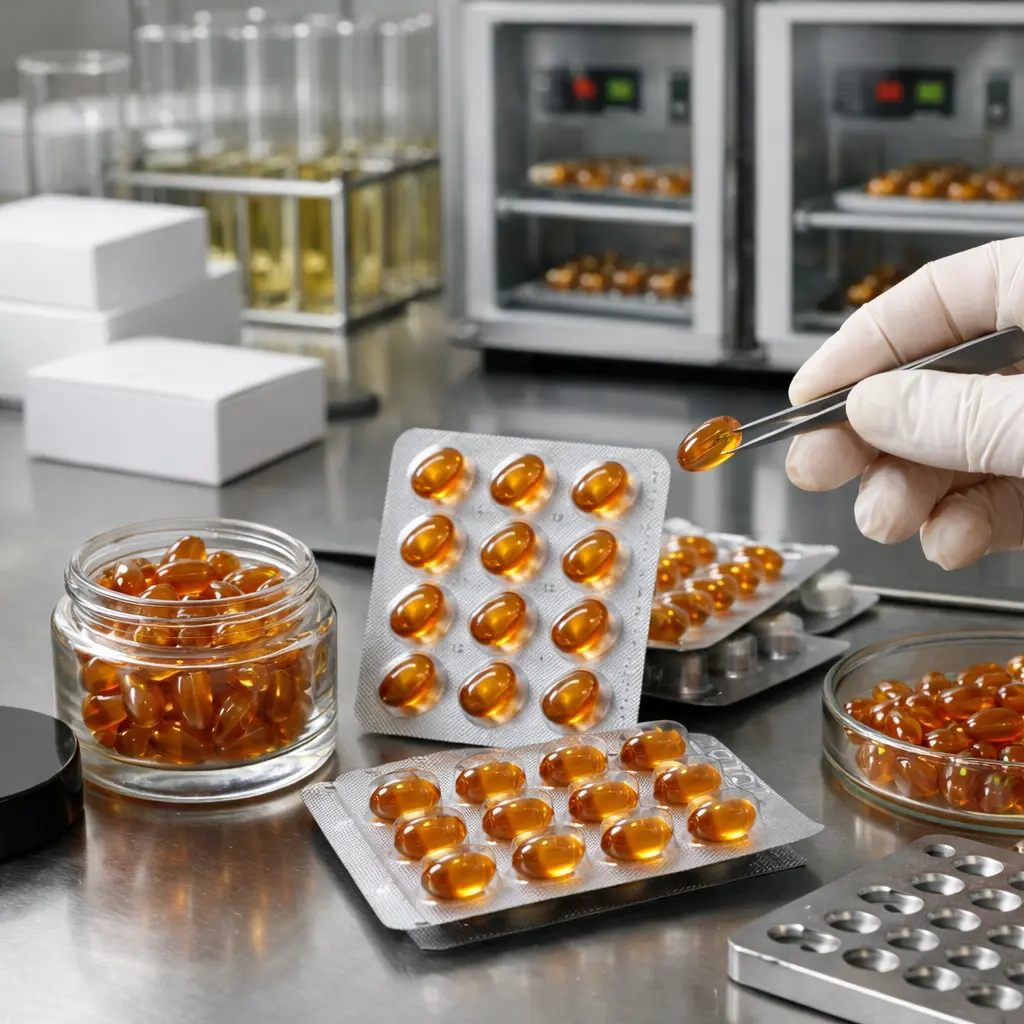
Capsule Formula, Shell, Mold, and Packaging Factors
Fill Formula and Oxidation Control
Request the quantitative formula under confidentiality controls, not merely an ingredient list. Confirm the oil phase, active concentration, antioxidant strategy, fragrance or essential-oil content, color additives, and residual water risk. Fill viscosity should be measured at a stated temperature because it influences pump accuracy, seam contamination, fill-weight variability, and capsule emptying. For oxidation-sensitive encapsulated retinol skincare, ask how raw-material assay, peroxide value or another justified oxidation marker, nitrogen management, bulk hold time, and light exposure are controlled.
Clinical or instrumental literature can inform test design, but it does not validate the buyer’s finished SKU. Research published through the International Journal of Cosmetic Science may support ingredient or methodology review; finished-product claims still require evidence tied to the final formulation, dose, packaging, and intended use.
Shell Material and Aging Behavior
Identify whether the shell is gelatin-based or uses a plant-derived polysaccharide system. Require the complete material specification, origin statement, allergen position, plasticizer information, colorant compliance, and evidence supporting vegan claims where applicable. The ODM should evaluate shell-fill interaction over time, including swelling, brittleness, tackiness, discoloration, odor transfer, seam weakness, and opening force. Compare candidate systems within the relevant cosmetic softgel products, rather than assuming one shell platform performs equally across every serum.
Mold, Fill Weight, and Commercial Reproducibility
Custom mold decisions affect tooling ownership, dose, appearance, line speed, opening behavior, and defect risk. Confirm cavity geometry, nominal dimensions, mold identification, ownership rights, maintenance responsibility, and replacement lead time. Fill weight must have an approved target, tolerance, sampling plan, calibrated measurement method, and investigation threshold. Ask the factory to compare pilot and commercial process capability using actual batch data from related private label serum capsules.
Packaging, Storage, and Shipment
Blisters generally provide stronger unit-level barriers and tamper evidence, while jars may support simpler consumer handling but expose capsules repeatedly to headspace oxygen and ambient humidity. Evaluate barrier properties, liner compatibility, closure torque, capsule-to-capsule adhesion, desiccant suitability, and the potential for extractables, odor transfer, or staining. Stability should use the final decorated pack and include protocol-defined long-term and accelerated conditions, such as 25°C at 60% relative humidity and 40°C at 75% relative humidity when scientifically appropriate. Add transport simulation and temperature-excursion assessment for the planned route.
For a capsule skincare collection, approve blister and jar formats independently. Packaging equivalence should not be assumed. Shipment release documentation should identify batch numbers, quantities, manufacturing and expiry information, storage requirements, pallet configuration, and excursion-response responsibilities.
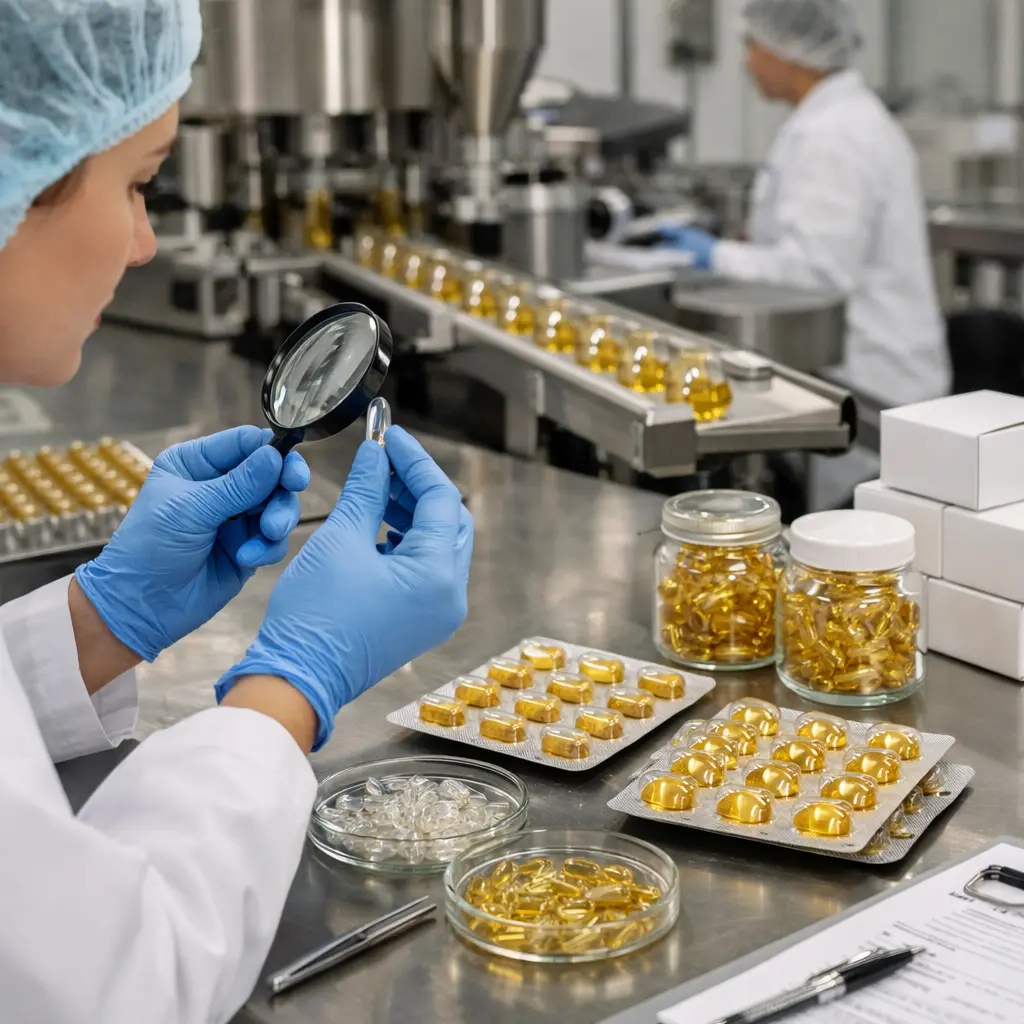
Decision Framework Table
| Factor | What to Check | Why It Matters | ODM Buyer Note |
|---|---|---|---|
| Fill formula | Quantitative composition, viscosity test temperature, active assay, oxidation controls, and bulk hold time | Controls dosing, filling consistency, stability, and claim support | Prohibit substitutions without written change approval |
| Capsule shell | Polymer source, plasticizer, colorant status, seam integrity, and aging behavior | Shell failure can cause leakage, tackiness, brittleness, or consumer-use defects | Request supplier specifications and lot traceability |
| Mold and fill weight | Geometry, ownership, nominal dose, tolerance, sampling plan, and process capability | Links visual identity to repeatable unit dosing and line performance | Retain approved samples and controlled drawings |
| Packaging compatibility | Blister barrier or jar closure, liner, desiccant, headspace, and component interaction | The pack determines moisture, oxygen, light, and transit exposure | Test every intended market pack separately |
| Stability and shipment | Final-pack stability, leakage, oxidation, appearance, microbiology, transport simulation, and excursions | Reduces warehouse, launch, and recall exposure | Define failure criteria and investigation ownership before production |
| US documentation | MoCRA roles, safety substantiation, ingredient review, label file, batch record, and complaint procedure | Supports lawful placement, traceability, and post-market response | Validate records during supplier qualification, not after shipment |
A qualified skincare capsules OEM should be able to populate this framework with controlled documents, named owners, and batch-level evidence. A presentation deck or generic certificate is not an adequate substitute for auditable records.
ODM Manufacturing Considerations
ODM manufacturing should be managed as a controlled handoff from formulation to filled capsule and final pack. A buyer evaluating OEM/ODM services should require one approval record connecting the formula version, shell, mold, packaging, release documents, and shipment instructions.
Confirm the reference sample
Start with an approved reference sample that identifies the formula code, target net fill, capsule dimensions, shell material, color, opacity, seam appearance, odor, and intended package. The supplier should define acceptance limits for appearance and handling, then keep a retained sample for comparison when the formula, shell, or component changes. This is especially important for retinol capsules, facial oil capsules, eye serum capsules, and hair oil capsules, where small changes can affect consumer perception.
Customize the formula and shell as one system
Formula customization should be documented at the ingredient and process level. Ask the formulator to state which variables may change, including oil or ester selection, active level, fragrance, color, and ingredients with strong odor. The record should explain how each change may affect shell contact, appearance, odor, and use feel. Shell options should be compared through material specifications, including gelatin or plant-derived composition, plasticizer and moisture range, dimensions, opacity, and storage behavior. For vegan skincare capsules, request lot traceability and compatibility information from the shell source.
Review the mold and package together
Match mold selection to the intended dose, silhouette, seam geometry, and packing format. Review the mold drawing, cavity layout, ownership, maintenance, and replacement terms. The supplier’s capsule technology and mold options materials can help frame these questions. Test filled units in the proposed blister film or jar and liner combination, including cap fit and headspace. A component that works with an empty capsule may create pressure, sticking, or deformation after filling.
Close the stability, MOQ, document, and shipment file
Before approval, request a filled-pack aging plan with defined checks for shell appearance, leakage, fill odor and color, package deformation, and label legibility. Confirm how retain samples are stored, when results are reviewed, and how out-of-specification findings are escalated. Confirm MOQ separately for capsules, custom molds, printed components, and finished packaging; the sample scope should state which formula, shell, mold, and pack are included. For a US launch, obtain the INCI ingredient declaration, net contents, lot or batch coding, ingredient specifications, applicable colorant support, label proof, and batch release records. Shipment instructions should state acceptable temperature exposure, pallet configuration, protective packaging, and the disposition process after a transport excursion.

Common Problems or Failure Cases
Most serum-capsule failures occur at the interface between formula, shell, mold, and packaging. Ask the supplier to identify the suspected cause and corrective action rather than treating every issue as a simple production defect.
- Shell brittleness: A capsule may crack during handling when shell composition, moisture balance, or storage exposure is unsuitable. Compare units from different production lots and review how they were stored before testing.
- Sticking or shell deformation: Units can stick to trays or each other when surface moisture, residual heat, or compression is not controlled. Check release from the mold, separation inside the pack, and shape after storage.
- Fill separation: Oil phases, color, or fragrance can separate during holding or storage. Review mixing sequence, hold time, visual uniformity, and whether the filled capsule returns to the approved appearance.
- Capsule leakage: A seam, pinhole, puncture, or excessive closure pressure can release facial oil or eye serum into the package. Inspect the capsule and the pack together, including contact points and movement during shipment.
- Fragrance sensitivity: Fragrance may migrate into a liner or create an unexpectedly strong odor in a closed jar. Compare fragrance-free or reduced-fragrance versions and retain the filled package for odor review.
- Packaging deformation: Blister pockets may collapse, jar liners may swell, or lids may distort under heat and compression. Evaluate the filled configuration rather than approving empty components alone.

Supplier Checklist
Use this checklist before approving a serum-capsule OEM/ODM supplier:
- Obtain a signed reference sample with formula, shell, mold, appearance, and net-fill identifiers.
- Request shell specifications, lot traceability, storage guidance, and colorant documentation.
- Verify the formula version, INCI list, ingredient specifications, and change-control process.
- Review the mold drawing, cavity records, ownership terms, maintenance plan, and replacement process.
- Check net-fill targets, batch records, release criteria, and deviation handling.
- Test the intended blister or jar configuration with filled capsules and closure components.
- Review the aging plan, retained-sample process, shipment conditions, and excursion procedure.
- Confirm MOQ and sample scope for capsules, molds, printed parts, and finished packaging.
- Assess data access controls, subcontractor restrictions, supply allocation rules, and social-compliance evidence.
FAQ
Can an OEM guarantee that our core formula will never be disclosed?
No supplier can credibly promise absolute secrecy. Require an NDA, role-based system access, access logs, physical separation of sensitive development work, controlled sample disposal, and restrictions on subcontractors. Contractual audit rights and a documented breach process provide stronger evidence than a verbal assurance.
How can we protect supply when shell or packaging materials become scarce?
Ask for a written allocation policy covering strategic customers, reserved production or material capacity, approved alternate shell and packaging sources, and notice before substitutions. The supplier should explain how formula, shell, and appearance changes are approved so priority supply does not create an uncontrolled specification change.
How can we verify that factory workers are treated fairly?
Request the latest social-compliance audit, corrective-action record, age-verification process, payroll and timekeeping controls, overtime records, and worker grievance channel. Where possible, include private worker interviews and review of subcontractor practices. A supplier should be willing to explain unresolved findings instead of presenting only a pass result.
What must be approved before a custom capsule formula moves to packaging?
Approve the versioned formula, shell material, mold drawing, target net fill, appearance limits, fragrance level, and intended packaging components. Review filled samples from the proposed production route and record who can authorize changes after sample sign-off.
Which documents should accompany a US cosmetic capsule launch?
Request the INCI declaration, net quantity statement, business information, lot coding method, applicable warnings, colorant support, packaging specifications, batch release records, and shipment instructions. Keep the label language within cosmetic scope and ensure the final proof matches the approved formula and package.
References
- FDA Cosmetics Labeling Guide for US cosmetic label elements and presentation.
- The FDA color additive permitted-use database for colorants used in capsule shells or cosmetic formulas.
- The International Journal of Cosmetic Science for cosmetic formulation and product-performance research.