Direct Answer
The right way to use an anti aging serum capsules buyer guide is to scope the portfolio as a controlled manufacturing system before evaluating suppliers. Define the active formats, capsule shell, fill viscosity, fill weight, mold geometry, primary packaging, storage profile, test plan, and documentation requirements as one interconnected specification. A retinol capsule, facial oil capsule, eye serum capsule, or cleansing oil capsule can appear commercially similar while presenting very different oxidation, leakage, compatibility, and regulatory risks.
For an established brand, the manufacturer should be selected only after it demonstrates repeatable pilot production, documented quality controls, validated stability methods, secure formula handling, and a credible scale-up path. The central procurement question is therefore not which supplier can provide a sample, but which supplier can reproduce the approved sample across regions, batches, packaging formats, and replenishment cycles without formulation re-engineering.
That approach is particularly important when a group is diversifying away from a disrupted incumbent supplier, adding a new softgel capability, or requiring a second qualified source for a time-critical product launch.
Key Takeaways for Private Label Buyers
- Scope the capsule portfolio by formula risk, not only by consumer positioning. Retinol, facial oil, eye serum, cleansing oil, and hair oil fills require different oxidation and compatibility controls.
- Approve the shell and fill together. Gelatin, plant-based, and vegan capsule shells can differ in moisture response, sealing behavior, elasticity, and storage tolerance.
- Make fill weight and mold geometry controlled specifications. Small changes affect dose consistency, visual presentation, packaging fit, and unit economics.
- Require packaging compatibility testing with the actual blister, jar, sachet, or secondary pack intended for launch, including heat and humidity exposure.
- Use pilot production to test process capability, leakage rates, appearance, labeling records, and shipment conditions before committing to a global purchase order.
- Evaluate the ODM on documentation, business continuity, IP protection, ESG evidence, and change-control discipline as rigorously as on formulation performance.
serum capsules manufacturer | serum capsule products | retinol capsules
Buyer Context
Capsule skincare is often introduced as a packaging innovation, but for a mature brand it is a multi-variable supply-chain decision. The capsule shell is part of the delivery system, the fill material is sensitive to oxygen and heat, and the mold determines both the consumer experience and the packaging footprint. A failure in any one component can create a batch-quality event, a delayed regional launch, or an expensive packaging redesign.
Retinol capsules typically require tighter oxidation control and light protection than a less reactive facial oil capsule. Eye serum capsules may require a smaller fill weight, controlled opening behavior, and a geometry that supports precise facial application. Cleansing oil capsules must be assessed for shell integrity and interaction with cleansing oils, fragrance components, or other solvent-sensitive ingredients. Hair oil capsules can require a larger fill profile and packaging that remains stable through repeated handling.
Vegan capsule shells and custom softgel molds create additional qualification requirements. A plant-derived shell may provide a preferred brand claim, but its moisture balance and sealing profile must be verified under the intended distribution conditions. A custom mold can differentiate the product, yet it may increase tooling lead time, inspection complexity, and packaging constraints. Procurement should therefore treat each proposed SKU as a technical configuration rather than a simple label change.
For international brands, the risk extends beyond factory output. The supplier must support regional labeling reviews, ingredient and batch documentation, stability evidence, change notifications, and shipment controls. The Modernization of Cosmetics Regulation Act of 2022 is relevant to US market readiness, while Australia’s TGA cosmetic-therapeutic boundary guidance illustrates why product presentation and claims should be reviewed market by market. For sunless or bronzing capsule concepts, the FDA guidance on DHA-based sunless tanning products should also be considered where applicable.
skincare capsules OEM | skincare capsule product lines | encapsulated retinol skincare
Capsule Formula, Shell, Mold, and Packaging Factors
Formula and fill behavior
Begin with the physical properties of the fill, not just the ingredient list. Record viscosity at the proposed filling temperature, density, suspended material, fragrance load, oil polarity, and sensitivity to oxygen, light, and moisture. A serum essence with a thin fill may require different dosing and sealing controls from a dense facial oil or a silicone-containing formula. The manufacturer should explain how the formula is deaerated, held, filled, sealed, and inspected.
Fill weight must be defined with an acceptable tolerance and verified through in-process sampling. The buyer should request the weighing method, balance calibration records, sampling frequency, and reconciliation process for bulk material. A nominal fill weight that is not tied to a validated process capability target is not a sufficient specification.
Shell material and mold selection
Compare gelatin, plant-based, and vegan shell options for moisture transmission, brittleness, elasticity, sealing performance, and aging behavior. Ask for technical data and production samples from the proposed shell supplier, rather than approving a verbal material description. Shell colorants, opacifiers, and surface treatments may also affect light protection and visual consistency.
Mold selection should be assessed against dose, application behavior, tooling ownership, replacement availability, and packaging cavity dimensions. A single-dose capsule can be round, oval, elongated, or custom formed, but the shape must remain stable during filling, transport, and opening. Request dimensional tolerances and inspection criteria for both empty shells and finished capsules.
Packaging, storage, and stability
Compatibility testing should use the final primary pack. Blister packaging may improve unit separation and light control, while a jar may simplify consumer access but increase repeated oxygen exposure. Confirm contact-material compatibility, seal integrity, capsule deformation, oil migration, and label adhesion after heat and humidity storage. The supplier should define the intended shipment temperature range, pallet configuration, protection from direct sunlight, and procedures for temperature excursions.
Stability work should include appearance, odor, fill weight, shell integrity, leakage, oxidation indicators, and relevant formula performance measures. Retinol and other oxidation-sensitive ingredients may require an opaque or higher-barrier package. The buyer should review both accelerated and real-time plans, test intervals, sample quantities, acceptance criteria, and responsibility for investigating out-of-specification results.
private label skincare capsules | cosmetic softgel products | retinol serum capsules | cosmetic softgel capsule factory

Decision Framework Table
| Factor | What to Check | Why It Matters | ODM Buyer Note |
|---|---|---|---|
| Fill formula | Viscosity, density, oxygen sensitivity, fragrance and solvent profile | Determines filling accuracy, oxidation risk, and sealing behavior | Require a formula-specific process record, not a generic capsule specification |
| Shell material | Gelatin or vegan composition, moisture response, elasticity, seal integrity | Influences leakage, brittleness, storage performance, and claims support | Review supplier qualification and change-control procedures for shell materials |
| Fill weight | Target weight, tolerance, balance calibration, sampling frequency | Supports dose consistency, cost control, and regulatory documentation | Request pilot batch reconciliation and in-process inspection data |
| Mold geometry | Dimensions, cavity fit, opening behavior, tooling ownership | Affects application, packaging compatibility, and production continuity | Approve dimensional drawings and retain a tooling contingency plan |
| Primary packaging | Blister or jar contact, barrier properties, seal, light protection | Controls oxygen exposure, deformation, leakage, and shelf performance | Test the finished capsule in the final pack before artwork approval |
| Stability and shipment | Heat and humidity profile, real-time plan, transport controls, excursion handling | Connects factory quality with global distribution reliability | Make shipment conditions and investigation duties contractual |

ODM Manufacturing Considerations
Supplier qualification should combine technical review with operational evidence. Ask whether the same line, shell source, filling equipment, inspection method, and packaging process will be used from sample through commercial production. A pilot run from 1,000 units can expose leakage, fill-weight variation, and packaging defects before larger commitments. The preferred scale-up path should demonstrate capacity from pilot quantities to 500,000 or more units per SKU without changing the approved formula or transferring production to an unqualified partner.
Assess whether formulation, stability, quality, regulatory, and packaging teams work in parallel. A manufacturer with an established library of more than 800 baseline formulations and third-party validation on more than 150 formulas may reduce development uncertainty, but those figures do not replace SKU-specific testing. Ask for the evidence behind each proposed claim, the applicable ISO 22716 controls, batch-release workflow, deviation procedure, and product-change notification period.
For a multinational procurement team, information security and resilience deserve equal weight. Review formula-access permissions, physical segregation, electronic records, backup systems, business-continuity plans, strategic raw-material allocation, insurance coverage, worker-welfare audits, environmental records, and waste-management controls. A technically capable capsule line is not an adequate second source if the site cannot withstand an audit or maintain supply during a disruption.
Finally, define the sampling package before the project begins: approved formula version, shell specification, mold drawing, fill-weight target, packaging configuration, test plan, labeling documents, certificate requirements, release criteria, and shipment conditions. This creates a controlled baseline against which the manufacturer can be evaluated and prevents a sample from being approved on appearance alone.
ODM Manufacturing Considerations
Before approving an OEM or ODM partner, treat the first sample as a technical confirmation stage rather than a visual approval. The supplier should document the formula version, capsule shell material, target fill weight, capsule dimensions, appearance, fragrance level, and intended package. A private-label buyer should receive samples from the proposed production route, because a laboratory sample made with different equipment may not represent production behavior.
Start with the fill formula. Ask the manufacturer to record viscosity, density, oil or water phase behavior, suspended ingredients, and any separation observed during filling. Retinol capsules, facial oil capsules, and eye serum capsules may require different handling because oxidation sensitivity, flow behavior, and dose size can vary. Customization should be assessed against the capsule format, not only against the ingredient list. A formula that looks stable in a beaker may be difficult to fill consistently or may increase leakage risk after sealing.
Confirm the shell option early. Standard gelatin softgels may differ from vegan capsule shells in moisture response, flexibility, aging behavior, and compatibility with the fill. The supplier should identify the shell composition, plasticizer system, colorants, and any relevant allergen or animal-origin statement. For a vegan skincare capsule, request aging samples and storage observations before selecting the shell for a full portfolio. The capsule technology overview can help buyers organize these questions.
Mold selection also affects the commercial brief. Confirm the capsule shape, length, width, seam position, tip geometry, surface finish, and expected fill capacity. A mold should be selected after the fill weight and user-opening experience are understood. Ask for dimensional drawings or approval samples, then compare the filled capsule with the proposed blister cavity, jar opening, scoop, or dispensing tray. A capsule that is attractive in isolation may be difficult to remove without puncturing or may occupy excessive package volume.
Packaging compatibility requires physical testing with the actual formula and shell. Review whether capsules stick to one another, deform under compression, rub against blister film, or become difficult to dispense from a jar. Check headspace, closure torque, inner seals, desiccant requirements, and label area. For retinol capsules, the package review should include light exposure and oxygen-control measures. For facial oil capsules, inspect staining, oil migration, and seal cleanliness. Product-specific references such as retinol capsules and facial oil capsules can support the initial specification discussion.
The stability review should match the intended market and shipment route. Request a written protocol covering appearance, odor, fill separation, leakage, shell hardness, seal integrity, fill-weight change, and package condition under heat and humidity exposure. The report should identify test duration, sampling intervals, acceptance criteria, and the tested batch. A buyer should also define what happens when a result is outside specification: reformulation, package revision, additional testing, or rejection.
Commercial terms should be linked to the technical scope. Clarify the minimum order by formula, shell color, mold, package, and printed component. Ask whether pilot samples, production samples, and retained samples are included, and identify charges for mold development, artwork adaptation, testing, and regulatory documents. Required labeling documents may include the ingredient declaration using accepted cosmetic nomenclature, net contents, batch coding format, shelf-life or period-after-opening guidance, country-of-origin information, certificate of analysis, safety documentation, allergen statements, and packaging material specifications.
Finally, define shipment conditions in writing. The supplier should state temperature limits, pallet or carton configuration, protection from crushing, exposure limits during transit, and procedures for receiving inspection. A shipment record should make it possible to connect cartons to the batch, package version, and release documentation. These details are especially important when a capsule portfolio includes oils or shell materials that respond differently to seasonal transport conditions.
Common Problems or Failure Cases
Shell brittleness: Capsules can crack, split, or develop fine surface defects when shell moisture is poorly controlled or storage conditions are unsuitable. Review shell hardness and flexibility at release and after conditioning. Retain samples from each major production batch so the buyer can compare future complaints against the original condition.
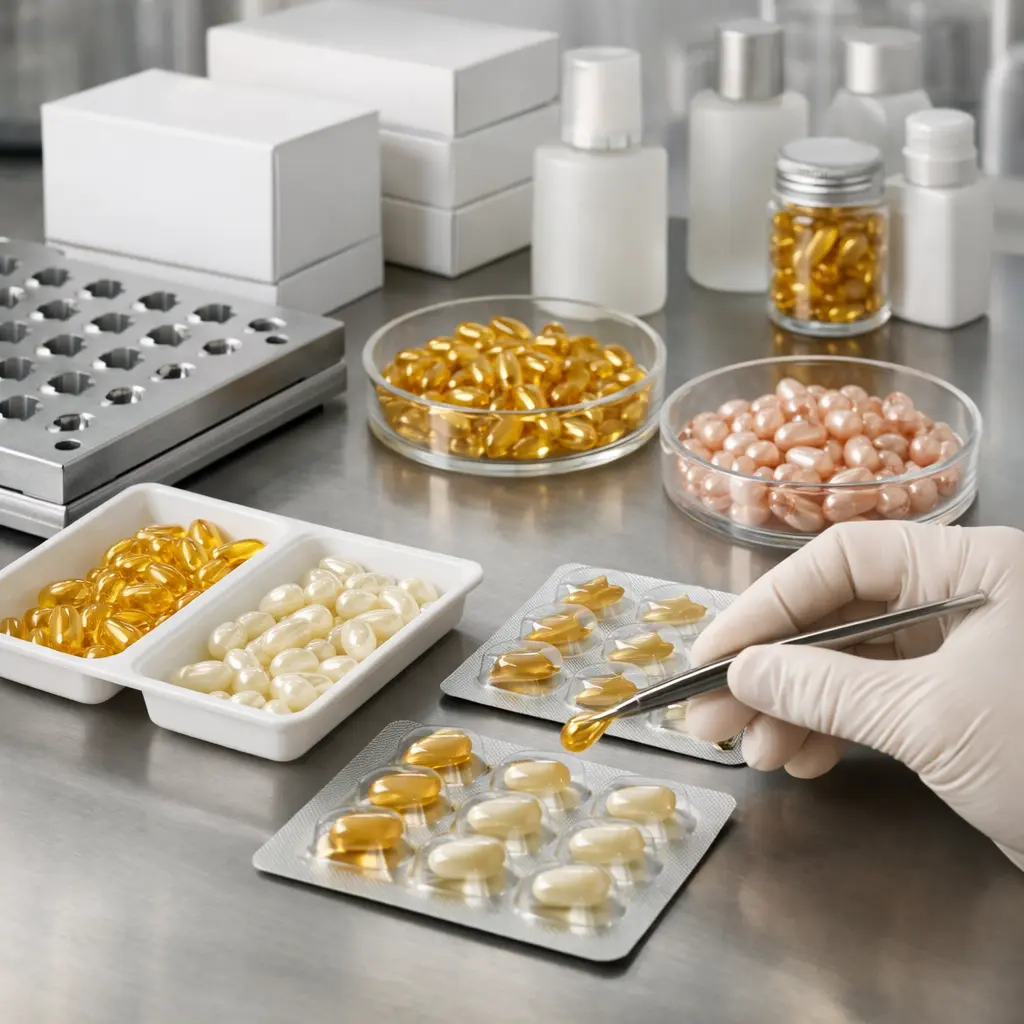
Sticking or deformation: Capsules may stick together in a jar, flatten under carton pressure, or deform inside a blister cavity. The cause may involve shell composition, residual moisture, package compression, or excessive surface contact. Test filled capsules in the final package during storage and simulated distribution, rather than evaluating empty shells alone.
Fill separation: An oil or essence can become visibly stratified, develop sediment, or show inconsistent color between capsules. Confirm whether the formula requires controlled mixing during filling and whether suspended ingredients remain uniform throughout the run. The buyer should establish acceptable appearance limits and compare samples from the beginning, middle, and end of filling.
Leakage: Leakage may result from an incomplete seal, unsuitable seam settings, excessive fill volume, sharp capsule geometry, or package abrasion. Inspect seam appearance, perform pressure or leak testing appropriate to the format, and examine capsules after transport simulation. Do not rely on a single visual inspection at the factory.
Fragrance sensitivity: A strong fragrance may intensify during storage or transfer to the shell and package. Request fragrance specifications, compatibility observations, and odor checks at defined intervals. The same review applies to essential-oil-rich facial or hair oil capsules, where fragrance, oxidation, and package interaction can influence consumer acceptance.
Packaging deformation: Blister film can distort, seals can wrinkle, and jars can place pressure on capsules when the cavity or closure is poorly matched. Approve the package with filled capsules, finished labels, and the intended carton configuration. A packaging revision should trigger a new compatibility check, even when the formula has not changed.
Supplier Checklist
- Confirm the shell material, shell additives, allergen status, animal-origin statement, color options, and aging behavior.
- Request formula records covering viscosity, density, fill weight, separation risk, fragrance level, and oxidation-control requirements.
- Review capsule dimensions, mold drawings, seam location, surface finish, and the process for dimensional approval.
- Test filled capsules in the intended blister, jar, tray, or carton for sticking, leakage, abrasion, deformation, and dispensing behavior.
- Obtain a stability protocol and report covering appearance, odor, shell condition, fill condition, package integrity, and storage limits.
- Define sample scope, formula revision control, minimum order by SKU, mold ownership, retained samples, and change-notification procedures.
- Verify labeling documents, ingredient nomenclature, batch coding, safety files, certificates of analysis, and package specifications.
- Audit information security, formula access permissions, visitor controls, production segregation, backup practices, and document retention.
- Ask for supply-continuity procedures covering approved alternatives, allocation during raw-material shortages, and communication of substitutions.
- Review environmental permits, emissions records, worker grievance channels, wage and overtime controls, age-verification procedures, and independent social-audit results.
- Set shipment requirements for temperature, humidity, carton strength, palletization, receiving inspection, and excursion reporting.
FAQ
Can an OEM supplier guarantee that our serum capsule formula will not be disclosed?
No supplier should make an absolute promise without showing controls. Ask for a confidentiality agreement plus a practical security review covering access permissions, formula coding, electronic records, physical segregation, visitor rules, sample disposal, and employee departures. Confirm who can view the formula and how unauthorized exports are detected and logged.
How can a buyer protect priority supply during a major raw-material shortage?
Put supply continuity into the commercial agreement. Define approved ingredients and substitutes, minimum safety stock or reserved capacity where appropriate, allocation rules, forecast windows, and escalation contacts. Require advance notice before any ingredient or shell change, followed by compatibility and stability review. Priority status should be documented rather than treated as an informal assurance.
What evidence should a buyer request about environmental and labor practices?
Request current permits, relevant emissions or wastewater records, corrective-action reports, and independent audit documentation. For labor practices, review age-verification controls, payroll and overtime records, grievance procedures, worker interviews, and remediation history. A policy statement alone does not establish that the factory is free of forced labor, child labor, wage violations, or excessive overtime.
How many capsule samples are needed before approving an ODM formula?
Use enough samples to assess formula behavior and packaging behavior, not merely appearance. The set should include capsules from more than one filling point, samples in the final package, reserve units for transport simulation, and retained units for comparison after storage. The supplier should record fill weight, dimensions, defects, odor, and package condition against written acceptance criteria.
Should one shell type be used across an entire anti-aging capsule range?
Consistency can simplify packaging and consumer handling, but it should not override compatibility. Compare gelatin and vegan shell options against each formula, especially retinol, facial oil, eye serum, and fragrance-rich fills. Differences in moisture response, flexibility, and aging may justify separate shell specifications within one portfolio.
What labeling and release documents should accompany a finished capsule order?
Agree on the ingredient declaration, net contents, batch code, shelf-life information, storage statement, country-of-origin details, certificate of analysis, safety documentation, allergen information, and packaging specifications. Also request a release record linking the finished goods to the approved formula, shell, mold, package, and test results.
References
For market-specific boundary questions, consult Australia’s TGA cosmetic-therapeutic boundary guidance. For products containing DHA-based tanning ingredients, review the FDA’s guidance on DHA-based sunless tanning products. For additional stability-testing context, see the cosmetic stability testing guide.