
Direct Answer
Retail and distributor readiness should be assessed before selecting a capsule skincare manufacturer, because the factory must prove that its formula, shell, fill process, packaging system, documentation, and shipment controls can support the intended channel. A strong retail skincare capsules private label buyer guide therefore begins with a technical readiness review, not a factory quotation. Confirm the capsule shell material, active compatibility, fill viscosity, fill weight tolerance, leakage controls, oxidation protection, packaging fit, stability evidence, labeling file, and batch-release process before approving samples. For international brands, the review should also test whether the manufacturer can maintain the same formula and quality standard from pilot production to scaled supply. This matters when a supplier quality incident, an ESG audit requirement, or a sudden capacity disruption forces a mature brand to qualify an alternative source under compressed launch conditions.
Key Takeaways for Private Label Buyers
- Define the commercial channel first: retail shelves, distributor cartons, subscription programs, and direct-to-consumer shipments impose different requirements for capsule durability and pack configuration.
- Approve the formula and shell as one system. Retinol, facial oil, eye serum, cleansing oil, and hair oil fills can interact differently with gelatin or vegan capsule materials.
- Require documented fill-weight controls and leakage testing rather than relying on visual inspection of finished capsules.
- Validate blister, jar, sachet, and secondary-carton compatibility during sampling; packaging cannot be treated as a late-stage artwork decision.
- Review stability protocols, storage conditions, transport exposure, and oxidation controls before making a launch commitment.
- Make the ODM provide a complete technical file covering ingredients, specifications, batch records, labeling support, claims substantiation, and shipment conditions.
Buyer Context
Capsule skincare products are often selected for their controlled dose, premium handling experience, and ability to protect a concentrated serum or oil from repeated exposure. Those advantages create a more demanding manufacturing assessment than a conventional pump bottle. A retinol capsule may require strict light and oxygen management. A facial oil capsule may remain chemically stable but still fail through shell softening, surface tack, or leakage during distribution. An eye serum capsule may require a smaller fill weight and a mold designed for precise opening and application. Cleansing oil capsules and hair oil capsules introduce additional questions about viscosity, dispensing behavior, and whether the user can empty the full dose without tearing the shell incorrectly.
For an international brand, the operational issue is continuity. A supplier may produce an attractive sample yet lack the process discipline required for repeatable commercial batches. This risk becomes material when a core manufacturer experiences a quality event, fails a surprise social-compliance audit, or cannot reserve capacity during a raw-material disruption. The replacement supplier must be assessed against the same procurement criteria used for an established strategic partner: quality-system maturity, traceability, information security, labor standards, environmental records, insurance coverage, and resilience of ingredients and packaging supply.
Regulatory scope also needs to be defined by destination market. The ISO 22716 cosmetic GMP standard provides a relevant manufacturing baseline, but it does not replace market-specific labeling, notification, ingredient, or claims review. For products distributed into the United States, buyers should examine the FDA Cosmetics Labeling Guide. When a brightening formula is under consideration, restricted or high-risk actives require a separate regulatory assessment; the FDA hydroquinone alternative-active guidance is one example of the type of authority source that should inform the review.
Market access may also require local conformity documentation. For distribution in Saudi Arabia, procurement teams should verify whether the product, packaging, and importer documentation must be managed through the SABER conformity certification platform. The manufacturer should be able to identify which documents it supplies and which remain the responsibility of the brand, importer, or distributor.
Review serum capsules manufacturer capabilities alongside the specific serum capsule products under consideration. A general factory profile is insufficient evidence that a selected capsule mold, fill formula, and package can perform through the target channel.

Capsule Formula, Shell, Mold, and Packaging Factors
Formula and Fill Behavior
The first technical question is whether the formula is suitable for encapsulation. Measure viscosity at the intended filling temperature and confirm that the serum or oil can be metered consistently. High-viscosity fills can create incomplete dosing, air entrapment, or irregular seals. Low-viscosity formulas may increase seepage risk if the seal design, shell moisture, or storage conditions are poorly controlled. The buyer should request fill-weight specifications, in-process sampling records, acceptable tolerance, and the method used to investigate out-of-specification units.
Ingredients also influence packaging and stability. Retinol, certain botanical oils, and unsaturated facial oils may require light-resistant packaging, oxygen-control measures, and an appropriate antioxidant strategy. The formula file should identify active concentration, carrier oils, preservative approach where relevant, compatibility screening, and the expected appearance of the capsule during storage. The manufacturer should distinguish cosmetic performance evidence from medical or therapeutic claims.
Shell Material and Mold Selection
Shell selection should be based on formula compatibility, consumer positioning, and shipment conditions. Gelatin shells may offer established processing behavior, while vegan capsule shells can support specific brand requirements but may respond differently to humidity, heat, and mechanical stress. Ask for shell composition, plasticizer information, moisture specifications, allergen statements, origin documentation, and aging or compatibility data.
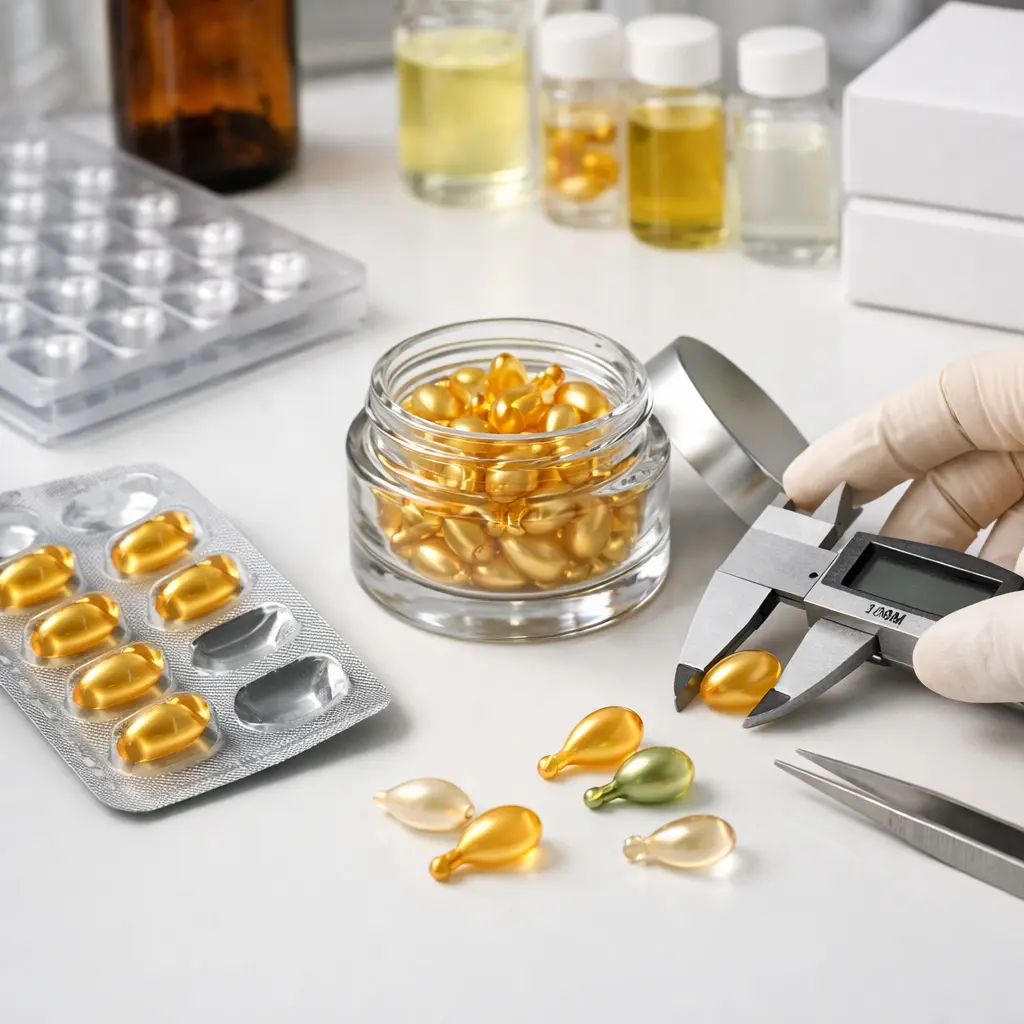
Custom softgel molds affect the dose, opening behavior, tactile experience, and packaging density. A mold that looks appropriate in a sample may create excessive seal area, difficult tear points, or inefficient blister utilization at scale. Compare capsule dimensions with the proposed blister cavity or jar neck, and inspect whether the capsule can be removed without puncture or deformation. Buyers evaluating retinol serum capsules should also confirm that the mold and package minimize exposure to light and oxygen throughout the expected shelf life.
Packaging, Storage, and Shipment
Packaging compatibility must be tested with the actual capsule, not an empty shell or substitute fill. Blister material, lidding seal, jar closure, desiccant use, headspace, and secondary-carton protection all affect performance. A jar format may improve consumer access but expose more units to air after opening. A blister may provide better unit separation but require careful control of cavity dimensions and sealing temperature.
Request storage and transport limits for temperature and humidity, together with evidence from accelerated and real-time stability programs. The supplier should explain how finished goods are protected during palletization, ocean shipment, air freight, and distributor warehousing. Examine capsule surface changes, leakage, odor, color, fill-weight drift, seal integrity, and active assay where applicable. These checks should be linked to a defined release decision, not merely included as observations in a sample report.
Decision Framework Table
| Factor | What to Check | Why It Matters | ODM Buyer Note |
|---|---|---|---|
| Shell material | Gelatin or vegan composition, moisture range, allergen and origin records | Controls formula compatibility, handling, and market positioning | Request a shell specification and compatibility sample using the final fill |
| Fill formula | Viscosity, active stability, oxidation sensitivity, fill-weight method | Determines dosing consistency, leakage exposure, and shelf-life risk | Approve a controlled formula version before artwork and commercial costing |
| Mold design | Dimensions, seal geometry, opening behavior, cavity utilization | Affects user experience, package fit, and production yield | Test the mold with the proposed blister or jar, including removal by hand |
| Packaging | Blister or jar compatibility, seal performance, light and oxygen protection | Protects the capsule through storage and distribution | Evaluate primary and secondary packaging together during pilot sampling |
| Stability and shipment | Heat, humidity, transport, leakage, appearance, odor, and assay review | Reveals risks that may not appear during factory acceptance | Obtain a written storage range and shipment-condition protocol |
| Documentation | Ingredients, specifications, batch records, labeling data, release records | Supports global compliance, distributor review, and traceability | Confirm document ownership, revision control, and response timelines |
Use the same evidence standard when comparing skincare capsule product lines, encapsulated retinol skincare, private label serum capsules, and cosmetic softgel products. The decision should be based on documented process capability, not the visual quality of one sample.

ODM Manufacturing Considerations
ODM readiness should be judged through documented sample decisions, not only through a factory presentation. Ask the supplier to define the sample scope for each capsule SKU: formula version, active concentration, capsule shell material, nominal fill weight, mold format, closure method, primary package, and expected storage conditions. A useful sample record should identify what is approved and what remains provisional. This prevents a buyer from approving a visually attractive capsule while the production formula, shell, or package is still changing.
For fill formula customization, compare the intended serum, facial oil, eye serum, retinol, cleansing oil, or hair oil against the supplier’s equipment and process limits. The supplier should review viscosity, oil polarity, suspended ingredients, fragrance load, color, active sensitivity, and dose consistency. Request a written explanation of how the formula will be mixed, held, filled, and protected from oxidation. For retinol capsules, the review should include light exposure, oxygen management, and container closure. For fragrance-sensitive formulas, ask for compatibility samples using the actual shell and package rather than relying on a formula-only evaluation.
Capsule shell options should be evaluated according to the product brief. A gelatin shell may offer a familiar softgel profile, while vegan shell materials may support a specific brand or market requirement. The decision should include shell moisture behavior, flexibility, surface feel, color, odor, regulatory documentation, and interaction with the fill. Mold selection also affects dose, appearance, opening experience, and package fit. Review sample mold dimensions against blister cavities, jars, sachet inserts, or other intended formats before approving tooling.
Packaging compatibility requires a physical trial with production-intent capsules. Check whether capsules stick together, deform under compression, rub against a blister seal, or lose their shape inside a jar during shipment. Confirm headspace, closure torque, liner material, tamper evidence, and orientation requirements. A facial oil capsule may behave differently from a water-rich serum capsule, even when both use the same package. Link the packaging review to the supplier’s capsule technology information and the relevant capsule skincare solutions rather than treating packaging as a separate purchasing step.
Stability review should cover the formula, shell, label, and finished package as one system. Ask for a protocol covering heat, humidity, light, appearance, odor, fill separation, leakage, shell hardness, and package deformation. The report should identify test conditions, sampling intervals, acceptance criteria, and deviations. A buyer expanding into a new region should also compare shipment conditions with the destination climate. Do not accept a general statement that a product is stable without seeing the product-specific protocol and results.
MOQ and sampling terms should be separated into development samples, packaging samples, pilot quantities, and commercial production. Clarify whether custom molds, printed components, and formula work have separate minimums. Request the full labeling document set, including ingredient nomenclature, product specification, batch coding format, net contents, usage language, warnings where applicable, certificate of analysis format, safety data where relevant, and artwork review responsibilities. The FDA Cosmetics Labeling Guide is a useful reference for checking whether the supplier’s document package supports the intended United States label.
Finally, define shipment conditions before the first purchase order. Specify temperature exposure limits, pallet configuration, carton compression expectations, humidity protection, data logger use where needed, and inspection at dispatch. For exports to Saudi Arabia or other markets using conformity systems, confirm whether the documentation can support registration through the SABER conformity certification platform. These details become especially important when a new supplier is being qualified after a quality incident, a sudden production interruption, or a group requirement for lower supply-chain emissions.

Common Problems or Failure Cases
Shell brittleness: A capsule may crack during filling, packing, or transport when shell moisture, drying time, or storage conditions are poorly controlled. Ask for shell specifications, conditioning requirements, and visual inspection criteria. Test capsules after exposure to the planned shipment and storage environment, not only immediately after production.
Sticking and deformation: Capsules can adhere to one another, a blister film, or a jar surface when the shell finish, residual moisture, package material, or filling temperature is unsuitable. Compression from an overfilled jar or a tight blister cavity can create flat spots and weak seams. Review actual cavity dimensions and run a packed-unit handling test before approving the format.
Fill separation: A serum or oil blend may show phase separation, sedimentation, color change, or inconsistent texture during holding. This can affect dose uniformity and consumer use. Require the supplier to document mixing order, holding time, agitation controls, and appearance limits. A formula that looks uniform in a small sample may behave differently in a larger vessel.
Leakage: Leakage can result from incompatible shell and fill chemistry, weak sealing, excessive capsule stress, or package movement. Test filled capsules after aging, vibration, stacking, and temperature exposure. Inspect both visible leaks and gradual weight loss. A leakage review should be linked to the intended formula and package, because a cleansing oil capsule and an eye serum capsule may impose different compatibility requirements.
Fragrance sensitivity: Fragrance materials can affect shell odor, surface feel, color, or long-term compatibility. Ask for fragrance disclosure at the level needed for regulatory review and request a retained sample from the final formula. Evaluate odor after storage, opening, and contact with the package liner.
Packaging deformation: Blisters, jars, lids, labels, and cartons may deform under heat, humidity, or stacking pressure. This can compromise presentation or create pressure on the capsules. Confirm packaging material specifications, carton load limits, and shipment orientation. Do not approve a package solely from an empty-component sample.
Supplier Checklist
- Confirm the capsule shell material, supplier documentation, moisture range, color, odor, and vegan or gelatin status where relevant.
- Record formula viscosity, fill chemistry, active ingredients, fragrance load, oxidation controls, mixing method, and holding limits.
- Verify mold dimensions, nominal fill weight, permitted tolerance, opening experience, and compatibility with the selected package.
- Request finished samples from the intended formula, shell, mold, label, and primary package combination.
- Review test methods and acceptance criteria for leakage, shell brittleness, sticking, deformation, separation, appearance, odor, and fill weight.
- Check stability protocols for heat, humidity, light, shipment vibration, and destination storage conditions.
- Separate development MOQ, custom mold MOQ, component MOQ, sampling fees, and commercial production MOQ.
- Obtain ingredient, specification, batch record, certificate of analysis, labeling, artwork, and export documentation responsibilities in writing.
- Define shipment temperature limits, carton configuration, pallet protection, inspection points, and claims evidence.
- Audit information security, formula access controls, backup practices, and confidentiality procedures for proprietary cosmetic formulas.
- Ask for supply-continuity evidence, including strategic ingredient allocation, approved alternatives, and escalation procedures during raw-material shortages.
- Request current environmental permits, emissions records, wastewater controls, labor policies, working-hour records, and third-party audit procedures.
FAQ
How can a buyer protect a proprietary capsule formula from information leakage?
Ask the supplier to map who can access the formula, specification, artwork, and batch records. Review role-based permissions, physical segregation of development and production records, visitor controls, backup security, employee confidentiality agreements, and document-retention rules. The contract should define permitted use, subcontractor access, incident notification, and return or destruction of confidential information. A verbal confidentiality promise is not enough for a strategic serum capsule program.
Can a supplier guarantee priority supply when key ingredients become scarce?
No supplier can remove global shortage risk entirely. A credible plan should identify strategic ingredients, approved alternates, safety-stock logic, allocation rules, and escalation contacts. Ask whether priority status is contractual, how it is measured, and whether the same ingredient is committed to competing customers. Review the formula impact and new approval requirements before accepting an alternate ingredient.
What environmental evidence should an international skincare buyer request?
Request current permits, wastewater treatment records, emissions monitoring, waste-transfer documents, energy and carbon records, and corrective-action reports. Confirm the reporting period, site address, responsible party, and whether records can be reviewed by an independent auditor. This is relevant when a group procurement policy requires measurable emissions reduction or when distributors need traceable supplier records.
What should be checked after a capsule fails in a stability or shipment test?
Separate the failure into formula, shell, process, package, and transport causes. Retest retained samples, compare fill weight and appearance, inspect seal integrity, examine package compression, and review temperature and humidity exposure. Require a root-cause report with corrective actions and a defined requalification sample before restarting production.
How should MOQ be evaluated for a new retinol or facial oil capsule?
Calculate the total commitment across formula development, mold, shell, printed components, packaging, and finished units. Ask whether unused components can be stored, transferred to another SKU, or discarded. A smaller initial order may still create substantial exposure if custom components have long lead times or limited reuse.
How can a buyer assess fair treatment of factory workers?
Request the supplier’s labor policy, age-verification process, payroll records, working-hour controls, overtime payment records, grievance channel, and recent social-audit findings. Ask how subcontracted work is monitored. Evidence should cover the actual capsule production site and should include corrective actions for any prior finding involving forced labor, child labor, wage deductions, or excessive overtime.
References
For United States cosmetic label structure and required information, consult the FDA Cosmetics Labeling Guide. For market-entry documentation in Saudi Arabia, consult the SABER conformity certification platform. For ingredient-specific regulatory review involving hydroquinone and alternative cosmetic actives, consult the FDA hydroquinone alternative-active guidance.