
Direct Answer
A reliable skincare capsule product portfolio quality checklist should evaluate the formula, capsule shell, mold, fill weight, packaging system, stability evidence, documentation, and production controls as one connected system. A retinol capsule may pass a laboratory review yet fail in market if oxidation protection is inadequate, the shell becomes brittle during storage, or the blister material is incompatible with the fill. For procurement teams, the central question is therefore not whether an ODM can produce a capsule sample. It is whether the supplier can reproduce the approved formula and physical performance at scale, under defined shipment and storage conditions, with complete labeling and quality records. Buyers should require evidence for shell composition, viscosity range, fill-weight tolerances, leakage controls, accelerated and real-time stability, packaging compatibility, batch traceability, and change management before approving a launch. This approach reduces the risk of a late reformulation, delayed market entry, or cross-market compliance issue.
Key Takeaways for Private Label Buyers
- Approve the formula and capsule shell together. Oil-based serum fills, retinol systems, cleansing oils, and hair oils can interact differently with gelatin or vegan shell materials.
- Define fill weight, viscosity, seal integrity, and visual acceptance criteria before pilot production. A sample that looks correct may still have inconsistent dosing or leakage risk.
- Test the complete commercial pack, including blister cavities, jars, liners, closures, and secondary cartons. Packaging compatibility is a product-quality requirement, not a procurement detail.
- Request stability data linked to the intended market, shipment route, and storage profile. Heat and humidity exposure can affect oxidation, shell aging, color, odor, and capsule cohesion.
- Require an ODM change-control process covering raw materials, capsule molds, equipment, packaging suppliers, and manufacturing sites before a purchase order is released.
For portfolio architecture, use a controlled core of validated capsule formats and add custom variants only when the commercial or technical case is clear. This creates a more manageable formula and packaging platform across multiple markets.
Buyer Context
Serum capsules are often treated as simple unit-dose cosmetics because their visual presentation is compact and easy to merchandise. In practice, they combine a topical formula, a softgel or other capsule shell, precision filling, sealing, packaging, and a defined storage environment. Each interface creates a separate failure mode. A facial oil capsule may show seepage when the fill solvent or fragrance system softens the shell. An eye serum capsule may require tighter control of fill weight and opening behavior because the application area is sensitive. A cleansing oil capsule may need a different viscosity window from a leave-on serum, while a hair oil capsule may require a shell and closure configuration that tolerates repeated handling during travel use.
Retinol capsules introduce additional risk because the active is sensitive to oxygen, light, and heat. The buyer must review the formula design, antioxidant strategy, primary packaging, and shipment conditions as a single stability program. Vegan capsule shells can support a specific brand policy, but their moisture response and mechanical performance should be compared with the intended fill and package rather than approved on a label claim alone. Custom softgel molds also require dimensional review: shape, seam position, opening behavior, cavity volume, and line capability can affect both consumer use and production yield.
These controls become more important when a group is qualifying an alternative supplier after a serious quality incident, responding to a new global ESG requirement, or adding a capsule format that an incumbent plant cannot manufacture. A qualified serum capsules manufacturer should provide a technical file that procurement, R&D, QA, regulatory, and legal teams can review without relying on unsupported assurances. Market-facing claims should remain aligned with the formula evidence and the applicable labeling framework, including the FDA Cosmetics Labeling Guide.
For portfolio mapping, buyers can compare serum capsule products by fill type, shell material, dose format, and packaging route. The same review should be applied to retinol serum capsules before a high-volume launch or global line extension.
Regional release planning also requires market-specific assessment. Where Gulf distribution is relevant, the Gulf Standardization Organization framework should be reviewed alongside the target country requirements. For substantiation strategy and cosmetic safety context, procurement and R&D teams may also consult the Journal of Cosmetic Dermatology.
Commercial evaluation should include more than unit pricing. A buyer should assess pilot scope, sample retention, line capacity, raw-material continuity, backup packaging sources, batch-release timing, and shipment conditions. A supplier able to support a small validation run and later reproduce it at commercial scale provides stronger launch control than a supplier whose sample and mass-production lines use different materials or equipment.
Related portfolio references include skincare capsules OEM, skincare capsule product lines, encapsulated retinol skincare, and private label serum capsules. These should be used as category references, while the final approval remains evidence-based and SKU-specific.
Capsule Formula, Shell, Mold, and Packaging Factors
Formula and Fill Performance
Begin with the fill rather than the visual shape. Record the formula type, viscosity range, density, volatile components, fragrance load, color, oxidation sensitivity, and compatibility with the intended shell. A precise fill-weight specification should be established during development and confirmed through in-process sampling. The acceptance range must account for equipment capability and the labeled amount without creating underfill exposure or unnecessary material variation.
Retinol, facial oil, eye serum, cleansing oil, and hair oil fills may require different oxygen-control measures. Review headspace, antioxidant use, light protection, nitrogen handling where applicable, and the time between filling and final packing. The buyer should request retained samples from pilot and validation batches so that appearance, odor, leakage, and formula performance can be compared over time.
Shell Material and Mold Design
Confirm whether the shell is gelatin-based or vegan, and obtain the material specification, source, color system, plasticizer profile, and applicable allergen or animal-origin statements. Shell moisture balance affects elasticity, seam strength, brittleness, and opening behavior. A vegan shell may satisfy a brand requirement but still need additional work on forming conditions, drying control, and storage protection.
For a custom mold, approve dimensional drawings and physical samples before production tooling is finalized. Review cavity volume, seam visibility, tip geometry, surface finish, and consumer opening force. Mold changes can alter fill capacity, packaging fit, line speed, and breakage rates. The approved golden sample should be retained with documented photographs and measurable specifications.
Packaging, Storage, and Stability
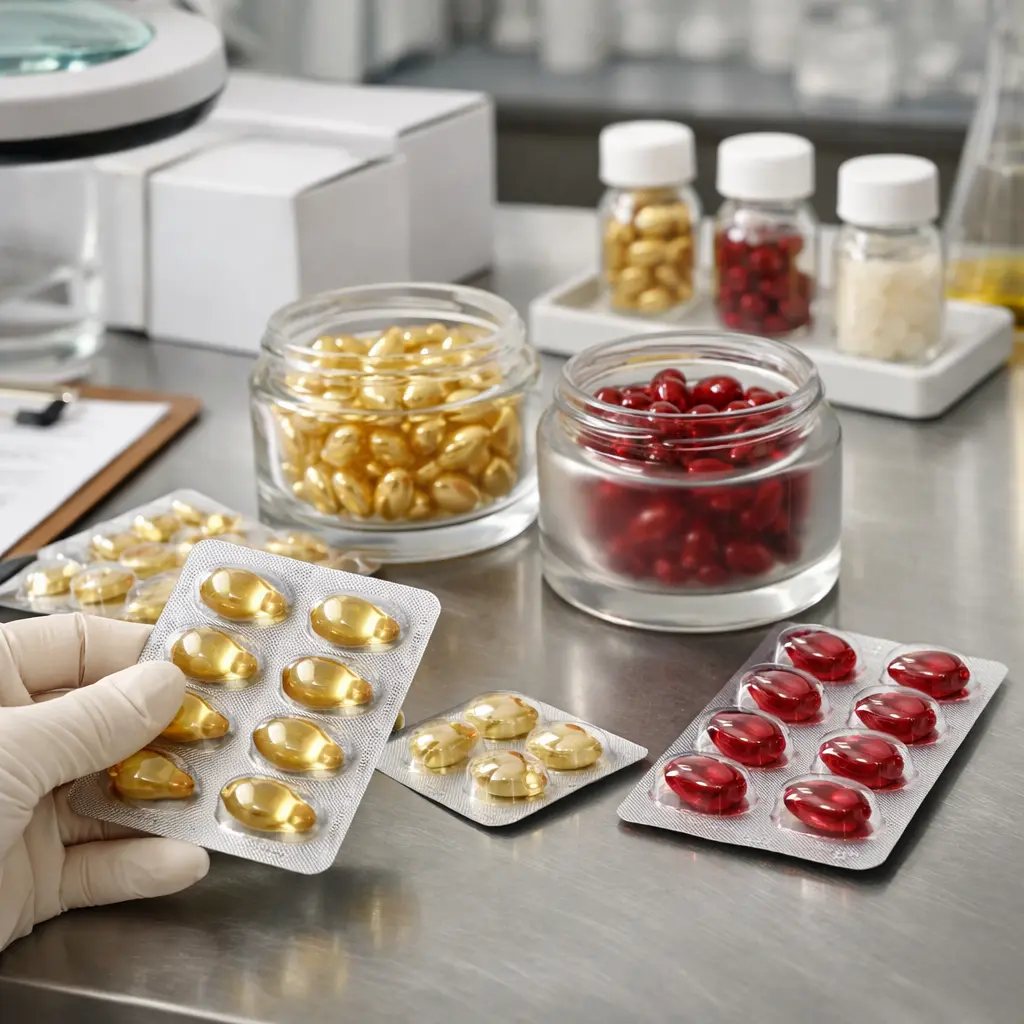
Packaging must be tested with the actual capsule and formula. Blister films, foil lidding, jars, liners, induction seals, and closures can influence oxygen transmission, moisture exposure, abrasion, and leakage. A jar format may be suitable for facial oil capsules but create friction or deformation if the capsule geometry is not matched to the neck and interior clearance. Blister packaging can improve unit separation and light protection, but the seal parameters and cavity dimensions require validation.
Request accelerated, real-time, and transport-relevant stability plans that reflect the destination market. Review heat and humidity storage, freeze-thaw exposure where relevant, light exposure, orientation, vibration, compression, and drop testing. The final report should cover fill weight, shell appearance, seam integrity, leakage, color, odor, active-marker or assay data where applicable, and package integrity. Do not accept a stability statement that covers the bulk formula but excludes the finished capsule and commercial pack.
Documentation should include raw-material specifications, batch records, certificates of analysis, microbiological results where applicable, packaging specifications, labeling support, claims substantiation, deviation records, and change-control commitments. Buyers should also confirm manufacturing-site controls, ISO 22716 procedures, quality-release authority, IP access restrictions, and escalation procedures for major complaints.
private label skincare capsules should be assessed against the same evidence standard as cosmetic softgel products. For a retinol line, the technical review should specifically address private label retinol capsules and their intended shipment conditions.

Decision Framework Table
| Factor | What to Check | Why It Matters | ODM Buyer Note |
|---|---|---|---|
| Fill formula | Viscosity, density, oxidation sensitivity, fragrance, and fill-weight control | Determines dosing consistency, leakage exposure, and stability behavior | Approve a measurable specification and retain pilot samples |
| Shell material | Gelatin or vegan composition, moisture balance, seam strength, and declarations | Affects elasticity, aging, opening behavior, and policy compliance | Match shell evidence to the specific formula, not only the brand claim |
| Mold | Cavity volume, dimensions, seam location, tip geometry, and line capability | Controls consumer handling, packaging fit, yield, and scale-up consistency | Sign off on the golden sample before tooling release |
| Packaging | Blister or jar compatibility, liner, seal, light and oxygen protection | Protects the capsule through storage, shipment, and repeated handling | Test the finished commercial pack with filled capsules |
| Stability | Heat, humidity, light, transport, leakage, appearance, and formula markers | Provides evidence for shelf-life and market-specific distribution | Require raw reports, protocols, deviations, and retained-sample review |
| Documentation | Batch records, certificates, labeling files, change control, and traceability | Supports cross-functional approval and recall readiness | Define document ownership and release timing contractually |

Supplier Checklist Before Approval
Before the sourcing committee approves a capsule portfolio, request one complete technical package for each representative SKU: formula specification, shell declaration, fill-weight data, mold drawing, packaging compatibility results, stability protocol, finished-product test report, shipment requirements, and labeling documents. Ask the supplier to identify which steps are performed in-house and which depend on external partners. Confirm whether the pilot uses the same formula, shell source, filling equipment, and packaging route intended for commercial production.
Finally, establish an escalation matrix for leakage, oxidation, shell deformation, fill-weight deviation, packaging seal failure, and delayed shipment. The supplier should define response ownership, investigation timing, retained-sample access, corrective-action documentation, and notification thresholds. This converts quality from a sample-stage judgment into a governed production process.
ODM Manufacturing Considerations
ODM planning should turn a promising serum-capsule concept into a documented, repeatable manufacturing specification. The buyer should approve a controlled sample before discussing a full launch. That sample should identify the formula, fill viscosity, fill weight, capsule shell material, mold dimensions, surface finish, color, fragrance level, primary package, and storage conditions. A sample approval based only on appearance is insufficient because leakage, separation, shell deformation, and oxidation may emerge during storage or shipment.
Start with the fill formula. Ask the supplier whether the serum, facial oil, cleansing oil, eye serum, or hair oil can be adjusted for viscosity, fragrance sensitivity, active concentration, color, and sensory finish without changing the capsule process. The supplier should provide a formula version number, ingredient list, specification limits, and a record of every approved change. For retinol capsules or other oxidation-sensitive formulas, request the proposed antioxidant system, light and oxygen controls, container closure approach, and relevant stability observations. Claims should remain aligned with the formula evidence and the intended cosmetic market.
Shell selection is a separate decision from fill development. Compare gelatin and vegan capsule shell options for brittleness, moisture response, sealing performance, color consistency, and compatibility with the fill. A vegan shell may support a particular brand position, but it can require different handling and storage controls. Ask for shell specifications, permitted colorants, allergen information where applicable, and a statement explaining how shell lots are identified and released.
Mold selection affects both presentation and production control. Confirm the capsule length, diameter, tip shape, seam position, wall thickness, and acceptable dimensional tolerance. A custom mold should have an approval drawing or sample reference, while a standard mold should be identified by a stable internal code. Buyers should also understand whether a mold is exclusive, shared, or available for future replacement. This matters when a portfolio includes several capsule sizes for retinol, facial oil, and eye serum products.
Packaging compatibility must be reviewed with the actual capsule and formula combination. Test blister cavities, foil seals, jars, inserts, and closures for compression, abrasion, migration, odor transfer, and ease of dispensing. A jar intended for facial oil capsules may need an insert or controlled opening to reduce exposure to air and handling contamination. Confirm whether the finished pack can tolerate the expected heat and humidity during storage and distribution. Packaging artwork should be checked against the approved product name, ingredient declaration, net contents, batch coding area, directions, warnings, and market-specific labeling requirements.
Stability review should cover the planned shelf-life claim, testing intervals, acceptance criteria, and storage conditions. Request results or protocols that examine shell appearance, leakage, fill odor, color, viscosity, separation, capsule weight, package integrity, and active-marker behavior where relevant. The buyer should know which observations are completed before launch and which remain ongoing. A small pilot can reveal process problems, but it does not replace a documented stability rationale for the commercial pack.
MOQ should be discussed by formula, shell color, mold, and packaging component rather than as one portfolio-wide number. Ask what changes when a small initial run uses existing tooling and what additional commitments apply to custom molds, printed blisters, special shells, or multiple fragrance variants. The quotation should identify sample charges, tooling ownership, retained samples, quality release documents, and the process for handling rejected units.
Labeling documents should include the complete ingredient declaration using the applicable nomenclature, product specification, batch or lot coding method, certificate of analysis where available, packaging material details, and supported claims language. For international launches, request a market review of the final label rather than relying on a generic template. The FDA Cosmetics Labeling Guide is a useful reference for United States labeling decisions, while buyers serving Gulf markets should review the Gulf Standardization Organization framework.
Shipment conditions should be written into the purchase specification. Define temperature and humidity expectations, pallet configuration, carton limits, protection from sunlight, maximum transit duration, and evidence required for a transport excursion. The supplier should explain how finished capsules are released, how samples are retained, and how a shipment is traced back to raw material and packaging lots.

Common Problems or Failure Cases
Shell brittleness: A capsule may crack during filling, packing, or transport when moisture balance is unsuitable or the shell is poorly matched to the fill. Review shell moisture specifications, conditioning time, compression points, and retained samples from different lots.
Sticking or deformation: Capsules can stick together or flatten when the shell surface, residual moisture, coating, or storage temperature is outside the approved range. Check separation after storage, carton stacking pressure, blister cavity clearance, and jar loading conditions.
Fill separation: A serum or oil blend may develop layers, sediment, color drift, or a changed sensory profile. Confirm the mixing process, viscosity range, temperature during filling, container headspace, and acceptance criteria for appearance and odor.
Leakage: Leakage may originate at the seam, from a weak shell, from excessive fill volume, or from compression inside the package. Inspect filled capsules after aging and transport simulation, then correlate defects with fill weight, seam integrity, mold dimensions, and package pressure.
Fragrance sensitivity: Fragrance can intensify, migrate into the package, or create an odor that differs from the approved sample. Use a fragrance reference sample, define sensory limits, and review compatibility with blister films, foil, jar liners, and closures.
Packaging deformation: Heat can warp trays, soften inserts, or reduce seal quality. Review the actual commercial materials under expected warehouse and shipment conditions. A package that looks acceptable at room temperature may fail after prolonged heat exposure or carton compression.
Supplier Checklist
- Confirm the formula version, fill viscosity range, fill weight tolerance, fragrance specification, and approved retained sample.
- Document shell material, shell color, moisture controls, seam performance, allergen information, and vegan-shell status where relevant.
- Approve mold drawings or standard mold codes, dimensional tolerances, tooling ownership, and replacement procedures.
- Review compatibility evidence for the selected blister, jar, foil, insert, liner, closure, and dispensing format.
- Request stability protocols and results covering leakage, separation, odor, color, shell appearance, weight, and package integrity.
- Define MOQ by formula, shell, mold, and packaging component, including pilot scope and change-control rules.
- Check ingredient declarations, specifications, batch coding, certificates of analysis, claims support, and market-specific label review.
- Verify shipment controls for temperature, humidity, sunlight, carton compression, palletization, and transit excursions.
- Ask how formula files, artwork, specifications, and production records are access-controlled, backed up, and physically segregated from other customers.
- Review complaint handling, recall traceability, product liability insurance limits, corrective-action timing, and retained-sample policy.
- Request ethical sourcing and labor records, including worker age verification, wage records, working-hour controls, grievance procedures, and independent audit access.
FAQ
Can the supplier protect a proprietary capsule formula from internal or external disclosure?
Ask for role-based system access, physical segregation of formula records, approval logs, backup controls, confidentiality obligations, and a clear list of personnel permitted to view the formula. Absolute secrecy cannot be promised, so the buyer should verify controls through an audit, document review, and a defined breach-notification procedure.
How can a strategic buyer secure supply during a raw-material shortage?
Request a written allocation policy, approved alternative raw materials, minimum safety-stock expectations, dual-source planning, and escalation rules for constrained ingredients or shell materials. The agreement should explain whether strategic orders receive priority and what evidence the supplier will provide when a substitution is proposed. Any change must be reviewed for fill behavior, stability, labeling, and claims impact.
What environmental records should a buyer review?
Review permits, wastewater and emissions monitoring, hazardous-material handling, energy records, waste-disposal manifests, and corrective-action reports. Ask whether records can be traced to the relevant production site and whether an independent auditor may verify them. Carbon targets should include a defined boundary, reporting method, baseline, and evidence rather than an unsupported statement.
What protection exists if a major quality complaint affects several markets?
Check product liability and product recall insurance, territorial coverage, exclusions, policy limits, deductibles, and the insurer confirmation date. Also confirm complaint triage, sample retention, batch traceability, investigation timing, customer notification, and recall-cost responsibilities. Insurance does not replace process controls or a usable recall plan.
How should a buyer evaluate labor practices at the factory?
Request age-verification records, payroll samples, working-hour and overtime records, labor-contract templates, grievance channels, health and safety training, and recent independent audit reports. Interviews should be conducted privately where possible. A supplier should be able to explain how subcontractors and temporary labor are controlled.
What is the minimum sample package needed before approval?
Request finished capsules in the intended shell and mold, filled at the proposed weight, placed in the intended blister or jar, plus formula and packaging specifications. Include samples from a repeat batch when feasible. The approval record should capture appearance, odor, texture, dispensing behavior, package integrity, storage observations, and any permitted deviation.
References
For visible labeling considerations, consult the FDA Cosmetics Labeling Guide. For cosmetic dermatology research that may inform responsible cosmetic claim review, consult the Journal of Cosmetic Dermatology published by Wiley. For Gulf-market standardization context, consult the Gulf Standardization Organization.