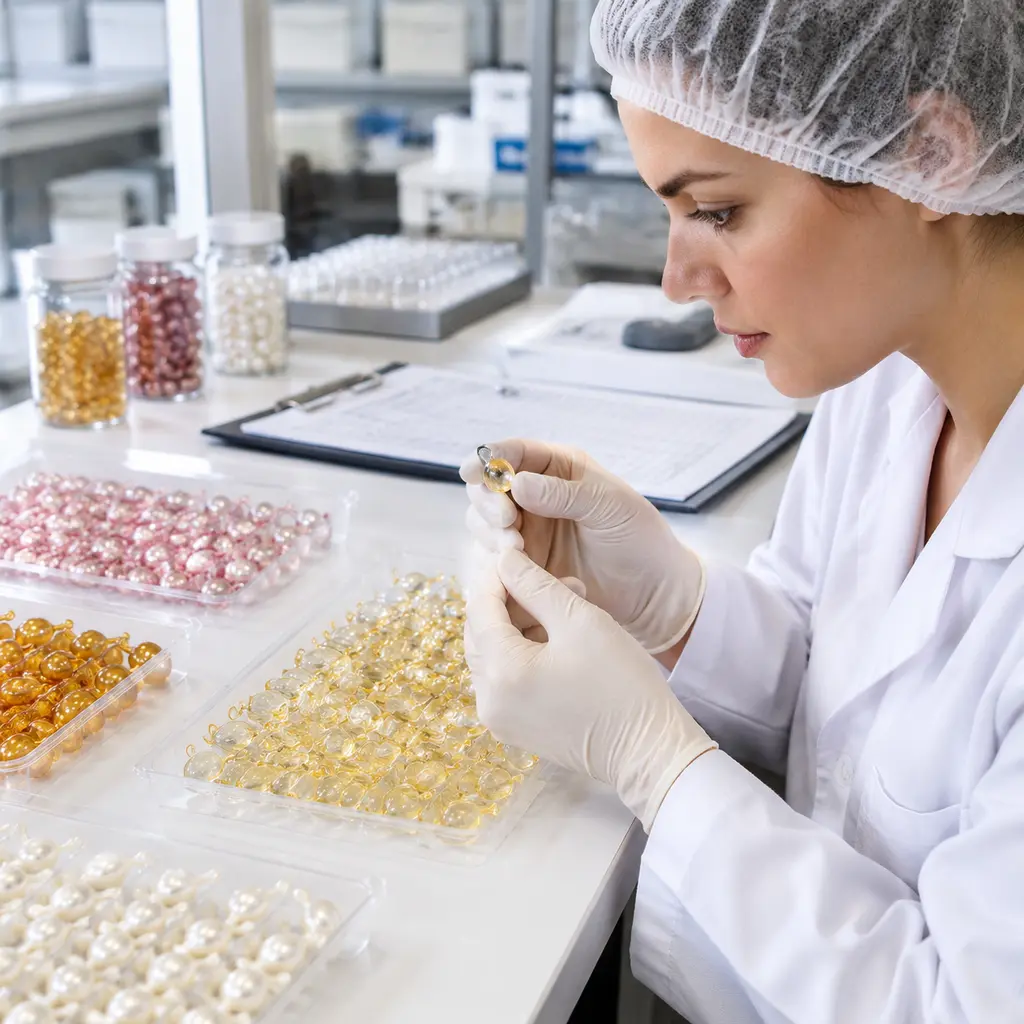
Direct Answer
A credible custom skincare capsule molds buyer guide should begin with one principle: do not approve a custom mold as an isolated tooling purchase. Scope the fill formula, shell material, target dose, opening method, packaging system, stability protocol, and production controls as one integrated capsule platform. Before selecting a manufacturer, require evidence that the proposed geometry can be filled consistently, dried without deformation, packaged without abrasion or leakage, and scaled without changing the approved formulation.
The procurement brief should define the intended product route, such as retinol serum capsules, facial oil, eye serum, cleansing oil, or hair oil capsules. It should then specify acceptable shell systems, fill-weight targets and tolerances, storage markets, packaging formats, testing responsibilities, tooling ownership, maintenance rights, and change-control procedures. A mold that produces an attractive sample but lacks documented process capability is not a qualified asset; it is an unresolved supply-chain risk.

Key Takeaways for Private Label Buyers
- Source the system, not the shape: Evaluate the formula, shell, mold, filling process, drying conditions, and package as an interconnected manufacturing system.
- Freeze the dose before tooling: Confirm the intended application amount and fill-weight range before approving capsule dimensions or cavity design.
- Test the commercial package: Jar and blister compatibility can materially affect abrasion, moisture exposure, oxidation, deformation, and leakage risk.
- Separate sample approval from process qualification: Hand-selected capsules do not demonstrate repeatable mass-production performance.
- Define ownership and continuity: Tooling title, drawing access, repair obligations, backup capacity, and end-of-life replacement must be written into the supply agreement.
Buyer Context
Custom capsule development becomes strategically important when an existing supplier experiences a serious quality event or capacity interruption, when a global brand enters a capsule category that its current manufacturing base cannot support, or when headquarters introduces stricter compliance and ESG requirements. Under those conditions, the question is not whether a manufacturer can produce a visually distinctive capsule. The question is whether the supplier can reproduce that capsule across approved batches, sites, and shipment lanes without creating formulation, regulatory, or launch risk.
The challenge differs by product. Encapsulated retinol skincare may require stronger oxidation and light-management controls. Facial oil capsules may prioritize dose consistency and clean opening. Eye serum capsules generally require smaller fills and tighter control of tip geometry. Cleansing oil capsules must be assessed for fill-shell interaction, while hair oil capsules may require larger doses and stronger packaging protection. Vegan capsule shells introduce another material pathway that must be validated against the selected ingredients and intended climate.
For a cross-functional sourcing committee, the early scope should allow procurement, R&D, quality assurance, regulatory, packaging engineering, legal, and operations to evaluate the same technical baseline. The broader skincare capsule product lines can help define the relevant product family, while a qualified serum capsules manufacturer should be able to convert that brief into documented sample stages, acceptance criteria, and scale-up controls.

Capsule Formula, Shell, Mold, and Packaging Factors
Start With the Fill Formula
Fill chemistry determines whether a proposed shape is manufacturable. The ODM should review viscosity at filling temperature, ingredient solubility, suspended materials, oxidation sensitivity, fragrance load, and the potential for migration into the shell. A thick serum may not flow reliably into a narrow cavity. A highly mobile facial oil may increase sealing and leakage demands. Reactive ingredients can also affect shell aging, color, elasticity, or odor over time.
Require the manufacturer to identify whether the laboratory sample and production batch will use the same ingredient sources, processing sequence, filling temperature, and equipment class. This is especially important for private label retinol capsules, where formula protection should be reviewed alongside the shell and final package rather than treated as a later packaging decision. For exfoliating concepts, claims and directions should also be reviewed against the FDA consumer advisory on alpha hydroxy acids when relevant.
Qualify the Shell as a Functional Component
The shell is not decorative wrapping. It controls containment, opening behavior, handling strength, moisture response, and the consumer application experience. Buyers should request the full shell composition, colorant information, plasticizer system where applicable, allergen or animal-origin declarations, and supporting documentation for vegan positioning. The manufacturer should also explain how the shell responds to heat, humidity, prolonged storage, and the selected fill formula.
A shell that performs in a controlled sample room may soften, become brittle, stick together, or lose its intended opening behavior under commercial distribution. Review retained samples after stability exposure, not only freshly produced capsules. The cosmetic softgel products selected for comparison should use comparable shell and fill systems; visual similarity alone is not sufficient.
Translate Dose Into Mold Requirements
The mold brief should define target fill weight, acceptable tolerance, capsule dimensions, seam location, opening mechanism, surface finish, orientation requirements, cavity count, and any logo or texture features. Ask the ODM to explain the relationship between nominal cavity volume and actual fill weight because density, viscosity, process settings, and sealing requirements can alter the usable range.
Complex geometry increases qualification risk. Sharp transitions, thin tips, embossed details, or asymmetric shapes may affect filling, demolding, drying, inspection, packaging orientation, and opening consistency. Procurement should request dimensioned drawings, revision control, prototype samples, tooling acceptance criteria, preventive-maintenance requirements, expected repair lead time, and confirmation of who owns the mold and associated technical files. A capable cosmetic softgel capsule factory should also disclose whether backup tooling or alternative qualified capacity is available.
Validate the Final Packaging and Shipment Route
Blisters generally provide greater separation and environmental protection, while jars may offer operational simplicity but expose capsules to repeated opening, capsule-to-capsule contact, and headspace conditions. Neither format should be approved without compatibility testing using production-representative capsules. Assess abrasion, sticking, deformation, leakage, odor change, color change, opening performance, and oxidation indicators after storage and transport simulation.
Packaging review should also include liner and closure compatibility, light protection, moisture control, pack count, label area, tamper evidence, carton strength, and shipment orientation. Ecommerce programs should screen relevant products against Amazon’s Hazmat classification rules for cosmetics. Projects intended for Saudi Arabia should verify the applicable route through the SABER conformity certification platform. U.S. regulatory teams should use the FDA cosmetics guidance documents when establishing labeling, facility, product-listing, and GMP review responsibilities.

Decision Framework Table
| Factor | What to Check | Why It Matters | ODM Buyer Note |
|---|---|---|---|
| Fill formula | Viscosity, density, oxidation sensitivity, ingredient solubility, and filling temperature | Determines filling accuracy, sealing performance, and compatibility with the shell | Require production-representative formula and ingredient sources before final mold approval |
| Shell material | Composition, origin declarations, moisture response, elasticity, colorants, and fill interaction | Affects leakage, brittleness, sticking, opening behavior, and positioning claims | Review aged stability samples rather than relying on newly produced serum capsule products |
| Fill weight | Target dose, tolerance, test method, sampling plan, and line capability | Controls consumer use, formula consumption, claim support, and batch consistency | Approve a measurable specification, not a visual estimate of capsule fullness |
| Mold geometry | Dimensions, seams, tip design, cavity layout, surface finish, and drawing revision | Influences filling, drying, inspection, opening, and packaging orientation | Link payment milestones to prototype and production qualification acceptance |
| Packaging | Blister or jar compatibility, closure, liner, light barrier, moisture control, and pack count | Protects capsule performance through storage, shipment, and consumer use | Test the exact commercial components rather than substitute packaging |
| Stability and logistics | Heat and humidity exposure, leakage, oxidation, deformation, and transport simulation | Identifies failures that may emerge only after international distribution | Align protocols with destination markets and the planned launch calendar |
| Supply continuity | Tool ownership, maintenance, repair lead time, backup capacity, and change control | Reduces dependency on one tool, line, or undocumented process | Evaluate continuity evidence before nominating the serum capsule supplier |
ODM Manufacturing Considerations
A useful custom skincare capsule molds buyer guide should treat ODM development as a controlled sequence of approvals, not a single sample request. The confirmation record should identify the exact serum formula version, shell composition, mold code, nominal fill weight, capsule appearance, opening method, primary package, pack count, and intended shipment route. Keep signed reference units from the approved sample batch and state whether the units were made on laboratory equipment, a pilot line, or the proposed commercial line.
Formula customization must be screened for manufacturing behavior as well as ingredient positioning. Changes in emollients, antioxidants, botanical oils, colorants, suspended ingredients, or fragrance can affect flow during filling, separation during holding, shell interaction, odor retention, and dispensing. Retinol capsules may need a different development path from facial oil, eye serum, cleansing oil, or hair oil capsules. Buyers can use the supplier’s capsule technology overview to organize formula, shell, dose, and package questions before approving a customized formulation.
Shell options should be identified by material system rather than by appearance alone. Request composition and origin declarations, color system details, moisture-handling instructions, and confirmation that the proposed serum was evaluated in the selected gelatin, plant-based, or vegan shell. Mold selection should then account for dose capacity, twist-off performance, consumer grip, line capability, and fit within the proposed jar, blister, pouch, or carton. Compare existing and proprietary shapes through the supplier’s capsule mold options, but define who owns a new tool, where it is stored, and what happens if production is transferred.
Commercial packaging should be evaluated with production-intent capsules and components. Confirm cavity dimensions, jar headspace, liner contact, closure pressure, capsule movement, light exposure, and package condition after relevant storage and distribution challenges. Stability work should use the final formula-shell-package combination and include agreed observations for appearance, odor, fill uniformity, shell condition, separation, and opening performance.
Separate MOQ requirements for formula batching, shell preparation, custom tooling, printed packaging, and finished production. A supplier may accept a smaller sampling quantity while requiring a materially different commercial commitment. This distinction is important when qualifying an alternate source after a serious quality incident or sudden capacity interruption at the incumbent factory.
Before release, confirm ingredient declarations, market-language artwork, lot coding, shelf-life presentation, responsible-party information, and available test or facility documents. US-bound projects should check the applicable FDA cosmetics guidance documents. An AHA serum capsule also requires specific attention to the FDA consumer advisory on alpha hydroxy acids. Saudi-bound consumer products should be classified with the importer through the SABER conformity certification platform. Shipment instructions should define carton configuration, pallet protection, storage precautions, route duration, receiving inspection, and responsibility for investigating deviations.

Common Problems or Failure Cases
- Shell brittleness: Capsules crack during packing or consumer opening when the shell system, moisture environment, or storage condition is unsuitable. Compare retained samples across multiple time points rather than approving only fresh capsules.
- Sticking or deformation: Facial oil or hair oil capsules may adhere to each other, flatten, or mark adjacent units. Review shell composition, capsule surface condition, fill interaction, package pressure, and warehouse conditions together.
- Fill separation: Suspended ingredients, pigments, or mixed oil phases may settle before or during encapsulation. Require defined bulk-holding controls and inspect capsules from the beginning, middle, and end of a production run.
- Capsule leakage: Leakage can result from poor seam formation, unsuitable fill behavior, mechanical stress, or an incompatible package. Investigate the location and timing of failure instead of treating every leaking capsule as the same defect.
- Fragrance sensitivity: Volatile fragrance components may migrate, fade, affect shell texture, or create odor changes in a closed jar. Approve the fragrance level only after evaluation in the final capsule and package configuration.
- Packaging deformation: Blister cavities, trays, jars, liners, or closures may warp or compress capsules during elevated-temperature storage or long distribution routes. Inspect both component dimensions and capsule condition after the full pack is assembled.

Supplier Checklist
- Obtain the controlled formula version, ingredient list, fill type, viscosity range, and handling instructions.
- Record the target fill weight, approved variation, measurement method, and production sampling frequency.
- Identify shell materials, plasticizers, colorants, origin status, moisture requirements, and storage limits.
- Confirm the mold code, dimensions, opening design, ownership terms, maintenance responsibility, and replacement process.
- Approve capsules made with production-intent formula, shell, equipment route, and packaging components.
- Review data for appearance, odor, separation, shell integrity, dispensing, and package condition over the agreed study period.
- Separate sampling quantities from tooling, packaging, and finished-goods MOQs.
- Verify artwork controls, ingredient declarations, lot coding, destination-market files, and change-notification procedures.
- Document shipment configuration, environmental precautions, receiving inspection, and deviation handling.
- For a corporate carbon-neutral supplier mandate, request traceable energy, emissions, waste, wastewater, and corrective-action records rather than accepting policy statements alone.
FAQ
How should a buyer confirm that an ODM sample represents commercial production?
Ask where and how the sample was produced, then require the approved record to name the formula, shell, mold, fill weight, equipment route, and package. If the sample uses temporary materials or laboratory equipment, require a production-intent confirmation batch before final approval.
Can a manufacturer guarantee that our core serum formula will never be disclosed?
No supplier can credibly promise absolute protection. Evaluate role-based system access, segregated project files, physical restrictions in laboratories and sample rooms, access logs, employee confidentiality controls, subcontractor disclosure, and contractual remedies. Limit the information shared before these controls are verified.
How can we secure priority supply during a global raw-material shortage?
Use written allocation terms supported by rolling forecasts, capacity reservations, approved alternate ingredients, defined safety-stock responsibilities, and advance notice for lot or supplier changes. Strategic-customer status should be evidenced by measurable commitments, not a verbal promise of priority.
Who should own a proprietary capsule mold?
The manufacturing agreement should identify the legal owner, permitted users, storage location, maintenance obligations, access rights, and transfer conditions. It should also explain whether replacement tooling can be produced if the original factory experiences an extended disruption.
What ESG and worker-welfare evidence should procurement request?
Request current permits, waste and wastewater records, emissions or energy data, payroll and working-hour samples, age-verification procedures, grievance channels, and corrective-action closure records. Where headquarters has a carbon-reduction mandate, require a dated baseline and auditable progress data from the actual capsule production site.
What shipment conditions should be fixed before the purchase order?
Specify inner protection, carton loading, palletization, storage precautions, expected route duration, inspection timing, and the evidence required after a deviation. The protocol should address the exact retinol, facial oil, eye serum, cleansing oil, hair oil, or vegan capsule configuration being shipped.