
Direct Answer
The capsule sample feedback process should be managed as a controlled product-route decision, not as an informal exchange of opinions. For a private-label skincare launch, the buyer should evaluate each sample against five linked variables: formula performance, capsule shell compatibility, fill weight, packaging behavior, and evidence generated during stability testing. A satisfactory serum texture is insufficient if the shell softens, the fill oxidizes, the blister seal fails, or the approved sample cannot be reproduced on the intended manufacturing line.
The recommended route is to define measurable acceptance criteria before sampling, test no more than a small number of deliberate formula or packaging variables in each round, and require the ODM to document every revision. This approach gives procurement, R&D, QA, regulatory, and packaging teams a common decision record. It also reduces the risk that a late-stage change to a retinol capsule, facial oil capsule, or vegan shell creates a new qualification cycle immediately before launch.
For a supplier such as PZIK, the objective is to connect the sample route to the production route from the beginning: pilot manufacturing under ISO 22716 controls, documented ingredient and packaging records, and a formulation that can move from a 1,000-unit pilot toward scaled production without re-engineering.
Key Takeaways for Private Label Buyers
- Source against a documented route: confirm whether the sample will use the same shell material, mold geometry, filling equipment, and packaging format planned for production.
- Review the formula as a physical system. Viscosity, oil polarity, active concentration, oxidation sensitivity, and interaction with the shell can affect leakage, seal integrity, and consumer handling.
- Set acceptance criteria for fill weight, capsule dimensions, appearance, odor, release behavior, and package compatibility before the first feedback round.
- Separate sensory revisions from compliance revisions. A change to fragrance, color, preservative system, or active level may require updated labeling and regulatory documentation.
- Require stability evidence under heat and humidity conditions relevant to the intended markets and shipment lanes, rather than relying only on an attractive day-one sample.
- Approve a production reference sample with retained units, revision history, and signed specifications before issuing a mass-production purchase order.

Buyer Context
Capsule skincare introduces a qualification problem that conventional pump or tube products do not fully share. The unit dose is part of the product claim and part of the packaging system. A retinol capsule must protect a sensitive formula while remaining easy to twist, puncture, or dispense. A facial oil capsule must hold a fluid fill without seepage during transport. An eye serum capsule may require a smaller fill weight and a more controlled dispensing profile. Cleansing oil capsules and hair oil capsules may require different viscosity and release characteristics from a lightweight facial serum.
These differences matter when a mature brand is adding a second manufacturing source after a quality event, a labor-audit concern, or an unexpected capacity interruption at an incumbent supplier. They also matter when a group enters a new format, such as softgel skincare, without wanting to create a separate governance model for every SKU. The sampling process becomes an early indicator of supplier discipline. If the ODM cannot provide clear shell specifications, batch records, revision controls, and packaging compatibility data during sampling, the risk is likely to increase during scale-up.
Buyers should also distinguish a genuine vegan capsule shell from a marketing description. The material, plasticizer system, moisture behavior, and storage requirements should be stated in technical documents. A custom softgel mold may improve brand differentiation, but it can also affect tooling lead time, fill accuracy, sealing performance, and line changeover. The decision therefore belongs in the cross-functional NPD review, not only in a creative packaging discussion.
Ingredient and claim decisions should remain aligned with market requirements. Buyers can use Health Canada's cosmetic ingredient hotlist as one regulatory reference and review peer-reviewed research indexed by PubMed and NCBI when assessing ingredient substantiation. For pigmentation-related positioning, the AAD treatment standards for hyperpigmentation provide useful context, while final cosmetic claims still require market-specific regulatory review.
Relevant internal product routes include serum capsules manufacturer, serum capsule products, private label skincare capsules, cosmetic softgel products, retinol capsules, encapsulated retinol skincare, retinol softgel capsules, and skincare capsules OEM.
Capsule Formula, Shell, Mold, and Packaging Factors
Formula and fill behavior. The ODM should record the formula's viscosity range, density, oil or water phase, active system, fragrance load, and oxidation controls. A fill that is too fluid may increase leakage risk; a fill that is too viscous may create incomplete dosing, air entrapment, or filling variability. For retinol and other oxidation-sensitive formulas, buyers should ask how the formula is protected from oxygen, light, and unnecessary heat during filling and storage. A nitrogen strategy, opaque secondary packaging, antioxidant system, or reduced headspace may be relevant, but each control should be verified through testing rather than assumed.
Shell material and aging. Conventional gelatin and plant-based or vegan shell systems can differ in moisture sensitivity, elasticity, sealing behavior, and aging profile. The buyer should request the shell composition, plasticizer information, colorant documentation, allergen statement where applicable, and storage limits. Inspect samples after conditioning in heat and humidity environments that reflect the target market. Look for tackiness, brittleness, deformation, color shift, odor transfer, and changes in opening force.
Fill weight and mold geometry. Fill weight should be confirmed by a defined sampling plan, with equipment calibration records available for review. Capsule length, width, seam position, tip geometry, and wall thickness influence both user experience and package fit. A custom mold can support a distinctive unit dose, but it also introduces tooling validation and replacement-part considerations. The production specification should identify tolerances rather than relying on visual similarity to a reference sample.
Packaging compatibility. The approved capsule must be evaluated in its final blister, jar, sachet, or tray. Check cavity dimensions, compression, seal temperature, foil or film compatibility, desiccant requirements, count accuracy, and abrasion during line handling. A jar may improve merchandising flexibility but expose capsules to repeated oxygen and humidity exchange after opening. A blister can provide stronger unit-dose protection but may constrain mold geometry and increase packaging qualification requirements. Shipment simulations should include vibration, temperature excursions, and orientation changes where relevant.
Stability and release readiness. Stability testing should compare the initial sample, revised sample, and production-equivalent pilot. Review appearance, odor, fill weight, shell integrity, leakage, active assay where applicable, microbiological status, and package seal performance. Do not approve a route solely because the sample performs well immediately after filling. The supplier should state test conditions, intervals, sample quantities, acceptance limits, and the disposition process for failures.
Decision Framework Table
| Factor | What to Check | Why It Matters | ODM Buyer Note |
|---|---|---|---|
| Formula | Viscosity, density, oxidation controls, active and fragrance system | Determines dose consistency, leakage risk, and product aging | Require a controlled formula revision code and change-impact assessment |
| Shell | Material, plasticizer, moisture response, seam and opening behavior | Protects product integrity and user handling | Confirm whether the approved shell is production-available, including vegan options |
| Fill weight | Target weight, tolerance, calibration, sampling method | Supports dose consistency and costed pack architecture | Review results from production-equivalent filling equipment |
| Mold | Dimensions, tooling ownership, tolerances, replacement plan | Affects package fit, sealing, and scale-up continuity | Document tooling approval before artwork and packaging release |
| Packaging | Blister, jar, tray, seal, foil, humidity protection, shipment exposure | Controls oxygen, moisture, abrasion, and leakage during distribution | Run compatibility and transport checks using final components |
| Stability | Heat, humidity, light, integrity, odor, assay, microbiological checks | Reveals risks that a fresh sample cannot show | Request the protocol, raw observations, deviations, and approval criteria |
| Documentation | INCI list, specifications, SDS where applicable, labeling data, batch records | Enables regulatory review and global launch coordination | Align document ownership across procurement, QA, regulatory, and legal teams |

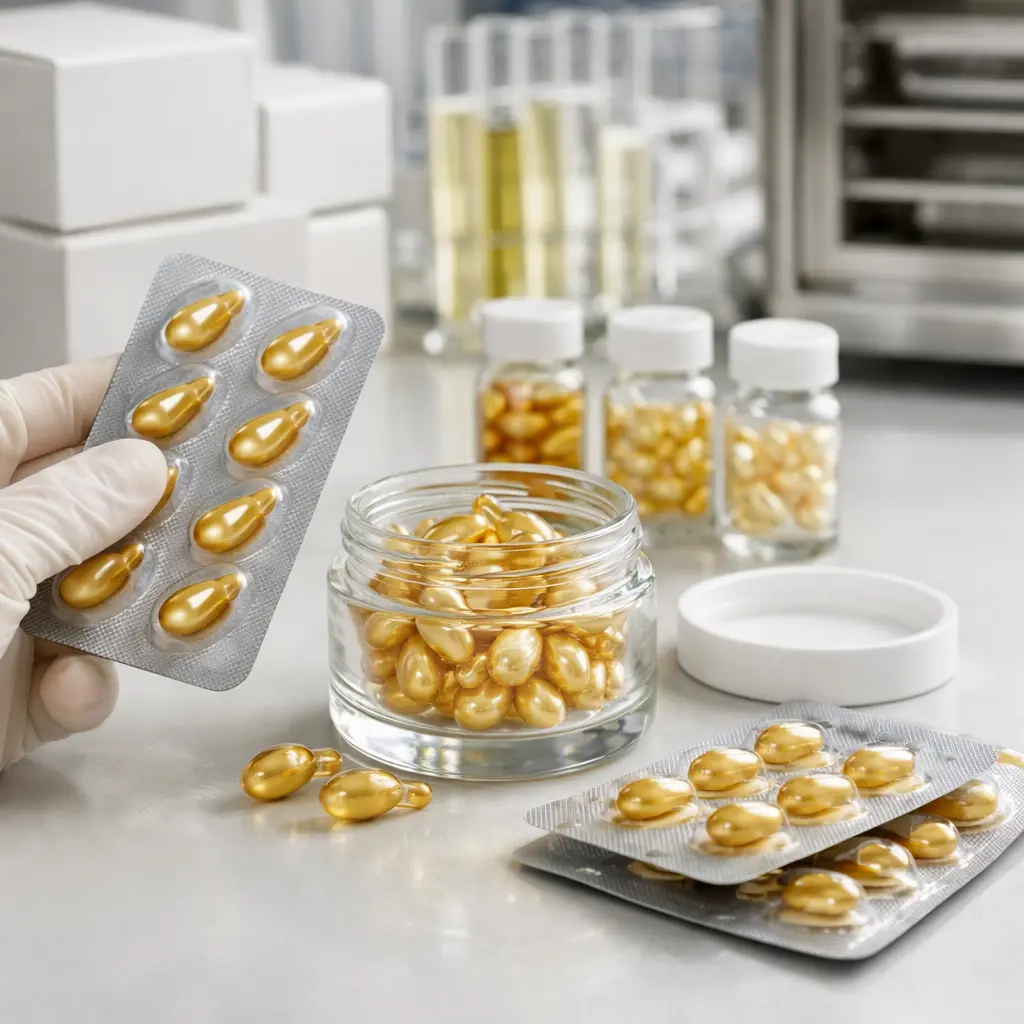
ODM Manufacturing Considerations
A reliable capsule sample feedback process product route should convert buyer comments into controlled manufacturing decisions. Start by confirming one reference sample with a written specification: capsule dimensions, shell material, appearance, fill quantity, serum texture, fragrance level, color, and intended package. Feedback such as too oily, too soft, or difficult to dispense should be translated into measurable revision points before the next sample is prepared.
Formula customization normally involves the oil or serum base, active selection, antioxidant system, fragrance concentration, and target fill weight. For retinol capsules, facial oil capsules, and eye serum capsules, ask the supplier to identify which ingredients may affect shell strength, color, odor, or oxidation behavior. A supplier should provide a revision record showing what changed between samples and what remained constant. This helps the brand distinguish a formula issue from a shell or package issue.
Capsule shell selection should match the product positioning and the formula. Gelatin and vegan shell systems can behave differently during storage, filling, sealing, and shipment. Request the shell composition, source documentation, colorant information, and any allergen or animal-origin declaration needed for the target market. For vegan skincare capsules, confirm that the proposed shell is genuinely compatible with the chosen serum and that its appearance remains consistent after storage.
Mold selection affects capsule size, dosing presentation, tooling cost, and package fit. A standard mold may be appropriate for an initial launch, while a custom mold can support a distinctive shape or brand experience. Before approving tooling, compare the capsule dimensions with the planned blister cavity, jar opening, scoop or dispenser arrangement, and label presentation. A capsule that looks suitable in a sample tray may be impractical when packed at production density.
Packaging compatibility requires a filled-capsule review rather than an empty-shell review. Examine whether capsules stick together, deform under pressure, rub against blister pockets, or become difficult to remove from a jar. Check the closure, liner, inner tray, and headspace, especially for facial oil capsules and cleansing oil capsules with mobile fills. The supplier should document storage orientation, light protection, temperature limits, and shipment conditions so the receiving team knows how to inspect the goods on arrival.
Stability review should include the final formula, final shell, and final package. Ask for observations on appearance, odor, texture, leakage, shell hardness, and fill consistency at agreed checkpoints. The review should also state the sample quantity, storage conditions, test duration, and acceptance criteria. Results from a serum filled in one shell or package should not automatically be applied to another capsule route.
MOQ should be discussed together with sample scope and revision limits. Clarify whether the quoted minimum applies separately to formula, shell color, mold, capsule size, and packaging. Also ask whether a pilot order can use an existing mold, whether unused components remain the buyer’s property, and how a change in fragrance or fill weight affects the minimum. Labeling documents should cover the ingredient declaration, nominal fill information, batch identification method, shelf-life or period-after-opening guidance where applicable, usage instructions, country-of-origin details, and packaging material information. Buyers should have time to review these documents before artwork is finalized.
For shipment, agree on carton configuration, inner protection, temperature exposure limits, pallet requirements, customs documents, and receiving inspection steps. Ask how the supplier handles a shipment delayed in a hot warehouse or exposed to freezing conditions. These conditions can change shell texture or package shape even when the product left the facility in acceptable condition.
Related process references such as capsule technology, OEM/ODM services, and serum capsule solutions can help organize the technical brief before supplier review.

Common Problems or Failure Cases
Shell brittleness: A capsule may crack during filling, packing, or removal from a blister when the shell loses moisture or is mismatched with storage conditions. Request hardness observations, breakage records, and a defined receiving check. Do not solve the problem only by adding more protective packaging if the shell specification itself is unsuitable.
Sticking or deformation: Capsules can adhere to one another when the shell surface, residual moisture, fill temperature, or package pressure is poorly controlled. In a jar of facial oil capsules, sticking can make individual dosing difficult. In a blister, pressure from an undersized cavity may flatten the capsule. Compare shell finish, cavity dimensions, separation materials, and storage orientation using the actual commercial package.
Fill separation: A serum or oil fill may show visible layering, sediment, or inconsistent color after storage. Review the formula’s compatibility with the shell and confirm whether the appearance is an acceptable product characteristic or a specification failure. For retinol capsules, also examine odor and color changes, since visual stability alone may not reveal all oxidation concerns.
Leakage: Leakage may originate from a weak seal, excessive fill volume, sharp package edges, rough handling, or pressure changes during shipment. Ask for leak-rate results from filled capsules and inspect both the capsule and the package cavity. Fragrance materials and certain oil-soluble ingredients can also affect shell integrity, so fragrance sensitivity should be evaluated before final approval.
Fragrance sensitivity: A fragrance that smells balanced in a beaker may become sharper after encapsulation or prolonged storage. Compare fragrance-free and fragranced samples, record the sensory acceptance range, and require the supplier to identify the fragrance documentation needed for each destination market. The Health Canada’s cosmetic ingredient hotlist is one reference for reviewing market-specific cosmetic ingredient considerations.
Packaging deformation: Blister film, jar liners, lids, or inner trays may warp when exposed to unsuitable heat, pressure, or humidity. Review the packed product after storage and shipment handling, not just the empty components. Any package change should trigger a new compatibility check because a small change in cavity depth or liner material can alter capsule stress.
Supplier Checklist
- Confirm the capsule shell material, source, colorants, animal-origin status, and compatibility with the formula.
- Request the formula specification, target fill weight, viscosity range, fragrance level, and revision history for every approved sample.
- Review mold drawings or dimensions before tooling, including blister cavities, jar openings, and removal clearance.
- Require filled-capsule checks for leakage, sticking, deformation, fill separation, odor change, and shell appearance.
- Verify the stability protocol for the final formula, shell, and commercial package, including acceptance criteria and storage conditions.
- Define MOQ by formula, shell, mold, packaging component, and color rather than accepting one combined figure.
- Obtain ingredient, labeling, batch coding, shelf-life, packaging, and destination-market compliance documents before artwork approval.
- Document carton protection, temperature limits, palletization, customs paperwork, and receiving inspection requirements.
- Review confidentiality controls, formula access permissions, development records, and sample retention procedures.
- Check worker welfare, environmental records, insurance coverage, and corrective-action procedures through verifiable documentation.
FAQ
Can an OEM/ODM supplier protect a proprietary capsule formula from internal leakage?
Ask for role-based system access, physical separation of development and production records, controlled sample rooms, visitor controls, and an agreement covering formula ownership and permitted use. No supplier should promise absolute secrecy without evidence. Request an audit trail for formula revisions and a clear process for destroying or returning retained samples.
How can a buyer secure supply when capsule shell or oil ingredients become scarce?
Ask whether the supplier has qualified secondary sources, approved substitute shell materials, reserved production capacity, and a documented allocation policy for strategic accounts. Any substitute should require written approval and a compatibility review because a different shell or oil can change leakage, texture, and stability performance.
What evidence should support environmental and labor due diligence?
Request current wastewater records, emissions documentation, waste-handling permits, energy or carbon records, and corrective-action reports where relevant. For labor conditions, ask for age-verification controls, payroll records, working-hour policies, grievance channels, and recent independent audit findings. Documentation should be traceable to the actual manufacturing site.
How many sample revisions should be included in an ODM project?
There is no universal number. Define the scope by revision rounds, formula changes, shell changes, mold changes, and package changes. A minor fragrance adjustment is different from changing a retinol system or moving from a gelatin shell to a vegan shell. Put approval criteria and additional development charges in writing.
When should a custom capsule mold be selected?
Choose a custom mold when the capsule shape is central to brand recognition or package efficiency and the expected volume supports the tooling work. Use dimensional drawings and a filled sample to verify removal, cavity fit, shell stress, and label presentation before committing.
What should a buyer inspect when the shipment arrives?
Record carton condition, temperature exposure if available, capsule count, visible leakage, sticking, deformation, odor, color, package damage, and batch identification. Retain representative samples and compare them with the approved reference. Escalate any deviation with photographs, lot details, and storage history.
References
For ingredient and cosmetic market review, consult Health Canada’s cosmetic ingredient hotlist. For substantiation research related to cosmetic ingredients and skin applications, search peer-reviewed research indexed by PubMed/NCBI. For consumer-facing context on pigmentation claims, review the AAD treatment standards for hyperpigmentation.