
Direct Answer
A cosmetic capsule documentation RFQ checklist should be completed before any sample request because a sample is only decision-grade when its formula, shell, mold, packaging, testing, and traceability records can be connected to the future production process. Ask the ODM to identify the capsule shell material, active and excipient specifications, fill viscosity, target fill weight, mold reference, packaging format, storage conditions, batch coding method, and applicable stability protocol. The supplier should also explain which documents are available at quotation, sampling, pilot, and commercial-production stages.
For international procurement teams, the central question is not whether a capsule looks acceptable in a sample review. It is whether the same formula and manufacturing controls can be reproduced across markets, production lots, and shipment conditions without a documentation gap. This is particularly important for retinol capsules, facial oil capsules, eye serum capsules, cleansing oil capsules, and vegan capsule shells.
Key Takeaways for Private Label Buyers
- Require a document index before sampling, including formula version, raw-material specifications, shell declaration, allergen information, and product coding logic.
- Make the fill-weight target and permitted tolerance explicit. A visually consistent capsule can still create major dosing, yield, and claims issues when fill weight is uncontrolled.
- Review packaging compatibility with the actual commercial format, whether blister, jar, sachet, or another protected capsule system.
- Separate sample approval from stability approval. A sample demonstrates appearance and handling; it does not establish shelf-life performance.
- Request traceability from incoming material through filling, sealing, inspection, release, and shipment, with clear responsibility for deviations.
- Align the sampling scope with the launch plan, including target markets, labeling documents, transport conditions, and the required pilot quantity.
Buyer Context
Capsule skincare creates a different procurement risk profile from conventional serum in a bottle. The product is a combined system: the fill formula must remain chemically and physically compatible with the shell, while the finished capsule must survive manufacturing, packaging, storage, transportation, and consumer handling. A supplier may provide an attractive sample while leaving unresolved questions about shell aging, oxygen exposure, seal integrity, or compatibility with the final jar.
These risks become material when a group needs to replace a supplier after a quality incident, build a second source following geopolitical supply disruption, or qualify a new capability under a global ESG and compliance mandate. In each case, the buyer needs evidence that can pass procurement, R&D, QA, regulatory, and legal review. A verbal statement that the capsule is vegan, stable, or suitable for international shipment is not an adequate substitute for controlled documentation.
The RFQ should therefore distinguish among a capsule sample, a laboratory formula, a production-intent sample, and a pilot lot. For example, a retinol serum capsule may require light-protection and oxidation controls that are less critical for a cleansing oil capsule. An eye serum capsule may require tighter control of sensory residue and package cleanliness. A hair oil capsule may create different viscosity and sealing requirements. Each product target should be linked to a defined formula version and manufacturing route.
Buyers should also determine whether the supplier operates under serum capsules manufacturer capabilities or merely sources finished capsules from another party. A vertically controlled serum capsule products platform can simplify accountability, but the buyer still needs to verify ownership of the formula, shell, mold, filling process, and release records.
For regulatory planning, confirm the documentation route for the intended claims and destination markets. General cosmetic claims should be supported by an appropriate technical file, while acne-related claims may require a separate assessment under FDA OTC acne monograph 21 CFR 333. For United States compliance planning, review the FDA Cosmetics Guidance Documents. For Dubai distribution, confirm the expectations of the Dubai Municipality Montaji registration system. These links do not replace market-specific legal review; they establish the questions that should be directed to the responsible regulatory team.
Where halal positioning is relevant, ask for the shell origin, processing aids, capsule lubricant information, and certificate scope rather than relying on a logo in a presentation. The MUI World Halal Council mutual-recognition guide can help frame certificate-recognition questions, although acceptance remains dependent on the destination market and certifying body.
Capsule Formula, Shell, Mold, and Packaging Factors
Formula and Fill Weight
The RFQ should require a formula summary that identifies the oil or emulsion base, sensitive actives, antioxidant system, fragrance or essential-oil content, and any ingredients that may interact with the shell. Ask the ODM to report fill viscosity at the relevant processing temperature, target fill weight, fill-weight tolerance, and the method used for in-process verification. These details affect capsule uniformity, leakage risk, line efficiency, and the accuracy of production records.
For retinol capsules, request the retinol form, assay method, light and oxygen controls, and the relationship between formula potency and label claims. For facial oil capsules or hair oil capsules, ask how oxidation is monitored and whether headspace, nitrogen handling, or light-protective packaging is required. The document should state whether the sample uses the same raw-material grades and active suppliers intended for the pilot run.
Shell Material and Mold
Shell documentation should identify whether the capsule uses gelatin, a vegan polymer system, or another declared material, together with plasticizer information, colorants, residual-moisture controls, and supplier specifications. Shell moisture can influence brittleness, deformation, sealing, and storage performance. A vegan capsule shell may also have different forming behavior and humidity sensitivity from gelatin, so the shell decision should be made before packaging qualification.
Request the mold reference, cavity geometry, capsule dimensions, seam design, and permitted tooling changes. A custom softgel mold affects visual identity, fill volume, line speed, and packaging fit. The buyer should confirm whether the mold is owned by the brand, the ODM, or a shared tooling program, and whether the same mold will be used for samples, pilot production, and scale-up. Link any requested retinol capsules specification to an approved drawing or controlled product code.
Packaging Compatibility and Storage
Packaging review should use the intended commercial component, not an improvised laboratory container. For blister packaging, verify cavity dimensions, lidding material, seal temperature, puncture resistance, and capsule deformation after sealing. For jars, verify contact with the inner surface, closure pressure, capsule movement, and the risk of capsules sticking together. Ask for compatibility evidence under heat and humidity storage, as well as transportation simulation where relevant.
The stability plan should define test conditions, time points, acceptance criteria, and tested packaging. It should cover appearance, odor, leakage, shell integrity, fill-weight change, active assay where applicable, oxidation indicators, and microbiological quality when relevant. A supplier offering skincare capsules OEM support should also state which reports are issued internally and which are generated by an independent laboratory.
Finally, shipment conditions must be documented. Confirm temperature and humidity limits, pallet or carton configuration, protective barriers, lot coding, retain samples, and the process for handling temperature excursions. The shipment document should connect the finished batch to the release decision and the destination-market labeling file.
Decision Framework Table
| Factor | What to Check | Why It Matters | ODM Buyer Note |
|---|---|---|---|
| Formula identity | Formula code, version, active specifications, viscosity, antioxidant system | Prevents sample-to-production re-engineering and unsupported claims | Require written change control and approval gates |
| Shell material | Material origin, plasticizer, moisture range, vegan or gelatin declaration | Influences sealing, brittleness, leakage, and certification review | Match the sampled shell to the pilot-intent shell |
| Fill weight | Nominal weight, tolerance, sampling frequency, balance calibration | Controls dosage consistency, yield, and package count | Request representative in-process records |
| Mold and tooling | Drawing, cavity dimensions, ownership, revision control | Determines appearance, capacity, and packaging fit | Document who funds and controls future modifications |
| Packaging | Blister or jar compatibility, seal conditions, barrier properties | Reduces deformation, oxidation, leakage, and transit damage | Test the intended commercial packaging |
| Stability | Conditions, time points, acceptance criteria, tested lot and pack | Supports shelf-life decisions and launch risk assessment | Do not treat a passing appearance sample as stability evidence |
| Traceability | Raw-material lots, batch records, inspection, release, shipment coding | Enables investigation, recall control, and multi-market accountability | Ask for a redacted example before issuing a purchase order |
Before requesting samples, send the supplier this framework together with the target formula, shell preference, mold requirement, packaging format, target markets, storage assumptions, and required documentation stage. The strongest RFQ response will show not only what the capsule looks like, but how the supplier intends to control its identity and performance from sampling through commercial launch.


ODM Manufacturing Considerations
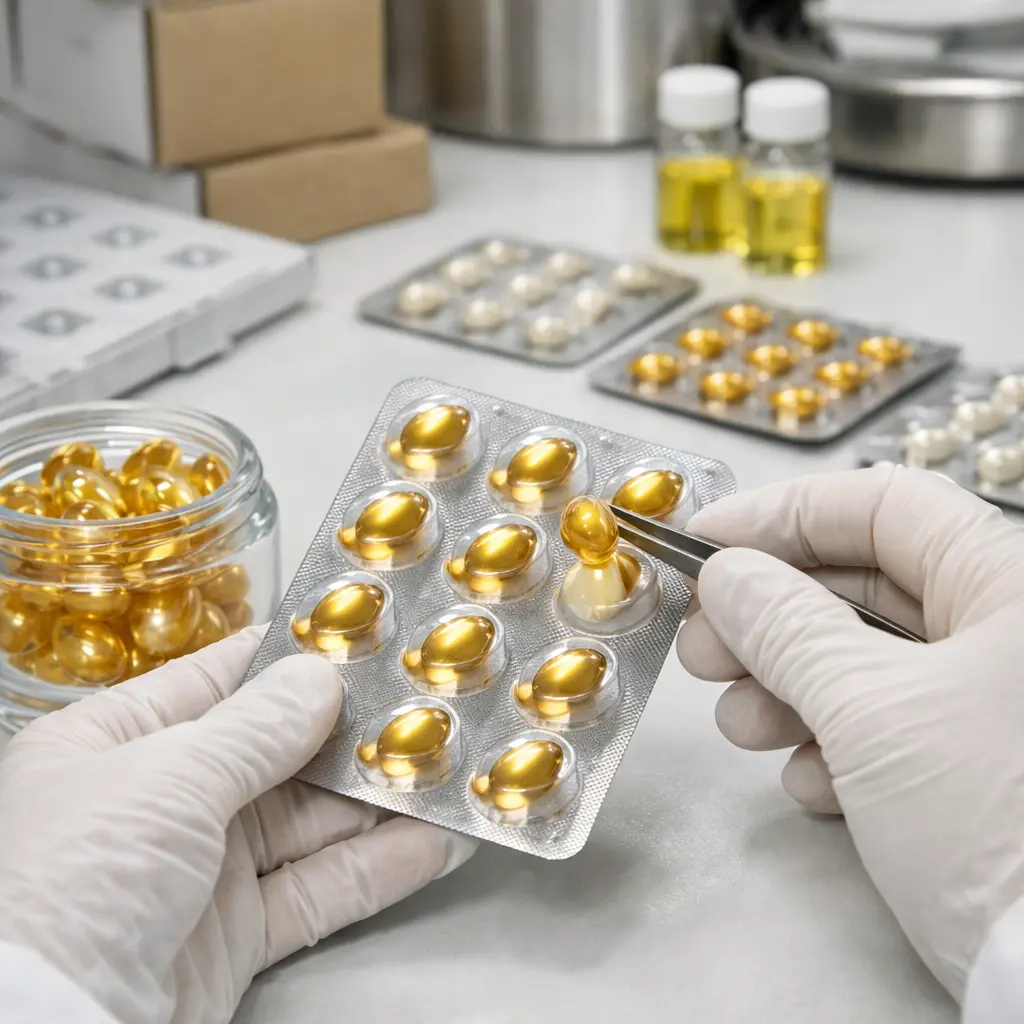
A cosmetic capsule documentation RFQ checklist should define what the buyer must approve before samples are made, what evidence accompanies those samples, and which conditions remain provisional until production validation. This matters when a brand is replacing a supplier after an audit failure or responding to a corporate requirement for lower-carbon sourcing. The RFQ should connect the proposed capsule, formula, package, label, and shipping configuration to one controlled development record.
Begin by defining sample confirmation. Ask whether the supplier will provide a reference sample, a customized laboratory sample, or a pilot sample made with production-intent equipment. Record the formula version, capsule shell composition, nominal fill weight, mold identifier, color, fragrance status, and package used for each submission. Approval should refer to a coded sample rather than an undated photograph or an informal description. Buyers comparing development routes can review the supplier’s OEM/ODM service scope and identify which work is included before issuing the RFQ.
For formula customization, specify the target texture, oil system, active level, antioxidant strategy, color, odor profile, and ingredients that must be excluded. Ask for the acceptable viscosity range at the filling temperature because a formula that appears suitable in a beaker may dose inconsistently or stress the shell during encapsulation. Require an ingredient list with INCI names, raw-material specifications, allergen or fragrance declarations where applicable, and a process for controlling formula revisions. Product-specific questions may differ for retinol capsules, eye serum capsules, and cleansing oil capsules.
Shell selection must be tied to the fill and intended storage environment. Request the shell polymer or gelatin source, plasticizer system, colorant specification, moisture range, and animal-origin or vegan declarations. For a plant-derived option, confirm that the proposed vegan skincare capsule has been evaluated with the actual fill rather than treated as an interchangeable substitute. Mold selection should document shape, dimensions, tail design, nominal capacity, tooling ownership, exclusivity, maintenance responsibility, and the approval method for dimensional changes.
Evaluate the final package as part of the sample plan. A jar can expose capsules to repeated moisture and oxygen exchange, while a blister can introduce forming-film, lidding, and cavity-depth constraints. Ask the supplier to test the intended capsule count, headspace, closure, liner, desiccant if used, and secondary carton. The review should include appearance, dispensing, capsule-to-capsule adhesion, package distortion, and protection during distribution. Relevant package choices can also be compared with the needs of facial oil capsules.
The stability plan should state sample batches, storage conditions, evaluation intervals, test methods, acceptance criteria, and responsibility for investigating failures. At minimum, align observations with the capsule’s appearance, odor, fill uniformity, shell integrity, and package condition. MOQ discussions should distinguish laboratory development quantities, pilot quantities, first commercial production, repeat orders, custom-color commitments, and dedicated mold or printed-packaging requirements.
Before dispatch, request the draft ingredient declaration, warnings, directions, net-content basis, country-of-origin statement, lot coding format, shelf-life basis, and available claims support. Market-specific requirements should be assigned to either the brand, manufacturer, or regulatory representative. The FDA cosmetics guidance documents provide a starting point for United States compliance planning, while brands entering Dubai should review requirements associated with the Dubai Municipality Montaji registration system. Shipping terms should identify carton configuration, pallet limits, temperature precautions, humidity precautions, data-logger expectations, and the party responsible for excursions or customs delays.
Common Problems or Failure Cases
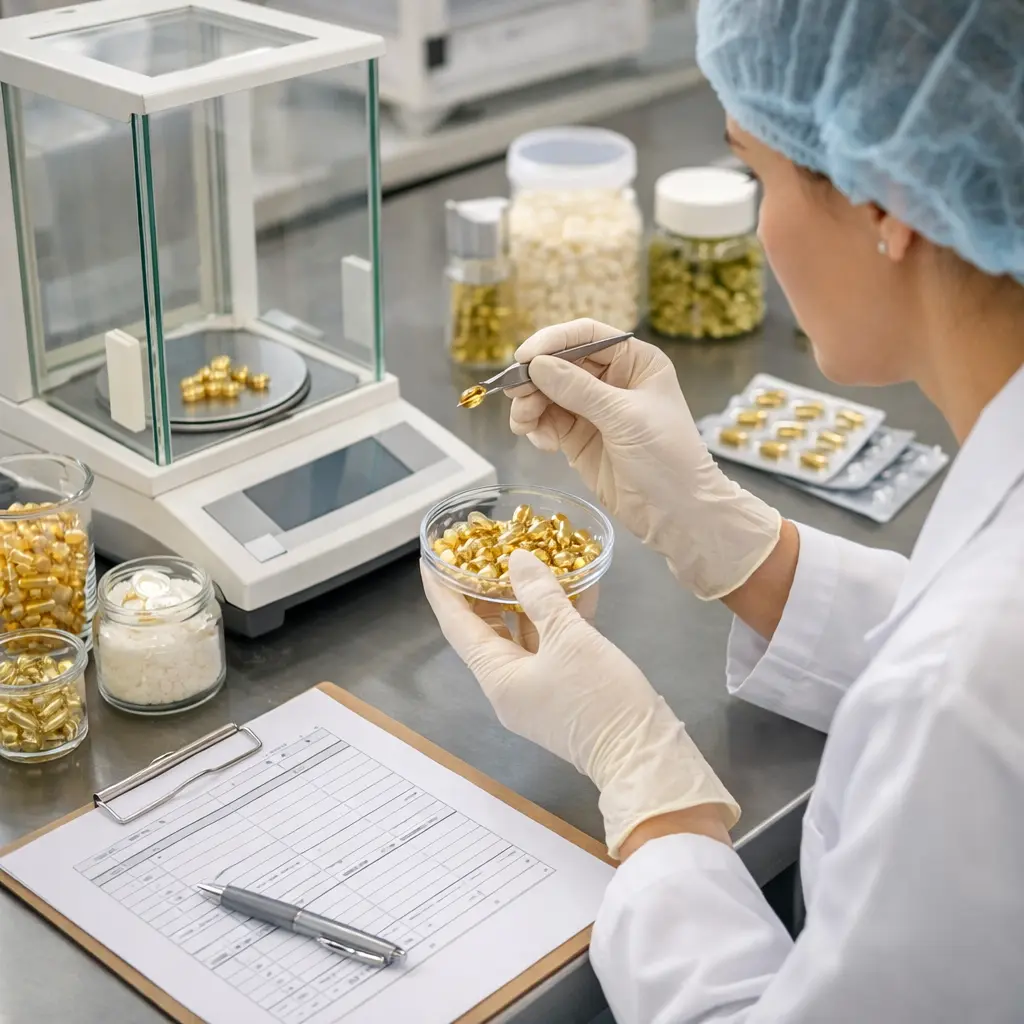
Brittle shells: Capsules can crack during counting, packing, or consumer handling when shell moisture falls outside the workable range. Investigate shell composition, room conditions, package moisture control, and transit exposure. A passing appearance check immediately after filling is not sufficient evidence for the intended sales period.
Sticking or deformation: Capsules stored in a jar may adhere to one another, flatten at contact points, or lose their intended shape. Causes can include excessive shell moisture, fill-shell interaction, package headspace, high storage temperature, or prolonged compression in bulk bags. Ask whether the supplier assessed loose capsules, packed capsules, and transport-loaded cases.
Fill separation: Suspended pigments or active-containing phases may settle, producing visible variation or inconsistent dosing. The investigation should compare mixing hold time, filling temperature, agitation controls, and samples taken from the beginning, middle, and end of a run. A reformulation may be more reliable than increasing process agitation indefinitely.
Leakage: Oil around the capsule tail, stained packaging, or reduced fill mass can result from sealing defects, unsuitable viscosity, shell incompatibility, or mechanical damage. Require defect definitions, inspection methods, sampling frequency, and retain samples from the affected lot. Do not accept cleaning of stained capsules as the sole corrective action.
Fragrance sensitivity: Fragrance components can migrate into or soften a shell, alter odor over time, or accelerate visible discoloration. The scented formula must be assessed independently from an unscented base. Any fragrance supplier change should trigger documented compatibility review.
Package deformation: A blister cavity can collapse, a jar liner can curl, or printed components can change when exposed to the product or distribution environment. Confirm that evaluation uses production-intent materials with the same gauges, coatings, inks, and sealing parameters proposed for launch.
Supplier Checklist
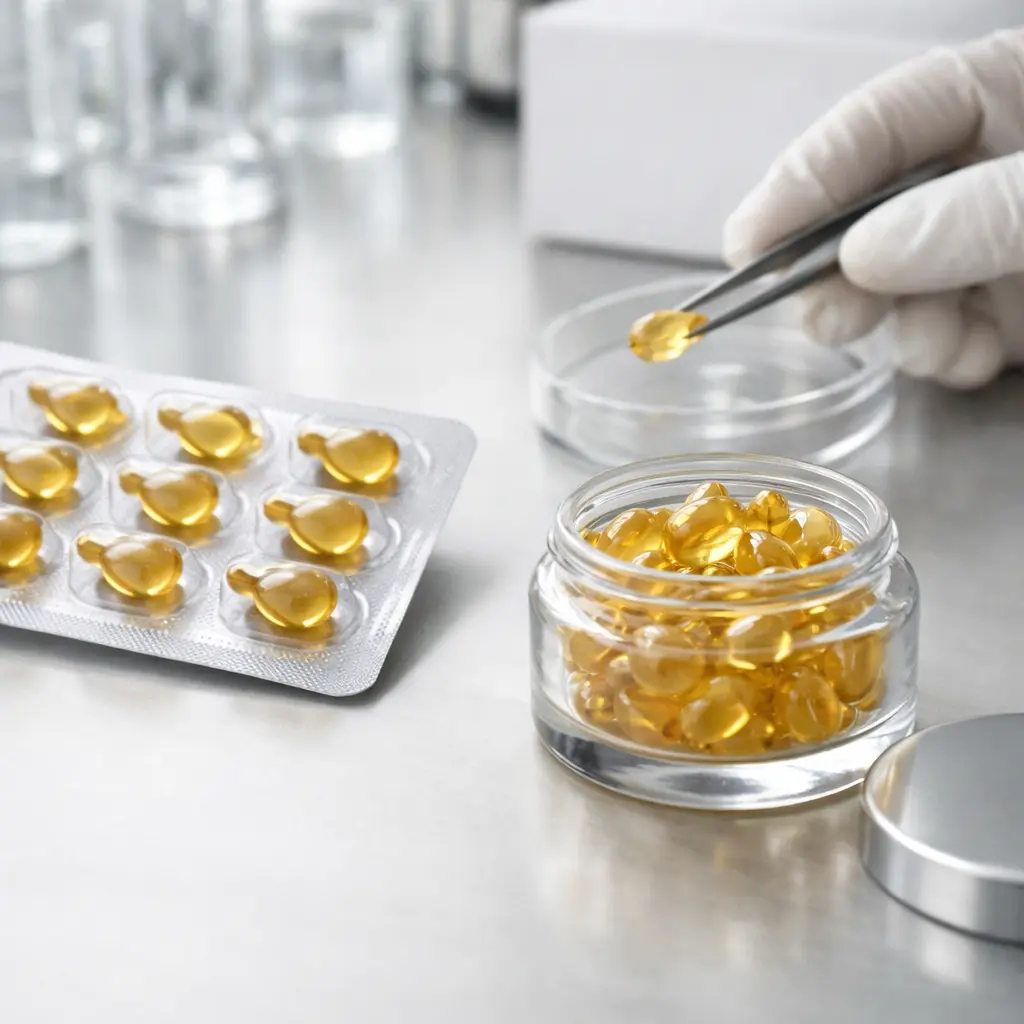
- Identify the legal manufacturing site and every subcontractor involved in filling, encapsulation, testing, printing, or packing.
- Request controlled specifications for the fill, shell, finished capsule, mold, and primary package.
- Confirm formula version control, sample codes, approval signatures, and rules for post-approval changes.
- Verify shell source, composition, colorants, moisture limits, and animal-origin or vegan evidence.
- Record target viscosity, nominal fill quantity, in-process limits, sampling method, and disposition of nonconforming output.
- Request mold drawings, tooling ownership terms, cavity identification, and maintenance records.
- Review evidence for leakage, deformation, adhesion, separation, odor change, discoloration, and package performance.
- Define development, pilot, and commercial quantities separately, including custom material commitments.
- List required label files, ingredient declarations, claims evidence, test reports, certificates of analysis, and market-registration support.
- Specify lot-code logic, raw-material genealogy, retain-sample policy, complaint investigation, and recall responsibilities.
- Document shipping configuration, environmental limits, excursion handling, insurance responsibility, and delivery records.
- Require written approval before changes to formula, shell source, mold, manufacturing site, test method, or package component.
FAQ
How can a buyer protect a confidential capsule formula?
Ask for the supplier’s access-control model, user permissions, audit logs, backup controls, network segregation, physical archive controls, and rules for sharing data with laboratories or subcontractors. Contractual confidentiality alone cannot prove absolute protection. Limit disclosed information by project stage, watermark controlled files, and require prompt reporting of unauthorized access.
What traceability evidence should accompany a sample?
Request the sample code, formula revision, fill and shell lot references, mold identifier, production date, quantity made, operators or line reference, package-component lots, test results, and storage history. The record should let the supplier reconstruct how the sample was produced and what changed between submissions.
How should environmental and carbon claims be verified?
Request site-specific permits, monitoring results, waste-transfer records, energy data, emissions methodology, reporting boundaries, and independent assurance statements. Confirm whether figures cover the actual capsule manufacturing site and relevant subcontractors. The supplier should permit evidence-based review and explain discrepancies instead of providing only group-level sustainability statements.
How can a buyer assess worker treatment?
Review recent independent social-audit reports, corrective-action closure, age-verification procedures, wage and hour records, grievance channels, recruitment-fee policies, and controls for temporary labor. Include the right to investigate credible allegations involving child labor, withheld wages, coercion, or excessive working hours.
What insurance evidence is appropriate before commercial production?
Request certificates and policy summaries for product liability, recall, property interruption, and relevant international territories. Check insured entities, exclusions, limits, deductibles, expiration dates, and whether the buyer can receive notice of cancellation. Insurance should complement, not replace, clear complaint, recall, and indemnity terms.
When should a buyer reject a sample despite acceptable appearance?
Reject or hold approval when the sample lacks an identifiable formula version, shell specification, fill data, package definition, or supporting test record. Appearance alone does not establish repeatability. Approval should also remain conditional if the sample was hand-filled or packed differently from the proposed manufacturing plan.