
Direct Answer
A disciplined vegan cosmetic capsules buyer guide should begin with portfolio architecture, not manufacturer comparison. Before issuing an RFQ, define each SKU by fill chemistry, vegan shell composition, target fill weight, capsule geometry, primary packaging, sales markets, stability protocol, and shipment conditions. These variables are interdependent: a retinol serum that performs in a high-barrier blister may oxidize in a clear jar, while an HPMC-based shell that supports a vegan claim may become brittle or deform when exposed to an incompatible fill or uncontrolled humidity.
The procurement objective is therefore to establish a qualification envelope that separates non-negotiable requirements from variables the ODM may optimize. This prevents suppliers from quoting materially different product systems under apparently comparable specifications. It also gives R&D, QA, regulatory, procurement, and ESG teams a common decision record before they assess a serum capsules manufacturer, request samples, or authorize production tooling.
Key Takeaways for Private Label Buyers
- Lock the fill, shell, mold, and pack as one product system; do not qualify them as independent components.
- Require full shell composition and processing-aid disclosure rather than accepting a vegan declaration at face value.
- Set fill-weight tolerance, seam integrity, leakage, oxidation, and appearance criteria before comparing commercial proposals.
- Test capsules in the intended blister or jar under accelerated, ambient, transport, heat, and humidity conditions.
- Align sample scope with the final manufacturing route so scale-up does not introduce a different shell, mold, or filling process.

Buyer Context
Serum capsules are exposed to coupled failure risks that conventional bottled serums do not face. The fill formula can migrate into the shell, volatile components can escape, oxygen can enter through the package, and temperature excursions can change both viscosity and seam behavior. These interactions matter across serum capsule products, including facial oil capsules, eye serum capsules, cleansing oil capsules, and hair oil capsules.
The risk is more material for retinol capsules and other oxidation-sensitive systems. A buyer must evaluate antioxidant strategy, light protection, headspace, oxygen transmission, and package barrier performance without converting cosmetic positioning into unsupported therapeutic claims. U.S. artwork should be reviewed against the FDA Cosmetics Labeling Guide. Pigmentation-related positioning should also be screened against the distinction between cosmetic appearance claims and treatment claims reflected in AAD guidance on hyperpigmentation.
For multinational portfolios, market access must be included in the initial brief. Gulf launches may require review against the Gulf Standardization Organization framework and UAE MoIAT industrial standards. Delaying this review until artwork approval creates avoidable relabeling and launch risk.
This discipline becomes especially important when a current supplier has suffered a quality incident, capacity interruption, or serious social-audit nonconformity. It also supports new group-level ESG mandates: procurement can trace shell inputs, colorants, labor controls, packaging materials, and shipment routes before transferring strategic volume to a new cosmetic softgel capsule factory.

Capsule Formula, Shell, Mold, and Packaging Factors
Fill Formula and Shell System
Start with the intended consumer dose and dispensing behavior. Record nominal fill weight, acceptable tolerance, fill viscosity at the filling temperature, active concentration, carrier oils, suspended solids, fragrance, antioxidants, and water activity. A laboratory formula is not production-ready evidence unless the ODM demonstrates that it can be pumped, metered, sealed, and cooled without active settling or fill-weight drift.
The shell specification should identify every constituent, including polymer, plasticizer, colorant, opacifier, and processing aid. HPMC, starch, or carrageenan systems may support vegan positioning, but plant-derived polymer alone does not establish claim integrity. Buyers should request supplier declarations, animal-origin statements, allergen information, country of origin, change-notification commitments, and lot traceability. These records should be reviewed alongside physical tests for elasticity, seam strength, brittleness, tackiness, deformation, and leakage.
Compatibility must be tested with the actual fill. Hygroscopic ingredients may move moisture across the shell interface; solvents and essential-oil components may soften the shell; low-viscosity facial oils may expose marginal seams. For encapsulated retinol skincare, the test plan should also monitor potency, color, odor, peroxide development, and capsule appearance over time.
Mold, Packaging, Storage, and Performance
Custom mold selection affects more than aesthetics. Capsule volume, wall distribution, seam length, twist-off geometry, cavity orientation, and tooling condition influence dose accuracy and leakage risk. Procurement should confirm ownership of custom tooling, maintenance responsibility, approved backup molds, replacement lead time, and whether samples are produced on the same mold family proposed for mass production.
Packaging is part of the stability system. Unit-dose blisters can provide stronger moisture, oxygen, and handling protection, while jars may simplify presentation but expose multiple capsules whenever the container is opened. Jar evaluations should cover closure torque, liner compatibility, headspace, capsule-to-capsule adhesion, and the effect of any desiccant. Excessive moisture removal can make some shells brittle, so a desiccant should never be added without package-level testing.
A credible private label skincare capsules program should test the final capsule and pack together at ambient and accelerated conditions. An illustrative accelerated condition is 40°C and 75% relative humidity, but the approved protocol must reflect formula risk, package barrier, intended shelf life, destination market, and applicable company standards. Add light exposure where relevant, freeze-thaw assessment where distribution routes justify it, and transport simulation for compression, vibration, and temperature excursions. Scale-up evidence should ideally cover three production-equivalent lots before strategic launch approval.

Decision Framework Table
| Factor | What to Check | Why It Matters | ODM Buyer Note |
|---|---|---|---|
| Fill formula | Viscosity, water activity, oxidation sensitivity, settling, and filling temperature | Determines metering accuracy, shell compatibility, and shelf-life risk | Request production-route samples, not hand-filled laboratory capsules |
| Vegan shell | Polymer, plasticizer, colorants, processing aids, and origin declarations | Supports claim substantiation and prevents hidden animal-derived inputs | Require change control for every shell constituent |
| Fill weight | Nominal dose, tolerance, sampling method, and batch records | Controls consumer dose consistency and formula cost variance | Review capability data across multiple production lots |
| Mold system | Geometry, seam design, tooling ownership, backup mold, and maintenance | Affects leakage, opening behavior, appearance, and continuity of supply | Confirm that approval samples represent commercial tooling |
| Primary pack | Blister barrier or jar closure, liner, headspace, light protection, and adhesion | The pack controls oxygen, moisture, handling, and deformation exposure | Qualify the complete capsule-pack configuration |
| Stability | Ambient, accelerated, light, transport, and relevant excursion conditions | Reveals leakage, oxidation, brittleness, discoloration, and potency loss | Predefine acceptance criteria and investigation ownership |
| Manufacturing governance | ISO 22716 controls, traceability, IP separation, ESG evidence, and continuity plans | Reduces recall, disclosure, audit, and supply-interruption exposure | Assess documentation depth before qualifying a skincare capsules OEM |
ODM Manufacturing Considerations
Begin ODM development with a written sample brief rather than a general request for vegan serum capsules. Define the intended capsule format, target fill mass, active system, sensory profile, shell color, capsule dimensions, opening behavior, pack type, target markets, and expected annual volume. The approved sample should become a signed reference standard supported by measurable specifications, not merely a visual benchmark.
Formula customization should start with the compatibility of the oil or serum concentrate with the encapsulation process. Ask the formulator to disclose the working viscosity range, phase behavior, processing limits, antioxidant strategy, fragrance level, and any suspended materials. A retinol capsule, facial oil capsule, and cleansing oil capsule may require different controls even when they share a similar exterior shape. Review relevant retinol capsule, facial oil capsule, or cleansing oil capsule routes before consolidating products into one manufacturing program.
For the shell, request the full material declaration and confirmation that colorants, plasticizers, processing aids, and incidental ingredients support the intended vegan positioning. Plant-derived systems can behave differently during forming, drying, storage, and consumer opening. HPMC may be relevant to certain capsule constructions, but buyers should not assume that every HPMC system is suitable for rotary-formed serum softgels. The supplier should identify the actual shell platform and explain its commercial production history.
Mold selection affects dose, appearance, line output, and ease of use. Compare an established mold with a custom shape by reviewing cavity dimensions, tip geometry, embossed-detail clarity, demolding performance, and the amount of fill the shape can hold consistently. A distinctive silhouette may support brand recognition but can increase tooling lead time and complicate secondary packaging. See available capsule mold options before approving artwork or carton dimensions.
Packaging evaluation should use production-intent capsules and components. Confirm how capsules settle in a jar, whether a blister pocket creates pressure points, whether oils affect liners or seals, and whether the carton protects the primary pack during distribution. For each SKU, document the formula batch minimum, shell-color minimum, tooling requirement, packaging minimum, pilot quantity, and reorder threshold. These figures may differ, so a single headline MOQ can be misleading.
Labeling files should include an ingredient declaration using accepted cosmetic nomenclature, net contents, batch coding format, responsible company details, country-of-origin information where applicable, directions, warnings, and substantiation for cosmetic claims. US-bound projects should be checked against the FDA Cosmetics Labeling Guide. Gulf projects may require separate review under the Gulf Standardization Organization framework and applicable UAE MoIAT industrial standards.
Before shipment, agree on carton configuration, pallet pattern, acceptable transit range, maximum staging time, batch-document release, and receiving inspection. If a current manufacturer has suffered a serious production interruption, approve the alternative route only after confirming that its commercial materials, equipment, and packaging match the authorized sample and specification.
Common Problems or Failure Cases
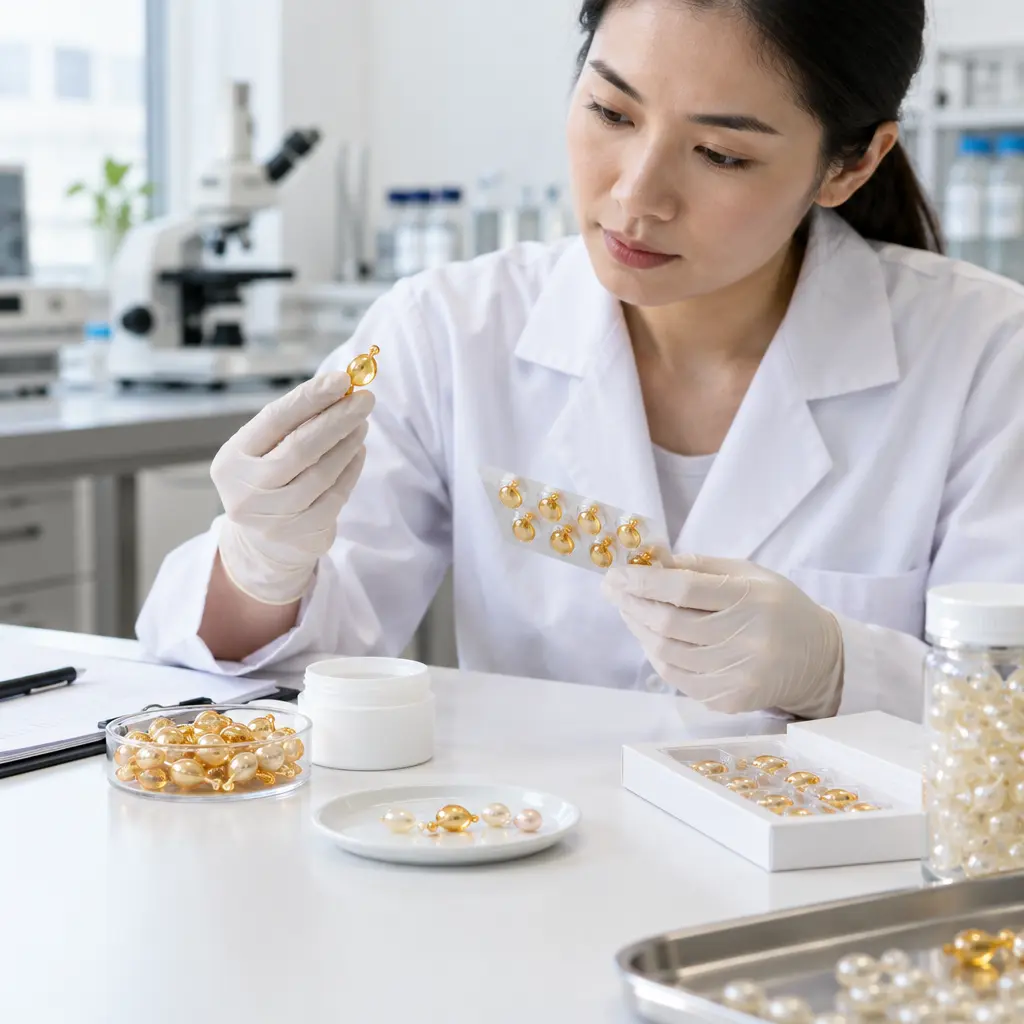
Shell brittleness: Capsules crack during packing or consumer opening when shell moisture balance moves outside the functional range. Investigate warehouse conditions, drying parameters, primary-pack closure, and storage duration rather than treating the symptom as a cosmetic defect.
Sticking or deformation: Capsules may clump in a jar or lose their intended profile when the shell surface remains tacky, the drying cycle is inconsistent, or compression occurs in transit. Review pack count, headspace, capsule curing records, and packed-product stacking pressure.
Fill separation: A serum containing waxes, powders, or multiple oil phases can develop sediment, crystals, or dose variation. The buyer should establish acceptable appearance and composition limits at both release and end of shelf life.
Leakage: Oil on the shell surface can result from forming contamination, insufficient closure strength, sharp mold geometry, or pressure from the pack. Record defect rates by batch and by packaging station so the root cause is not hidden through manual sorting.
Fragrance sensitivity: Some aromatic components can soften the shell, migrate into packaging, or change odor over time. Evaluate the fragranced formula rather than relying on results from an unfragranced base.
Packaging deformation: Facial oil or cleansing oil residues can affect certain liners, trays, or plastic components. Visible swelling, warping, print damage, or loss of closure performance requires a component or formula review.
Supplier Checklist
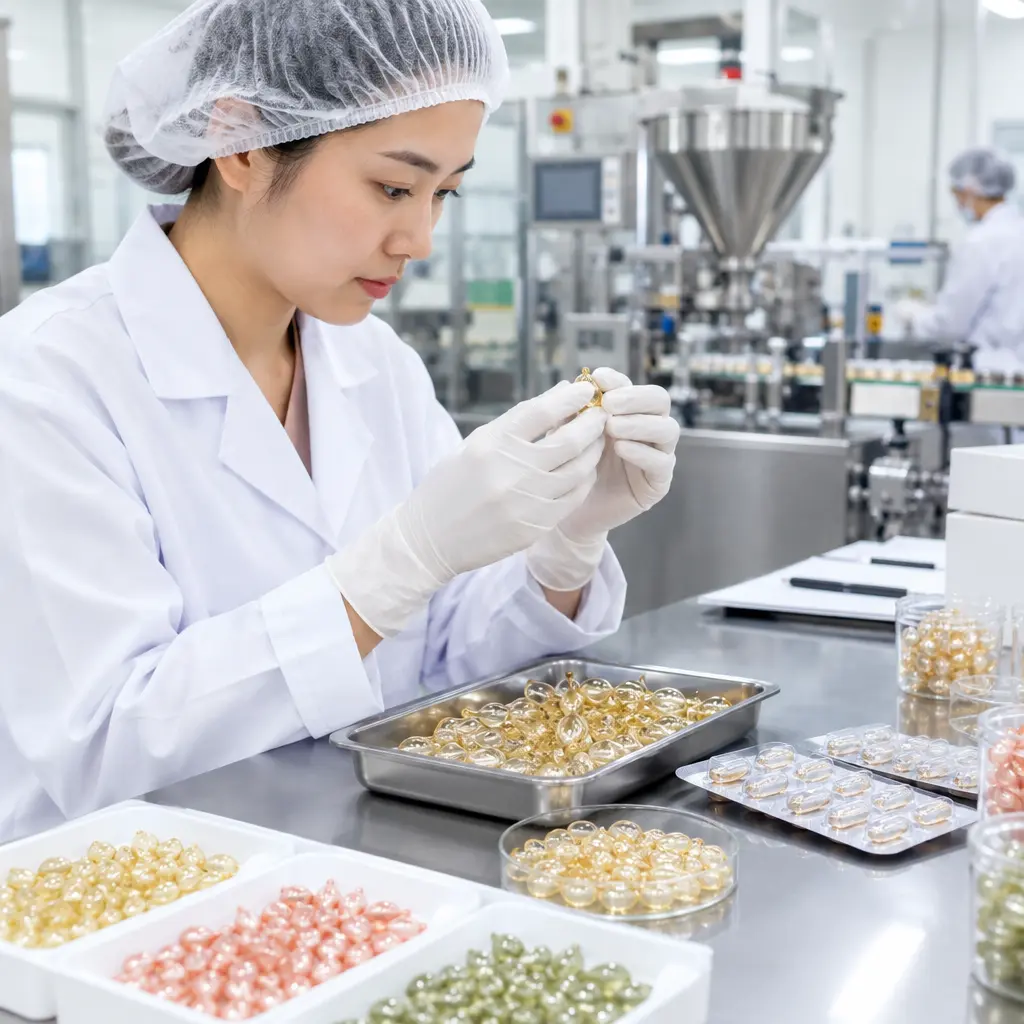
- Obtain the complete vegan shell material statement, including processing aids, colorants, and cross-contact controls.
- Record the formula’s viscosity range, processing limits, active assay targets, fragrance content, and phase-uniformity criteria.
- Define nominal fill mass, in-process sampling frequency, release limits, and the method used to reconcile filled output.
- Review mold identity, cavity dimensions, dose capacity, tooling lead time, and maintenance responsibility.
- Approve a physical reference sample with color, odor, dimensions, opening behavior, surface finish, and defect criteria.
- Test the exact blister, jar, liner, closure, label, and carton intended for launch.
- Request stability reports that identify batch, pack configuration, test interval, methods, results, deviations, and conclusions.
- Separate minimums for bulk formula, shell production, custom color, printed components, and finished capsules.
- Confirm ingredient list, claim support, safety assessment inputs, batch coding, certificates of analysis, and market-specific label review.
- Document shipment range, palletization, carton protection, release records, and arrival inspection procedures.
- Assess change-control rules for raw materials, production sites, shell systems, molds, and packaging components.
- Review capacity allocation, labor practices, confidentiality controls, and business-continuity evidence before supplier approval.
FAQ
How can a buyer confirm that capsules are genuinely vegan?
Request a signed composition statement covering the formula, shell, colors, processing aids, and relevant production controls. A gelatin-free shell alone does not establish that the complete cosmetic capsule supports a vegan claim. Certification may help, but it should be matched to the actual SKU and manufacturing site.
Can a factory guarantee that a confidential formula will never leak?
No supplier can credibly promise absolute immunity from every human or cyber risk. Buyers should instead verify role-based system access, separation of customer files, controlled sample rooms, download logs, confidentiality agreements, employee exit procedures, and restrictions on subcontracting. The manufacturing agreement should define ownership, permitted use, breach notification, and remedies.
How should priority supply be secured during a global raw-material shortage?
Use a written allocation plan tied to rolling forecasts, reserved capacity, approved substitute materials, safety-stock responsibilities, and escalation rules. Ask for evidence that critical shell and serum inputs have qualified secondary sources. Strategic-customer status has little value unless allocation rights and forecast obligations are documented.
How can worker treatment be evaluated during supplier qualification?
Review recent independent social-audit findings, age-verification procedures, payroll records, working-hour records, overtime consent, grievance channels, and corrective-action closure. Interviews should include production workers involved in capsule forming, inspection, filling, and packing rather than management alone.
Should buyers accept the supplier’s standard capsule MOQ?
Only after the MOQ is broken into its components. Formula manufacture, vegan shell preparation, custom color, mold setup, blister or jar procurement, and printed cartons may each have different thresholds. Pilot and commercial quantities should be quoted separately.
What should be approved before placing the first commercial order?
Approve the final formula, shell declaration, mold reference, fill-mass specification, physical sample, packaging set, stability conclusion, label files, release tests, defect limits, shipment conditions, and change-control procedure. For custom development, align these records with the supplier’s documented OEM and ODM service route.