
Direct Answer
A skincare capsule jar packaging RFQ checklist should define the capsule system, jar configuration, environmental exposure, test protocol, and commercial production conditions before samples are requested. At minimum, the brief should state the fill formula, shell material, nominal fill weight, capsule dimensions, mold ownership, count per jar, closure and liner structure, desiccant requirement, artwork method, target markets, storage conditions, and shipment route.
The central procurement risk is not whether a supplier can produce an attractive sample. It is whether the sampled capsule-and-jar combination can be reproduced at bulk scale without leakage, blocking, oxidation, deformation, count variation, or regulatory rework. Buyers should therefore require samples made with production-intent ingredients, molds, packaging materials, and filling parameters. Any substitution must be documented. This converts sampling from a visual approval exercise into a controlled qualification stage for quality, compliance, launch timing, and supply continuity.

Key Takeaways for Private Label Buyers
- Source the capsule and jar as one functional system. A jar that passes an empty-component inspection may still fail after prolonged contact with oily capsules, shell plasticizers, fragrance components, or residual surface oil.
- Freeze the production assumptions before samples. Confirm fill viscosity, nominal fill weight, shell composition, mold geometry, jar count, headspace, liner, desiccant, and secondary packaging.
- Separate appearance approval from technical approval. Color, gloss, capsule shape, decoration, and artwork require review, but they do not replace leakage, oxidation, transport, and heat-and-humidity testing.
- Test market-specific configurations. Label content, responsible-person details, batch coding, language, and notification obligations differ across destinations. Review the FDA summary of cosmetics labeling requirements and the UK SCPN cosmetic notification protocol early.
- Make sample-to-bulk equivalence contractual. Approved material codes, tolerances, component suppliers, test methods, and change-control obligations should transfer into the specification and quality agreement.
Buyer Context
Jar qualification is particularly consequential for skincare capsules OEM programs because the primary pack protects many individual unit doses rather than one homogeneous bulk formula. A single closure, liner, or moisture-control failure can affect every capsule in the jar. The resulting defects may include capsules adhering to one another, shell softening, brittleness, oil migration, odor change, or loss of visual uniformity.
The risk profile also varies by product direction. Retinol serum capsules require disciplined light and oxygen control. Facial oil capsules may place different compatibility demands on liners and jar resins. Eye serum capsules often use lower fill weights, making dimensional consistency and dosing perception more sensitive. Cleansing oil and hair oil capsules may contain fragrance or solvent-like ingredients that require targeted material-contact review. Vegan shells can respond differently to humidity than conventional softgel systems.
For mature brands, these issues extend beyond product performance. A jar change can trigger artwork revision, stability bridging, packaging-line adjustment, notification updates, logistics requalification, and new supplier audits. This is material when a current manufacturer has experienced a quality incident or capacity interruption and an alternative serum capsule supplier must be qualified under compressed timelines. It is equally relevant when group procurement imposes new traceability, labor, or carbon-reporting requirements.
The RFQ should therefore identify manufacturing site, jar converter, resin origin, decoration site, capsule filling site, assembly location, and contingency source. For outsourced verification, buyers can define a test plan with SGS cosmetic compliance and stability testing services. This provides stronger evidence than relying exclusively on supplier-issued pass statements.

Capsule Formula, Shell, Mold, and Packaging Factors
Fill Formula and Oxidation Control
Provide the complete production-intent formula or, where intellectual-property controls restrict disclosure, a compatibility brief identifying oil classes, antioxidants, fragrance, colorants, volatile constituents, and other ingredients relevant to packaging contact. The supplier should state fill viscosity at a defined temperature, nominal fill weight, permitted variation, and the method used to verify net contents.
For oxidation-sensitive encapsulated retinol skincare, ask whether compounding, holding, encapsulation, and jar filling use controlled light exposure or inert-gas protection. Clarify allowable bulk hold time and headspace-management strategy. A dark jar can reduce light exposure, but it does not by itself resolve oxygen ingress through the closure or repeated consumer opening.
Shell Material and Moisture Balance
Specify whether the shell is gelatin-based, plant-derived, or another validated system. Request the shell composition category, color system, plasticizer approach, allergen statement, animal-origin declaration where applicable, and vegan substantiation if claimed. Moisture balance is critical: excessive humidity can soften capsules and promote blocking, while low humidity can increase brittleness and cracking.
Buyers reviewing broader skincare capsule product lines should not assume that one jar specification works across every shell and fill combination. Require stability data for the actual formula, shell, and pack, not merely a platform-level report from a related cosmetic softgel product.
Mold Geometry and Fill Weight
The RFQ must distinguish between an existing mold and a custom mold. Record capsule shape, dimensions, seam orientation, target fill weight, dimensional tolerances, cavity identification, tool ownership, maintenance responsibility, replacement lead time, and restrictions on use for other customers. Confirm that commercial equipment uses the same geometry and operating principle as the sample process.
Review samples from multiple cavities and production positions rather than selecting only presentation-grade pieces. The assessment should cover seam integrity, tail formation, surface finish, color consistency, deformation, and fill-weight distribution. Buyers comparing cosmetic softgel products should also verify whether the proposed shape can move reliably through counting, feeding, and jar-filling equipment.
Jar, Closure, Liner, and Shipment Compatibility
Define jar resin or glass type, color, wall construction, nominal capacity, count per jar, headspace, neck finish, closure material, liner structure, induction-seal requirement, tamper evidence, and desiccant format. Request component drawings, material declarations, regulatory statements, supplier codes, and change-notification periods.
Compatibility work should include upright and inverted storage where relevant, repeated opening, capsule blocking, surface-oil transfer, closure torque retention, odor migration, seal integrity, and decoration resistance. Heat-and-humidity exposure should reflect the intended distribution route rather than a generic room-temperature condition. Transport evaluation should represent case pack, pallet pattern, vibration, compression, and temperature excursions. If a formula or shipment classification raises platform questions, review Amazon’s Hazmat classification rules for cosmetics before launch.
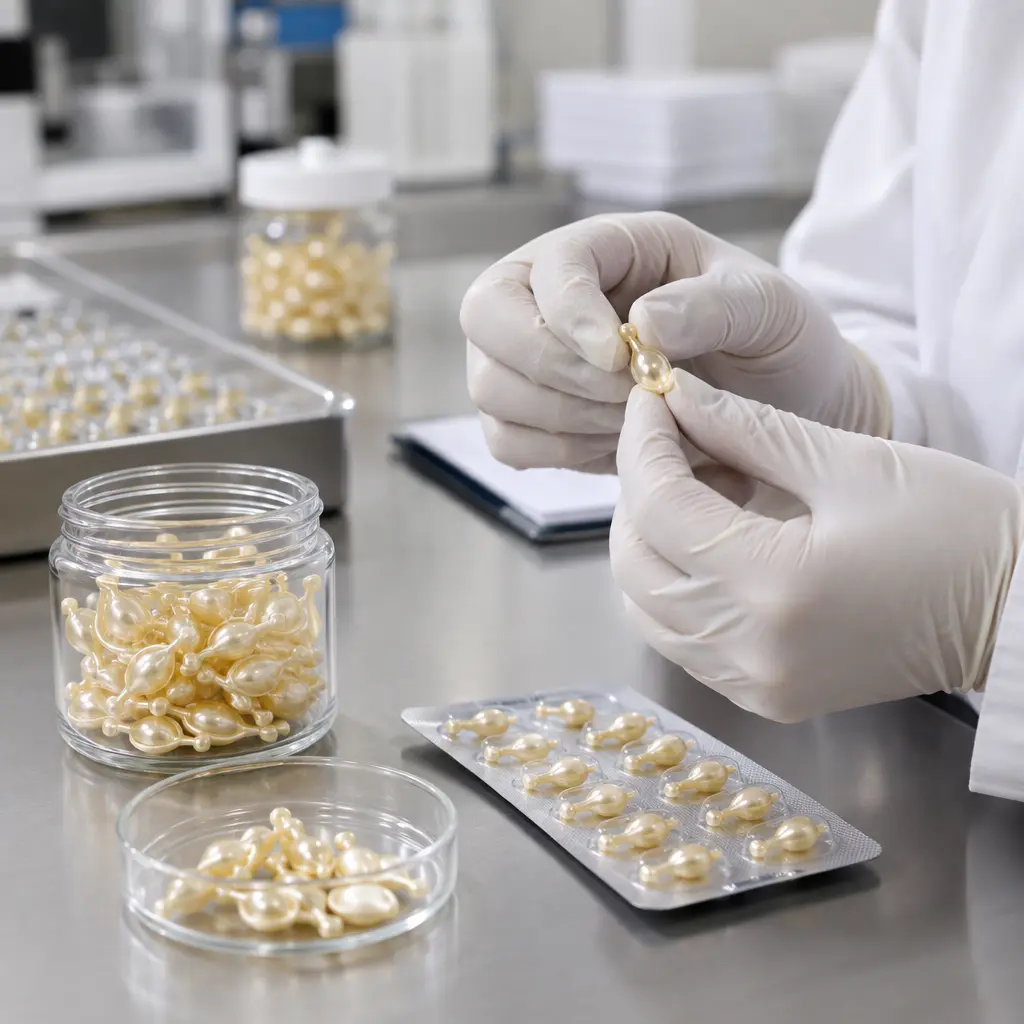
The final sample set should include filled jars, loose capsules for laboratory review, empty components, printed artwork proofs, coding examples, and retained controls. The approved configuration should be tied to the specification used by the selected cosmetic softgel capsule factory.

Decision Framework Table
| Factor | What to Check | Why It Matters | ODM Buyer Note |
|---|---|---|---|
| Fill formula | Oil classes, viscosity condition, oxidation sensitivity, nominal fill weight, and bulk hold controls | Determines shell interaction, dosing consistency, leakage exposure, and packaging compatibility | Require production-intent material codes in the sample record |
| Capsule shell | Material system, plasticizer approach, moisture behavior, colorants, and origin declarations | Controls brittleness, softening, blocking, and claim substantiation | Do not bridge conventional-shell data to vegan capsules without justification |
| Mold | Geometry, cavities, dimensions, ownership, maintenance, and scale-up equipment | Affects seam strength, fill capacity, line handling, and exclusivity | Attach the approved drawing to the quality agreement |
| Jar system | Jar, closure, liner, seal, desiccant, headspace, and component traceability | The complete system governs moisture, oxygen, contamination, and consumer handling | Evaluate the assembled pack, not isolated components |
| Stability and transport | Storage orientations, heat, humidity, light, opening cycles, vibration, and compression | Reveals failures that appearance samples cannot predict | Define acceptance criteria before testing begins |
| Scale and change control | Sample line versus bulk line, approved suppliers, substitution rules, capacity, and contingency source | Reduces qualification drift during production transfer or disruption | Use the same control logic across private label skincare capsules in the program |
ODM Manufacturing Considerations
ODM sampling should produce a documented manufacturing benchmark, not merely an attractive presentation sample. Ask the supplier to record the approved capsule appearance, shell composition, formula version, target fill weight, dimensional tolerance, packaging configuration, and acceptance criteria. Keep sealed reference units from the confirmed sample lot, and state which characteristics require written approval before production parameters or ingredients may change.
For fill formula customization, provide a brief covering intended capsule type, skin feel, ingredient direction, fragrance restrictions, color expectations, target market, and prohibited substances. The manufacturer should explain whether the proposed serum is compatible with encapsulation and whether suspended ingredients, volatile fragrance materials, or high-polarity components could affect filling behavior or shell integrity. Confirm how fill viscosity and actual fill weight will be measured during both sampling and production. Buyers developing retinoid formats can also review relevant retinol capsule options before finalizing the brief.
Shell selection should distinguish gelatin, plant-derived, and other custom shell systems rather than relying only on a vegan marketing description. Request the material identity, colorant information, ingredient declaration, allergen position, and any supporting documentation needed for the destination market. If a custom mold is required, define capsule shape, dimensions, twist-off or cut-open design, cavity capacity, tooling status, expected cosmetic variation, and responsibility for maintenance or replacement. The supplier’s available capsule technology should match the fill and dispensing experience rather than forcing the formula into an unsuitable shape.
Packaging approval should use capsules from the intended shell and formula combination. Evaluate jars and blister formats with the proposed primary pack, secondary carton, and shipping case. The review should cover capsule movement, opening force, exposure after repeated consumer opening, odor transfer, surface marking, and pack distortion. Stability work should include defined temperatures, humidity conditions, light exposure where relevant, observation intervals, and pass or fail criteria for appearance, odor, fill separation, shell condition, and active-content protection.
MOQ discussions should separate formulation development quantity, mold quantity, capsule production quantity, jar decoration quantity, carton quantity, and final packed-unit quantity. Also confirm sampling fees, unused component handling, overrun and underrun rules, and whether a repeat order can use previously approved tooling. This detail is especially important when replacing a supplier after a quality incident or sudden capacity interruption.
Before shipment, agree on labeling documents, ingredient nomenclature, net contents, responsible-party details, country-of-origin wording, caution statements, lot identification, and shelf-life presentation. Define pallet pattern, case count, acceptable transit temperature range, container loading method, and responsibility for freight damage evidence. A group operating under a new carbon-reduction procurement policy should additionally request shipment emissions data boundaries and the methodology used to calculate them.

Common Problems or Failure Cases
- Brittle shells: Capsules crack during counting, jar filling, or consumer handling. Potential contributors include an unsuitable shell system, excessive moisture loss, prolonged exposure to dry conditions, or a mismatch between the fill and shell.
- Sticking and deformation: Capsules adhere to one another, flatten against the jar wall, or lose their intended shape. Investigate storage environment, surface residues, pack headspace, compression during case packing, and the behavior of the selected shell under destination-market conditions.
- Fill separation: A facial oil capsule may develop sediment, visible layers, or inconsistent color. The supplier should determine whether the issue is expected settling, incomplete ingredient solubility, crystallization, or a process inconsistency. Acceptance limits must be established before approval.
- Leakage: Oil around a capsule seam can originate from sealing variation, shell damage, overfilling, sharp contact surfaces, or transport stress. Inspect individual units and the inside of the jar rather than judging only the outer package.
- Fragrance sensitivity: Fragrance or essential-oil components may alter odor, shell feel, or capsule appearance over time. Evaluate the final fragranced formula instead of relying on results from an unfragranced base.
- Packaging deformation: A jar, lid, blister cavity, or internal fitment may warp, loosen, or mark the capsules after conditioned storage or shipment. Production materials and decoration processes should be represented in approval samples.
Supplier Checklist
Use the following skincare capsule jar packaging RFQ checklist to compare technical capability rather than quotations alone:
- Identify the exact serum capsule format: facial oil, eye serum, retinol, cleansing oil, hair oil, or another cosmetic use.
- Request the fill formula version, ingredient list, viscosity range, target fill weight, and permitted production variation.
- Verify shell material, vegan substantiation where applicable, colorants, allergens, and market-specific ingredient restrictions.
- Define mold shape, dimensions, opening method, cavity capacity, tooling ownership, and replacement responsibilities.
- Request sample quantities sufficient for internal evaluation, regulatory assessment, packaging trials, and retained references.
- Compare jar and blister options using production-representative capsules, closures, decoration, cartons, and shipping cases.
- Obtain a written stability protocol covering fill appearance, oxidation-sensitive ingredients, shell condition, leakage, sticking, and pack performance.
- Separate MOQs and lead times for formula, capsules, molds, jars, decoration, cartons, and finished units.
- List required labeling files, ingredient documentation, safety information, test reports, certificates of analysis, and market-notification support.
- Specify shipping route, seasonal exposure, palletization, case strength, inspection point, and claims procedure for transit damage.
- Audit change-control, complaint investigation, backup capacity, raw-material continuity planning, and the process for approving substitute ingredients.
- For broader development capability, assess the supplier’s documented OEM and ODM process and confirm which activities are performed internally or by subcontractors.
FAQ
Can a factory guarantee that our core formula will never be leaked?
No supplier can credibly promise absolute protection. Ask for evidence of role-based system access, segregated project folders, physical sample controls, confidentiality agreements, visitor restrictions, employee access logs, subcontractor disclosure, and procedures for returning or destroying formula files. Contractual remedies should identify both direct and indirect disclosure risks.
How can strategic supply be protected during a global raw-material shortage?
Priority cannot be assumed from account size alone. Define allocation rules in the supply agreement, approved secondary sources, safety-stock ownership, forecast commitments, reserved capacity, ingredient substitution approval, and escalation contacts. Request evidence that critical shell and fill ingredients have qualified alternatives without permitting unapproved formula changes.
Can environmental and carbon records be independently traced?
Request site-specific permits, discharge monitoring records, energy data, waste manifests, emissions-calculation boundaries, and the names of verification bodies. Confirm whether records cover the capsule plant itself or only a corporate office. Procurement teams should reserve audit rights and require corrective-action evidence when discrepancies are found.
How many samples are needed before confirming a serum capsule project?
The quantity depends on the evaluation plan. Include enough units for sensory review, fill-weight sampling, shell inspection, packaging assessment, conditioned storage, regulatory review, photography, and retained controls. Ask whether all samples come from one run and whether their mold, shell, and formula match the proposed production configuration.
What should buyers confirm when the factory states an MOQ?
Determine whether the MOQ refers to loose capsules, filled jars, decorated components, cartons, or finished sellable units. Also ask about component overruns, partial packing, storage of unused materials, reorder quantities, and expiration limits for retained shell or formula materials.
Which labeling records should be available before artwork approval?
Request the final ingredient declaration, product identity, net quantity, responsible-party information, origin statement, warnings, usage instructions, lot-code format, and durability marking. Requirements vary by market. For example, the FDA summarizes core US cosmetic labeling obligations, while products placed on the Great Britain market may require notification through the UK SCPN process.