Direct Answer
The core single dose skincare capsules technical requirements should be fixed before formula development, shell tooling, or packaging procurement begins. For a private-label buyer, the critical decisions are the fill formula profile, capsule shell material, target fill weight, mold geometry, packaging system, and the stability evidence required for each launch market. These variables are interdependent: a low-viscosity facial oil may perform well in a softgel shell but create migration or leakage concerns in an incompatible blister; a retinol serum may require stronger oxygen and light protection than a cleansing oil capsule; a vegan shell may require different sealing and storage controls than gelatin.
The correct operating model is therefore a controlled technical brief, followed by laboratory samples, shell and packaging compatibility testing, pilot production, and documented stability review. A capable serum capsules manufacturer should confirm these parameters before issuing a commercial quotation or promising a launch schedule.
Key Takeaways for Private Label Buyers
- Define the intended use, market claims, active ingredients, fill viscosity, target fill weight, and unit dose before requesting samples.
- Require separate approval of shell material, color, opacity, sealing performance, and any vegan or cruelty-free documentation.
- Test capsule and package compatibility together. Blisters, jars, sachets, and secondary cartons can change oxygen, light, heat, and humidity exposure.
- Set acceptance criteria for leakage, deformation, oxidation, fill-weight variation, appearance, odor, and active retention before pilot production.
- Confirm that the pilot line, tooling, quality records, and labeling documents can support the intended global markets without re-engineering.
Buyer Context
Single-dose packaging is often treated as a merchandising decision. For mature brands and regional procurement teams, it is a product-control decision with direct consequences for quality, logistics, and regulatory review. The unit must protect a sensitive serum or oil, open cleanly, dispense consistently, and remain stable through manufacturing, transport, warehouse storage, and consumer use.
This is particularly important for retinol capsules, facial oil capsules, eye serum capsules, cleansing oil capsules, and hair oil capsules. These product types may contain oxidation-sensitive oils, volatile fragrance components, suspended materials, or actives whose performance depends on a narrow formula environment. An eye serum capsule also creates a higher expectation for dose consistency and clean application because the product is used near a sensitive area.
Shell selection introduces a second layer of risk. Gelatin remains widely used because of its established forming and sealing behavior, while vegan capsule shells may support a different brand policy or retailer requirement. That choice must be evaluated technically rather than accepted as a label claim. Buyers should request the shell composition, supplier qualification records, allergen statement where relevant, colorant information, and evidence that the shell remains intact under the planned heat and humidity conditions.
The issue becomes more material when a brand is replacing an incumbent supplier after a quality incident, responding to a failed third-party audit, or adding a new capsule format that the existing factory cannot produce. In each case, speed matters, but an accelerated approval process is only defensible when the technical baseline is explicit and the same formula, mold, shell, and packaging controls can be reproduced at scale. PZIK describes an operating model that supports pilot runs from 1,000 units, formulation cycles under 30 days, and scale-up beyond 500,000 units per SKU; buyers should validate these capabilities against their own quality agreement and audit protocol.
For regulatory planning, documentation should be assembled while samples are being evaluated. US launches require consideration of the Modernization of Cosmetics Regulation Act of 2022, while global claims and ingredient reviews require market-specific assessment. A cruelty-free program should be mapped against the Leaping Bunny cruelty-free certification standard where that certification is commercially relevant. Stability planning should also be documented using recognized study principles, with the buyer retaining control of the protocol and acceptance criteria.
Relevant product architecture can be compared across the supplier’s serum capsule products, retinol serum capsules, and broader skincare capsules OEM capabilities. The objective is not to copy a catalog item. It is to identify a validated starting point that reduces formulation change between sample approval and commercial manufacture.
Private label skincare capsules can be evaluated efficiently when the buyer receives a complete technical pack: formula INCI, specification sheet, certificate of analysis format, shell declaration, packaging options, sample fill weight, manufacturing tolerances, and proposed storage conditions. Any missing document should be recorded as an approval dependency.
Manufacturing documentation should also distinguish a formula sample from an OEM-ready product. A sample may demonstrate appearance and application feel but provide no evidence of long-term shell integrity, active retention, or shipment performance. The procurement decision should therefore reference the supplier’s cosmetic softgel products and encapsulated retinol skincare only after the intended formula and package have passed the buyer’s own review.
Capsule Formula, Shell, Mold, and Packaging Factors
Fill formula. Start with viscosity, density, water activity, oil polarity, active solubility, fragrance load, and oxidation sensitivity. An anhydrous facial oil is not automatically compatible with every shell or seal. A water-containing serum may require a different shell barrier, preservative strategy, or packaging environment. Confirm whether the fill is clear, suspended, colored, or prone to crystallization. The supplier should provide a target specification and identify which ingredients could migrate into, plasticize, or weaken the shell.
Fill weight. Fill weight determines consumer dose, material consumption, mold output, and label accuracy. The buyer should approve a nominal target with an operating tolerance, then review actual in-process sampling data. Weight alone is insufficient: confirm that the capsule delivers a repeatable volume and does not retain an excessive residue after opening. For retinol or eye serum products, dose consistency is closely tied to claims substantiation and consumer experience.
Shell material. Gelatin and vegan shells differ in moisture sensitivity, mechanical behavior, sealing window, appearance, and storage response. Request shell specifications, origin information, colorant declarations, and aging data. For vegan capsule shells, verify that the material and manufacturing aids align with the brand’s certification position. The capsule skincare collection should not be approved on visual appearance alone; shell performance must be assessed with the actual fill.
Mold and geometry. Custom softgel molds affect capsule dimensions, wall distribution, seam position, opening behavior, and packaging efficiency. A smaller cavity may improve portability but reduce fill flexibility. A distinctive shape can strengthen shelf recognition while complicating blister cavities, jar counting, and automated feeding. Approve a dimensional drawing and physical mold trial before artwork, tooling release, or packaging purchase.
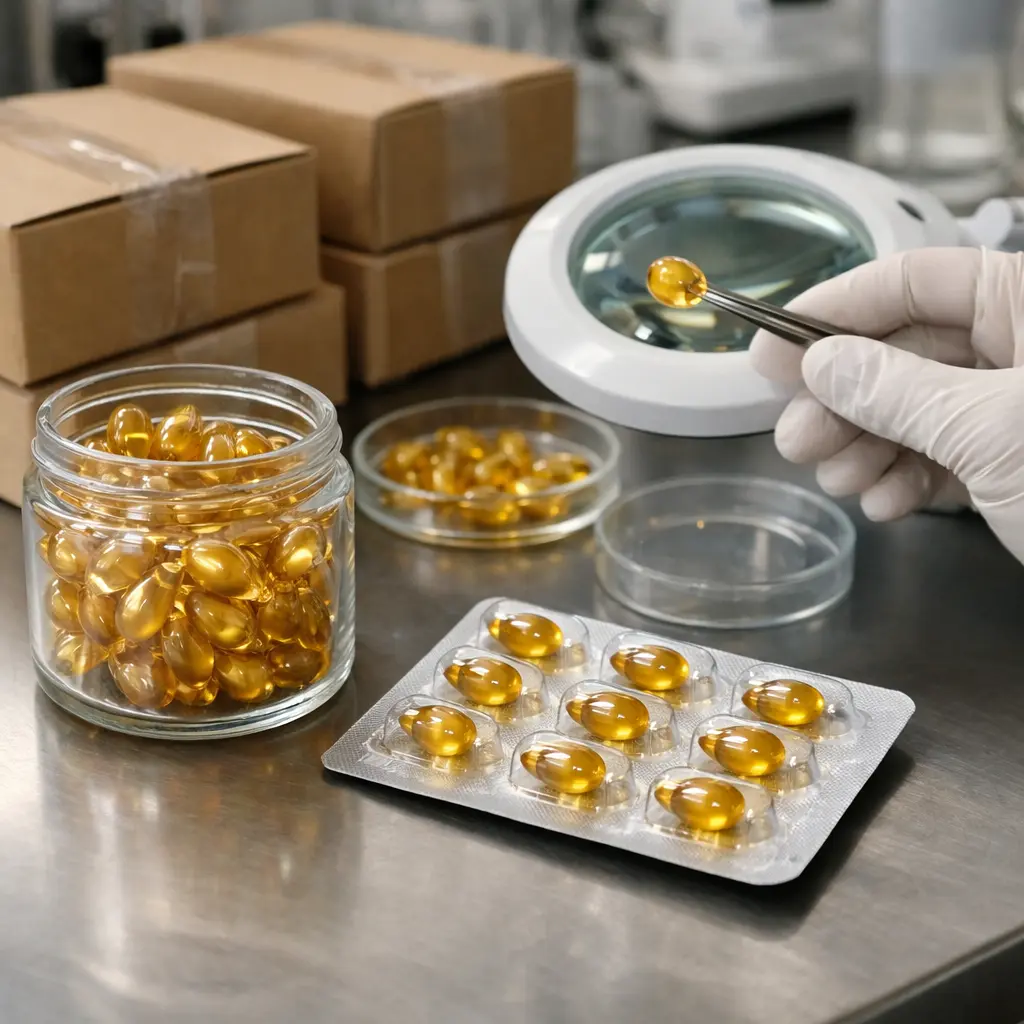
Packaging compatibility. Evaluate the capsule inside its final primary pack. Blister materials influence oxygen and moisture transmission; jars introduce headspace, counting, and repeated opening exposure. Review liner contact, capsule movement, abrasion, adhesive interaction, and the risk of deformation during compression. For cleansing oil capsules and facial oil capsules, leakage and staining should be assessed after transport simulation. Shipment conditions should define temperature exposure, humidity controls, pallet configuration, and the process for handling excursions.
Stability and release. A practical program should examine appearance, odor, shell integrity, leakage, fill-weight change, viscosity, peroxide or oxidation indicators where applicable, preservative performance where applicable, and active assay when claims depend on an active ingredient. Include real-time storage and accelerated conditions selected for the target markets. Review samples in the final package, not only in laboratory containers. Release criteria, retain samples, batch coding, deviation handling, and change-control obligations should be written into the quality agreement.
Decision Framework Table
| Factor | What to Check | Why It Matters | ODM Buyer Note |
|---|---|---|---|
| Formula | Viscosity, density, solubility, oxidation sensitivity, fragrance, and water content | Determines shell behavior, dose consistency, and stability risk | Approve a formula specification, not only a texture sample |
| Shell | Gelatin or vegan composition, moisture response, seam strength, color, and supplier records | Controls leakage, appearance, certification position, and storage resilience | Request shell documentation and test it with the actual fill |
| Fill weight | Nominal target, tolerance, dispensing performance, and residue after opening | Supports claims accuracy, consumer experience, and material planning | Review in-process weight records from the pilot batch |
| Mold | Dimensions, cavity shape, seam position, tooling ownership, and change control | Affects capacity, opening behavior, and package fit | Approve drawings and physical samples before tooling release |
| Packaging | Blister or jar compatibility, light and oxygen barrier, headspace, abrasion, and sealing | Protects product through storage and shipment | Run compatibility and transport checks using the final primary pack |
| Stability | Real-time and accelerated protocol, acceptance criteria, retains, and deviation process | Provides evidence for release, shelf-life decisions, and market review | Align the protocol with the buyer’s global quality system |
Private label retinol capsules and other capsule formats should enter commercial review only after these variables are documented, tested, and linked to a controlled change-management process.
ODM Manufacturing Considerations
For a private-label serum capsule project, sample confirmation should establish more than appearance. The approved sample should record the formula version, capsule shell material, color, dimensions, fill weight, fill viscosity, fragrance level, closure condition, and packaging format. A buyer should retain signed sample records and representative reference samples so later production can be compared against an agreed standard.
Formula customization normally begins with the intended use and filling behavior. Retinol capsules, facial oil capsules, eye serum capsules, cleansing oil capsules, and hair oil capsules may require different viscosity ranges and oxidation controls. Ask the ODM team to identify which ingredients may affect shell integrity, clarity, odor, color, or fill uniformity. The formula brief should also state whether the serum is an anhydrous oil, a water-containing emulsion, or another cosmetic format, because each can impose different shell and packaging requirements.
Shell selection should be documented as a technical decision. Gelatin softgel shells may provide a familiar manufacturing route, while vegan capsule shells can support specific brand positioning but may have different moisture response, sealing behavior, and storage requirements. Buyers should request material specifications, permitted colorants, plasticizer information where applicable, and a description of the shell’s expected behavior during filling, storage, and shipment. The vegan skincare capsule options page can be used as an internal starting point for comparing shell requirements.
Mold selection affects capsule dimensions, visual identity, fill volume, and tooling cost. A standard mold may shorten the approval path, while a custom mold can support a distinctive shape or controlled unit dose. Confirm the mold drawing, dimensional tolerances, cavity count, tooling ownership, replacement policy, and whether the proposed fill weight is realistic for the selected shell size. The supplier should also explain how mold changes affect production scheduling and packaging fit.
Packaging compatibility must be confirmed with filled capsules, not empty shells. Test the proposed jar, blister, tray, or sachet configuration for abrasion, compression, oxygen exposure, closure pressure, and movement during shipment. For a facial oil capsule jar, check whether the neck, inner seal, and cap create pressure points. For blister packaging, verify pocket depth, lidding adhesion, and capsule release. Packaging samples should be evaluated after heat and humidity exposure and after a shipment simulation. Related capsule technology guidance and OEM/ODM service information should be read alongside the supplier’s project-specific protocol.
The stability review should connect formula, shell, and package. Request observations for odor, color, phase separation, fill weight, leakage, shell flexibility, seal condition, and package deformation at defined intervals. The report should identify test conditions, sample quantities, test dates, acceptance criteria, and any deviations. It should not present a general stability statement as proof that every capsule formula and package combination will perform identically.
Before approval, clarify the MOQ and sample scope in writing. Ask whether the MOQ applies to each formula, shell color, mold, fragrance, and package configuration. Confirm how many pilot samples are included, who pays for tooling or analytical work, and what happens if the first sample fails a technical requirement. Labeling documents should include the ingredient list using the destination market’s naming convention, net content, lot coding, shelf-life or period-after-opening guidance where applicable, storage language, warnings, country-of-origin information, and packaging component specifications. For the United States, regulatory responsibilities should be reviewed against the Modernization of Cosmetics Regulation Act of 2022.
Shipment conditions should be part of the release decision. Define acceptable temperature and humidity exposure, carton orientation, pallet configuration, transit duration, data logger use, and inspection steps at receipt. A capsule that passes factory inspection may still deform or leak if it is compressed, overheated, or exposed to unsuitable humidity in transit.

Common Problems or Failure Cases
Shell brittleness: A shell may become hard, cracked, or difficult to cut open when moisture balance is unsuitable or storage conditions are poorly controlled. Review shell specifications, conditioning practices, and retained samples from the intended shipment route.
Sticking or deformation: Capsules can stick together, flatten, or develop surface marks when residual moisture, temperature, coating, or package pressure is outside the working range. Inspect capsules in bulk and inside their final jar or blister. A package that looks acceptable at room temperature may create problems after warm storage.
Fill separation: A facial oil or serum fill may show visible separation, sediment, or inconsistent color when the formula is not sufficiently stable. Confirm whether the fill requires a defined mixing sequence, controlled holding time, or special filling temperature. Any rework instruction should be documented rather than handled informally.
Leakage: Leakage may result from weak seals, unsuitable shell composition, sharp mold geometry, excessive fill volume, or compression inside the package. Check seal dimensions, fill weight, capsule orientation, and package pressure. Retain leaking units for root-cause analysis instead of relying only on a visual inspection of unopened cartons.
Fragrance sensitivity: Fragrance and essential-oil components may interact with the shell or intensify during storage. Conduct odor checks on the filled capsule and the opened dose after defined storage periods. The formula specification should identify fragrance concentration and any change-control requirement.
Packaging deformation: Blister pockets may collapse, lidding may lift, and jar components may warp when the package material is not suited to the capsule or shipment environment. Require filled-package trials, seal checks, and transport samples before committing to a full production run.
Supplier Checklist
- Verify the shell material, shell colorants, dimensions, sealing method, and storage limits.
- Request the formula specification, ingredient naming format, fragrance details, fill viscosity range, and target fill weight.
- Confirm mold drawings, cavity dimensions, tooling ownership, tolerances, and change-control procedures.
- Review leakage, shell flexibility, fill uniformity, oxidation control, odor, and phase-separation test methods.
- Test filled capsules in the final jar, blister, or tray after heat, humidity, compression, and shipment simulation.
- Define MOQ by formula, shell, mold, fragrance, and package; record sample quantities and approval gates.
- Obtain draft labeling documents, lot coding rules, ingredient declarations, storage language, and destination-market support records.
- Ask for batch traceability, retained-sample policy, deviation handling, complaint investigation, and recall communication procedures.
- Review information-security controls, formula access permissions, confidentiality terms, and whether production records are digitally auditable.
- Request evidence of worker welfare, environmental permits, emissions records, waste handling, and independent audit access where required.
- Document shipment temperature limits, humidity limits, carton protection, palletization, insurance responsibility, and receiving inspection.
FAQ
Can an OEM supplier protect a proprietary capsule formula from internal disclosure?
Protection depends on controls that can be verified, not only on a confidentiality clause. Ask how formula files are permissioned, whether the information system separates customer projects, who can access weighing and filling records, how samples are logged, and how data exports are controlled. The agreement should define ownership, permitted use, subcontracting limits, incident notification, and document destruction or retention.
How can a strategic buyer secure supply during raw-material shortages?
Request a written allocation plan covering critical oils, active cosmetic ingredients, shell materials, and packaging components. Useful controls include approved alternatives, dual sourcing, safety stock responsibilities, forecast windows, reserved production capacity, and escalation rules. Supply priority should be contractual and supported by inventory records rather than described only as a relationship benefit.
What evidence should a buyer request on environmental and labor practices?
Ask for current permits, waste-transfer records, emissions or energy records, corrective-action reports, and access terms for an independent audit. For labor, review age-verification procedures, wage records, working-hour controls, grievance channels, and subcontractor requirements. A supplier should be able to show how these controls operate at the production site, not just provide a policy document.
How many samples are needed before approving a serum capsule?
At minimum, review multiple samples from more than one filling session and compare them for shell appearance, fill weight, leakage, odor, and package fit. For a custom capsule mold or sensitive retinol formula, include filled-package samples and storage observations before final approval. The supplier should define acceptance criteria and the process for resolving sample deviations.
Should a buyer choose a standard or custom capsule mold?
A standard mold usually reduces design complexity and makes package fitting more predictable. A custom mold may strengthen product identity, but it adds tooling, dimensional, and compatibility decisions. Choose custom tooling only after the target fill weight, shell material, closure geometry, and final package have been technically confirmed.
What labeling records are important for a global cosmetic launch?
Request the full ingredient declaration, formula version, net content, lot-code format, storage conditions, warnings, country-of-origin details, packaging specifications, and applicable product information for each destination market. Claims should match the evidence available for that exact formula and capsule format.
References
Modernization of Cosmetics Regulation Act of 2022, U.S. Food and Drug Administration.
Leaping Bunny cruelty-free certification standard, Coalition for Consumer Information on Cosmetics.