
Direct Answer
A capsule factory project onboarding buyer guide should define the evidence, controls, decision rights, and acceptance criteria required before a skincare capsule manufacturer enters commercial qualification. The scope should cover formula ownership, shell chemistry, fill-weight control, mold specifications, packaging compatibility, stability protocols, regulatory files, ethical sourcing, information security, business continuity, and shipment conditions. Buyers should evaluate these controls as one connected manufacturing system rather than approving an attractive sample in isolation.
For an international brand, the central question is whether the supplier can reproduce an approved retinol, facial oil, eye serum, cleansing oil, or hair oil capsule across batches and markets without unapproved formulation changes. A stated pilot capability of 1,000 units or a development cycle of under 30 days may support an accelerated project, but neither replaces ISO 22716 evidence, batch records, validated specifications, social-compliance findings, or documented scale-up controls. Onboarding should therefore be structured as a gated risk review, not a purchasing formality.

Key Takeaways for Private Label Buyers
- Freeze the approved fill formula, capsule shell composition, color system, nominal fill weight, tolerances, and mold geometry in a controlled product specification.
- Qualify the fill and shell as an interacting system; viscosity, active concentration, oxygen exposure, and shell plasticization can change leakage or aging performance.
- Test the commercial capsule inside the intended blister, jar, sachet, or secondary carton under defined heat, humidity, light, and transport conditions.
- Separate prototype approval from production authorization. Require pilot-batch records, in-process controls, deviation procedures, and retained samples before launch.
- Map labeling and notification responsibilities by market, including evidence supporting cosmetic claims and the party accountable for regulatory submissions.
- Confirm alternate raw-material sources, reserved capacity, labor standards, emissions records, insurance coverage, IP controls, and incident escalation before supplier nomination.
Buyer Context
Serum-capsule sourcing becomes strategically material when a brand is responding to a quality incident, a sudden capacity interruption, a failed social audit, or a planned move into a capsule format its incumbent factory cannot produce. Under those conditions, speed matters, but compressed onboarding can transfer hidden risk into global inventory. A technically credible serum capsules manufacturer must be assessed for repeatable process control and governance, not merely laboratory sample quality.
The category also creates terminology risk. A cosmetic softgel contains a topical serum or oil and should not be treated as an ingestible supplement capsule. Procurement, regulatory, artwork, and claims teams should use a shared product classification from project initiation. Market pathways differ: buyers should review the FDA cosmetics guidance documents, the UK SCPN cosmetic notification protocol, and Australia’s TGA cosmetic-therapeutic boundary guidance against the intended claims and sales channels.
Portfolio scope affects qualification depth. Standard serum capsule products may use an existing shell and mold platform, while custom skincare capsules OEM programs can introduce new tooling, pigments, vegan shell materials, or oxygen-sensitive actives. Retinoid programs require particular scrutiny of light and oxygen control; buyers comparing retinol capsules should request active-assay methods, packaging rationale, and stability data for the final commercial configuration.

Capsule Formula, Shell, Mold, and Packaging Factors
Fill Formula and Process Window
Start with the fill’s complete INCI list, target active level, viscosity range, density, antioxidant system, and sensitivity to oxygen, water, heat, and light. The factory should identify which attributes are critical to filling accuracy and capsule sealing. Confirm how bulk serum is mixed, filtered, held, transferred, and protected before encapsulation. For salicylic-acid cosmetics, claims and concentration decisions should be reviewed against applicable market rules and safety evidence such as the CIR final report on salicylic acid in cosmetics.
Nominal fill weight alone is insufficient. The specification should define the acceptable weight range, sampling frequency, measurement method, line-stop threshold, and disposition of out-of-specification capsules. Buyers should compare pilot and commercial equipment to determine whether scale-up changes shear, hold time, dosing accuracy, or oxidation exposure. Review comparable skincare capsule product lines for process relevance, but require evidence from the buyer’s own formula and package.
Shell Material and Mold Control
Request the shell’s full material declaration, including gelatin or vegan polymer, plasticizer, colorants, opacifiers, and relevant animal-origin or allergen statements. Vegan positioning requires documentary traceability, not only a supplier declaration. The onboarding protocol should test shell brittleness, tackiness, deformation, seam integrity, and compatibility with the fill over time.
Mold geometry affects appearance, dose volume, drying behavior, sealing area, and packing efficiency. Define cavity dimensions, ownership of tooling, maintenance responsibility, approved replacement criteria, and controls preventing use for another customer. A qualified cosmetic softgel capsule factory should connect each mold revision to controlled drawings, inspection records, and change approval.
Packaging, Stability, and Distribution
Packaging must be qualified with the capsule, not selected after formula approval. Blisters can provide unit-dose protection but require compatible forming film, lidding material, and seal parameters. Jars may improve packing density but expose multiple capsules whenever opened and can create capsule-to-capsule pressure during shipping. The factory should test leakage, adhesion, odor change, discoloration, active loss, and package integrity in the final configuration.
A defensible protocol normally includes real-time, accelerated, light-exposure, and transport assessments appropriate to the product. Conditions such as 25 degrees Celsius at 60 percent relative humidity and 40 degrees Celsius at 75 percent relative humidity may be considered, but the final design must reflect capsule chemistry, market climate, package barrier performance, and expected distribution. Buyers evaluating encapsulated retinol skincare should require data from the intended blister or jar rather than extrapolation from bulk formula testing. The broader private label skincare capsules portfolio can indicate platform experience, but it does not substitute for SKU-specific validation.

Decision Framework Table
| Factor | What to Check | Why It Matters | ODM Buyer Note |
|---|---|---|---|
| Formula control | Master formula, INCI, active assay, viscosity, bulk hold time, and change-control authority | Prevents unapproved substitution or performance drift | Make commercial production conditional on a signed specification |
| Shell system | Polymer source, plasticizer, pigments, traceability, and fill compatibility | Shell-fill interaction can cause brittleness, tackiness, or leakage | Require supplier notification before any shell-material change |
| Fill weight | Nominal value, tolerance, sampling plan, gauge calibration, and rejection rules | Controls dose consistency, claims exposure, and pack count performance | Review actual pilot-batch distribution, not only averages |
| Mold and tooling | Dimensions, ownership, maintenance, revision control, and segregation | Geometry affects sealing, drying, appearance, and IP protection | Record tooling rights and destruction obligations contractually |
| Packaging | Barrier properties, seal integrity, capsule pressure, opening exposure, and artwork files | Package selection can alter oxidation and leakage risk | Approve the complete saleable configuration |
| Stability | Protocols, chambers, time points, analytical methods, deviations, and retained samples | Supports shelf-life and distribution decisions | Define who owns data and investigates adverse trends |
| Supply resilience | Alternate sources, capacity allocation, incident response, ESG audits, and shipment controls | Reduces disruption and reputational exposure | Verify evidence through QA, compliance, legal, and procurement review |
ODM Manufacturing Considerations
ODM onboarding should convert the commercial brief into measurable acceptance criteria before tooling, packaging procurement, or production scheduling begins. Buyers should approve a controlled sample that records the formula version, capsule shell material, mold reference, nominal fill weight, color, odor, surface finish, and primary packaging. Keep signed retention samples with both parties. A visual approval alone is insufficient because two serum capsules can look similar while differing in active concentration, fill behavior, or shell performance.
For fill formula customization, provide target ingredients, excluded substances, desired sensory profile, market destinations, and intended cosmetic claims. Ask the formulator to disclose the workable viscosity range, ingredient tolerances, expected color or odor drift, and any interaction between the active system and shell. Oil-soluble retinol, botanical extracts, fragrances, and antioxidant systems require especially clear specifications. Buyers moving from supplements into cosmetics should not assume that oral-capsule materials, claims, or manufacturing records automatically fit topical serum capsules.
Shell selection should compare animal-derived and vegan skincare capsule options against formula compatibility, appearance, storage behavior, and destination-market expectations. Mold decisions should define capsule shape, dimensions, seam geometry, cavity ownership, identification marks, and replacement responsibility. Review established capsule technology and mold options before authorizing a proprietary shape.
Packaging must be evaluated as part of the product system. A jar may expose facial oil capsules to repeated opening, compression, and fragrance migration, while a blister can change unit protection and pack-out requirements. Request assembled samples using production-intent resin, liners, lidding material, labels, and cartons. The review should cover capsule appearance, pack deformation, odor transfer, closure performance, and dispensing throughout the proposed shelf life.
Define the stability program by formula, shell, package, and destination climate. Agree on evaluation intervals and acceptance limits for appearance, odor, fill homogeneity, active content where relevant, capsule integrity, and package condition. The final scope should also state the sample quantity, minimum order quantity by color or mold, allowed production variance, excess-component policy, and whether the first order can use a standard shape.
Labeling files should include an ingredient declaration using the required nomenclature, net-content basis, batch coding format, responsible-party details, warnings where applicable, and evidence supporting claims. Destination rules differ: buyers selling in Great Britain should review the UK SCPN cosmetic notification protocol, while Australian teams should assess Australia’s TGA cosmetic-therapeutic boundary guidance. Shipment specifications should define carton count, pallet pattern, temperature exposure limits, container loading, data-logger use when justified, and the process for handling delayed or visibly heat-affected deliveries.
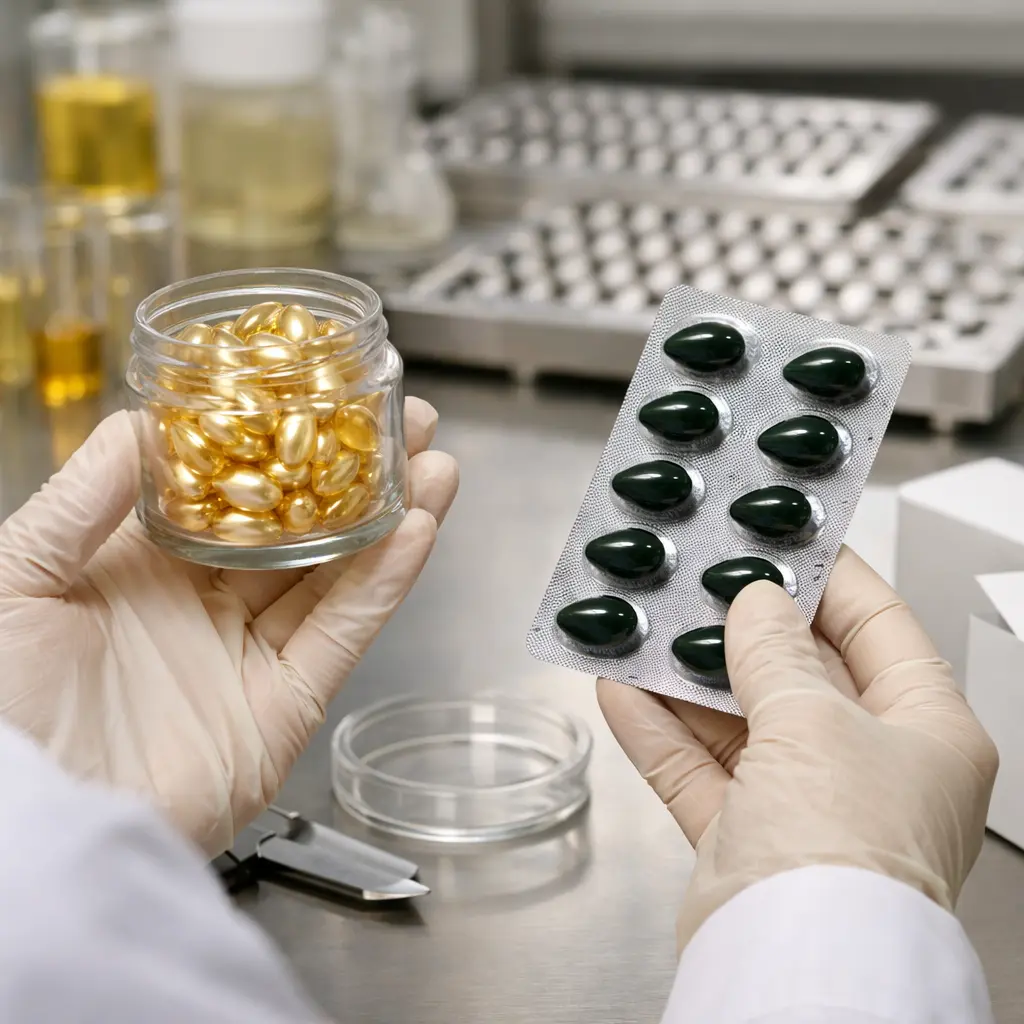
Common Problems or Failure Cases
Shell brittleness: Capsules crack during packing or consumer handling when the shell loses flexibility or is incompatible with the storage environment. Investigate shell composition, moisture balance, warehouse controls, and compression inside the jar or blister rather than treating breakage as a purely cosmetic defect.
Sticking or deformation: Capsules may adhere to one another, flatten, or develop surface marks after warm storage. Likely contributors include shell softening, residual surface material, excessive pack pressure, or migration from the fill or packaging. Confirm whether the defect is reversible and establish an objective release limit.
Fill separation: Pigments, suspended actives, or mixed oils can stratify between filling and use. Compare top, middle, and bottom line samples and determine whether agitation controls preserve uniformity. A formula that is homogeneous in a laboratory beaker may behave differently during a longer manufacturing run.
Capsule leakage: Wet capsules, oily cartons, or declining fill weight can indicate seam damage, pinholes, or shell-fill incompatibility. Trace the affected mold cavity and batch stage. Do not accept wiping or repacking as the sole corrective action without evidence that the underlying cause was contained.
Fragrance sensitivity: Fragrance components can alter shell texture, odor perception, or color over time. Fragranced cleansing oil capsules and hair oil capsules should be compared with an unfragranced control when feasible, with explicit limits for odor change and surface condition.
Packaging deformation: Jars, liners, or blister components may warp, loosen, or transmit odor after prolonged exposure to the formula and distribution environment. Test fully decorated packs because inks, adhesives, coatings, and secondary packaging can introduce failures absent from undecorated components.
Supplier Checklist
- Obtain the legal manufacturer name, production address, scope of cosmetic operations, audit history, and current corrective-action status.
- Lock the fill formula version, ingredient sources, viscosity range, active specification, fragrance status, and change-notification period.
- Record shell material, colorants, plasticizers where applicable, allergen declarations, and evidence of vegan status when claimed.
- Approve mold drawings, capsule dimensions, cavity identification, fill-weight target and tolerance, tooling ownership, and maintenance responsibility.
- Define sampling locations, test methods, defect categories, release criteria, retention quantity, and complaint-investigation records.
- Evaluate leakage risk, oxidation controls, shell flexibility, fill uniformity, and performance after heat and humidity exposure.
- Test production-intent jars or blisters with liners, closures, labels, cartons, and realistic product counts.
- Confirm sample scope, MOQ by formula and component, lead-time assumptions, component overage, and rules for obsolete inventory.
- Review ingredient lists, specifications, safety documentation, claims support, batch records, coding, and destination-market notification responsibilities.
- Document shipment conditions, pallet protection, container loading, inspection at receipt, deviation reporting, and replacement responsibility.
- Assess formula-access permissions, electronic record controls, backup practices, supplier continuity plans, labor standards, and insurance certificates.

FAQ
How can a buyer verify that its core formula will remain confidential?
No factory can credibly promise absolute immunity from disclosure. Require role-based access, segregated project folders, controlled formula exports, confidentiality obligations for staff and subcontractors, access logs, backup controls, and a documented response to unauthorized access. During an audit, sample the records for one active project rather than accepting a policy statement alone.
How should strategic supply priority be handled during a raw-material shortage?
Ask for written allocation rules, approved alternate sources, safety-stock ownership, forecast commitments, and notice periods. Priority language should identify specific materials and capacity, not merely label the buyer strategic. Confirm that substitutions require written formula and regulatory approval.
What labor evidence should be reviewed during supplier qualification?
Review age-verification procedures, payroll and time records, overtime approvals, grievance channels, agency-worker controls, and recent independent social-audit findings. Interview a worker sample privately where audit rules permit. Contract terms should require corrective action and disclosure of material labor violations.
What insurance evidence matters for a major quality complaint?
Request current product-liability and recall certificates showing limits, territories, exclusions, insured entities, and policy dates. Verify the certificate with the broker or insurer and compare coverage with realistic recall, disposal, testing, logistics, and third-party claim exposure.
Can one approved sample authorize commercial production?
Only if the approval record identifies the exact formula, shell, mold, fill weight, and packaging configuration. For customized retinol capsules or eye serum capsules, buyers should also approve measurable specifications and production-line samples before routine release.
Who is responsible for cosmetic notification and claim compliance?
The contract should allocate dossier preparation, safety documentation, notification submission, label review, and post-market updates by destination. The brand or designated responsible party may retain legal duties even when the ODM prepares files. FDA cosmetic guidance also makes clear that cosmetics and therapeutic claims are governed differently.