
Direct Answer
For Middle East skincare capsules private label technical requirements, the primary decision is not whether a serum capsule can be produced. It is whether the complete system of fill formula, shell material, mold, packaging, stability evidence, labeling file, and shipment controls can remain compliant and commercially stable under Gulf heat and humidity. A qualified ODM should therefore be assessed as a controlled manufacturing extension, with documented specifications for capsule composition, fill viscosity, fill weight, leakage tolerance, oxidation protection, and container compatibility before any formula or shell development is approved. Buyers should also confirm that the same validated process can support pilot sampling and commercial scale without unplanned re-engineering. The Gulf Standardization Organization (GSO) framework and the Saudi FDA cosmetic registration framework should be treated as reference points for regional market access, while product-specific legal review remains essential.
Key Takeaways for Private Label Buyers
- Source against a written technical specification, not a capsule photograph or a nominal formula name.
- Require fill-viscosity and fill-weight data at the intended production temperature, including acceptable variation by batch.
- Select shell material and mold geometry together; both affect dose presentation, sealing performance, and packaging fit.
- Test blister, jar, and secondary-packaging compatibility under heat, humidity, vibration, and extended storage conditions.
- Approve retinol, facial oil, eye serum, cleansing oil, and hair oil capsules only after oxidation and leakage controls are demonstrated.
- Make launch approval conditional on a complete compliance file, traceable raw materials, stability data, and shipment specifications.
Buyer Context
For a multinational beauty group or established regional brand, capsule skincare is usually a capacity and risk-management decision rather than a product-story exercise. A new supplier may be required after a serious quality event, an adverse third-party audit, or a sudden interruption at an incumbent plant. The same decision can arise when a brand expands from conventional facial serum into retinol capsules, eye serum capsules, cleansing oil capsules, or hair oil capsules and needs specialized softgel capability that its current network does not possess.
These products concentrate several failure points into a small unit dose. A minor change in shell moisture, fill viscosity, mold dimensions, or seal temperature can create tackiness, deformation, leakage, or inconsistent dispensing. For retinol, facial oil, and eye serum formats, oxygen exposure and light transmission can also affect appearance and active stability. A procurement team therefore needs evidence that the supplier controls the full process, from incoming ingredients and shell materials through filling, sealing, inspection, packaging, release, and shipment.
Regional conditions increase the importance of this review. Products may move through hot warehouses, long inland transport routes, and retail environments where temperature control is limited. A capsule that performs acceptably in a temperate stability cabinet may still soften, adhere to neighboring units, or lose seal integrity during a Gulf distribution cycle. Buyers should request storage assumptions, transport limits, excursion procedures, and clear responsibility for investigating deviations. The FDA Cosmetics Labeling Guide is not a substitute for Gulf-market requirements, but it illustrates the level of ingredient, identity, net-content, and responsible-party documentation expected in a mature compliance process.
For global procurement, the supplier file should also address audit readiness, worker standards, environmental records, business continuity, information security, and product-liability insurance. A facility that cannot produce controlled records during an unannounced review creates more exposure than its quoted manufacturing capacity suggests. Independent market intelligence, including Business of Fashion beauty intelligence, can help frame category demand, but technical acceptance must remain evidence-led and product-specific.
Serum capsules manufacturer qualification should begin with a controlled sample program. Buyers can use the supplier’s serum capsule products portfolio to identify relevant process families, but portfolio similarity does not establish equivalence. A retinol capsule, a low-viscosity facial oil capsule, and a cleansing oil capsule may use different shell, fill, mold, and packaging parameters.
For active-led development, the retinol capsules category should be reviewed for light protection, antioxidant strategy, compatibility with the shell, and claims substantiation. The buyer should approve a technical transfer package before committing a regional launch date.
Skincare capsules OEM evaluation should also include capacity reservation and contingency planning. A supplier interruption, raw-material shortage, labor-compliance finding, or geopolitical shipping disruption should trigger a documented escalation path, alternate-material qualification process, and allocation policy for strategic accounts.
Capsule Formula, Shell, Mold, and Packaging Factors
Fill formula. The fill must be characterized by viscosity, density, oil polarity, active concentration, water activity where relevant, and sensitivity to oxygen and light. A fluid facial oil may require a different filling and sealing window from a thicker serum or a cleansing oil. The formula should be screened for interaction with shell plasticizers, pigments, opacifiers, and sealing layers. Do not approve a nominal dose until the actual fill weight, weight variation, and dispensing behavior have been measured on production-representative equipment.
Shell material. Gelatin and vegan shell systems have different moisture profiles, mechanical properties, drying behavior, and aging risks. A vegan capsule shell may support a specific brand standard, but it should not be accepted solely on certification language. Verify material identity, supplier qualification, allergens, colorants, residual moisture, seal strength, and performance after heat and humidity exposure. Shell aging can change brittleness, tackiness, and deformation, particularly when paired with hygroscopic or volatile fills.
Mold and dose geometry. Custom softgel molds determine capsule dimensions, surface area, seam placement, visual identity, and the amount of fill that can be delivered consistently. The mold should be reviewed against the intended dose, applicator or opening method, blister pocket, jar neck, counting equipment, and carton configuration. A visually distinctive shape that cannot run reliably at line speed is a packaging and throughput liability.
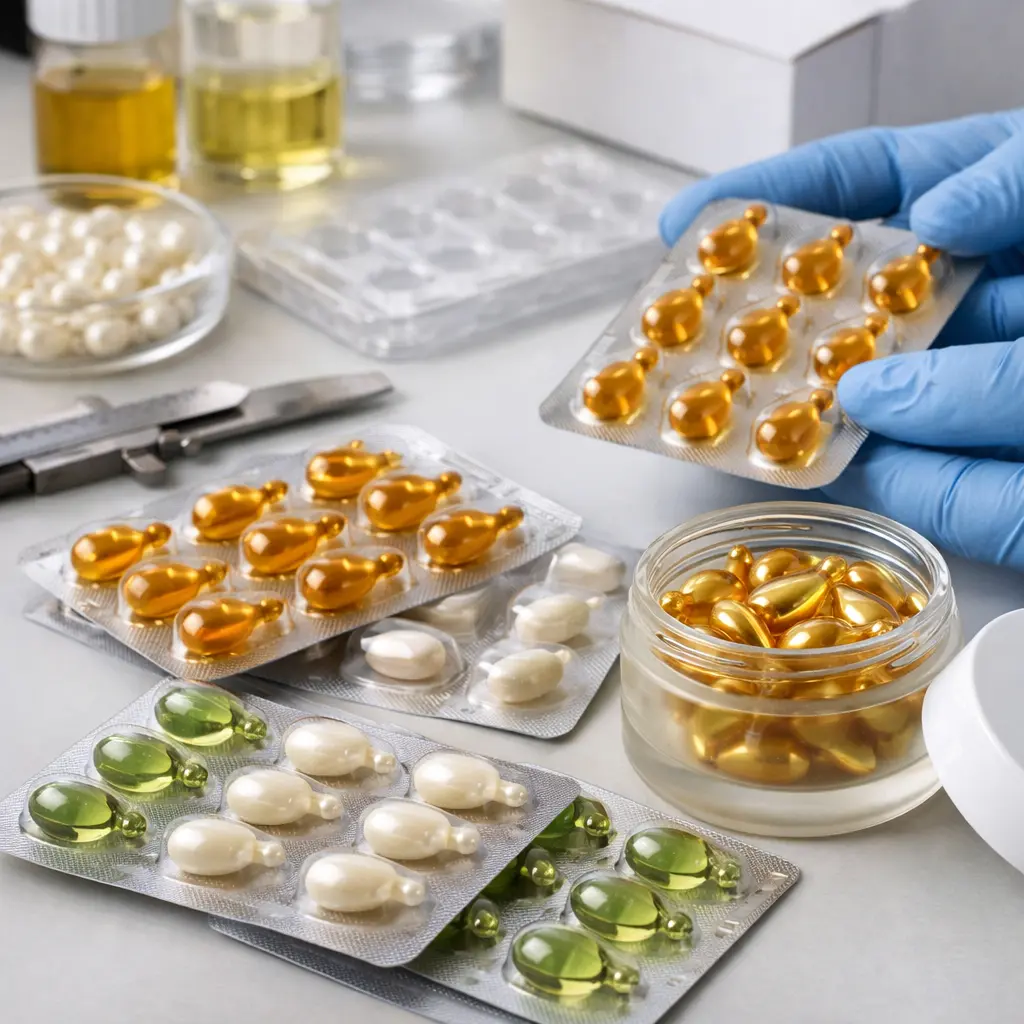
Packaging compatibility. Blisters can provide unit separation and controlled presentation, while jars may simplify merchandising but increase the importance of moisture, oxygen, and repeated opening controls. Confirm pocket depth, seal material, headspace, desiccant strategy where applicable, closure torque, capsule-to-capsule contact, and extraction ergonomics. A facial oil capsule that remains intact in bulk may still leak when compressed inside a blister or exposed to elevated warehouse temperatures.
Storage and stability. The development protocol should include accelerated, long-term, and transport-relevant evaluation with appearance, odor, fill weight, shell integrity, seal integrity, active assay where applicable, and microbial testing where relevant. Heat and humidity conditions must reflect the intended distribution network, not only a generic laboratory schedule. Shipment specifications should define palletization, outer-case protection, temperature excursions, humidity exposure limits, and release procedures after a logistics deviation.
Sampling and scale-up. Request samples made with the intended shell, mold, fill process, and packaging—not a hand-filled approximation. The supplier should disclose sample scope, pilot quantity, retained samples, inspection criteria, and the point at which formula or process changes require renewed approval. A credible private label skincare capsules program preserves the approved specification from pilot to commercial production and documents every justified deviation.
Decision Framework Table
| Factor | What to Check | Why It Matters | ODM Buyer Note |
|---|---|---|---|
| Fill system | Viscosity, density, fill weight, oxygen sensitivity, and active compatibility | Controls dose consistency, oxidation, and sealing behavior | Require production-equipment samples and batch records |
| Shell material | Gelatin or vegan composition, moisture, seal strength, allergens, and aging data | Determines mechanical stability and regional storage performance | Request material certificates and humidity-exposure results |
| Mold geometry | Dimensions, seam location, opening method, and line-speed capability | Links dose presentation to filling yield and package fit | Approve mold drawings before tooling release |
| Packaging | Blister or jar compatibility, pocket depth, closure, headspace, and contact risk | Prevents leakage, sticking, deformation, and difficult dispensing | Run filled-packaging transport and heat studies |
| Stability | Heat, humidity, light, oxidation, appearance, assay, and seal integrity | Supports shelf-life and launch confidence across the Gulf supply chain | Align protocols with destination markets and claims |
| Compliance file | Ingredients, specifications, labeling, GMP records, traceability, and change control | Enables registration, audit defense, and controlled global rollout | Make document completeness a commercial gate |
Retinol serum capsules should receive an additional review for light and oxygen protection, while a private label skincare capsules program should confirm whether the selected packaging can be sourced consistently across launch markets. These technical decisions should be closed before final artwork, tooling payment, and regional forecast lock.


ODM Manufacturing Considerations
ODM development should end with a documented sample approval, not simply a visual agreement on capsule appearance. Ask the supplier to identify the serum formula, capsule shell material, color, dimensions, nominal fill weight, packaging format, and storage conditions on the approval record. A facial oil capsule, retinol capsule, eye serum capsule, or hair oil capsule may require different shell and fill decisions even when the outer shape looks similar.
Start by confirming the fill formula and its intended dose. The supplier should provide the ingredient list, target viscosity range, fragrance specification, color standard, and any restrictions on heat, light, oxygen, or moisture exposure. For a customized serum, request a retained sample from the approved batch and define which changes require renewed approval. A small adjustment to fragrance, oil blend, active concentration, or fill weight can affect shell compatibility and leakage risk.
Shell selection is a technical decision. Gelatin softgel shells may offer familiar processing characteristics, while vegan capsule shells can involve different moisture behavior, elasticity, sealing conditions, and storage tolerances. Request the shell composition, plasticizer information where applicable, colorant details, allergen statement, and certificates relevant to the destination market. For retinol and facial oil capsules, the shell should be reviewed alongside oxidation control and light protection rather than evaluated as an isolated component.
Mold selection determines more than the visual identity of the capsule. It affects wall distribution, seam position, usable fill volume, opening behavior, and the amount of surface area exposed to the package. Compare the proposed mold with the formula viscosity and the intended dose. Ask whether the mold is existing or newly developed, who owns the tooling, what the approval sample represents, and how dimensional tolerances will be controlled during production. Internal resources on capsule technology and mold options can help structure this review.
Packaging compatibility must be tested with the actual capsule and the actual primary pack. A blister can protect individual doses and reduce handling, while a jar may simplify presentation but increase capsule-to-capsule contact. Review the liner, closure torque, headspace, desiccant use, light exposure, and transportation orientation. Check whether a facial oil capsule sticks to the blister film, whether an eye serum capsule deforms under compression, and whether a cleansing oil capsule transfers fragrance to the package. Packaging samples should remain filled during evaluation.
Stability review should cover the intended heat and humidity profile, not only an ambient laboratory condition. Ask for a written protocol covering appearance, odor, fill separation, leakage, shell brittleness, weight change, and package deformation. Confirm how samples are labeled, retained, and inspected at each interval. Shipment conditions should define temperature exposure, pallet configuration, carton protection, transit duration, orientation limits, and any prohibition on leaving cartons in direct sunlight or an uncontrolled container.
MOQ should be discussed as a development and supply variable. Request separate figures for laboratory samples, pilot samples, the first commercial order, and repeat production. Clarify whether the minimum applies to one formula, one color, one mold, one package, or the combined order. Labeling documents should include the ingredient declaration using the destination market naming convention, net content or capsule count, batch coding format, shelf-life basis, storage statement, country-of-origin information, and any required manufacturer documents. For Gulf distribution, review the Gulf Standardization Organization framework and, where applicable, the Saudi FDA cosmetic registration framework with the local responsible party.

Common Problems or Failure Cases
Shell brittleness: A capsule can crack during filling, packing, or shipment when shell moisture is outside its acceptable range or when the formula and shell are poorly matched. Inspect samples after conditioning and after simulated handling. Record seam integrity, edge cracking, and changes in flexibility rather than relying on a first-day visual check.
Sticking or shell deformation: Capsules may stick together in a jar or distort inside a blister when surface tack, residual moisture, compression, or heat is excessive. Test the proposed package under stacked storage and transport vibration. The result should be assessed by dose count, capsule shape, release from the pack, and visible scuffing.
Fill separation: A serum containing multiple oils, extracts, or suspended ingredients can separate during storage. Review the formula after temperature cycling and extended standing. Confirm whether the appearance is reversible with gentle movement and whether the active or fragrance phase remains evenly distributed. Do not approve a sample solely because it looks uniform immediately after filling.
Leakage: Leakage can arise from an incomplete seal, an unsuitable shell, excessive fill volume, formula migration, or pressure during transit. Ask for leak testing after filling, packaging, conditioning, and shipment simulation. Inspect both the capsule and the package because a small leak may first appear as oily residue on the blister cavity, jar wall, or closure liner.
Fragrance sensitivity: Fragrance may migrate into packaging or become noticeably stronger after heat exposure. This is especially important for facial oil, cleansing oil, and eye serum capsules. Compare the approved fragrance profile with samples stored in the final package, and define an odor acceptance standard before production.
Packaging deformation: Blister film, lids, liners, and trays can warp under warehouse heat or compression. Confirm the packaging material specification and perform filled-pack testing under the expected shipment conditions. A package that protects the capsule in the laboratory may still fail when cartons are stacked in a hot distribution environment.
Supplier Checklist
- Obtain the shell material, shell composition, colorant, allergen, and vegan-status documentation.
- Confirm formula identity, ingredient declaration, fragrance specification, viscosity range, fill weight, and allowable tolerances.
- Review mold dimensions, tooling ownership, capsule geometry, seam position, and sample-to-production controls.
- Require filled samples in the intended blister, jar, or other primary package.
- Verify leakage, shell flexibility, fill separation, odor, oxidation control, and package deformation checks.
- Ask for stability conditions, inspection intervals, retained-sample practice, and release criteria.
- Separate MOQ requirements for samples, tooling, first production, repeat orders, and packaging components.
- Request labeling, batch coding, shelf-life, storage, origin, and registration-support documents.
- Define shipment temperature limits, carton protection, orientation, transit assumptions, and damage reporting.
- Review information-security controls, formula access permissions, backup practices, and confidentiality terms.
- Request current environmental records, waste-handling evidence, worker-policy documentation, and an independent audit process.
- Confirm product-liability insurance territory, exclusions, limits, claims procedure, and the supplier entity named on the policy.
FAQ
Can the supplier technically prevent our core formula from being leaked?
No supplier should promise absolute secrecy without evidence. Ask for role-based system access, physical segregation of formula records, controlled sample rooms, batch-document permissions, visitor logs, employee confidentiality agreements, and an incident-notification process. The contract should identify the protected information, permitted users, retention rules, and remedies. A technical and operational review is more useful than a generic confidentiality statement.
How can a strategic buyer protect supply during a global raw-material shortage?
Request a documented allocation policy, approved alternative ingredients, safety-stock assumptions, and a change-control process. The supplier should disclose which ingredients are single-source, how much notice is required for substitutions, and whether packaging components share capacity with other customers. A supply agreement can define forecast visibility, reserved production windows, escalation contacts, and priority rules, but priority should be supported by written capacity planning rather than an informal promise.
What environmental and labor evidence should an international buyer request?
Ask for wastewater and emissions records relevant to the site, waste-disposal manifests, energy or carbon data, and the latest independent audit or corrective-action report. Labor review should cover age verification, wage records, working hours, overtime consent, grievance channels, and subcontractor controls. The supplier should be able to explain how records are retained and how an independent auditor can verify them.
What should be confirmed before approving a retinol capsule?
Confirm the retinol form and concentration, light and oxygen controls, fill-weight tolerance, shell compatibility, fragrance restrictions, and package light barrier. Review stability observations for color, odor, leakage, and fill uniformity in the final blister or jar. The label and storage statement should match the formula documentation and the destination-market requirements.
How should a buyer compare blister and jar packaging for serum capsules?
Compare dose protection, capsule contact, light exposure, opening frequency, closure performance, shipping compression, and consumer handling. Blisters may reduce capsule-to-capsule contact, while jars require closer review of headspace, liner contact, humidity, and repeated opening. Approve the format only after filled-pack testing under expected storage and shipment conditions.
Does product-liability insurance eliminate quality risk?
No. Request the insurer, policy period, covered territories, product category, per-occurrence limit, aggregate limit, exclusions, deductible, and claims procedure. Confirm that the named manufacturing entity is the insured party and that exported cosmetics are covered. Insurance should complement documented release controls, traceability, complaint investigation, and recall procedures.
References
For visible regulatory and labeling checks, consult the Gulf Standardization Organization framework, the Saudi FDA cosmetic registration framework, and the U.S. FDA Cosmetics Labeling Guide. These sources should be reviewed with the importer or responsible party because market-specific registration, language, and labeling obligations can vary.