
Direct Answer
A strong capsule skincare quotation request RFQ checklist should establish technical feasibility, regulatory readiness, supply continuity, and packaging compatibility before a buyer asks for physical samples. For serum capsules, the central question is not whether an ODM can produce an attractive prototype. It is whether the same formula, shell, fill weight, mold, and packaging configuration can be controlled from pilot production through global commercial supply.
Before requesting samples, define the active system, oil or serum viscosity, capsule shell material, target fill weight, storage conditions, intended markets, packaging format, and evidence required for approval. Require the supplier to disclose sample scope, manufacturing line, analytical controls, stability protocol, labeling file, and change-control process. This prevents a common procurement failure: a sample is approved, but the mass-production formula, capsule tooling, or packaging specification later changes. For mature brands, the RFQ is therefore a qualification document and a supply-risk screen, not merely a pricing exercise.
Key Takeaways for Private Label Buyers
- Specify the commercial use case before formulation review: retinol capsules, facial oil capsules, eye serum capsules, cleansing oil capsules, or hair oil capsules each impose different oxidation, viscosity, and dosage-control requirements.
- Request the exact shell composition, fill-weight tolerance, capsule dimensions, mold ownership terms, and permitted substitute materials.
- Require packaging compatibility testing with the intended blister, jar, sachet, or unit-dose presentation under defined heat and humidity conditions.
- Separate sample approval from production approval. The RFQ should require pilot-batch records, retained samples, stability data, and a documented scale-up path.
- Ask for regulatory and quality documents at quotation stage, including ingredient specifications, certificates of analysis, GMP evidence, labeling support, and market-specific notification responsibilities.
- Evaluate resilience as part of the commercial award: raw-material dual sourcing, emergency capacity, business continuity, information security, and escalation governance should be documented.
Buyer Context
Capsule skincare creates a narrower manufacturing risk profile than a conventional pump or dropper serum. A buyer is approving a coordinated system: the formula must remain compatible with the shell; the fill must be dosed consistently; the capsule must survive handling and transport; and the primary pack must protect the product through its declared shelf life. A failure in any one of these interfaces can create leakage, oxidation, deformation, consumer complaints, or a delayed market launch.
This matters particularly when a group is onboarding supplementary capacity after a supplier quality incident, expanding into an unfamiliar format such as a BOV-compatible or unit-dose capsule system, or building a second manufacturing source to reduce geopolitical and operational concentration. The relevant diligence is not limited to a factory tour. Procurement, R&D, QA, regulatory, legal, and ESG teams should be able to trace the RFQ answers to verifiable records.
For a retinol product, the RFQ should address light and oxygen exposure, antioxidant strategy, assay retention, and packaging protection. For facial oil or hair oil capsules, it should address rancidity risk, fragrance migration, and interaction between the fill and shell. Eye serum capsules require particular attention to unit-dose hygiene, opening behavior, and consumer handling. Vegan capsule shells may require a separate review of moisture sensitivity, mechanical performance, and supplier continuity. Buyers can use the retinol serum capsules product reference and the broader capsule skincare product lines overview to frame the initial technical brief.
Capsule Formula, Shell, Mold, and Packaging Factors
Formula and fill behavior
The RFQ should state whether the fill is an anhydrous facial oil, a water-in-oil emulsion, a silicone-containing serum, or another cosmetic system. The supplier should report viscosity at a defined temperature, density, target fill weight, dosing method, and acceptable tolerance. These details determine whether a formula can run consistently through the filling equipment and whether each capsule delivers a uniform consumer experience.
Ask how the ODM controls oxygen exposure during compounding and filling, how bulk holding time is limited, and which tests verify oxidation or active degradation. For retinol capsules, request assay and degradation monitoring rather than relying on a visual review. For botanical oils, request peroxide or comparable oxidation-control data where applicable. The FDA Cosmetics Labeling Guide can help define the documentation and label review inputs required for the intended United States market, while the EU Cosmetics Regulation framework provides a reference point for European compliance planning.
Shell and mold qualification
Shell material must be identified precisely, including gelatin or vegan polymer basis, plasticizer system, colorants, residual moisture, and supplier specifications. Do not accept a generic description such as natural shell or plant-based shell without supporting documentation. Shell composition affects flexibility, brittleness, sealing behavior, moisture transfer, and storage performance.
The RFQ should also identify whether the mold is standard or custom, who owns the tooling, how dimensional changes are approved, and whether the capsule geometry is reproducible on the proposed commercial line. A custom softgel mold may improve differentiation, but it can increase validation effort, replacement lead time, and packaging complexity. The supplier should provide capsule drawings, dimensional tolerances, seam information, and a defined inspection method.
Packaging and stability
Packaging compatibility is a release criterion, not an afterthought. Ask the ODM to test the actual capsule against the proposed blister film, aluminum laminate, glass or plastic jar, closure liner, and any insert material. Review leakage, sticking, shell softening, color transfer, odor migration, fill evaporation, and capsule deformation. A jar may improve merchandising flexibility but expose capsules to repeated oxygen and humidity ingress. A blister may provide stronger unit-dose protection but introduce sealing, recycling, and tooling constraints.
Define shipment conditions and storage limits in the RFQ. At minimum, the supplier should explain how heat and humidity excursions are assessed, which stability program is used, how retain samples are managed, and what happens when results trend outside specification. A sample that performs well at the factory but fails after ocean freight has not demonstrated commercial readiness. The serum capsules manufacturer overview can serve as a starting point for discussing integrated formulation, filling, packaging, and quality responsibilities.
The CIR safety assessment on thioglycolate-based depilatories is not a substitute for a product-specific safety review, but it illustrates the level of ingredient evidence and use-condition discipline expected in regulated cosmetics. For executive market context, Business of Fashion beauty intelligence can supplement, but not replace, primary technical and regulatory records.

Decision Framework Table
| Factor | What to Check | Why It Matters | ODM Buyer Note |
|---|---|---|---|
| Fill formula | Viscosity, density, oxygen exposure, active assay, bulk hold time | Determines dosing consistency and degradation risk | Require the commercial formula and sample formula to use the same specification |
| Shell material | Gelatin or vegan basis, moisture, plasticizer, colorants, supplier records | Affects sealing, flexibility, migration, and shelf-life performance | Request full material documentation and approved-substitute rules |
| Fill weight | Target weight, tolerance, balance method, in-process frequency | Supports declared quantity and consistent consumer use | Ask for batch records and a statistically meaningful sampling plan |
| Mold and tooling | Dimensions, seam design, ownership, replacement lead time | Controls reproducibility and future capacity transfer | Document tooling rights before approving a custom capsule shape |
| Packaging | Blister or jar compatibility, seal integrity, liner interaction, transport protection | Reduces leakage, oxidation, deformation, and shipment claims | Test the intended commercial pack, not a temporary sample container |
| Stability and release | Heat and humidity exposure, retain samples, assay trend, deviation process | Links sample approval to shelf-life confidence | Request protocol ownership, acceptance criteria, and change notification |

ODM Manufacturing Considerations
For a mature brand, supplier selection should test whether the ODM can preserve the approved configuration under pressure. Ask whether pilot production and commercial production use the same line, process controls, quality organization, and approved raw-material sources. A micro-batch architecture can be useful for controlled qualification, but the supplier must demonstrate that scale-up will not trigger reformulation, revalidation, or an unplanned supplier handoff.
Request the manufacturing site certificate, ISO 22716 evidence, audit history, deviation and CAPA examples, batch-release workflow, and recall traceability. Also define information-security controls: formula access permissions, physical segregation, electronic records, confidentiality obligations, and subcontractor disclosure. ESG diligence should cover labor records, environmental permits, wastewater controls, carbon accounting, and independent audit availability. These materials allow a global procurement committee to distinguish documented capability from a persuasive presentation.
Capacity resilience deserves equal attention. The RFQ should ask for critical raw-material dual sourcing, safety-stock policy, allocation rules during shortages, backup utilities, disaster recovery, and escalation contacts. PZIK’s stated operating model includes pilot production from 1,000 units and scalability beyond 500,000 units per SKU without a planned reformulation path; any such capability should be verified through site records, line data, and a controlled qualification plan rather than accepted as an unqualified promise.

Initial RFQ Gate
Before samples are commissioned, require the supplier to return a completed technical questionnaire with the formula brief, shell specification, mold proposal, fill-weight target, packaging drawings, stability plan, regulatory deliverables, ESG evidence, capacity model, and change-control terms. The buyer should approve the sample request only after the proposed configuration is technically and commercially traceable. For additional supplier due diligence, the private label skincare capsules catalog and encapsulated retinol skincare reference provide useful product-specific starting points.
ODM Manufacturing Considerations
A strong capsule skincare quotation request RFQ checklist should define what the supplier must confirm before samples are made. Sample approval is not only a visual decision. Ask for the exact formula version, capsule count, target fill weight, shell material, mold reference, packaging format, storage conditions, and acceptance criteria. The approved sample should become a controlled reference for later pilot and commercial batches.
For formula customization, provide the intended product role and operating limits rather than only a list of ingredients. A retinol capsule, facial oil capsule, eye serum capsule, cleansing oil capsule, or hair oil capsule may require different carrier oils, antioxidant systems, fragrance levels, and fill characteristics. Ask whether the supplier can adjust viscosity, density, color, scent, and skin-feel while maintaining capsule performance. Formula changes should be documented with a revision number, sample date, and confirmation of which ingredients are customer-owned or supplier-provided.
Shell selection should be treated as a functional decision. Ask whether the proposed capsule uses gelatin, a vegan shell, or another cosmetic-grade shell system, and request the relevant material specifications. Confirm shell color, opacity, surface finish, moisture sensitivity, brittleness risk, and compatibility with the proposed fill. Buyers evaluating vegan skincare capsules should also check whether the shell material is suitable for the intended storage and packaging conditions, rather than approving it only from a marketing description. The supplier should explain available capsule technology and how it affects appearance, rupture behavior, and shelf handling.
Mold selection affects capsule size, shape, dispensing experience, and visual identity. Request mold drawings or dimensional specifications before approving a custom mold. Clarify whether the mold is standard or customer-specific, who owns it, how revisions are controlled, and what happens if the selected format cannot run consistently. A sample from a custom mold should be inspected for seam uniformity, wall thickness, opening behavior, and compatibility with the filling equipment.
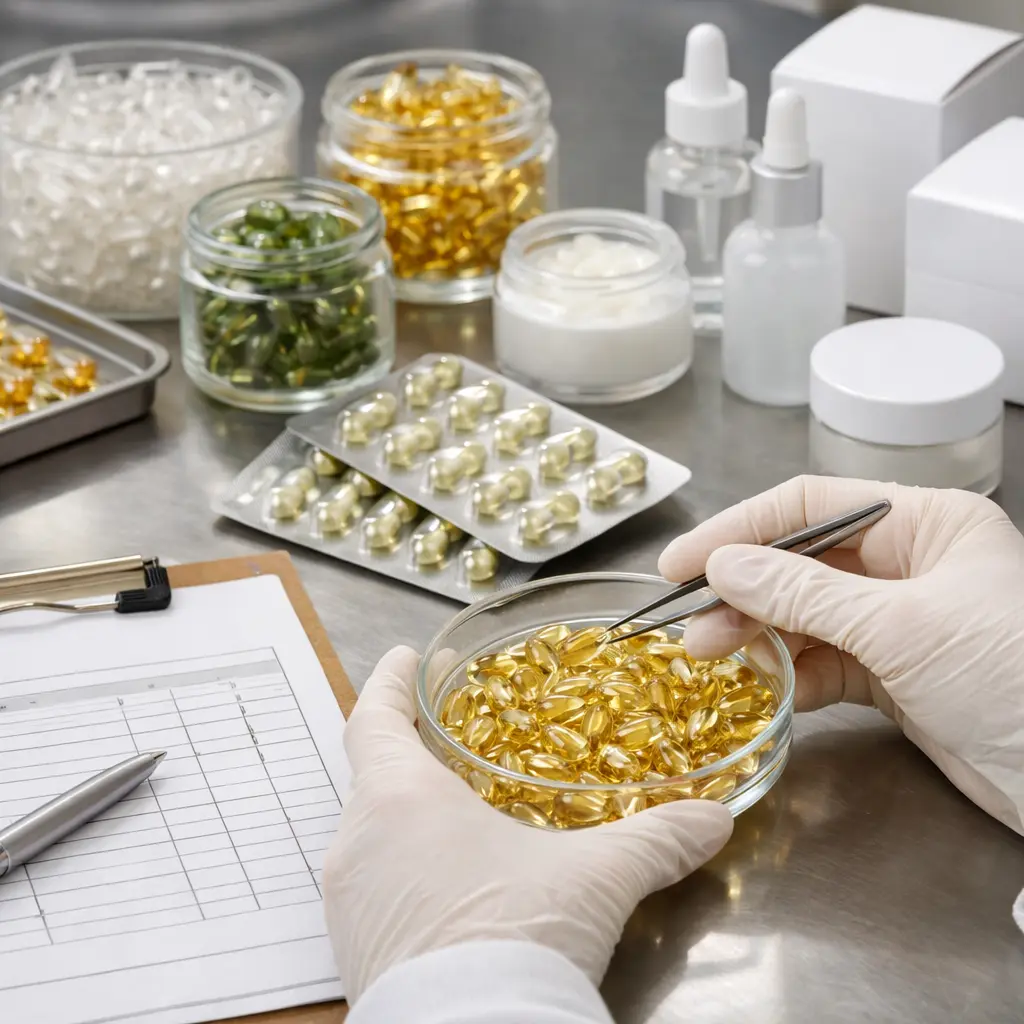
Packaging approval should include filled capsules, not empty shells. Test the selected blister, jar, or other primary pack for compression, friction, headspace, closure pressure, and product removal. Facial oil capsules may soften or migrate under certain conditions, while a rigid blister may stress a brittle shell. Ask for packaging compatibility observations after heat and humidity exposure, including whether the capsule sticks to the cavity, deforms against the lid, or transfers oil to the pack.
The stability review should define sample quantities, time points, test conditions, and observations. Useful checks include appearance, odor, fill separation, leakage, shell weight or dimensions, and packaging deformation. For oxidation-sensitive formulas, ask how retain samples, assay testing, light exposure, and oxygen exposure are managed. Stability conclusions should apply to the final shell, formula, closure, and shipment configuration together.
MOQ should be quoted by formula, shell color, mold, and packaging format. Ask whether a sample order uses production-equivalent materials and whether the quoted MOQ changes after a custom mold or special shell is approved. Request the labeling and technical document package needed for your market, such as the ingredient declaration, batch coding format, product specification, certificate of analysis approach, storage statement, and packaging material information. Cosmetic labeling should be reviewed against the relevant market requirements, including the EU Cosmetics Regulation framework where applicable.
Shipment conditions should be agreed before sampling. Confirm carton configuration, protection from heat and freezing, transport duration, temperature monitoring, seal integrity, and responsibility for damage discovered on receipt. If an existing supplier has suffered a quality incident, strike, or sudden capacity interruption, these shipment and continuity questions become qualification gates rather than administrative details.
OEM/ODM services should be assessed by the evidence supplied for these decisions: controlled samples, traceable specifications, clear change management, and realistic shipment assumptions.
Common Problems or Failure Cases
Shell brittleness often appears after exposure to unsuitable humidity, prolonged heat, or an incompatible fill. Capsules may crack during counting, packing, transport, or consumer opening. Ask the supplier to define acceptable shell defects and to show inspection results from filled units stored under the proposed conditions.
Capsule sticking and shell deformation can result from residual surface oil, excessive pressure in a jar, inadequate cavity clearance, or a shell that softens during storage. A capsule may look acceptable immediately after filling but adhere to neighboring units later. Test the actual pack at both upright and inverted positions, then inspect removal force, surface condition, and capsule shape.
Fill separation is a common concern for facial oil, cleansing oil, and eye serum capsules containing materials with different densities or limited compatibility. Review the formula after standing, agitation, temperature cycling, and shipment simulation. If separation is visible, determine whether it changes dosing consistency, appearance, or consumer use. The supplier should identify the approved mixing and holding window for the formula.
Leakage can originate at the seal, from overfilled capsules, through microcracks, or after compression in the package. Inspect filled samples after handling, vibration, temperature exposure, and closure pressure. Oil on the blister foil, jar wall, or carton is evidence that requires investigation even when the capsule still appears intact.
Fragrance sensitivity may create odor transfer to the shell or packaging, or cause discomfort during opening and use. Ask for a fragrance-free control sample and compare it with the scented version under sealed and opened conditions. Document the fragrance specification and any restrictions on fragrance changes after approval.
Packaging deformation may occur when a blister film, lid, insert, or carton cannot tolerate the formula or shipment environment. Approve the package only after filled capsules have been evaluated for dimensional change, scuffing, oil migration, and closure performance. The capsule mold options and package should be reviewed as one system.
Supplier Checklist
- Confirm the formula revision, ingredient declaration, target viscosity, density, fill weight, tolerance, color, odor, and storage statement.
- Identify the capsule shell material, shell specifications, moisture sensitivity, vegan status where relevant, and defect acceptance limits.
- Request mold dimensions, cavity count, ownership terms, revision control, and evidence that the mold produces uniform filled capsules.
- Approve filled samples in the final or production-equivalent blister, jar, or other primary package.
- Define tests for leakage, sticking, deformation, separation, oxidation, fragrance transfer, and package compatibility.
- Record stability conditions, observation time points, retain-sample policy, and responsibilities for investigation.
- Obtain MOQ by SKU and packaging format, sample scope, lead-time assumptions, and all mold or tooling charges.
- Request labeling and technical documents required for the destination market, with a process for reviewing formula or label changes.
- Specify shipment temperature protection, carton design, inspection on arrival, damage claims, and batch traceability.
- Review information-security controls, access permissions, confidentiality terms, and the physical separation of customer formula records.
- Ask how critical shell, oil, antioxidant, and packaging materials are allocated during shortages and how customers receive documented supply priority.
- Request social-compliance evidence covering wages, working hours, age verification, grievance channels, and independent audit access.
FAQ
Can the supplier guarantee that our core formula will not be exposed?
No supplier should rely on an absolute verbal guarantee. Request a written confidentiality agreement, role-based system access, formula revision controls, physical access restrictions, backup protection, and a record of who can view or change formula information. Ask whether production and quality records are separated by customer and whether subcontractors are covered by the same controls.
How can a private-label buyer test supply priority during a global raw-material shortage?
Ask for a documented allocation policy covering strategic shell, oil, antioxidant, fragrance, and packaging materials. The supplier should explain approved alternatives, minimum reserve levels, forecast requirements, notice periods, and escalation contacts. A useful RFQ response identifies what priority means operationally, such as reserved material, scheduled capacity, or an agreed substitution approval process.
What evidence should be requested about worker treatment?
Request recent social-compliance audit records, worker age-verification procedures, payroll and working-hour controls, grievance channels, and corrective-action reports. Ask whether independent auditors can interview workers privately. The review should cover the facility making the capsules and any subcontracted packaging location.
Should the first sample use the final capsule shell?
Yes, whenever practical. A fill can behave differently in gelatin and vegan shells, and shell moisture or wall properties can affect leakage, sticking, opening, and stability. If a substitute shell is used for early feasibility work, the supplier should label that limitation and repeat confirmation with the intended production shell.
What should be included in sample approval records?
Record the formula revision, capsule dimensions, shell material and color, target fill weight, pack format, storage condition, photographs, observed defects, and approval signatures. Keep retained samples from the approved lot so future batches can be compared against a physical reference.
When should a buyer reject a sample instead of requesting another adjustment?
Reject or place the sample on hold when leakage, severe deformation, unexplained separation, unacceptable odor transfer, or packaging failure affects use or traceability. Minor appearance differences may be adjustable, but the supplier should document the root cause, corrective action, and new acceptance criteria before another sample is approved.
References
- The CIR safety assessment on thioglycolate-based depilatories, used as a reference for ingredient safety review where relevant to cosmetic formulation screening.
- The EU Cosmetics Regulation framework, for cosmetic product compliance context in the European market.
- Business of Fashion beauty intelligence, for broader beauty supply-chain and category context.