Direct Answer
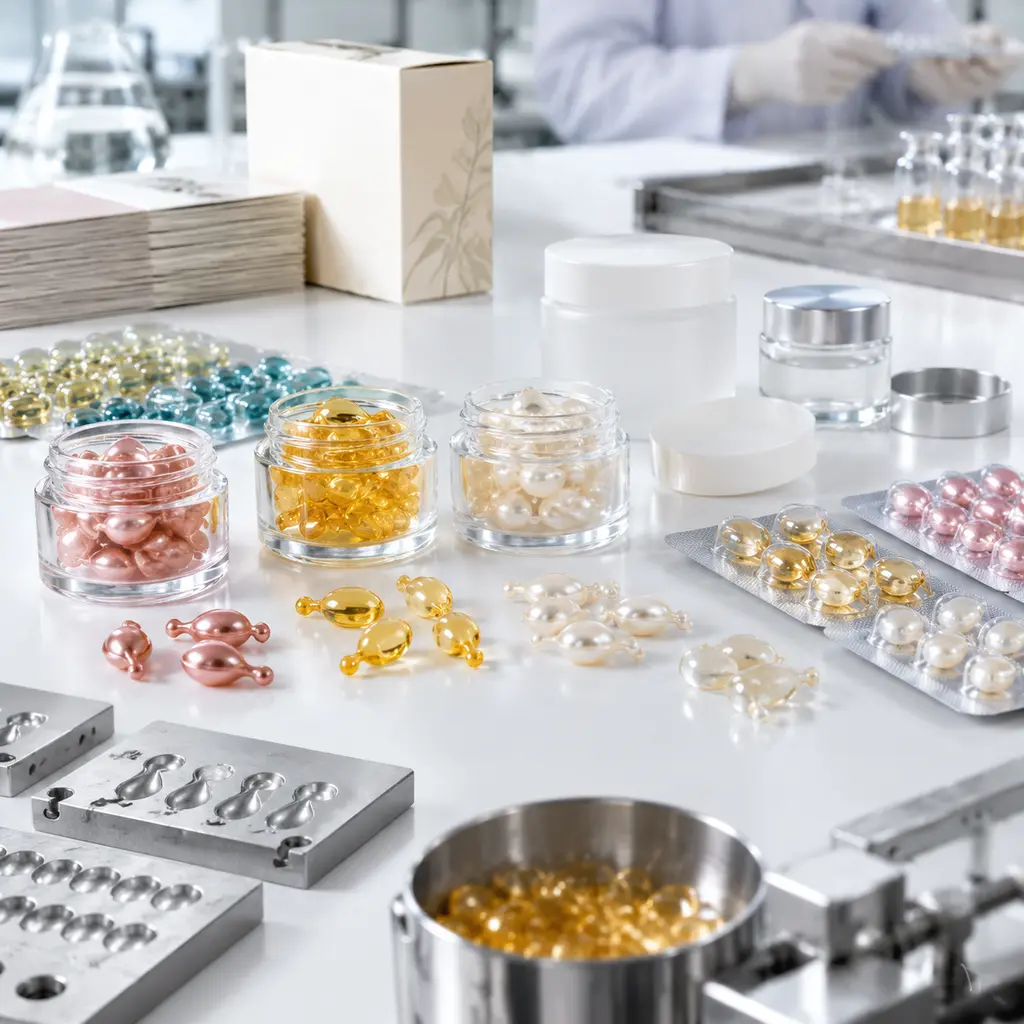
For travel skincare capsule sets packaging options, buyers should freeze six interdependent specifications before authorizing samples: fill formula, capsule shell material, target fill weight, mold geometry, primary package, and expected shipment environment. Treating the jar, blister, pouch, or secondary carton as a late-stage design decision creates avoidable leakage, oxidation, deformation, and line-validation risk.
The sample request should therefore define the commercial package, not merely the serum inside a generic capsule. Retinol capsules may require stronger light and oxygen protection than facial oil capsules. Eye serum capsules may need lower fill weight and tighter dispensing control. Vegan shells can respond differently to heat and humidity than conventional gelatin systems. A qualified serum capsules manufacturer should document these dependencies in a sample specification, compatibility plan, stability protocol, and scale-up record. Mold exclusivity, tooling ownership, replacement lead time, labeling evidence, and shipment conditions should also be agreed before physical sampling begins.

Key Takeaways for Private Label Buyers
- Source the system, not separate components. Assess formula, shell, mold, seal integrity, and package as one product configuration.
- Sample in the intended primary pack. Generic jars or laboratory bags cannot establish commercial blister or jar compatibility.
- Define measurable acceptance criteria. Specify fill-weight tolerance, leakage limits, appearance, odor, capsule deformation, and dispensing performance.
- Test distribution exposure. Heat, humidity, vibration, compression, light, and oxygen can affect capsules differently across global routes.
- Resolve tooling rights early. Document whether a custom mold is exclusive, who owns it, where it is stored, and how continuity is protected.
- Keep sample-to-scale controls unchanged. The approved formula, shell, equipment path, and packaging material should not be silently re-engineered for mass production.
Buyer Context
Travel and discovery sets concentrate supply-chain risk into a small format. A single set may combine retinol, facial oil, eye serum, cleansing oil, or hair oil capsules with different sensitivities and fill viscosities. These products can appear visually similar while requiring different shell compositions, cavity dimensions, barrier properties, and storage controls. Buyers evaluating broader skincare capsule product lines should therefore avoid assuming that one capsule-and-package architecture can support every formula.
The issue becomes material when an incumbent supplier has experienced a quality interruption, failed a social or quality audit, or lacks the line required for a new capsule category. Under those conditions, supplier substitution is not simply a purchasing event. R&D, QA, regulatory, legal, packaging engineering, and procurement must establish whether the alternative site can reproduce critical quality attributes without introducing undisclosed material or process changes.
Format selection also affects regulatory and claims review. A concentrated facial formula in a single-use capsule may invite usage or efficacy language that changes its classification in some markets. Buyers should screen claims against Australia’s TGA cosmetic-therapeutic boundary guidance and market-specific rules. For relevant formulas, ingredient substantiation can reference the CIR final report on salicylic acid in cosmetics. Saudi market entry should be assessed against SASO conformity assessment standards, rather than assuming that an EU or US dossier transfers unchanged.

Capsule Formula, Shell, Mold, and Packaging Factors
Fill Formula and Fill Weight
The ODM should disclose the target fill weight, operating tolerance, density basis, viscosity range, and method used to verify dose consistency. Low-viscosity facial oils may migrate through weak seals or expose marginal shell compatibility. Highly viscous serum fills can create incomplete dosing, stringing, or variable capsule shape. Suspended ingredients may settle before encapsulation unless mixing controls and hold times are defined.
For oxidation-sensitive products such as retinol serum capsules, buyers should request controls for bulk holding, headspace, light exposure, antioxidant strategy, and filling-room conditions. The selected package must support the same protection objective. A stable bulk formula does not establish that the filled capsule will remain stable after contact with the shell and package.
Shell Material and Seal Integrity
Shell selection should consider the fill’s polarity, water activity, solvent profile, fragrance system, and potential migration into the shell. Conventional gelatin and vegan capsule shells are not automatically interchangeable. A change in shell material can affect mechanical strength, seam formation, drying behavior, tackiness, and performance under heat or humidity.
Procurement teams assessing a cosmetic softgel capsule factory should request the shell composition, colorant status, allergen and animal-origin declarations, supplier traceability, and change-control process. For vegan positioning, documentary evidence must cover the complete shell system rather than only the principal polymer. Finished-capsule inspection should include seam quality, surface defects, leakage, brittleness, blocking, and recovery after storage stress.
Mold Geometry and Tooling Control
Capsule geometry determines more than appearance. Cavity volume, wall distribution, seam length, tail design, and twist-off behavior influence fill capacity and consumer dispensing. A custom star, pearl, teardrop, or elongated eye capsule may require dedicated tooling and different drying or sorting settings. Buyers should compare available shapes across established serum capsule products before commissioning a new mold.
The tooling agreement should identify ownership, exclusivity, maintenance responsibility, validated equipment, storage location, service life, and replacement procedure. It should also prohibit unapproved use for another cosmetic customer. If business continuity is critical, determine whether duplicate tooling can be qualified at an approved secondary line without changing the capsule’s critical dimensions.
Primary Packaging and Storage
Blisters usually provide stronger unit separation and tamper visibility, while jars can simplify filling and improve shelf presentation. However, jars expose the remaining capsules whenever opened and can permit capsule-to-capsule adhesion. Pouches reduce secondary-pack volume but require careful review of barrier structure, seal strength, puncture resistance, and consumer reclosure behavior. The packaging review should follow a documented process such as this blister packaging decision framework.
Compatibility testing should use the production-intent resin, foil, adhesive, liner, closure, desiccant, and decoration. Buyers should examine migration, odor transfer, panel distortion, capsule staining, moisture exchange, and opening force after heat and humidity storage. Shipment qualification should represent expected pallet compression, vibration, seasonal temperature exposure, and final-mile handling. Commercial capsule platforms such as CosmoPod beauty capsules also demonstrate why capsule geometry and delivery format must be evaluated as an integrated system.

Decision Framework Table
| Factor | What to Check | Why It Matters | ODM Buyer Note |
|---|---|---|---|
| Fill formula | Viscosity, density, oxidation sensitivity, suspended ingredients, and bulk hold controls | These variables affect dosing, sealing, migration, and stability | Approve a controlled formula version before tooling trials |
| Fill weight | Target, tolerance, sampling method, and line capability | Variation changes consumer dose, capsule dimensions, and declared content | Review records from multiple positions and production periods |
| Shell material | Composition, origin, colorants, allergens, and fill compatibility | The shell affects strength, leakage, claims, and regional documentation | Require formal notification before any supplier or material change |
| Mold | Cavity volume, seam design, dispensing feature, ownership, and exclusivity | Geometry governs appearance, capacity, sealing, and continuity | Define replacement and duplicate-tool qualification in the contract |
| Primary package | Barrier, closure, liner, seal, opening force, and capsule contact material | The package controls moisture, oxygen, light, contamination, and adhesion | Sample in production-intent components from approved suppliers |
| Stability | Appearance, odor, assay where relevant, leakage, deformation, and package interaction | Bulk stability alone does not establish finished-product suitability | Use protocols aligned with formula risk, market, and expected shelf life |
| Shipment | Heat, humidity, vibration, compression, case configuration, and pallet pattern | Distribution can damage an otherwise compliant factory-release batch | Link release criteria to documented lane and seasonal risk |
| Scale-up | Same formula, shell, mold, equipment path, and QC methods as approved samples | Undisclosed changes can invalidate compatibility and stability conclusions | Apply change control through the qualified skincare capsules OEM program |
ODM Manufacturing Considerations
For travel skincare capsule sets packaging options, sample approval should cover the capsule and its intended commercial pack as one system. A loose-capsule sample may look acceptable while behaving differently in a compact jar, blister cavity, or mixed discovery set. Ask the ODM to provide an approval specification recording appearance, odor, dimensions, net content tolerance, shell material, opening behavior, and acceptable defect limits. Retain signed samples from the approved pilot batch for comparison with initial production.
Formula customization should begin with a written product brief defining the intended face or hair application, sensory profile, target dose, excluded ingredients, fragrance level, and destination markets. Confirm whether the fill is homogeneous at normal storage temperatures and whether viscosity changes could interfere with pumping, encapsulation, or sealing. If salicylic acid or another restricted ingredient is proposed, the safety assessment and market limits should be reviewed against relevant resources, including the CIR final report on salicylic acid in cosmetics.
Shell selection should document the polymer or gelatin basis, plasticizer system, colorants, and any animal-origin declarations. Vegan shell options can have different moisture sensitivity and processing windows from conventional materials. Request comparative pilot samples when switching shell systems rather than assuming that an existing mold and formula will perform identically.
Select mold geometry according to dose, consumer handling, pack cavity dimensions, and the supplier’s validated operating range. Clarify whether the mold is standard, shared, exclusive, or buyer-funded; who stores it; how maintenance is recorded; and what happens if production transfers. A custom shape should also be reviewed for sharp radii, thin shell areas, difficult tear points, and orientation inside the selected package. Buyers considering different formats can review related blister packaging decisions for skincare capsules.
Packaging trials should use production-intent components, including the final jar resin, liner, blister film, lidding material, carton, insert, and any mask or cream products sharing the discovery kit. Stability protocols should include defined heat, humidity, light, and room-temperature conditions, with scheduled checks for odor change, discoloration, mass change, tackiness, deformation, and pack integrity. The protocol, acceptance criteria, and responsibility for investigating an out-of-specification result should be agreed before testing begins.
MOQ discussions should separate capsule manufacturing quantity, packaging-component quantity, decorated component quantity, and finished-set assembly quantity. Also confirm the sampling scope, paid tooling, setup losses, overrun policy, and disposition of unused printed material. Required labeling documents may include the ingredient list, specifications, certificate of analysis, safety data where applicable, origin declarations, batch coding format, artwork approval, and market-specific claim support. Australia-bound projects should check Australia’s TGA cosmetic-therapeutic boundary guidance, while Saudi-bound projects should review applicable SASO conformity assessment standards.
Finally, define shipment conditions: maximum transit temperature, humidity precautions, carton count, pallet pattern, storage orientation, desiccant use, and handling of partial cartons. This becomes especially important when a group adopts new carbon-reporting requirements or replaces a supplier following serious audit findings. Procurement should request traceable logistics records and verified environmental data rather than relying on broad sustainability statements.

Common Problems or Failure Cases
- Shell brittleness: Capsules crack during handling when moisture balance is unsuitable or when aging changes shell flexibility. Compare conditioned samples with freshly produced capsules and record breakage rates.
- Sticking or deformation: Capsules may adhere to one another in a jar or flatten under elevated temperature. Review shell composition, residual surface material, headspace, liner choice, and the number of capsules packed together.
- Fill separation: Pigments, suspended ingredients, or incompatible oil phases can create an uneven dose. Inspect retained samples at multiple temperatures and confirm whether gentle warming causes reversible or permanent change.
- Capsule leakage: Weak seams, unsuitable fill viscosity, or excessive pressure inside a tight blister cavity can release serum. Approval standards should distinguish cosmetic surface residue from an actual seal failure.
- Fragrance sensitivity: Fragrance components can alter odor, color, or shell performance over time. Evaluate the fragranced and unfragranced bases separately before selecting the final sensory profile.
- Packaging deformation: A jar, tray, or blister can warp, lose closure fit, or place pressure on capsules during warm transit. Test actual decorated components because inks, coatings, and assembly processes may change behavior.

Supplier Checklist
- Obtain the legal manufacturer name, production address, relevant cosmetic certifications, audit history, and scope of subcontracting.
- Confirm the complete fill formula, viscosity range, target content, ingredient origin requirements, fragrance status, and prohibited-material list.
- Request shell composition, allergen or animal-origin declarations, color specifications, dimensional limits, and storage requirements.
- Document mold identity, cavity design, ownership, maintenance responsibility, exclusivity, replacement lead time, and transfer terms.
- Approve a sample plan that includes naked capsules, final packaging, discovery-set assembly, and retained control samples.
- Review test protocols for temperature, humidity, light exposure, pack compatibility, and shelf-life monitoring.
- Define defect categories for cracks, tackiness, deformation, visible separation, short fill, contamination, and seal failure.
- Break down MOQ and lead time by formula batch, capsule run, decorated package, carton, and final kitting stage.
- Verify specifications, batch records, certificates, ingredient nomenclature, artwork control, coding, and destination-market files.
- Agree on shipping temperature limits, pallet configuration, release inspection, traceability, complaint investigation, and recall responsibilities.
FAQ
Should a buyer approve the capsule before approving the package?
Approve them together. The shell may perform well in bulk but deform in a shallow blister or become tacky in a crowded jar. Final approval should use commercial materials, intended capsule count, and realistic storage conditions.
How can we protect a proprietary formula from disclosure?
Require a confidentiality agreement plus operational evidence: role-based system access, access logs, segregated project folders, controlled formula printing, restricted laboratory access, and documented deletion or return of files. No supplier can promise absolute secrecy, but these controls make exposure measurable and auditable.
How should priority supply be handled during a raw-material shortage?
Ask for written allocation rules, approved alternate sources, safety-stock ownership, forecast commitments, and escalation procedures. Strategic status should be defined in the supply agreement rather than left to verbal assurances. Formula changes still require buyer approval and suitable verification.
What evidence shows that factory workers are treated fairly?
Review independent social-audit reports, corrective-action closure, payroll and working-hour samples, age-verification procedures, grievance channels, and policies against recruitment fees. Where risk is significant, reserve the right to commission an independent audit that includes confidential worker interviews.
Can one capsule design be used for every market?
Not automatically. Ingredient restrictions, cosmetic claims, language rules, responsible-party details, and conformity documentation vary. Review each destination before artwork release, especially when the same discovery set is sold through distributors in multiple regions.
What should be included in a useful ODM sample order?
Include formula variants, shell alternatives where relevant, at least one production-intent mold, final or equivalent packaging, agreed storage conditions, test checkpoints, and enough retained units for investigation. State which differences from commercial production remain unresolved.