Direct Answer
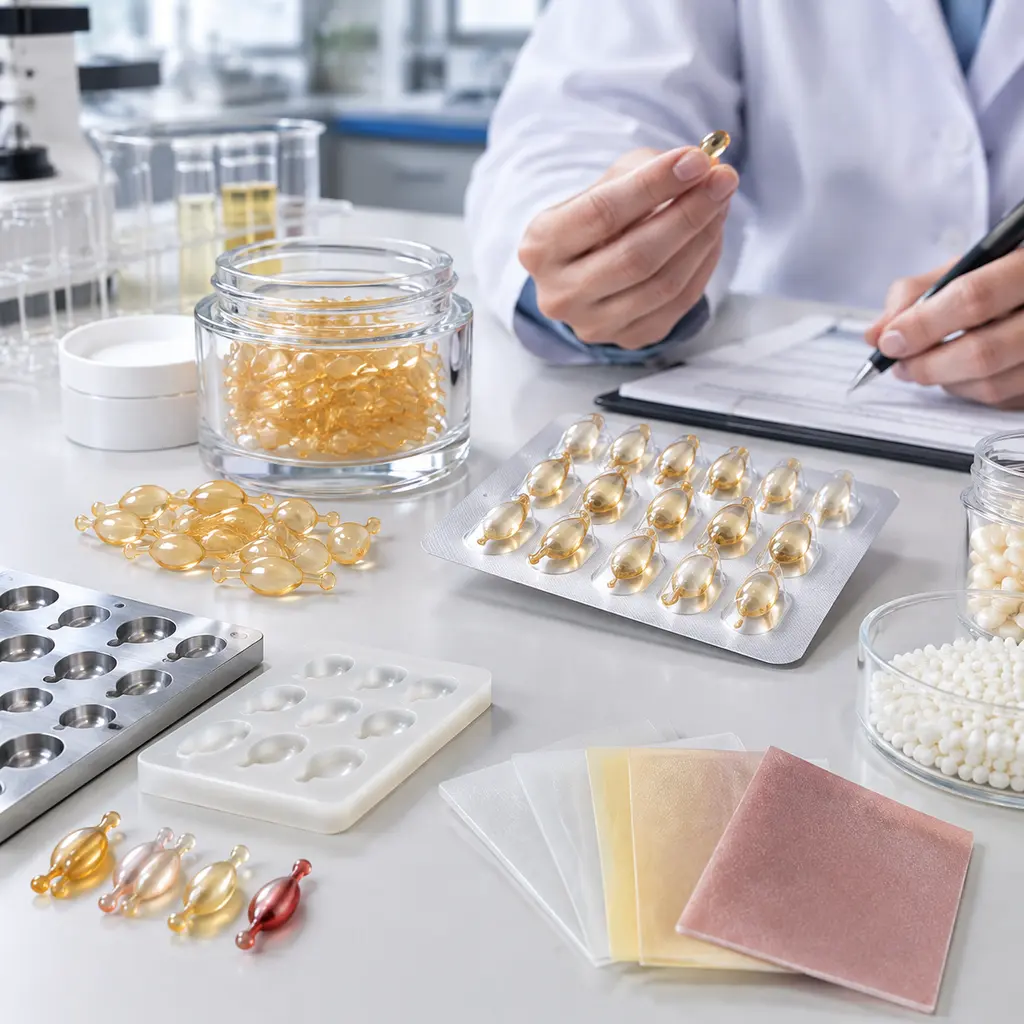
Buyers comparing single dose skincare capsules packaging options should settle the fill formula, shell material, dose weight, mold geometry, primary package, and stability protocol before authorizing samples. These elements operate as one technical system. A serum that remains stable in bulk may migrate into the capsule shell; a custom mold may create a weak seam or twist-off neck; and a blister cavity that is too tight may deform or puncture an otherwise acceptable capsule.
The correct sourcing sequence is therefore not formula first and packaging later. Procurement, R&D, QA, regulatory, and packaging engineering should approve a production-intent configuration together. Buyers evaluating a serum capsules manufacturer should request samples made with the proposed commercial formula, shell chemistry, tooling profile, blister or jar materials, and shipment configuration. Loose capsules alone cannot establish package compatibility, shelf-life performance, or scale-up readiness.

Key Takeaways for Private Label Buyers
- Freeze the serum formula, shell system, fill weight, mold, and primary packaging as one controlled specification.
- Require production-intent materials and tooling; hand-filled or substitute-component samples have limited qualification value.
- Match oxygen, light, heat, and humidity protection to the most sensitive ingredients, especially in retinol capsules.
- Define leakage, seam integrity, dimensional variation, opening performance, and fill-weight acceptance criteria before testing.
- Separate capsule, tooling, blister, carton, and printing minimum quantities when assessing pilot and launch exposure.
- Approve labeling documents, market declarations, shipment conditions, and change-control obligations before artwork lock.
Buyer Context
Single-dose formats concentrate multiple failure modes into a small cosmetic component. The fill can remain visually acceptable while changing shell flexibility. A vegan shell may respond differently from gelatin under heat or moisture. A distinctive face, eye, cleansing, or hair oil capsule may improve dose presentation but reduce usable internal volume or introduce stress around the neck and seam.
This matters most when a multinational brand is qualifying alternate capacity after a serious quality incident, a failed third-party audit, or an unexpected production interruption. Replicating capsule color and shape without reproducing formula viscosity, shell composition, curing conditions, fill weight, and shipment protection creates false equivalence. The replacement product may pass an initial visual review yet fail during packaging, transport, or accelerated storage.
The same control discipline applies to synchronized launches. US documentation should be reviewed against the FDA’s regulatory framework for cosmetics, including facility, product, safety, and labeling obligations applicable to the project. For markets requiring religious compliance, buyers should assess shell origin, processing aids, segregation, and certification status against the JAKIM Halal certification framework. Reviewing complete skincare capsule product lines also helps procurement compare material declarations, traceability, tooling control, and packaging waste rather than focusing only on the quoted capsule.
Capsule Formula, Shell, Mold, and Packaging Factors
Fill Formula and Dose Control
Fill chemistry determines whether a capsule can be formed, sealed, stored, and opened consistently. Oils, esters, silicones, fragrances, antioxidants, surfactants, and oil-soluble actives can interact differently with each shell system. The buyer should specify viscosity, density, active sensitivity, target dose, and expected application area. Density is necessary to translate fill volume into fill weight, while viscosity influences pumping accuracy, air entrapment, seam contamination, and line speed.
For oxidation-sensitive retinol serum capsules, review compounding atmosphere, light exposure, holding time, headspace, and package barrier. Stability in a laboratory vial does not demonstrate performance in the commercial capsule and pack. The approved specification should state nominal fill weight, tolerance, sampling method, and investigation rules for drift.
Shell Material and Aging
Gelatin and plant-derived shells do not have identical moisture, temperature, and fill-polarity responses. Buyers should obtain the full material declaration, plasticizer system, colorant information, animal-origin status, allergen statement, and relevant market documentation. A vegan positioning must be supported by controlled sourcing and production records, not appearance alone. Plant-based unit-dose platforms can use materials such as carrageenan, but each supplier system requires its own compatibility evidence. Catalent’s plant-based topical capsule platform, for example, illustrates how shell material, anhydrous fill, dose format, and custom geometry are developed as an integrated technology.
A qualified cosmetic softgel capsule factory should evaluate brittleness, tackiness, discoloration, odor transfer, seam integrity, leakage, and shell-to-fill migration over time. Retained samples should be traceable by batch, storage condition, and package configuration.

Mold Geometry and Tooling Governance
Capsule length, width, wall distribution, seam position, tail design, twist-off neck, and target fill volume must be engineered together. Highly sculpted custom molds may reduce internal capacity or create local stress points. The package cavity should be developed from the controlled capsule drawing and verified production samples, allowing sufficient clearance for normal dimensional variation and distribution movement.
The quality agreement should identify tooling ownership, storage location, maintenance responsibility, revision control, access restrictions, and rules governing third-party use. A signed golden sample and controlled drawing should govern production. Buyers comparing cosmetic softgel products should also confirm whether sampling uses commercial rotary dies or temporary tooling, since seam profile and wall distribution may differ.
Packaging, Storage, and Stability
Blisters provide individual separation but require careful cavity, film, lidding, and seal-window selection. Transparent thermoformed structures support visual inspection but may offer less protection from oxygen, moisture, or light than higher-barrier alternatives. Cold-form aluminum can increase barrier protection but removes product visibility and generally requires more package area. Jar packaging may simplify counting for some serum capsule products, yet repeated opening exposes all remaining capsules to ambient conditions.
Testing should use the exact commercial capsule, blister or jar, closure, carton, and count. An illustrative stability matrix may include 25°C/60% RH, 30°C/65% RH, and 40°C/75% RH, but conditions and duration must be justified for the formula, shell, destination markets, shelf-life objective, and distribution route. Add vibration, compression, drop, and temperature-excursion review for cross-border shipment. A practical packaging review should assess cavity deformation, adhesion, seal leaks, oil migration, odor change, oxidation, and consumer opening performance.
Decision Framework
| Factor | What to Check | Why It Matters | ODM Buyer Note |
|---|---|---|---|
| Fill formula | Viscosity, density, active sensitivity, and shell interaction | Controls dosing, oxidation, migration, and leakage risk | Approve the final formula revision before package qualification |
| Shell system | Composition, plasticizer, colorant, origin, and moisture response | Determines brittleness, tackiness, and storage behavior | Require declarations, traceability, and formal change control |
| Fill weight | Nominal dose, tolerance, method, and sampling frequency | Affects consumer use and batch consistency | Review capability data from production-intent equipment |
| Mold | Geometry, seam, neck strength, drawing, and ownership | Influences manufacturability, handling, and IP control | Secure a controlled drawing and signed golden sample |
| Primary package | Cavity clearance, barrier, lidding, closure, and seal integrity | Protects capsules from deformation and environmental exposure | Test the exact commercial material combination |
| Stability | Accelerated, real-time, transport, and excursion conditions | Confirms performance through the proposed shelf life | Predefine failure criteria and reporting intervals |
| Launch file | INCI, claims, label copy, coding, and traceability records | Reduces approval delays and recall exposure | Link artwork approval to destination-market review |
Before releasing a sampling order, request a written matrix connecting every formula, shell, mold, and package combination to its test plan. A serum capsule supplier should distinguish exploratory prototypes from qualification-ready samples and identify every non-production-intent component. For multicountry private label skincare capsules, confirm that the approved formula, tooling, quality controls, and packaging specification can transfer from pilot production to commercial volume without re-engineering.

ODM Manufacturing Considerations
For single dose skincare capsules packaging options, sample approval should confirm the complete commercial configuration rather than appearance alone. The approval record should identify the serum formula version, capsule shell material, mold code, nominal dose, primary package, capsule count, color standard, fragrance level, and destination market. Keep signed samples from the development lot and require written change notification if the manufacturer later proposes different ingredients, shell components, processing conditions, or packaging materials.
Formula customization should begin with the intended use: a light eye serum capsule, richer facial oil capsule, cleansing oil capsule, or larger hair oil dose. Ask the ODM team to document viscosity, density, color, odor, active concentration, and separation behavior. A custom formula may need adjustment if it fills inconsistently, reacts with the shell, or leaves too much residue after opening. Buyers comparing retinol capsule concepts should also define acceptable changes in color, odor, and active content during storage.
Shell selection affects handling, positioning, and manufacturing feasibility. Request the exact material declaration instead of relying only on terms such as plant-based or vegan. Confirm plasticizers, colors, processing aids, allergens, and animal-origin statements where relevant. Plant-derived unit-dose formats are commercially available, but each proposed shell still requires assessment with the buyer’s own fill and package. ([catalent.com](https://www.catalent.com/self-care/skin-hair-fragrance/manufacturing/cosmopod)) The capsule technology overview and mold options can help buyers structure these decisions.
Select the mold according to application amount, opening experience, packing density, and production control. A stock shape may be suitable for an initial market launch, while a custom shape may require tooling ownership terms, maintenance responsibilities, replacement rules, and exclusivity boundaries. MOQ should be separated by component: bulk capsules, printed cartons, blister films, jars, labels, and custom tooling may each have different minimum runs. Ask whether pilot quantities use the same equipment and materials planned for commercial production.
Packaging compatibility should be reviewed using the intended capsule count and distribution configuration. For blister packs, examine cavity depth, sealing performance, puncture risk, and removal force. For jars, inspect capsule movement, surface marking, closure performance, and headspace. A review of capsule pack-count formats can help align trial, travel, and retail presentations.
Stability work should record appearance, odor, shell texture, deformation, sticking, fill consistency, package condition, and relevant chemical markers. Labeling documents should include the cosmetic ingredient list, product specifications, batch coding format, safety support, claims evidence, and market-specific declarations. The FDA states that companies marketing cosmetics are legally responsible for product safety and provides separate resources covering cosmetic labeling and registration obligations. ([fda.gov](https://www.fda.gov/cosmetics))
Shipment conditions should specify carton strength, inner protection, pallet pattern, temperature precautions, route length, and acceptance checks upon arrival. This becomes especially important when a current manufacturer has suffered a major quality event or an abrupt capacity interruption. Buyers operating under a new corporate carbon strategy should also request measurable freight, energy, waste, and packaging data before approving the supply route.

Common Problems or Failure Cases
Capsule shell brittleness: Capsules may crack during twisting, packing, or shipment if the shell loses flexibility. Review the fill-shell combination, storage environment, package protection, and elapsed time between manufacture and use.
Sticking or deformation: Facial oil capsules can adhere to one another or develop flattened areas when the shell, surface finish, heat exposure, and package geometry are poorly matched. A jar that looks satisfactory at room conditions may still permit clumping during long distribution routes.
Fill separation: A serum may show sediment, layering, or uneven color after storage. This can produce inconsistent application even when the average dose remains correct. Require inspection of individual capsules from the top, middle, and bottom of the batch rather than checking only a composite sample.
Capsule leakage: Oil around seams, necks, blister cavities, or jar walls may indicate sealing defects, physical compression, or incompatibility between the cosmetic fill and shell. Leakage acceptance limits and inspection methods should be written into the finished-product specification.
Fragrance sensitivity: Fragrance and essential-oil components can alter odor, color, shell behavior, or consumer tolerance. Evaluate the fragranced formula rather than assuming an unscented base represents the final product.
Packaging deformation: Blisters, trays, liners, or closures may warp during storage or transport. This can compress capsules, weaken presentation, or change opening performance even when the serum itself remains within specification.
Supplier Checklist
- Confirm the legal manufacturing entity, production location, applicable cosmetic certifications, and capsule-specific production scope.
- Request the complete shell material declaration, formula specification, fill target, tolerances, mold identity, and package component specifications.
- Review sample records for appearance, opening performance, fill uniformity, odor, shell condition, and packaging compatibility.
- Define stability measurements, test intervals, failure limits, retained samples, and responsibility for investigations.
- Separate MOQ, lead time, and ownership terms for capsules, molds, blister components, jars, labels, and cartons.
- Verify batch traceability from raw material receipt through filling, packing, release, and shipment.
- Request ingredient naming support, labeling files, claims documentation, safety materials, and destination-market declarations.
- Audit business-continuity controls, backup equipment, critical-material sourcing, allocation rules, and recovery plans.
- Review information-security access, formula-file permissions, confidentiality procedures, and data-retention rules.
- Inspect environmental records, labor controls, complaint escalation, recall support, and relevant insurance certificates.

FAQ
How should we confirm a serum capsule sample before production?
Approve a coded sample linked to the formula version, shell material, mold, dose, color, fragrance, package, and specification. The signed sample should not replace measurable release criteria.
Can a manufacturer guarantee that our core formula will never be disclosed?
No responsible supplier can promise absolute zero risk. Buyers should instead verify role-based system access, restricted formula files, physical document controls, confidentiality agreements, visitor rules, employee authorization, cybersecurity procedures, and documented handling of customer-owned ingredients.
How can we secure supply during a global raw-material shortage?
Ask for the approved-source list, alternate-material qualification process, inventory policy, allocation rules, forecast requirements, and written priority terms. Strategic status is meaningful only when capacity reservations, forecast commitments, and escalation procedures are documented.
What environmental and labor evidence should an international buyer request?
Request permits, waste and emissions records, energy and carbon data, worker-hour and wage records, age-verification controls, grievance channels, and recent independent audit reports. Confirm whether original records can be traced during an unannounced or customer-appointed assessment.
Do vegan capsule shells automatically meet Halal requirements?
No. Plant-derived material does not by itself establish Halal certification. Review every formula and processing input, manufacturing controls, and the certification route required for the target market. The JAKIM portal provides certification procedures, status verification, and application channels for domestic and international organizations. ([halal.gov.my](https://www.halal.gov.my/))
Should MOQ be confirmed before or after sampling?
Discuss it before sampling and confirm it again after specifications are frozen. Formula customization, shell color, capsule mold, printed packaging, testing scope, and component purchasing can create separate quantity thresholds.
What should be checked when shipping serum capsules internationally?
Confirm route duration, expected temperature exposure, carton and pallet design, inner cushioning, batch documents, customs labeling, and arrival inspection. Retain pre-shipment samples so deformation, leakage, odor, and fill condition can be compared if a complaint occurs.
References
- The FDA’s regulatory framework for cosmetics — U.S. regulatory, labeling, safety, registration, and compliance resources.
- The JAKIM Halal certification framework — certification procedures, application channels, and status verification.
- Catalent CosmoPod beauty capsules — an industry example of plant-based topical unit-dose capsule formats.
- Blister packaging for skincare capsules — capsule, package, and sampling decisions for private-label buyers.