Retinol Capsule Packaging Technical Requirements: Decisions Before Formula and Shell Development
Direct Answer
Retinol capsule packaging technical requirements should be defined before the fill formula, capsule shell, mold, or pilot sample is finalized. The primary pack is not a downstream purchasing choice; it is part of the product stability system. A jar, blister, pouch, or dispensing format changes oxygen exposure, light protection, moisture transfer, capsule deformation risk, line configuration, and shipment resilience. Those variables can alter retinol potency, shell flexibility, leakage behavior, and consumer opening performance.
For procurement teams evaluating retinol serum capsules, the correct starting document is an integrated product-package specification covering fill composition, target fill weight, shell chemistry, mold geometry, headspace control, barrier performance, closure integrity, storage conditions, and transport testing. A qualified cosmetic softgel capsule factory should then validate the commercial formula, capsule, and final packaging together rather than extrapolating from bulk serum data or unfilled package certificates.
Key Takeaways for Private Label Buyers
- Freeze the intended jar, blister, pouch, or secondary barrier concept before approving the capsule shell and mold.
- Assess retinol oxidation, oil migration, shell plasticization, moisture exchange, and leakage as one compatibility system.
- Specify fill weight by target, allowable tolerance, sampling method, and test frequency rather than by nominal claim alone.
- Run stability in the final sale pack, including closure components, liners, desiccants, and induction seals where applicable.
- Confirm that pilot and commercial samples use equivalent ingredients, tooling, filling equipment, and sealing parameters.
- Link artwork approval to substantiated net-content, ingredient, warning, traceability, and market-registration documents.

Buyer Context
Serum-capsule sourcing creates a different control problem from conventional bottled essence. Each unit has a high surface-area-to-fill relationship, and the shell remains chemically active throughout shelf life. A change in plasticizer, color system, oil polarity, antioxidant package, or storage humidity can therefore affect both appearance and mechanical performance. This is particularly material for encapsulated retinol skincare, where oxygen and light management must be considered alongside shell compatibility.
The same governance applies across skincare capsule product lines. Facial oil capsules may soften if the fill migrates into the shell. Eye serum capsules require controlled opening geometry and additional attention to intended use; claims and directions should be reviewed against the FDA’s eye-area cosmetic safety framework. Cleansing oil and hair oil capsules may require different fill viscosity, shell thickness, and dispensing behavior. Vegan capsule shells introduce another supplier and processing matrix rather than functioning as a direct material substitution.
This issue becomes operationally urgent when a brand is qualifying alternate capacity after a quality incident, line interruption, or adverse social-compliance audit. It is equally important when an established cosmetics group enters softgel skincare without internal capsule tooling expertise. In either case, transferring only a formula sheet is insufficient. Procurement needs a controlled design history that connects raw materials, process settings, package specifications, testing protocols, and approved suppliers. The FDA Cosmetics Labeling Guide should also be built into artwork governance for products entering the United States.
Capsule Formula, Shell, Mold, and Packaging Factors
Fill Formula and Oxidation Control
Retinol is normally evaluated in an anhydrous or tightly moisture-controlled oil system, but an oil base does not eliminate degradation risk. Buyers should request the active’s assay basis, carrier identity, antioxidant system, raw-material storage controls, manufacturing light controls, and maximum permitted oxygen exposure. Nitrogen blanketing or reduced-headspace practices may support oxidation control, but they do not replace package-barrier validation. Stability evidence should use an assay method capable of distinguishing genuine potency retention from visual acceptability. Relevant method development and cosmetic stability research can be reviewed through the International Journal of Cosmetic Science.
Shell Material and Fill Compatibility
The shell specification should identify the film-forming polymer, plasticizer, water range, colorants, opacifiers, and animal-origin status. Gelatin and plant-derived systems do not necessarily run on identical drying curves or tolerate the same fill ingredients. Fragrance components, solvents, surfactants, and certain low-molecular-weight oils can migrate into the shell, leading to tackiness, brittleness, swelling, or seam weakness. Buyers assessing private label serum capsules should require compatibility screening on the exact commercial ingredient grades, not merely on ingredients with similar INCI names.
Fill Weight, Mold, and Opening Performance
Fill weight determines dose consistency, capsule dimensions, material consumption, and label declarations. The ODM specification should state the target mass, operating tolerance, test method, sample size, and escalation rule. A custom mold must also control body geometry, seam location, wall distribution, and twist-off or cut-open behavior. A visually distinctive tail that tears unpredictably is a quality liability. Tool ownership, maintenance, cavity identification, replacement lead time, and access during business-continuity events should be documented before approving custom cosmetic softgel products.

Primary Packaging, Storage, and Stability
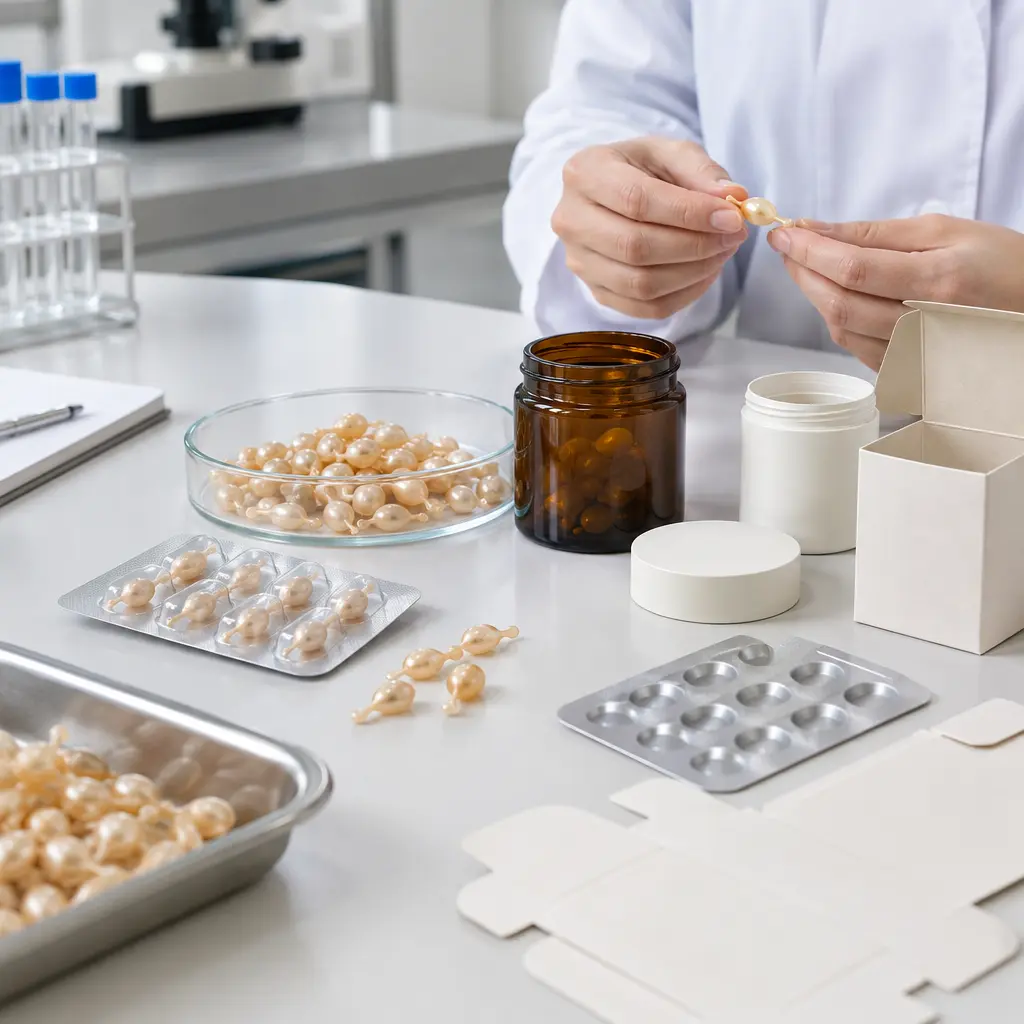
Blisters generally provide stronger unit-level separation and tamper evidence, while jars can simplify consumer handling but repeatedly expose the remaining capsules to ambient air and humidity. Pouches can add barrier protection but require seal-integrity and puncture-resistance controls. For every format, review light transmission, oxygen and water-vapor barrier, closure torque, liner compatibility, headspace, capsule-to-wall abrasion, count accuracy, and opening behavior after aging.
A defensible protocol normally combines real-time storage, accelerated conditions such as 40°C/75% RH, and a controlled condition such as 25°C/60% RH when appropriate to the destination market and company standard. These conditions are examples, not universal release rules. Include thermal cycling, vibration, drop or compression exposure, and post-transit leakage inspection for the intended shipping configuration. For Middle East distribution, packaging and documentation planning should also reflect the Dubai Municipality Montaji registration system and local heat exposure. The selected serum capsules manufacturer should provide predefined acceptance criteria for assay, leakage, shell appearance, odor, opening force, and package integrity.
Decision Framework
| Factor | What to Check | Why It Matters | ODM Buyer Note |
|---|---|---|---|
| Fill formula | Retinol grade, carrier oils, viscosity, antioxidants, fragrance, and moisture | Controls oxidation, machinability, migration, and dispensing | Lock commercial ingredient grades before compatibility approval |
| Capsule shell | Polymer, plasticizer, water range, color system, and origin declarations | Determines flexibility, seam strength, and heat or humidity response | Require supplier change control and traceable certificates |
| Fill weight | Target, tolerance, sampling plan, equipment capability, and records | Affects dose consistency, dimensions, claims, and yield | Compare pilot and mass-production measurement methods |
| Mold | Geometry, cavities, seam, opening feature, ownership, and maintenance | Influences leakage, appearance, opening, and continuity of supply | Define tooling access and replacement responsibility contractually |
| Primary package | Barrier data, closure, liner, seal, headspace, abrasion, and compatibility | Protects the capsule through shelf life and consumer use | Test the exact resin, color, decoration, and component supplier |
| Stability and shipment | Assay, leakage, appearance, opening performance, transit, and climate | Identifies failures not visible during initial sampling | Approve acceptance criteria, pull points, deviations, and retained samples |
| Labeling documents | INCI list, net content, batch code, warnings, claims, and market files | Reduces registration delays and artwork rework | Keep formula, specification, test report, and artwork versions aligned |

ODM Manufacturing Considerations
Converting retinol capsule packaging technical requirements into an ODM project requires a controlled sequence of sample, specification, and production decisions. The buyer should avoid approving a capsule only by appearance. Sample confirmation should cover the fill formula, shell composition, nominal fill weight, capsule dimensions, opening behavior, fragrance level, color tolerance, package format, and storage instructions. A signed reference sample is useful, but measurable acceptance criteria should govern future batches.
Formula customization begins with the intended sensory profile and use area. The development team should document fill viscosity, oil polarity, ingredient solubility, fragrance content, antioxidant system, and expected application dose. A formula that flows well in a facial serum capsule may be unsuitable for a smaller eye serum capsule or a mold with a narrow neck. Buyers should also confirm whether proposed ingredients can remain uniformly distributed during filling and throughout the planned shelf life. The available retinol capsule product routes can help procurement teams distinguish between formula-led and package-led development paths.
Shell selection commonly involves gelatin-based or plant-derived systems. The decision should account for formula interaction, regional positioning, humidity response, color, opacity, and opening feel rather than relying only on a vegan or conventional claim. For more background, buyers can review vegan skincare capsule options. Mold selection then establishes capsule geometry, cavity volume, tail design, and practical fill range. Existing molds generally shorten development, while a new shape requires tighter dimensional approval and a clearer ownership agreement.
The chosen jar, blister, pouch, or secondary carton should be evaluated with actual capsules from the intended shell and fill combination. Check capsule movement, headspace, closure fit, liner interaction, odor retention, scuffing, and deformation under expected distribution conditions. A jar that performs well for facial oil capsules may not provide the same protection for a retinol serum capsule with a different shell or count.
The stability program should monitor appearance, odor, fill uniformity, shell flexibility, opening force, mass change, and package condition at scheduled intervals. MOQ discussions should separately identify formula batch minimums, capsule-forming minimums, printed component minimums, and any excess packaging commitment. Before production, request the ingredient list, specifications, batch records available to the buyer, safety documentation, label copy review, lot coding format, and market-specific declarations. US-bound labels should be checked against the FDA Cosmetics Labeling Guide. Shipment instructions should state temperature precautions, carton orientation, pallet limits, container loading method, and whether data loggers are required.

Common Problems or Failure Cases
Shell brittleness: Capsules may crack during packing or consumer opening when the shell loses too much moisture or when the formulation changes shell flexibility. Confirm the failure across unopened controls and packaged samples before blaming transportation alone.
Sticking or deformation: Capsules can adhere to one another, flatten, or develop surface impressions after heat exposure, excessive compression, or an unsuitable shell-fill combination. High capsule counts in a small jar can make the problem worse.
Fill separation: Suspended colorants, powders, or poorly solubilized ingredients may settle, creating inconsistent appearance or delivery. Review mixing time, holding time before encapsulation, and samples taken at the beginning, middle, and end of filling.
Leakage: Pinholes, weak seams, damaged tails, overfilling, or local package pressure can release serum. The investigation should map defect location and production timing rather than reporting only a total reject percentage.
Fragrance sensitivity: Fragrance components can alter odor over time or affect shell behavior. Evaluate the fragranced version itself; results from an unfragranced base are not automatically transferable.
Package deformation: Thin jars, liners, or blisters may warp, loosen, or place pressure on capsules during warehousing and shipment. Component drawings and assembled-pack samples should be approved together.

Supplier Checklist
- Obtain the legal manufacturing site name, relevant cosmetic manufacturing certifications, and the actual encapsulation location.
- Confirm shell material, color system, ingredient restrictions, and written compatibility rationale for the proposed fill.
- Record viscosity range, nominal fill weight, permitted variation, capsule dimensions, and defect definitions.
- Review mold ownership, maintenance responsibility, cavity identification, and replacement procedure.
- Request pilot samples in the final jar, blister, or pouch rather than evaluating loose capsules only.
- Agree on observations, test intervals, acceptance limits, retained samples, and responsibility for out-of-spec results.
- Separate MOQ figures for bulk formula, formed capsules, decoration, printed cartons, and market-specific labels.
- Verify ingredient naming, warnings where applicable, net contents, responsible-party details, batch coding, and supporting label documents.
- Document shipment temperature precautions, pallet configuration, carton strength, loading limits, and deviation reporting.
- Assess backup capacity if the current manufacturer has experienced a serious quality event, labor disruption, or sudden capacity loss.
- For corporate carbon targets, request site-specific energy and emissions records with reporting boundaries and verification status.
FAQ
Can a factory guarantee that our core formula will never be disclosed?
No responsible supplier can promise absolute protection. Buyers should verify role-based system access, separated project files, restricted sample rooms, confidentiality clauses, download logs, visitor controls, employee obligations, and procedures for disposing of formula documents. The agreement should also define ownership of custom work and remedies for unauthorized disclosure.
How can we secure supply during a global raw-material shortage?
Ask for the approved supplier list, lead-time assumptions, safety-stock policy, allocation rules, and documented alternatives for critical oils, retinol grades, shell inputs, and packaging components. Strategic-customer priority should appear in a supply agreement; it should not depend on a verbal assurance. Any substitute still requires written buyer approval and an appropriate confirmation program.
What insurance evidence should be requested for a major quality complaint?
Request current certificates for product liability and, where relevant, product recall coverage. Check policy territory, insured products, per-occurrence limit, annual aggregate, exclusions, deductibles, and whether the buyer can be named as an additional insured. Insurance supports financial recovery but does not replace traceability or a written complaint-response process.
Should we approve the formula before choosing the capsule shell?
Not completely. Formula and shell development should progress together because oil composition, viscosity, fragrance, and active loading can influence shell performance. An early formula direction is necessary, but final approval should use the intended shell, mold, fill weight, and commercial package.
Is a jar or blister preferable for retinol capsules?
Neither format is universally preferable. Blisters isolate individual capsules but require suitable cavity dimensions and sealing materials. Jars simplify consumer access but expose the remaining capsules whenever opened. Decide using the product count, distribution climate, consumer use pattern, component barrier properties, and assembled-pack findings.
What should an ODM approval sample include?
It should include capsules from a representative pilot run, the final or production-equivalent package, fill and shell specifications, fill-weight data, ingredient documentation, proposed label copy, lot-code example, and clear notes identifying any components that are not yet production standard.
References
- FDA Cosmetics Labeling Guide — US cosmetic labeling principles and required label information.
- Dubai Municipality — official access point for the Montaji registration system and Dubai market requirements.
- International Journal of Cosmetic Science — peer-reviewed cosmetic science research that can inform development methodology, while not replacing product-specific evidence.