Direct Answer
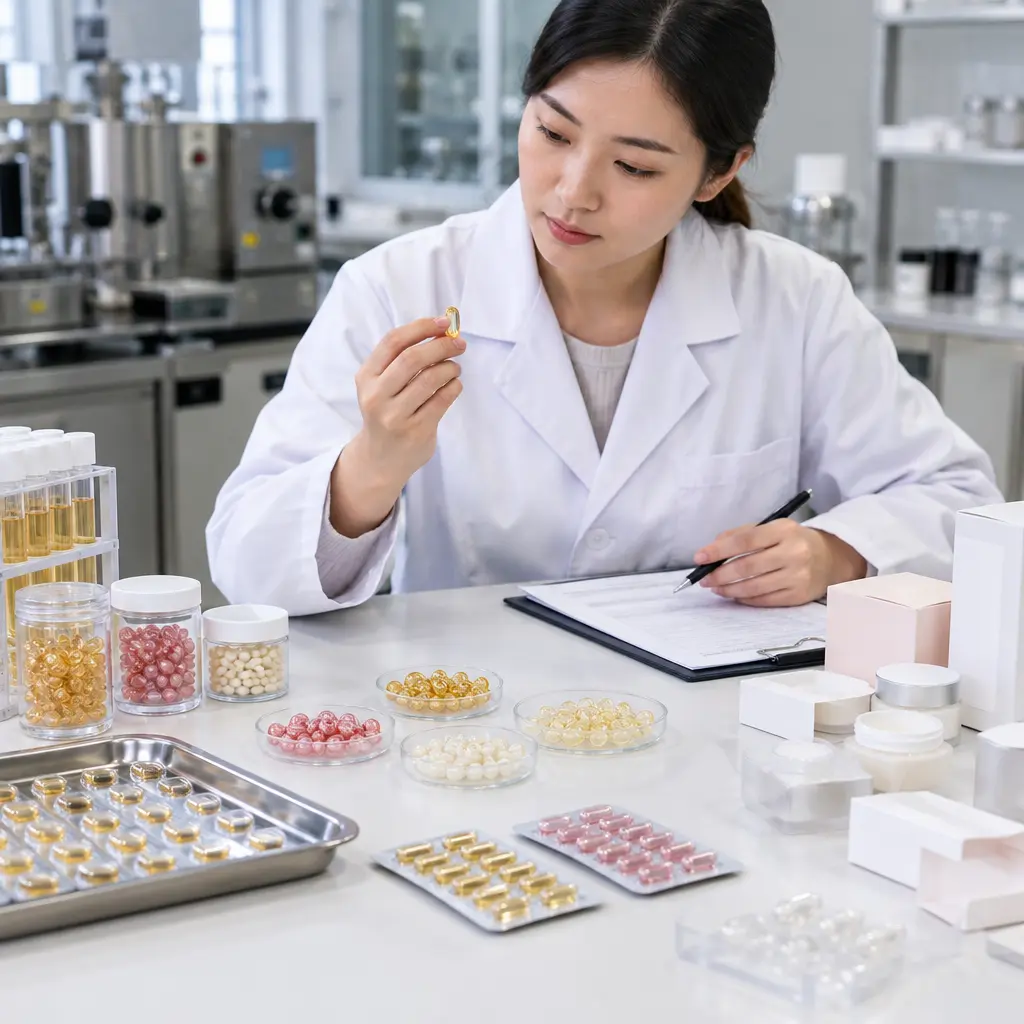
A cosmetic softgel factory due diligence buyer guide should treat capsule evidence and factory evidence as two separate approval gates. First, confirm that the fill formula, shell material, seam design, fill weight, mold, and final packaging remain compatible throughout storage and shipment. Second, verify that the manufacturer can reproduce the approved capsule under controlled conditions, with traceable materials, calibrated equipment, documented change control, and credible business-continuity measures.
Do not approve a serum capsules manufacturer from samples, certificates, or commercial claims alone. Require batch-level records, stability data in the intended package, leakage and oxidation controls, labeling documentation, and objective evidence of ISO 22716 implementation. Claims such as pilot production from 1,000 units or development in under 30 days should be tested against line scheduling, component readiness, validation scope, and compliance lead times. The central question is not whether a supplier can make an attractive capsule. It is whether the supplier can repeatedly deliver the same approved product across markets, seasons, and disruption scenarios.
Key Takeaways for Private Label Buyers
- Scope the product before the factory: Freeze the fill, shell, mold, fill-weight specification, package, and target markets before comparing suppliers.
- Evaluate evidence by SKU: Data for facial oil capsules cannot automatically support retinol, eye serum, cleansing oil, or hair oil capsules.
- Test the marketed package: Bulk stability does not establish compatibility with a jar, blister, liner, closure, or secondary carton.
- Audit execution, not certificates: Review production records, deviations, training, calibration, traceability, and corrective actions behind ISO 22716 claims.
- Link launch timing to unresolved risks: Shell migration, leakage, oxidation, artwork, or shipment qualification can invalidate an accelerated development schedule.
- Separate approval from allocation: Technical qualification does not prove that capacity, critical materials, or molds will remain available during a supply interruption.

Buyer Context
Serum capsules concentrate formulation, dosage, primary packaging, and consumer delivery into one unit. This creates dependencies that conventional bottled serum sourcing does not have. A change in oil polarity may soften the shell; an antioxidant adjustment may alter color; a heavier fill may stress the seam; and a different jar liner may change moisture exposure. Buyers reviewing serum capsule products therefore need an integrated specification rather than separate formula and packaging approvals.
The risk becomes material when an incumbent supplier has experienced a quality event, failed an unannounced social-compliance audit, or cannot meet a new group carbon-disclosure requirement. Supplier transfer is rarely a simple formula handoff. Existing tooling may be proprietary, shell composition may differ by factory, and processing settings may not be portable. A second source must demonstrate equivalence without quietly reformulating the approved sample.
Category differences also matter. Retinol capsules require disciplined light and oxygen control. Facial oil and hair oil capsules may place different demands on viscosity and dispensing. Eye serum capsules require close attention to dose consistency and opening behavior. Cleansing oil capsules may contain surfactants that interact with shell materials. Vegan shells can support specific positioning, but their humidity response and sealing window must be assessed rather than inferred from gelatin systems.
Capsule Formula, Shell, Mold, and Packaging Factors
Fill Formula and Fill Weight
Begin with a complete quantitative formula, ingredient specifications, supplier identities, allergen statements, and defined acceptance criteria. Softgel fills are commonly anhydrous or predominantly oil-based because water, volatile solvents, surfactants, and certain polar ingredients can migrate into or weaken the shell. The factory should explain how it controls viscosity during filling, prevents entrapped air, limits oxidation, and manages temperature-sensitive actives.
Fill weight must be stated as a target with justified release limits, not as a nominal marketing dose. Review in-process sampling from the beginning, middle, and end of a run, plus finished-capsule weight variation and reconciliation. A private label serum capsules program should also define acceptable appearance, seam integrity, opening force, residue, odor, and dispensing performance.
Shell Material and Active Compatibility
Request the full shell composition, including gelatin or plant-derived polymers, plasticizers, colorants, opacifiers, processing aids, and relevant origin declarations. For vegan shells, determine whether the system uses modified starch, carrageenan, cellulose-derived materials, or another polymer platform. The label claim must align with supplier declarations and market requirements.
Compatibility testing should assess brittleness, tackiness, deformation, sweating, discoloration, and fill migration. Retinol and other oxidation-sensitive actives need assay or another justified stability-indicating method, not visual inspection alone. For exfoliating actives, safety and use conditions should be reviewed against sources such as the CIR final report on alpha hydroxy acids. Natural or organic positioning should be checked against the COSMOS organic and natural cosmetics standard rather than accepted from an ingredient-level statement.

Mold, Seam, and Scale-Up Control
Custom shape is not purely an aesthetic decision. Mold geometry affects shell distribution, seam length, fill capacity, drying behavior, ejection, and the consumer opening experience. Confirm mold ownership, storage, maintenance, replacement lead time, exclusivity, and transfer rights. Compare pilot and commercial equipment to determine whether scale-up changes the die, pump, drying conditions, or inspection method.
Buyers reviewing cosmetic softgel products should require approved golden samples and measurable specifications. Photographs are useful for alignment but insufficient for release. The control plan should define dimensions, fill weight, leakage criteria, seam appearance, and defect classification.
Packaging, Storage, and Stability
Stability must use capsules produced by a representative process and packed in the intended market configuration. Jars require assessment of closure torque, liner interaction, headspace, desiccant strategy, repeated opening, and capsule-to-capsule abrasion. Blisters require cavity fit, seal integrity, barrier performance, opening force, and foil compatibility. Secondary packaging should protect light-sensitive retinol serum capsules without relying on consumer storage behavior to compensate for inadequate protection.
The protocol should include real-time and justified accelerated conditions, heat and humidity exposure, light where relevant, and transport simulation reflecting actual lanes. Freeze-thaw or low-temperature work may be necessary when distribution conditions create that risk. Evaluate leakage, shell aging, odor, color, active retention, microbial quality where applicable, and dispensing performance. Shipment specifications should define palletization, case orientation, temperature controls, excursion handling, and data-logger responsibilities.
Regulatory files should be assessed against the FDA’s regulatory framework for cosmetics and current FDA cosmetics guidance documents. Buyers should distinguish facility registration and product-listing obligations from any suggestion of product approval. Comparable discipline is required for ingredient review, claims support, responsible-person files, notification data, and market-specific labeling.

Decision Framework Table
| Factor | What to Check | Why It Matters | ODM Buyer Note |
|---|---|---|---|
| Fill formula | Quantitative composition, viscosity range, oxygen controls, active specifications | Fill chemistry can alter shell strength and stability | Prohibit substitutions without written change approval |
| Capsule shell | Polymer source, plasticizer, colorants, origin and vegan declarations | Shell composition affects labeling, humidity response, and leakage | Verify declarations to lot-level records |
| Fill weight | Target, release limits, in-process sampling, reconciliation | Dose inconsistency creates performance and compliance risk | Review capability data from representative runs |
| Mold and seam | Ownership, dimensions, seam criteria, maintenance, transfer rights | Tooling failure can interrupt supply or prevent dual sourcing | Document access before commercialization |
| Packaging | Jar or blister barrier, liner, seal, closure, opening performance | The final package controls moisture, oxygen, light, and damage | Approve the complete pack, not bulk capsules |
| Stability and shipment | Real-time, accelerated, transport, excursion, and final-pack data | Laboratory appearance alone does not predict distribution performance | Set launch gates for unresolved failure modes |
| Factory governance | ISO 22716 records, deviations, CAPA, traceability, ESG and continuity evidence | Certificates do not establish sustained operational control | Audit the actual cosmetic softgel capsule factory and approved subcontractors |
| Portfolio transfer | SKU-specific evidence across the capsule skincare collection | One successful model does not qualify every formula and package | Use separate risk files for each commercial SKU |
ODM Manufacturing Considerations
ODM approval should convert the proposed formula, capsule, and commercial requirements into a controlled product specification. This becomes especially important when a brand is qualifying a backup source after a production interruption or responding to a corporate requirement for lower-carbon strategic suppliers.
Sample confirmation: Require samples that represent the intended production process rather than hand-filled presentation pieces. The confirmation record should identify the formula version, target fill weight, shell type, capsule shape, color, fragrance, packaging components, and acceptance criteria. Keep signed or digitally approved reference samples under defined storage conditions. If changes are made later, assign a new version instead of relying on informal email approval. Buyers comparing development pathways can review typical serum-capsule OEM and ODM services.
Fill formula customization: Define whether the project uses a supplier base, a modified base, or a buyer-owned formula. For retinol, facial oil, eye serum, cleansing oil, or hair oil capsules, obtain the full ingredient list, target active concentration, processing tolerances, and restrictions on fragrance, colorants, antioxidants, and origin claims. Ask how the factory evaluates separation, sediment, odor drift, and changes in flow behavior during filling. Development samples should be tested at the proposed fill mass rather than assessed only as bulk serum.
Shell and mold selection: Confirm the exact polymer or gelatin system, plasticizing system, color package, and any animal-origin or vegan declaration. Different shell systems respond differently to oils, fragrance materials, water traces, and environmental exposure. Review available shapes through documented capsule mold options, then confirm cavity dimensions, nominal capacity, visual tolerances, tooling access, and replacement responsibility. A distinctive shape may improve brand recognition but can increase qualification work and constrain alternate sourcing.
Packaging compatibility and stability review: Test the selected capsule directly in the intended jar, pouch, or blister materials, including decorative coatings and internal surfaces. The review plan should cover appearance, odor, shell feel, capsule recovery after compression, formula uniformity, and package condition under normal and stressed storage. For sensitive products, such as retinol capsules, define light exposure and headspace requirements in the written protocol.
MOQ, documents, and shipment: Separate the MOQ for bulk capsules from minimums for custom shells, molds, printed cartons, blisters, and decorated jars. Request a cost model showing which minimum applies at each stage and what happens to unused components. The document package should include the ingredient declaration, certificate of analysis format, batch identification method, country-of-origin support, claim substantiation supplied by the manufacturer, and artwork approval history. Shipping specifications should state case count, pallet pattern, temperature or humidity limitations, maximum transit duration, and the procedure for assessing delayed or exposed shipments.

Common Problems or Failure Cases
Shell brittleness: Capsules may crack during handling when the shell loses flexibility or when the shell formulation is poorly matched to the fill. Compare retained samples across storage conditions and record breakage during dispensing, not merely visual appearance in an unopened package.
Sticking or deformation: Facial oil capsules can adhere to one another, flatten, or take impressions from adjacent units. Likely contributors include shell composition, residual surface material, excessive compression in the package, and unsuitable heat or humidity exposure. Establish an objective limit for clumping and the force needed to separate capsules.
Fill separation: A serum may appear uniform in bulk yet develop sediment, layering, or active concentration differences after encapsulation. Investigate mixing time, hold time before filling, ingredient solubility, and temperature history. Sampling should represent different points in the batch and multiple finished packages.
Leakage and odor transfer: Small amounts of oil around capsules can spread through a jar and make the failure appear larger than the initial defect. Fragrance components may also soften a shell, migrate into package materials, or create odor differences after storage. Fragrance-free and fragranced versions should not be assumed equivalent.
Packaging deformation: A jar, liner, tray, or blister may warp, haze, stain, or absorb oil even when the capsules remain intact. Cosmetic appearance is part of the acceptance standard because deformation can affect dispensing, labeling, and customer perception.
Supplier Checklist
- Identify the legal manufacturer, production address, subcontractors, and processes performed off-site.
- Match approved sample codes to the formula version, shell specification, mold, fill target, and final package.
- Verify shell composition, origin declarations, allergen statements, and vegan support where applicable.
- Review controls for fill flow, mixing, hold time, mass variation, visible defects, and batch reconciliation.
- Request evidence from heat and humidity storage using the commercial capsule and package configuration.
- Confirm separate MOQs and lead times for formula, shell color, mold, printed components, and finished goods.
- Check ingredient naming, warnings, responsible-party details, batch coding, net contents, and market-specific label files.
- Define deviation approval, change notification, retained-sample access, complaint investigation, and recall responsibilities.
- Document shipping limits, pallet configuration, data-recording expectations, and disposition rules for excursions.
- Assess cybersecurity access controls, raw-material continuity, labor practices, environmental records, and commercial insurance evidence.
A structured request package can be aligned with the supplier’s serum-capsule manufacturing capabilities before commercial quotation and sample approval.

FAQ
Can a factory guarantee that our core formula will never be disclosed?
No supplier can credibly promise absolute protection. Ask for role-based system access, segregated project folders, formula-code use on production records, download logs, employee confidentiality terms, backup controls, and restrictions on subcontractor access. The quality agreement should define ownership, permitted use, breach notification, and return or destruction of files.
How can a buyer secure priority during a global raw-material shortage?
Request a written allocation policy, approved alternate sources, safety-stock rules, forecast commitments, and escalation contacts. Strategic priority should be linked to measurable capacity or inventory reservations rather than a verbal assurance. Pre-approve alternatives only after capsule and formula testing.
What proves that environmental and carbon records are transparent?
Review permits, waste and wastewater records, energy data boundaries, emissions calculations, corrective actions, and independent audit reports. Confirm whether records cover the actual capsule site and whether source data can be traced. A headquarters carbon-neutrality target does not by itself demonstrate factory-level performance.
How should labor-practice risks be checked?
Use independent social-audit evidence plus payroll, age-verification, working-hour, grievance, and corrective-action records. Interview access and unannounced assessment rights improve confidence. Check whether temporary workers and labor agencies are included, especially during production peaks.
What insurance evidence matters for a major quality complaint?
Request current product-liability and recall-policy certificates, covered territories, exclusions, per-event limits, aggregate limits, and the insured legal entity. Have qualified counsel or an insurance adviser assess whether coverage aligns with expected sales and capsule-related recall exposure.
Which sample should become the commercial approval standard?
Use a documented pilot sample made with the intended formula, shell system, capsule geometry, fill target, and package. Approval should include measurable criteria and retained units, not only photographs or a subjective assessment of color and feel.
References
- The FDA regulatory framework for cosmetics provides United States regulatory context for cosmetic responsibilities and labeling.
- FDA Cosmetics Guidance Documents consolidate current agency guidance relevant to cosmetic businesses.
- The COSMOS organic and natural cosmetics standard is a reference point when organic or natural certification claims are included in a capsule project.