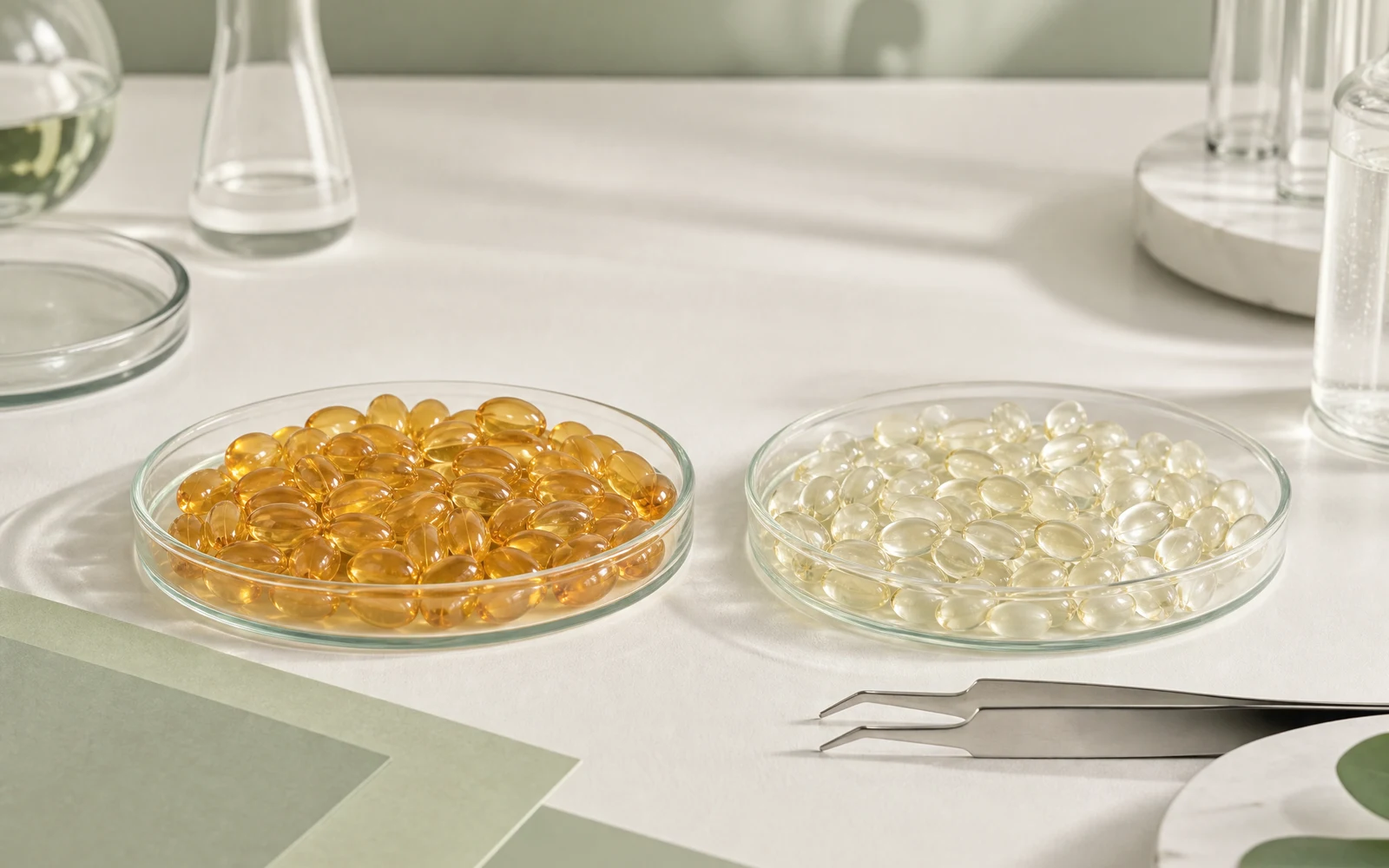
Short answer: choose gelatin when it fits the actual formula and the brand has no material requirement that rules it out; choose a vegan shell when the project has a defined plant-based requirement and the complete formula-plus-package route can support it. Neither shell is automatically better. Compare compatibility, market needs, claim scope, capsule appearance, package route and validation work for the finished product.
Project decision
- Start with non-negotiable market and brand requirements, then test feasibility with the actual fill.
- Do not treat a vegan or halal positioning label as proof of finished-product suitability.
- Record shell, formula and package versions together during sample review.
Shell selection is often treated as a marketing decision: gelatin for a conventional soft capsule and a plant-based shell for a vegan line. That is incomplete. In cosmetic capsules, the shell and fill must work together through manufacturing, packaging, storage and consumer use. A brand can set a vegan positioning objective, but the project still needs to establish whether the chosen material suits the fill and the proposed production route.
Start with the non-negotiables
Before comparing shell materials, list the project constraints. These are the facts that should guide the discussion with a manufacturer, not generic descriptions from a supplier catalogue.
- Target market and the claims or declarations the brand intends to make.
- Fill type, including oil phase, active ingredients, fragrance direction and any known handling sensitivities.
- Capsule shape, size, visual target and consumer break-open experience.
- Primary packaging, secondary packaging and expected distribution conditions.
- Evidence the brand needs before it can represent the product as vegan, plant-based or otherwise positioned.
The Vegan Skincare Capsules page is the right starting point for a vegan capsule conversation. It should be followed by a formula and shell review, rather than being treated as a guarantee that every formula can use the same shell direction.
Compare the project, not the label
| Question | Why it matters |
|---|---|
| What is in the fill? | Compatibility is specific to the formula. Discuss the complete fill route, not only the hero active ingredient. |
| What should the capsule feel and look like? | Shell selection affects appearance, handling and how the consumer opens a single-dose product. |
| What does the brand need to claim? | Vegan and related claims require a documented supply-chain and formulation review appropriate to the market. |
| What is the package and storage path? | The outer format and conditions can affect the behaviour of the finished capsule system over time. |
| What must be proven before launch? | The team needs a defined sample, test and approval process for the selected formula, shell and package. |
Where gelatin can be a practical route
Gelatin shell options may fit a capsule project when they are compatible with the formula and brand requirements. The relevant point is not that gelatin is universally easier or harder to run. It is whether the chosen material supports the intended fill, capsule geometry, package and consumer proposition. A buyer should ask what the manufacturing team has actually evaluated for the proposed formula, and what still needs to be confirmed through samples.
Where a vegan shell can be a practical route
A vegan shell may be important where brand positioning or channel requirements make it a material requirement. The buyer should define what “vegan” means for the project, including shell inputs, formula inputs, processing aids and the evidence expected by the brand or market. Avoid using the claim in artwork or sales copy until the responsible quality, regulatory and brand teams have reviewed the full product route.
The same discipline applies to related terms such as plant-based, clean, halal or natural. They can have different meanings across customers and markets. A technical sample may establish feasibility, but it does not by itself settle the claim substantiation question.
Use a controlled sampling sequence
For shell selection, the sample stage should answer a small number of specific questions. Keep a written comparison between candidates rather than relying on memory after a presentation.
Sample review checklist
- Does the capsule meet the visual target and handle consistently?
- Does it open in a way that suits the intended application?
- Is the fill amount appropriate for one use?
- Does the proposed package protect and present the capsule format coherently?
- What remaining technical, regulatory or claim questions need formal review?
Pair this shell review with the fill-weight selection guide and the stability review checklist. The three decisions influence one another: a shell is not selected in isolation from dose, formula and packaging.
Questions to ask a capsule manufacturer
A useful supplier conversation should be detailed enough to expose uncertainty. Ask which shell routes are being proposed for the actual fill, what packaging directions the team considers, what sample quantity and information are needed, and which points require testing or qualified review before production. Also ask how the supplier records changes between formula, shell and packaging versions so that the final approval is traceable.
For a structured project conversation, use PZIK OEM/ODM services with the formula intent, market, shell preference, pack format and quantity range. That provides a more useful starting point than asking for a generic vegan or gelatin capsule price.
Compare shell options with the complete project in view
Gelatin and vegan shell discussions often become oversimplified because the material label is easy to understand. The project decision is harder. Buyers need to compare the material against the fill, capsule geometry, opening experience, package, market language and validation work. A shell that works for one formula and one channel may not be the right route for another.
| Decision dimension | Questions for either shell route | Buyer consequence |
|---|---|---|
| Formula compatibility | How does the actual fill behave with the proposed shell during manufacture, storage and use? | A label preference cannot replace a representative sample review. |
| Brand positioning | Is gelatin, vegan, plant-based or another claim a genuine product requirement? | Claims should not be finalized before the full route is reviewed. |
| Appearance | What color, clarity, shape and surface finish does the brand need? | Shell direction affects photography, packaging and range consistency. |
| Opening experience | How will the user remove, open and apply one capsule? | The shell must support the intended routine, not only look right. |
| Evidence and documentation | What supplier, quality and market documents are required? | The buyer needs a documented basis for claims and procurement approval. |
Use the 6-question shell selection gate
The 6-question shell selection gate is our own project framework, not an industry standard. It helps a buyer decide whether the shell discussion is ready to move to sampling. If any answer is unknown, record it as an open question instead of silently assuming that the shell is suitable.
Question 1: What is non-negotiable?
Some projects have a true vegan or gelatin exclusion requirement. Others have a preferred positioning but remain open to comparison. State the difference. A preference can guide the sample route; a non-negotiable requirement may determine which options are screened out before sampling.
Question 2: What is in the fill?
Record the formula type, oil phase, active ingredients, fragrance direction, color target and any known sensitivities. Compatibility is specific to the fill, not to the hero ingredient name alone. A shell comparison should use a representative formula direction whenever possible.
Question 3: What should the capsule do?
Define the single-use amount, application area and opening experience. A shell is part of the delivery format. If the consumer needs a clean opening, controlled release or a particular tactile experience, make that a sample question rather than a late-stage assumption.
Question 4: What package will carry it?
Review primary packaging, count, carton, storage and distribution assumptions. A shell and fill that look good in a laboratory tray may need a different presentation in a blister, jar or travel set. Packaging should be part of the comparison whenever it can affect the finished product.
Question 5: What can the brand claim?
Separate brand intention from substantiation. Words such as vegan, plant-based, halal, clean or natural can require different evidence depending on the market and the brand’s policy. A shell sample can support feasibility; it does not automatically approve the claim language.
Question 6: What must be proven before launch?
List the evidence needed for the project: formula and shell review, package compatibility, quality documentation, market review, label information or another agreed checkpoint. The answer should be attached to the product version that was actually reviewed.
Where gelatin may be a practical route
Gelatin may be a practical route when it fits the formula, consumer experience, brand policy and target markets. It can be a useful comparison route for an early project because the buyer can focus on fill behavior, capsule appearance, opening and package before making a final positioning decision. That does not make gelatin universally better or simpler. It means the route may be useful when it satisfies the project constraints.
A buyer should still ask what documentation is available, which claims are permitted for the intended market and how the shell will be represented in the finished product information. If the brand serves a market or channel that excludes gelatin, a technically attractive sample may not be commercially usable. The shell selection must therefore remain connected to the sales plan.
Where a vegan shell may be a practical route
A vegan shell may be essential when plant-based positioning is a defined brand or channel requirement. The project should specify what the brand means by vegan, what evidence is expected and whether the formula, processing aids, packaging and supply chain need review. Do not treat the word “vegan” as a substitute for a documented product route.
Vegan positioning can also affect how the product is presented. The capsule appearance, color, transparency, shell feel and package may all be part of a plant-based story. A buyer should review whether those elements match the brand’s expectations and whether any changes to formula or shell direction alter the intended consumer experience.
Run a fair shell comparison
When comparing gelatin and vegan shells, keep as many other variables constant as practical. Use the same formula direction, intended amount, mold family and package concept for the first comparison. Then record what changed. If the shell, fill and package all change at once, the buyer may not know which variable created the difference.
Shell comparison record
- Formula version and fill direction used for each sample.
- Shell material and any positioning or documentation requirement.
- Mold, capsule shape, target fill amount and opening method.
- Appearance, surface, clarity, color and package presentation.
- Consumer application notes: release, spread, feel and residual product.
- Technical or quality questions that remain open after the sample review.
- Decision status: compare again, proceed to package review, or stop this route.
Do not confuse shell selection with claim approval
The shell material is one part of a claim story. A vegan capsule does not automatically prove that every formula input, processing aid or package component meets the brand’s claim policy. A gelatin capsule does not automatically answer every market or labeling question either. The responsible process is to define the claim, identify the evidence needed and have the appropriate quality or regulatory owner approve the finished language.
The same caution applies to halal and other market-positioning language. A certificate or supplier statement may support due diligence, but the buyer should confirm which entity, product, process and market the document covers. PZIK’s factory and quality pages are a starting point for evidence questions; they are not a replacement for project-specific verification.
Questions to put in the RFQ
A shell-specific RFQ should make the buyer’s priorities visible. State whether the requirement is mandatory, preferred or open. Explain the formula direction and intended use. Describe the package and market. Ask the manufacturer to propose a comparison route when a final decision cannot yet be made. This creates a better conversation than asking for a generic price for a vegan or gelatin capsule.
| RFQ question | Why ask it |
|---|---|
| Which shell routes are feasible for this fill direction? | It keeps the discussion tied to the actual formula rather than a catalogue label. |
| What sample information will be recorded? | It protects traceability between shell comparison and production planning. |
| What package should be used for the comparison? | Shell behavior and presentation may change inside the final pack. |
| What claim or documentation questions remain open? | It prevents a marketing preference from being mistaken for substantiation. |
| What changes would trigger another review? | It makes formula, shell, mold and packaging change control explicit. |
When not to force a shell decision
Do not force a final gelatin-versus-vegan decision when the formula direction is still unstable, the target market is unknown, the package has not been considered or the brand has not defined what its claims mean. In those cases, a comparison sample can still be useful, but the outcome should be recorded as a development decision rather than a final launch approval. The goal is to reduce uncertainty, not to create false certainty.
FAQ
Is a vegan capsule automatically more premium?
No. Premium positioning depends on the complete product experience: formula, capsule appearance, opening, package, instructions, claims and channel. A vegan shell may be essential for one brand and irrelevant to another.
Can a gelatin shell be used for a skincare capsule?
It may be suitable for a project when the formula, brand policy, market and quality route support it. Confirm the actual fill, shell and package through sampling rather than relying on a generic material description.
Does a vegan shell prove the finished product is vegan?
No. The finished-product claim may require review of formula inputs, processing, supply chain, documentation and market wording. Treat shell selection as one part of the claim review.
Should buyers compare both shells even if vegan is preferred?
That depends on the project. If vegan is non-negotiable, screen out routes that cannot meet the requirement. If vegan is a preference, a controlled comparison may reveal useful technical and commercial tradeoffs before the final decision.
What should I send a manufacturer for shell selection?
Send the product route, formula direction, target market, claim preference, intended amount, capsule shape, package concept and quantity range. State what is mandatory and what is open for discussion.
Request a shell comparison brief
Send PZIK your formula direction, target market, shell preference, intended capsule use and packaging idea. We can help turn gelatin-versus-vegan positioning into a sample and documentation plan with open questions clearly identified. Request a capsule shell review.
About this guide
This guide is a manufacturer-side comparison framework. It does not certify a finished product as vegan, halal, natural or compliant in any market. Those conclusions require the appropriate product, quality and regulatory review for the specific formula, shell, package and claim.
Decision summary
Choose the shell direction that supports the complete project. Gelatin may be appropriate for one formula and commercial route; a vegan shell may be essential for another. The right decision comes from an evidence trail covering the fill, shell, capsule format, package and intended claims. That process protects the buyer from treating an attractive positioning label as proof of finished-product suitability.