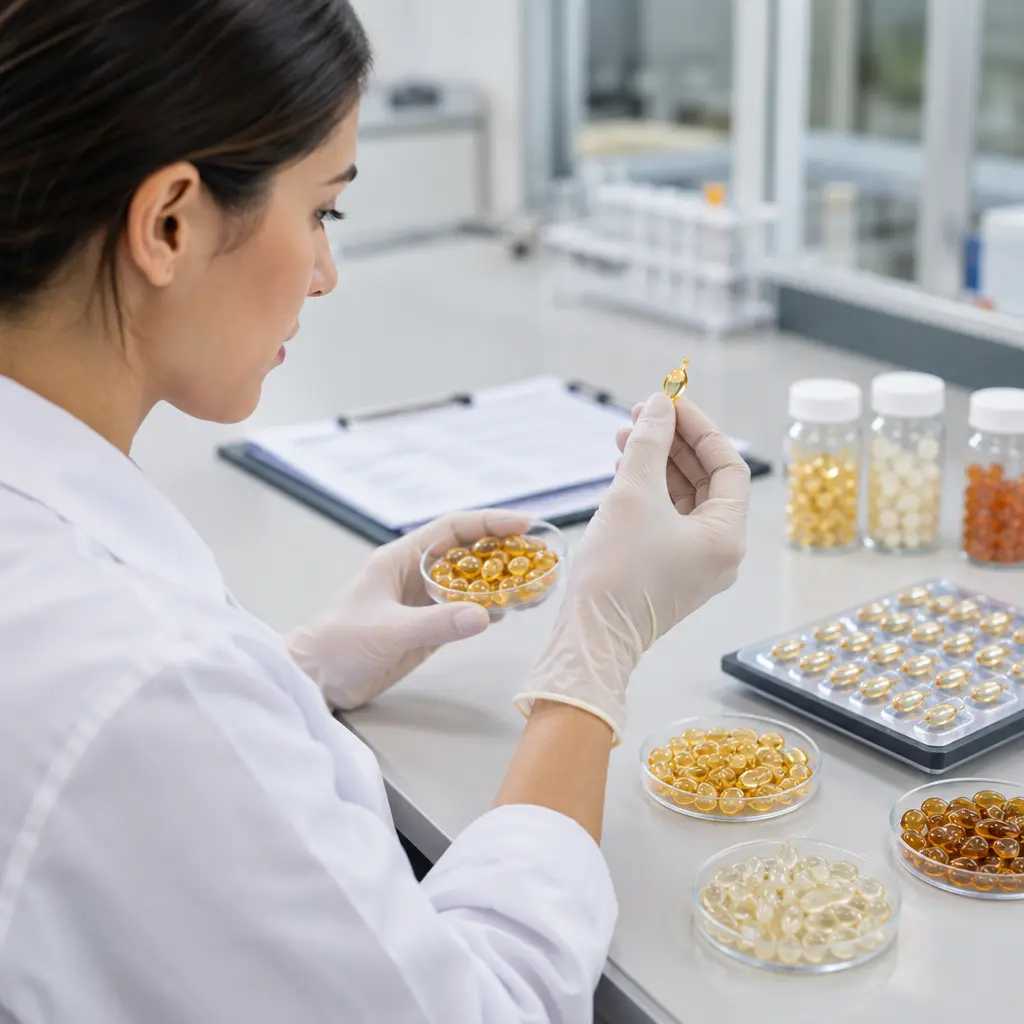
Direct Answer
A reliable capsule sample feedback process quality checklist should convert buyer observations into measurable specifications, controlled revisions, and documented approval gates. Buyers should assess six linked areas: fill formula, shell material, capsule geometry, fill weight, package compatibility, and stability under expected storage and shipment conditions. Comments such as ‘too soft,’ ‘oily,’ or ‘leaking’ are insufficient unless translated into testable acceptance criteria.
For each sample round, the ODM should issue a version-controlled specification showing what changed, why it changed, which materials or process parameters were affected, and whether previous stability or compatibility evidence remains applicable. Approval should cover both the bulk fill and the finished capsule-packaging system. This discipline is especially important for retinol, facial oil, eye serum, cleansing oil, and hair oil capsules because shell-fill interaction, oxygen exposure, and heat can alter performance after an apparently acceptable initial sample.

Key Takeaways for Private Label Buyers
- Define the sample. Confirm whether it was produced on laboratory equipment, a pilot line, or the intended commercial line. A visually acceptable hand-made capsule does not establish production repeatability.
- Separate preference from nonconformance. Color, fragrance, break force, and after-feel may be preference decisions; leakage, oxidation, fill-weight variation, and seal failure are quality risks.
- Freeze the complete specification. Approval should identify the formula version, shell composition, mold, nominal fill weight, packaging components, and applicable test methods.
- Test the final pack. Evaluate capsules in the intended blister, jar, pouch, or unit-dose format rather than relying only on bulk storage data.
- Control every revision. Any change to oils, antioxidants, pigments, shell plasticizers, capsule dimensions, or package materials should receive documented impact assessment.
- Do not release artwork prematurely. Label dimensions, count claims, topical-use directions, warnings, and product identity should follow confirmation of the commercial capsule and package configuration.
Buyer Context
Serum-capsule sampling is not merely a sensory approval exercise. It is an early test of whether the supplier can preserve the same product definition through scale-up, registration, and routine manufacturing. Procurement teams reviewing a replacement serum capsule supplier after a quality incident or capacity interruption should therefore examine the supplier’s change-control behavior as closely as the sample itself.
The risk profile varies by format. Retinol serum capsules require particular attention to light and oxygen control. Facial and hair oil capsules may place different solvent or swelling stresses on the shell. Eye serum capsules require precise dose delivery and controlled rupture behavior. Cleansing oil capsules must release cleanly without leaving shell fragments in normal use. Vegan shells may require different moisture management from gelatin-based systems. A custom mold introduces further dependencies involving cavity dimensions, seam geometry, tooling ownership, and replacement lead time.
These issues become material when a brand is adding a capsule category that its current factory cannot manufacture, or when a candidate ODM has received significant findings during an independent quality or labor audit. A mature buyer should review the capsule skincare collection to establish relevant manufacturing experience, but portfolio breadth is not a substitute for batch records, deviation controls, traceability, and audit evidence.
Cosmetic capsules must also be clearly differentiated from an ingestible supplement through product identity, directions, pack design, and labeling review. United States market planning should align with the FDA’s regulatory framework for cosmetics and the agency’s cosmetic GMP inspection checklist. ISO 22716 alignment should be supported by current certification scope and audit records, not only a logo in a presentation.

Capsule Formula, Shell, Mold, and Packaging Factors
Fill Formula and Oxidation Control
Request the qualitative ingredient list, quantitative ranges where confidentiality permits, raw-material specifications, antioxidant strategy, and manufacturing controls for oxygen-sensitive ingredients. Fill viscosity should be measured using a defined method, temperature, spindle, and speed; an unqualified viscosity number is not comparable. For encapsulated retinol skincare, review assay or other justified marker testing over time and verify that sample handling did not expose the formula to conditions unlike commercial production. Scientific rationale for ingredient performance can be checked against peer-reviewed research indexed by PubMed/NCBI, but literature does not replace finished-product testing.
Shell Material and Fill Weight
The supplier should disclose the shell-forming polymer, plasticizer system, colorants, opacifiers, and relevant animal-origin or vegan declarations. Buyers of private label skincare capsules should inspect tackiness, brittleness, odor, seam integrity, deformation, and residue after storage. Nominal fill weight and permitted variation must be defined in the approved specification, supported by an in-process sampling plan and calibrated equipment. Net-content compliance should be assessed at finished-pack level, not inferred from a small number of attractive capsules.
Mold, Rupture, and User Performance
Capsule shape affects dose perception, filling behavior, seam length, package count, and rupture force. Confirm whether the mold is standard or custom, who owns the tooling, and whether the same mold will be used for scale-up. Compare samples from multiple cavities where applicable. The approval protocol for cosmetic softgel capsule factory production should define acceptable dimensions, seam appearance, opening behavior, and delivered dose without relying solely on photographs.
Packaging, Storage, and Stability
Test the capsule and package as one system. Jar headspace, induction seals, liners, desiccants, blister barrier properties, and closure torque can influence oxidation, moisture exchange, and physical damage. Example stability conditions may include 25°C/60% RH and 40°C/75% RH, with refrigerated or freeze-thaw studies added when justified by formula and distribution risk. These conditions are protocol examples, not universal shelf-life evidence. Study duration, sampling points, test attributes, and acceptance limits should reflect target markets and shipment lanes. A recognized cosmetic stability testing guide can support protocol design, while the ODM remains responsible for product-specific justification.
Before approving cosmetic softgel products, require observations for leakage, shell softening, brittleness, color shift, odor, assay where relevant, fill weight, microbial quality, and package integrity. Shipment simulation should address compression, vibration, and temperature exposure expected in the distribution model.
Decision Framework Table
| Factor | What to Check | Why It Matters | ODM Buyer Note |
|---|---|---|---|
| Formula identity | Version, ingredient specifications, viscosity method, oxidation controls | Prevents undocumented reformulation between sample and production | Request a signed change log for every revision |
| Capsule shell | Polymer, plasticizer, origin declarations, seam condition, aging behavior | Shell-fill incompatibility can cause leakage, tackiness, or brittleness | Verify vegan or animal-origin claims through supplier documentation |
| Fill weight | Nominal target, tolerance, sampling frequency, equipment calibration | Controls dose consistency, count claims, and finished-pack compliance | Review pilot-line data rather than laboratory averages alone |
| Mold and tooling | Geometry, cavity consistency, ownership, maintenance, replacement plan | Tooling changes can alter seams, appearance, and package fit | Record the approved mold identifier in the master specification |
| Packaging | Blister barrier or jar closure, liner, headspace, seal, capsule count | The pack may accelerate oxidation or physical deformation | Approve the market-ready pack, not an interim sample container |
| Stability and shipment | Conditions, intervals, attributes, acceptance limits, transport simulation | Initial appearance does not demonstrate shelf-life performance | Link each report to the exact formula, shell, and package versions |
| Sample scope | Quantity, production method, commercial-line equivalence, retained samples | Clarifies what the sample can and cannot validate | For pilot planning, confirm whether the skincare capsules OEM can scale without formula re-engineering |

ODM Manufacturing Considerations
ODM sampling should convert a product concept into measurable acceptance criteria. Before approving a serum capsule, buyers should confirm the target fill texture, capsule dimensions, delivered dose, appearance, fragrance level, opening behavior, primary packaging, and intended sales regions. A signed specification and retained approval sample are more reliable than approval based on photographs or informal messages.
Sample Confirmation and Formula Customization
Each submission should identify the formula code, shell composition, mold reference, nominal fill quantity, packaging configuration, production date, and storage history. Feedback should distinguish mandatory corrections from preferences. For example, leakage is a release issue, while a request for a softer after-feel may require a separate development round.
Fill formula customization can affect both sensory performance and manufacturability. Ask the ODM team to define acceptable viscosity, ingredient solubility, color variation, odor, and separation limits. Increasing botanical oils, powders, fragrance, or oxidation-sensitive ingredients may change flow during encapsulation or affect the shell over time. Buyers developing retinol capsules or facial oil capsules should require an ingredient rationale and evidence appropriate to the intended cosmetic claims.
Shell, Mold, and Packaging Decisions
Confirm whether the shell is gelatin-based or plant-derived, along with colorants, opacifiers, plasticizers, and relevant allergen or origin declarations. Different shell systems can respond differently to the same oil blend, storage environment, and packaging. For vegan skincare capsules, obtain written composition and origin records rather than relying only on a marketing statement.
Mold selection influences dose, appearance, opening force, and line efficiency. Standard shapes may simplify tooling and scheduling, while a custom shape can require additional trials and replacement-tool planning. Approval should cover cavity consistency, seam quality, tip formation, and whether the mold can maintain the intended fill quantity without creating an oversized or fragile capsule.
Packaging should be assessed with actual production-representative capsules. Evaluate whether capsules become compressed, adhere to each other, lose fragrance, or change appearance in the proposed jar, pouch, or blister. Decorative coatings, inserts, liners, adhesives, and printed materials should also be reviewed because packaging deformation or odor transfer can undermine an otherwise acceptable sample.

Stability, MOQ, Documents, and Shipment Conditions
A stability plan should define test batches, checkpoints, acceptance limits, and the final pack format. Record appearance, odor, shell condition, fill homogeneity, leakage, and package integrity. The sample may support an initial decision, but it does not replace review of pilot or commercial-scale output.
MOQ discussions should separate formula batch size, encapsulation run size, shell-color requirements, printed component quantities, and finished-product assembly. This helps buyers identify which element is setting the commercial minimum. It is particularly important when a brand is qualifying a backup factory after an incumbent supplier experiences a quality event or sudden capacity interruption.
Before production, request the ingredient list using INCI names, finished-product specification, batch coding format, certificate-of-analysis format, safety data where applicable, fragrance or allergen statements, artwork approval record, and market-specific label review responsibilities. Under the FDA’s regulatory framework for cosmetics, companies placing cosmetics on the US market remain responsible for product safety and compliant labeling.
Shipment approval should state carton configuration, pallet requirements, maximum stacking, lot segregation, acceptable transit exposure, and inspection steps after arrival. Samples sent by air may not represent the compression, dwell time, or temperature variation of a commercial ocean shipment.
Common Problems or Failure Cases
- Shell brittleness: Capsules crack during handling or opening. Investigate shell moisture balance, storage exposure, shell composition, and excessive compression inside the primary pack.
- Sticking or deformation: Capsules clump, flatten, or develop surface marks. Possible causes include unsuitable storage, interactions with the fill, inadequate curing, or excessive pack pressure.
- Fill separation: Pigments, powders, or oil phases become visibly uneven. Confirm mixing order, hold time before encapsulation, temperature controls, and whether the formula remains uniform throughout the run.
- Leakage: Oil appears around the seam or opening tip. Review seal formation, shell thickness, fill quantity, fill-shell interaction, and damage during packing or transportation.
- Fragrance sensitivity: Odor changes, migrates into packaging, or becomes stronger after storage. Compare fragranced and fragrance-free samples and assess whether the fragrance affects shell performance.
- Packaging deformation: Blisters warp, jar inserts compress capsules, or closures loosen. Repeat the assessment using final materials and production-equivalent filling and distribution conditions.
A corrective report should identify the affected lot, observed defect rate, probable cause, containment action, revised sample, and evidence that the correction did not create another failure. Cosmetic changes alone should not close a leakage or integrity investigation.
Supplier Checklist
Use this capsule sample feedback process quality checklist when comparing serum-capsule OEM/ODM suppliers:
- Confirm legal manufacturer identity, production site, relevant licenses, audit status, and capsule-line capabilities.
- Request full shell composition, ingredient origin declarations, and compatibility rationale for the selected fill.
- Define fill viscosity, nominal quantity, tolerances, appearance, odor, separation, leakage, and opening-performance criteria.
- Verify mold reference, ownership or usage rights, maintenance responsibility, cavity controls, and replacement timing.
- Review sample, pilot, and commercial batch differences before final authorization.
- Approve the actual jar, blister, liner, insert, carton, and closure combination.
- Agree on stability checkpoints, test attributes, failure thresholds, retain samples, and reporting format.
- Separate MOQ requirements for formula, encapsulation, custom shell color, mold, and printed packaging.
- Check INCI documentation, specifications, analysis records, artwork control, claims support, and traceable batch codes.
- Define defect classification, inspection level, change-notification period, complaint investigation, and recall cooperation.
- Review business-continuity arrangements for critical ingredients, capsule shells, tooling, utilities, and logistics.
- Specify shipping cartons, palletization, transit monitoring, arrival inspection, and handling of damaged lots.

FAQ
How many sample rounds should a custom capsule project require?
There is no universal number. A straightforward change may need one correction round, while a new fill, shell, mold, and pack combination can require several. Progress should depend on written acceptance results, not a promised round count.
Can a factory guarantee that our core formula will never be leaked?
No supplier can responsibly promise absolute protection. Buyers should assess role-based data access, segregated project files, restricted laboratory and production records, confidentiality agreements, access logs, backup controls, employee obligations, and procedures for returning or destroying project information.
What insurance evidence should buyers request for a major quality complaint?
Request current certificates and policy details for product liability, recall expenses where covered, geographic scope, exclusions, limits per event, aggregate limits, named insured entities, and insurer rating. Confirm whether coverage applies in every intended sales market and whether subcontracted operations are excluded.
How can buyers assess whether factory workers are treated fairly?
Review recent independent social-audit reports, age-verification procedures, payroll and working-hour samples, overtime consent, grievance channels, corrective actions, and subcontractor controls. An audit finding should be evaluated together with closure evidence rather than accepted as a paperwork exercise.
Should the approved laboratory sample be treated as the final production standard?
It should be retained as a sensory and appearance reference, but commercial approval should also rely on measurable specifications and production-scale evidence. Line conditions, material lots, hold times, and packing speeds can change capsule performance.
What happens if an ingredient or shell material changes after approval?
The supplier should provide advance written notification, the reason for change, updated documents, risk assessment, and replacement samples. Buyers should define which changes require renewed compatibility, stability, label, or claims review.
Can ingredient studies be used directly to support capsule marketing claims?
Not automatically. Research on an ingredient may use a different concentration, vehicle, population, or endpoint. Evidence from peer-reviewed research indexed by PubMed/NCBI should be evaluated against the finished cosmetic formula and the exact wording of the proposed claim.