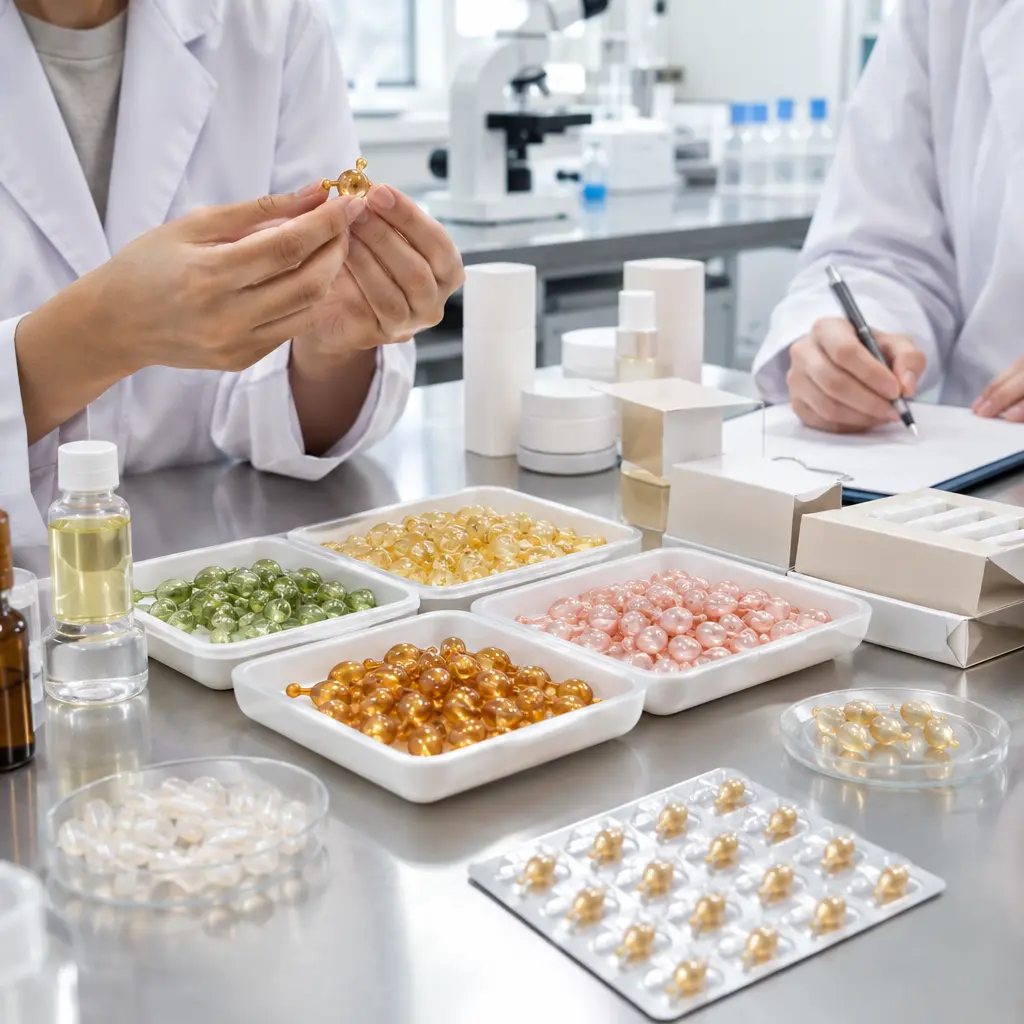
Direct Answer
An effective anti aging serum capsules RFQ checklist should resolve five matters before samples are commissioned: formula composition, capsule-shell compatibility, dose and mold specifications, packaging performance, and the evidence required for commercial release. Procurement teams should not treat the first sample as a creative exploration. It should be a controlled verification batch tied to measurable requirements and a manufacturing route that can be reproduced at scale.
For each proposed serum capsules manufacturer, request the fill formula framework, shell material and plasticizer system, nominal fill weight and tolerance, mold ownership, packaging configuration, stability protocol, shipment conditions, and sample-to-production change controls. Also establish which party owns testing, artwork review, market-access documentation, and corrective action. The central sourcing question is not whether a capsule looks acceptable on arrival. It is whether the same formula, shell, equipment, raw-material sources, and controls will remain valid through launch and repeat production.
Key Takeaways for Private Label Buyers
- Freeze the technical brief first. Define active form, target dose, fill viscosity, shell type, capsule geometry, color, fragrance, and market restrictions before requesting physical samples.
- Test the capsule as an integrated system. A stable bulk serum may still soften, stain, swell, become brittle, oxidize, or leak after contact with the shell.
- Qualify the commercial package concurrently. Blisters, jars, liners, desiccants, and secondary cartons create different moisture, oxygen, light, and abrasion risks.
- Require production-representative sampling. Confirm whether the sample uses the intended manufacturing line, mold, raw-material grades, filling temperature, and sealing process.
- Link approval to evidence. Sampling should generate agreed records for specifications, fill-weight control, stability, compatibility, labeling, traceability, and shipment release.

Buyer Context
Anti-aging capsule sourcing becomes strategically important when an incumbent supplier suffers a quality event or abrupt capacity interruption, when an audit identifies serious nonconformance, or when a brand enters a format its existing network cannot manufacture. In each case, an attractive bench sample provides little assurance against recall exposure, delayed NPD, or inconsistent regional supply.
The risk profile also varies by product. Retinol capsules require disciplined control of light, oxygen, raw-material potency, and compatibility throughout shelf life. Facial oil and hair oil capsules may appear simpler but can stress a shell through solvent behavior, fragrance components, or low-viscosity leakage. Eye serum capsules require tight dose consistency and clean evacuation. Cleansing oil capsules introduce surfactant compatibility questions. Vegan shells require confirmation of the complete shell composition rather than reliance on a general plant-based description.
Procurement should therefore assess the proposed SKU within the broader capsule skincare product lines, not as an isolated formula. Evidence from a different shell chemistry, mold geometry, fill system, or package has limited transferability. Published work in the International Journal of Cosmetic Science can inform test design, but it does not replace SKU-specific stability and packaging compatibility data.
Geographic scope must also be declared in the RFQ. Gulf-market planning should be checked against the Gulf Standardization Organization framework. If Halal positioning is intended, review certification pathways under the JAKIM Halal certification framework; vegan status alone does not establish Halal compliance. For the United States, the FDA discussion of postmarket regulation of cosmetic products reinforces the need for traceable records and postmarket controls.
Capsule Formula, Shell, Mold, and Packaging Factors
Fill Formula and Oxidation Control
The RFQ should identify the active ingredient by exact grade, carrier, concentration basis, antioxidant system, and relevant impurity or assay limits. Ask whether the fill is anhydrous, its viscosity range at filling temperature, and whether fragrance, surfactants, botanical extracts, or solvents can migrate into the shell. For encapsulated retinol skincare, require a potency test method, light-control procedure, compounding hold-time limit, and oxidation-control plan. Nitrogen blanketing may reduce oxygen exposure during compounding, but it cannot compensate for unsuitable package permeability or uncontrolled storage.
Shell Material and Aging
Specify gelatin or vegan shell architecture, colorants, opacifiers, plasticizers, allergens, animal-origin declarations, and restricted-substance requirements. A credible cosmetic softgel capsule factory should explain how shell moisture is controlled and how brittleness, tackiness, deformation, seam weakness, and fill migration are assessed over time. Buyers should request aged samples, not only freshly finished capsules, because early appearance can conceal later failure.
Fill Weight, Mold, and Dose Delivery
Nominal fill weight must be accompanied by an approved tolerance, sampling plan, test frequency, and disposition rule for out-of-specification results. Mold geometry affects seam area, mechanical strength, visual differentiation, package density, and the consumer’s ability to twist or cut the capsule and evacuate the serum. For a custom mold, establish tooling ownership, maintenance responsibility, replacement lead time, exclusivity, dimensional drawings, and business-continuity provisions. Confirm that the same mold and filling line will support both pilot and commercial runs without formula re-engineering.

Packaging, Storage, and Shipment
Evaluate blisters and jars as distinct systems. A blister can provide unit-level separation and stronger moisture or oxygen control, depending on its materials and seal integrity. A jar may improve presentation but exposes capsules repeatedly to ambient humidity, oxygen, handling, and abrasion. Require compatibility testing with the final cavity, liner, closure, desiccant, and decoration. The protocol should include intended storage, elevated heat and humidity, light exposure where relevant, transport simulation, and defined excursion handling. Shipment specifications should state carton configuration, pallet protection, allowable conditions, monitoring requirements, and release inspection.
Decision Framework Table
| Factor | What to Check | Why It Matters | ODM Buyer Note |
|---|---|---|---|
| Fill formula | Active grade, carrier, viscosity, filling temperature, antioxidants, fragrance, and surfactants | Determines chemical stability, shell interaction, and process repeatability | Compare the approved brief with the formula used for the sample and master batch |
| Capsule shell | Gelatin or vegan composition, plasticizer, moisture range, color system, and origin declarations | Controls flexibility, seam performance, claims support, and market access | Request specifications and supplier change-notification terms |
| Fill weight | Nominal dose, tolerance, sampling plan, test method, and rejection rule | Protects dose consistency and declared pack content | Review actual sample-batch distribution, not only an average result |
| Mold | Shape, dimensions, seam design, evacuation performance, ownership, and backup capacity | Affects leakage, usability, pack count, and continuity | Document whether tooling is custom, shared, or exclusive |
| Package | Blister barrier or jar closure, liner, desiccant, headspace, light protection, and abrasion | The package can accelerate oxidation, moisture exchange, or physical damage | Test the final decorated configuration rather than a substitute container |
| Stability | Assay, appearance, odor, shell aging, leakage, weight change, and package integrity | Links shelf-life decisions to product-specific evidence | Predefine test points, acceptance criteria, deviations, and reporting format |
| Scale-up | Production line, batch size, material sources, in-process controls, and change management | Reduces the risk that an approved sample cannot be reproduced | Use the same technical basis across cosmetic softgel products |
| Compliance file | Ingredient documentation, safety support, claims evidence, labeling inputs, traceability, and certificates | Prevents documentation gaps from delaying launch | Set a market-by-market responsibility matrix before purchase authorization |
A mature RFQ should also distinguish sample MOQ, commercial MOQ, sample quantity by test purpose, tooling charges, retained samples, and the status of stability work at quotation. PZIK’s operating model supports pilot runs from 1,000 units under ISO 22716 and a formulation-to-shelf cycle of under 30 days, but any accelerated schedule should remain conditional on brief completeness, packaging availability, testing scope, and regulatory review. Speed is operationally useful only when the approved skincare capsules OEM route remains unchanged at mass production.
Before sample authorization, procurement, R&D, QA, regulatory, legal, and packaging teams should sign one controlled specification. That document should identify unresolved assumptions and define which sample outcomes permit progression, require reformulation, or stop the project. The objective is not merely a visually acceptable capsule. It is a transferable, auditable, and repeatable manufacturing decision across the relevant capsule skincare collection.

ODM Manufacturing Considerations
Before authorizing samples, define what sample approval will mean commercially. A laboratory capsule may confirm texture and skin feel, but it does not automatically confirm production equipment, final shell color, printed packaging, or shipping performance. The RFQ should identify the sample quantity, production method, acceptance criteria, testing included, and whether the approved specimen becomes the reference standard for future manufacturing.
For formula customization, provide a target ingredient profile, prohibited ingredients, desired sensory finish, fragrance position, and intended cosmetic claims. State whether the serum should be an anhydrous facial oil, a silicone-based texture, or another capsule-compatible system. Ask the ODM to disclose which requested ingredients may destabilize the fill, interact with the shell, or require claim substantiation. If the concept involves the eye area, compare the brief against the practical questions in this eye serum capsule development guide.
Shell selection should cover animal-derived or vegan materials, plasticizer system, colorants, opacity, allergen statements, and market-specific restrictions. Buyers should request the shell specification and confirm whether changes in color, softness, or odor are acceptable over the intended shelf life. Mold selection should document capsule geometry, nominal dose, seam location, tooling status, and exclusivity. Stock shapes can shorten development, while a custom mold may support a distinct brand identity but introduces tooling approval, maintenance, replacement, and ownership questions.
Packaging must be evaluated as part of the product rather than after formula approval. Confirm the exact blister laminate or jar resin, closure, liner, induction seal, secondary carton, and capsule count. Decorative finishes should not interfere with closure performance or become distorted during storage. The stability program should use the proposed formula, shell, and sale packaging together, with agreed observation intervals and criteria for appearance, odor, fill consistency, capsule integrity, and package function.
MOQ discussions should separate development samples, validation quantities, first commercial production, packaging component minimums, and repeat orders. Ask whether unused printed materials will be stored, invoiced, or destroyed. Labeling documentation should include ingredient nomenclature, net contents basis, batch coding format, warnings, country-of-origin language, responsible-party details, and available support for cosmetic notification or registration. Shipment terms should state carton configuration, pallet method, storage range, route assumptions, customs responsibilities, and the procedure for recording arrival condition.
These details become especially important when a current supplier has suffered a serious quality event or when corporate procurement introduces mandatory carbon-reduction criteria for strategic suppliers. In either situation, technical readiness and traceable evidence matter more than a visually attractive sample.

Common Problems or Failure Cases
Shell brittleness: Capsules may crack during counting, packing, or consumer handling if moisture balance shifts or the shell system is unsuitable for the environment. Ask the supplier to define acceptable crack rates and examine retained samples throughout the study period.
Sticking or deformation: Capsules stored in jars can adhere to one another, flatten, or transfer color when exposed to unsuitable temperature, pressure, or headspace conditions. A package that performs well with one shell material may not perform identically with another.
Fill separation: Pigments, suspended actives, or blended oils may separate inside the capsule. The issue can produce inconsistent appearance or dose composition even when the shell remains intact. Sample review should include capsules taken from different points in a batch and observations after storage.
Leakage: Weak seams, fill-shell interaction, mechanical compression, or package abrasion can leave oily residue in a blister cavity or jar. Define how leaking capsules are counted, how the root cause is investigated, and whether residues affect labels or cartons.
Fragrance sensitivity: Fragrance components can change odor during storage or affect shell behavior. Buyers should compare fragranced and fragrance-free variants before committing to a scented launch, particularly for eye serum capsules or products positioned for sensitive users.
Packaging deformation: Jars, liners, or blister components may warp, lose closure security, or show cosmetic defects under warehouse and transit conditions. Commercial packaging should therefore be included in the approval record rather than substituted after testing.
Supplier Checklist
- Confirm legal manufacturer identity, production site, relevant cosmetic scope, and audit history.
- Obtain complete specifications for the serum formula, capsule shell, nominal fill weight, tolerances, and finished capsule dimensions.
- Record whether the mold is standard or custom, who owns it, where it is stored, and how replacement is handled.
- Request sample-stage test methods, acceptance limits, retained-sample policy, and an investigation process for out-of-specification results.
- Verify the proposed blister or jar components using the same capsule construction intended for launch.
- Separate formula MOQ, capsule production MOQ, printed packaging minimums, and component lead times.
- Review ingredient lists, allergen declarations, safety data, certificates of analysis, label text support, and batch traceability records.
- Document shipment temperature expectations, pallet configuration, route risks, receiving inspection, and claim-notification deadlines.
- Ask for approved-source controls and contingency plans for critical oils, antioxidants, shell inputs, and packaging components.
- Review cybersecurity access controls, confidentiality obligations, subcontractor disclosure, and restrictions on formula sharing.
- Evaluate environmental records, emissions data, labor-audit evidence, corrective actions, and the supplier’s ability to support corporate sustainability targets.
- Require written authorization before any commercial batch differs from the approved formula, shell, mold, dose, or packaging baseline.

FAQ
Can a factory guarantee that our core formula will never be disclosed?
No supplier can credibly promise absolute protection. Buyers should instead verify segmented access, role-based permissions, audit logs, controlled laboratory records, employee confidentiality terms, subcontractor restrictions, and procedures for returning or destroying confidential files. The agreement should identify remedies and notification duties if unauthorized access occurs.
How can we secure priority supply during global raw-material shortages?
Use a written allocation clause supported by rolling forecasts, reserved capacity, agreed safety inventory, and preapproved alternate sources. Confirm which inputs are single-source and who pays for strategic stock. Priority language without inventory evidence or capacity commitments may offer little practical protection.
How do we check whether factory workers are treated fairly?
Request recent independent social-audit reports, corrective-action closure evidence, payroll and working-hour sampling, age-verification procedures, grievance channels, and records for labor agencies. Serious findings involving child labor, withheld wages, or excessive overtime should trigger escalation and documented remediation before approval.
Is one attractive sample enough to approve commercial production?
No. Approval should cover representative capsules, formula and shell specifications, dose tolerance, package components, test status, label copy, and defined defect limits. Record the approved sample lot and any unresolved differences before issuing a purchase order.
What market-access documents should be requested for Gulf or Halal launches?
Requirements vary by destination and product positioning. Ask for ingredient-origin statements, manufacturing declarations, label files, and relevant certification scope, then verify current requirements under the Gulf and Halal frameworks listed in the references. Certification of a facility does not automatically mean every capsule formula is covered.
When should a custom mold be approved?
Approve it only after the target dose, formula behavior, dimensions, consumer opening method, package cavity, tooling ownership, and replacement terms are settled. Altering the dose or geometry later can require new samples, packaging revisions, and additional evaluation.
References
- Gulf Standardization Organization framework for checking current regional standards and conformity information.
- JAKIM Halal certification framework for certification scope and current Malaysian Halal guidance.
- International Journal of Cosmetic Science for peer-reviewed cosmetic science research relevant to formulation and evaluation.