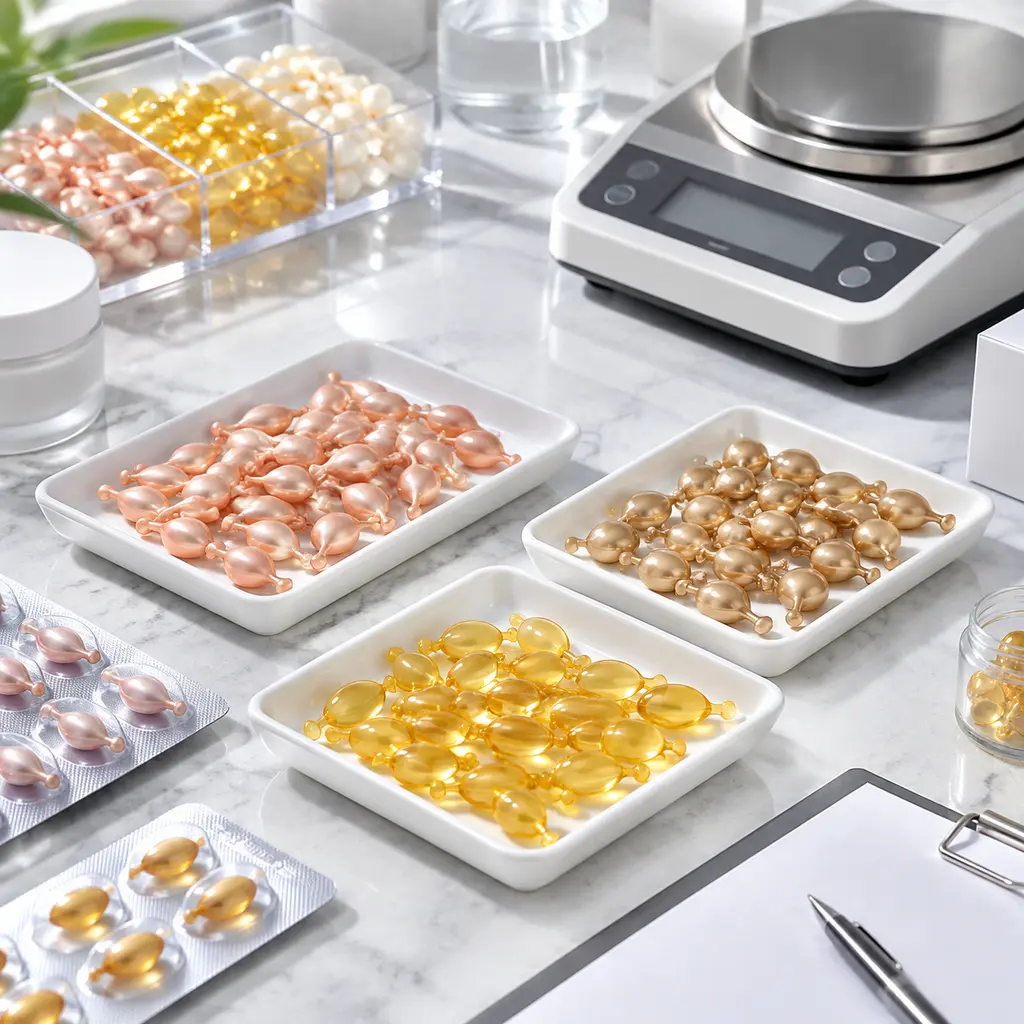
Direct Answer
Capsule shape, unit dose, shell system, and final packaging should be approved as one technical package before sampling. The central decision in evaluating skincare capsule shape and dose packaging options is not whether an oval, teardrop, or twist-off capsule looks distinctive. It is whether the selected geometry can hold the target serum fill weight, seal consistently, survive the intended climate and distribution lane, and dispense the promised facial or hair application dose without leakage or excessive residue.
The correct sequence is fill formulation, shell compatibility, dose definition, mold selection, primary-packaging selection, and stability validation. Reversing that sequence creates predictable rework. A custom mold selected for visual impact may have an unfavorable seam, insufficient internal volume, or a tail that breaks inconsistently. A jar selected before humidity testing may accelerate shell softening or brittleness. Buyers should therefore require production-representative capsules and packaging during sampling, rather than approving a hand-filled formula in a provisional shell.
Key Takeaways for Private Label Buyers
- Freeze the target application dose and fill-weight tolerance before authorizing a production mold.
- Review the serum, shell, plasticizer, colorant, and packaging as one compatibility system.
- Do not assume gelatin and plant-derived shells respond identically to heat, humidity, or fill ingredients.
- Test jar, blister, and secondary packaging under the intended storage and shipment conditions.
- Require sample records covering mold identity, actual fill weight, leakage results, and batch traceability.
- Keep labeling and market classification under regulatory review; a cosmetic capsule must not be presented as an ingestible supplement.

Buyer Context
For multinational procurement teams, this decision becomes material when a current supplier has a quality incident, an unexpected capacity interruption, or no qualified line for a new capsule format. A replacement source cannot be assessed solely through formula matching. Its capsule mold inventory, shell controls, filling equipment, environmental controls, packaging network, and change-control discipline must also be qualified.
The risk differs by product. Retinol capsules require disciplined light and oxygen management. Facial oil and cleansing oil capsules may challenge the shell through ingredient migration. Eye serum capsules require a tightly controlled dose because the application area is small. Hair oil capsules may need greater volume and a geometry that remains easy to open with wet hands. Plant-derived shells require documentary verification before a vegan positioning is approved.
Buyers comparing a new serum capsules manufacturer should also distinguish laboratory capability from scalable process capability. The relevant question is whether the approved sample can transfer to routine production without changing the shell recipe, mold, fill process, or packaging material. Broader serum capsule products can help procurement map platform commonality, but each SKU still requires its own compatibility assessment.
Capsule Formula, Shell, Mold, and Packaging Factors
Fill Formula and Unit Dose
Start with the intended consumer use: one capsule per eye area, face, cleansing event, or hair application. Convert that use into a target fill weight and an agreed tolerance. The ODM should measure net fill gravimetrically across multiple machine positions, not infer dose from nominal mold volume. Fill viscosity, suspended ingredients, air entrapment, and temperature sensitivity affect pumping accuracy and seam contamination.
Low-water oil serums are common, but compatibility cannot be assumed. Fragrance components, solvents, botanical extracts, and active carriers can migrate into the shell or alter its mechanical behavior. Retinol formulas also require oxidation controls appropriate to the formula and package. Buyers reviewing retinol serum capsules should request stability data tied to the proposed shell color, opacity, headspace, and primary pack. Ingredient acceptability should be screened against the European Commission’s CosIng ingredient database, Health Canada’s cosmetic ingredient requirements, and the destination market’s rules.
Shell Material and Mechanical Performance
Shell selection involves more than choosing gelatin or a plant-derived polymer. Procurement should document the polymer source, plasticizer system, colorants, opacifiers, residual moisture controls, allergen statements, and animal-origin status where relevant. A vegan claim requires supplier documentation and segregation controls; appearance alone is insufficient.
The finished shell should be evaluated for seam integrity, puncture resistance, opening force, brittleness, tackiness, deformation, and interaction with the fill. These properties can shift during aging. Qualification of a cosmetic softgel capsule factory should therefore include environmental control records and shell-material change notification, not only finished-product inspection.

Mold Geometry and Opening Route
Oval and round formats are mechanically simple but may require piercing or cutting. Teardrop and twist-off formats provide a defined opening route, although tail dimensions and shell thickness must be controlled to avoid premature breakage or difficult dispensing. A custom cosmetic mold adds differentiation but also introduces tooling qualification, maintenance, replacement, and ownership questions.
Before tooling approval, request dimensional drawings, nominal capacity, cavity count, mold identification, acceptable cosmetic defects, and confirmation of who owns and stores the mold. The sample scope should state whether capsules are machine-produced with the intended tooling. Reviewing a skincare capsule product line can identify existing geometries that reduce validation exposure, while a custom shape should be treated as an engineering change.
Packaging, Storage, and Shipment Compatibility
Jars offer efficient consumer access but expose remaining capsules to repeated oxygen and humidity exchange. Blisters isolate individual doses and can provide stronger moisture, oxygen, and light protection depending on material construction and seal quality. The ODM must confirm compatibility among the capsule, blister cavity or jar, closure liner, desiccant where used, and secondary carton.
Packaging trials should use sale-intent materials and realistic capsule counts. Check capsules at the top and bottom of jars for sticking, compression, oil transfer, color change, and opening performance. For blisters, inspect seal integrity, capsule deformation, cavity fit, and opening force. Packaging artwork should follow the FDA Cosmetics Labeling Guide, while market responsibility and safety obligations should be reviewed under the FDA’s regulatory framework for cosmetics.
Stability protocols should cover the intended shelf life, heat and humidity exposure, light where relevant, and transport stress based on actual distribution lanes. Acceptance criteria should include leakage, shell appearance, odor, fill assay where applicable, dose delivery, and package integrity. An ISO 22716 environment supports process discipline, but it does not replace product-specific stability evidence. Buyers assessing skincare capsules OEM capability should require the same formula, shell, mold, and pack configuration for approval and commercial production.
Decision Framework Table
| Factor | What to Check | Why It Matters | ODM Buyer Note |
|---|---|---|---|
| Application dose | Target fill weight, tolerance, and delivered residue | Controls consumer use and claim consistency | Approve measured output, not nominal volume |
| Fill formulation | Viscosity, water content, oxidation sensitivity, and ingredient migration | Affects filling accuracy and shell aging | Lock the commercial formula before compatibility testing |
| Shell system | Polymer source, plasticizer, moisture, colorants, and origin documents | Drives mechanical performance and claim eligibility | Require notification before shell-component changes |
| Mold | Geometry, dimensions, capacity, seam, tail, ownership, and maintenance | Determines dose capacity and opening behavior | Record the mold identifier in the approved specification |
| Primary pack | Jar barrier, closure, liner, blister materials, and seal integrity | Controls environmental exposure and leakage risk | Test production-intent components |
| Stability | Heat, humidity, light, aging, and performance criteria | Identifies interactions that initial samples cannot show | Include shell and package performance in the protocol |
| Sampling scope | Quantity, tooling route, batch records, and test outputs | Determines whether the sample represents scale-up | Separate appearance samples from qualification samples |
| Shipment | Carton loading, compression, temperature exposure, and lane profile | Protects capsules beyond the factory gate | Define release and arrival inspection criteria |
Procurement may use the capsule skincare collection to compare platform formats and encapsulated retinol skincare to review category-specific requirements. These comparisons should inform technical due diligence rather than substitute for SKU-level validation.

ODM Manufacturing Considerations
When comparing skincare capsule shape and dose packaging options, treat the approved sample as a controlled commercial reference rather than a general visual concept. The confirmation record should state capsule geometry, nominal fill weight and tolerance, shell color, seam appearance, opening method, odor, surface feel, package count, and acceptable cosmetic defects. Retain signed samples from the final pilot lot so production teams and incoming inspectors evaluate against the same standard.
Formula customization should begin with the target dose and dispensing behavior. An anhydrous facial oil may run well in a small twist-tip capsule, while a higher-viscosity eye serum may require a larger opening or different fill temperature. Ask the ODM to document viscosity range, ingredient addition order, deaeration controls, and limits for pigments, fragrance, suspended ingredients, and oxidation-sensitive materials. Review relevant ingredients against the European Commission’s CosIng ingredient database and destination-market restrictions before locking the formula.
Shell selection should consider more than a gelatin or vegan claim. Request the complete shell composition, plasticizer system, colorants, residual-moisture target, and compatibility findings for the proposed serum. Plant-derived shells can meet specific brand positioning, but they still require verification under the intended heat and humidity conditions. The supplier should also clarify whether the product is regulated and labeled as a cosmetic rather than an ingestible supplement. Additional background is available in the vegan skincare capsule overview.
For mold selection, compare an established cavity with a newly developed shape. Existing tooling generally shortens development, while a custom mold can create a distinctive dose format but adds engineering, tooling validation, maintenance, and replacement considerations. Confirm cavity dimensions, seam location, tip break behavior, embossing limits, tooling custody, and the procedure for changes. See the available capsule mold options before approving artwork around an unverified capsule silhouette.
Packaging must be evaluated as part of the capsule system. A jar requires suitable closure torque, liner selection, headspace, and moisture protection. A blister requires compatible forming film, lidding material, pocket depth, and sealing parameters. Review the completed pack at planned stability intervals for retinol color shift, oil odor, shell softening, adhesion, brittleness, and package distortion. MOQ should be separated into formula batch minimum, encapsulation run minimum, custom-color minimum, tooling quantity, and printed-package minimum. Shipment approval should define case orientation, pallet pattern, storage range, container loading, seasonal exposure controls, and whether temperature loggers are required on sensitive routes.
Labeling files should include the ingredient declaration, net contents, responsible-party details, lot coding method, warnings when applicable, and substantiation for cosmetic claims. For US-bound products, use the FDA Cosmetics Labeling Guide as a starting point, while recognizing that the brand remains responsible for final market compliance. A structured OEM/ODM development process is especially important when qualifying an alternate source after a quality incident or abrupt capacity interruption at an incumbent supplier.

Common Problems or Failure Cases
- Shell brittleness: Capsules crack during packing or consumer handling when shell moisture falls outside its working range. Investigate warehouse humidity, drying parameters, package barrier performance, and prolonged exposure to air after opening.
- Sticking or deformation: Capsules may adhere to one another or flatten in a jar after warm storage. Possible causes include excess shell moisture, formula migration into the shell, insufficient cure time, unsuitable liners, or compression from an overfilled container.
- Fill separation: Pigments or suspended cosmetic ingredients can settle, producing inconsistent appearance or dose composition. Review particle size, mixing time, suspension design, holding time before filling, and whether the formula remains uniform throughout the run.
- Capsule leakage: Oil around the seam may result from poor sealing, fill contamination in the seal area, excessive internal volume, impact damage, or incompatibility between the serum and shell. Inspect leakage by cavity, production time, and package position rather than averaging the result across a lot.
- Fragrance sensitivity: A fragrance can change odor during storage or affect shell flexibility. Compare fragranced and fragrance-free controls, then assess the finished capsule rather than relying only on bulk serum observations.
- Packaging deformation: Blister pockets can collapse under stacking pressure, while jars can warp or lose closure performance during hot shipment. Test saleable cartons and shipper cases, not only loose capsules stored in laboratory containers.
For oxidation-sensitive formats, review the full component set used for retinol capsules, including light barrier, oxygen exposure after opening, headspace, and secondary packaging.

Supplier Checklist
- Obtain the fill formula specification, viscosity range, nominal dose, fill-weight tolerance, and ingredient sourcing records.
- Verify shell material, plasticizers, colorants, moisture limits, allergen statements, and animal-origin or vegan declarations.
- Review mold dimensions, cavity count, seam location, tip performance, tooling control, and replacement responsibility.
- Request pilot samples in the intended jar or blister, with the proposed liner, lidding film, carton, and shipper.
- Define stability conditions, timepoints, acceptance criteria, retained samples, and responsibility for out-of-specification investigations.
- Separate MOQ information for bulk formula, capsule run, shell color, printed components, and custom tooling.
- Confirm batch coding, ingredient-list support, safety documentation, claim files, and destination-market label review.
- Audit filling-room controls, line clearance, foreign-material prevention, traceability, complaint handling, and recall readiness.
- Document shipment temperature limits, carton strength, palletization, freight handoffs, and contingency capacity.
- For a 2030 carbon-neutral sourcing policy, request measurable energy, emissions, waste, and improvement records rather than relying on a general sustainability statement.
FAQ
Can an ODM guarantee that our core serum formula will never be disclosed?
No supplier can credibly promise absolute zero risk. Buyers should verify role-based system access, encrypted file transfer, access logs, separated customer folders, restricted laboratory access, controlled batch documents, employee confidentiality terms, and rules for external testing. The agreement should define ownership, permitted use, retention periods, breach notification, and deletion or return of confidential records.
How can strategic supply priority be protected during a global raw-material shortage?
Use a written allocation framework covering forecast commitments, reserved capacity, safety-stock ownership, lead-time triggers, and escalation contacts. Prequalify alternate grades or sources where formula performance permits. Priority language is meaningful only when supported by inventory evidence, supplier commitments, and a tested continuity plan.
What proves that environmental and carbon records are transparent?
Request permits, energy and water data, waste manifests, treatment-system maintenance records, emissions methodology, and corrective-action history. Confirm reporting boundaries for Scope 1 and Scope 2 emissions and whether records can be traced to source documents during an independent audit. Environmental claims should identify the site, reporting period, baseline, and verification status.
Can we switch from a jar to blister packaging after formula approval?
Not without further evaluation. The new pack changes moisture, oxygen, light, sealing, compression, and shipment exposure. Produce samples in the intended blister structure and reassess shell condition, dose release, seal quality, appearance, and package integrity before commercial production.
How many sample rounds should be planned?
There is no universal number. A practical scope often includes a formula-and-shell feasibility sample, a revised appearance or sensory sample, and a packaging-confirmation pilot. Additional rounds may be needed for a custom mold, vegan shell, fragrance, suspended ingredients, or a highly oxidation-sensitive serum.
Which documents are needed for multi-market labeling?
Request the complete ingredient nomenclature, formula percentages for regulatory review, product specifications, safety support, claim substantiation, lot-code format, shelf-life basis, and packaging artwork controls. Screen Canadian requirements against Health Canada’s cosmetic ingredient resources, then complete a market-specific legal review.