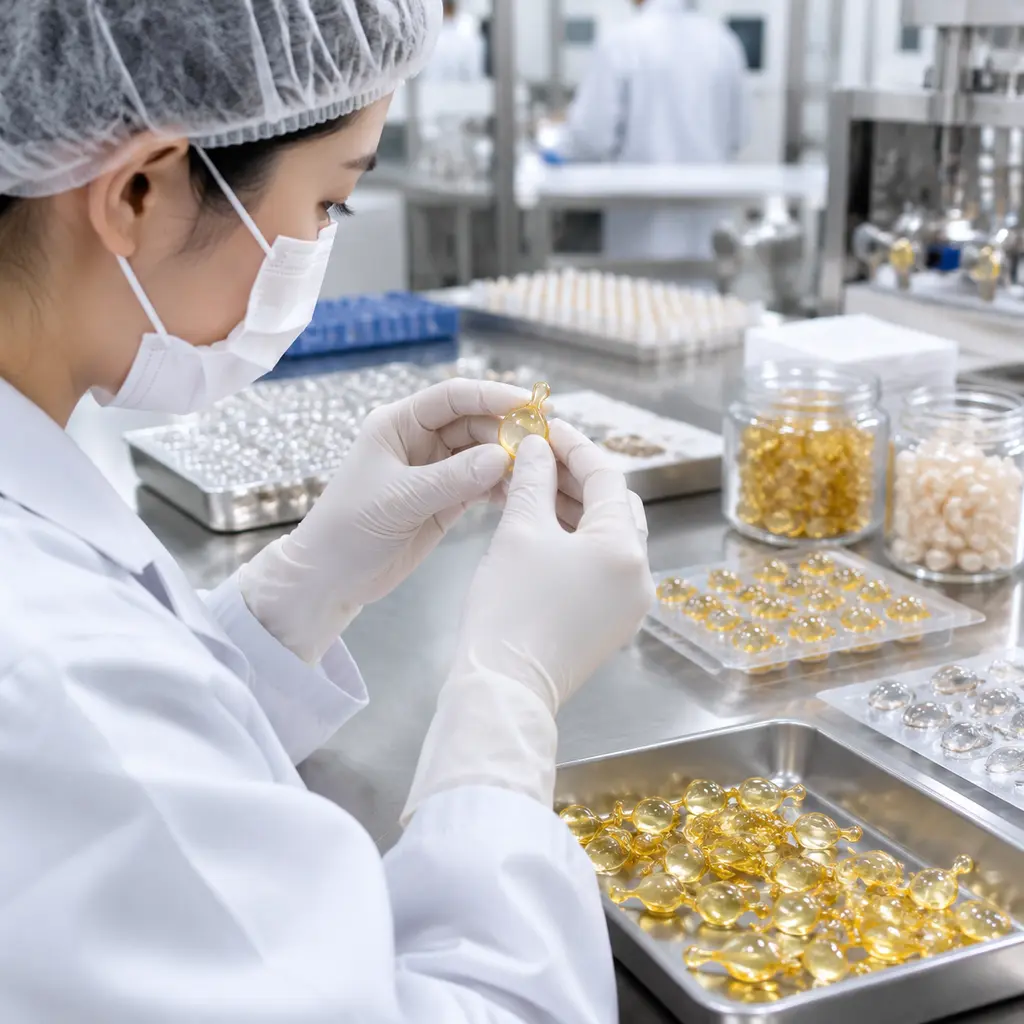
Direct Answer
The right skincare capsule product portfolio packaging options should be selected before sampling, because the capsule shell, fill formula, mold geometry, fill weight, and primary pack function as one technical system. A retinol capsule may require stronger oxidation control and light protection than a cleansing oil capsule; an eye serum capsule may require a smaller dose and more precise opening behavior; a vegan capsule shell may require different humidity controls from a conventional gelatin shell. For international brands, the decision is therefore not primarily aesthetic. It is a risk-control decision covering leakage, oxygen exposure, transport damage, stability, labeling, and line scalability. Before approving samples, require the ODM to document the proposed shell material, fill viscosity range, target fill weight, mold specification, blister or jar compatibility, storage conditions, and test plan. Packaging should be approved only after the filled capsule has passed a relevant stability and handling review in its intended commercial pack.
Key Takeaways for Private Label Buyers
- Define the commercial dose and fill-weight tolerance before requesting a custom capsule mold; the mold determines more than appearance.
- Match shell material to formula polarity, viscosity, water activity, oxygen sensitivity, and the intended use of the cosmetic.
- Evaluate blister, jar, and travel-pack formats with filled capsules, not empty shells, because contact and compression behavior can change after filling.
- Require stability, leakage, seal-integrity, transport, and heat-and-humidity evidence that reflects the target market and shipment route.
- Separate a sampling mold from a mass-production mold only when the ODM can demonstrate dimensional equivalence and a controlled transfer process.
- Make compliance documents, artwork data, batch traceability, and change-control obligations part of the sampling brief.
Buyer Context
Portfolio packaging becomes a strategic issue when a brand adds several capsule formats under one visual identity. Retinol capsules, facial oil capsules, eye serum capsules, cleansing oil capsules, and hair oil capsules can share a family resemblance while requiring different technical controls. A mature procurement team must decide whether the portfolio should use one standard shell and pack architecture or a controlled set of custom variants.
This matters most when a current supplier has suffered a quality event, when an audit identifies weaknesses in documentation or labor controls, or when a global launch requires a second qualified manufacturing source. A capsule that performs acceptably in a laboratory sample may fail after extended warehouse storage, sea shipment, repeated handling, or exposure to a warm and humid distribution center. The commercial impact includes repacking, relabeling, delayed market release, and possible withdrawal of affected lots.
For that reason, buyers should assess the serum capsules manufacturer as a controlled manufacturing partner, not only as a source of attractive samples. Review the wider serum capsule products portfolio to understand whether the supplier has relevant experience with facial, eye, cleansing, and hair applications. For an oxidation-sensitive active, compare the proposed approach with the supplier information available for retinol capsules and ask whether the same controls apply to the new formula.
Regulatory assessment should also be tied to the destination markets. The United States requirements summarized by the FDA cosmetics law guidance and the technical literature represented by the International Journal of Cosmetic Science can help structure internal questions, but the ODM must still provide product-specific records, claims support, ingredient information, and packaging documentation.
Capsule Formula, Shell, Mold, and Packaging Factors
Formula and fill behavior
Start with the formula rather than the mold. The ODM should characterize viscosity, density, volatility, oil polarity, suspended materials, fragrance load, and sensitivity to oxygen, light, and heat. A thin facial oil may migrate through an unsuitable shell or create seal stress during filling. A more viscous serum may require a larger opening, altered temperature control, or a different dosing method. The buyer should request the target fill weight, acceptable tolerance, net-content method, and in-process checks used to verify every batch.
For retinol or other oxidation-sensitive serum, ask whether nitrogen management, low-headspace filling, opaque secondary packaging, and antioxidant compatibility have been evaluated. For cleansing oil capsules, confirm that the formula does not soften, swell, or weaken the shell during storage. Eye serum capsules need particular attention to opening force, dose repeatability, and user contact around the eye area. These are performance and safety controls, not merely user-experience preferences.
Shell material and mold geometry
Shell selection should cover gelatin, plant-derived, and other approved capsule materials considered by the ODM. A vegan capsule shell can support a brand requirement, but its moisture response, sealing behavior, brittleness, and storage profile must be tested with the actual fill. Ask for material specifications, supplier qualification records, allergen statements where relevant, and a documented change-notification process.
Mold geometry controls capsule volume, wall distribution, seam position, opening behavior, and visual consistency. A custom softgel mold may improve portfolio differentiation, but it introduces tooling lead time, maintenance responsibility, dimensional approval, and replacement risk. Confirm whether the sampling mold is production-equivalent, how cavity consistency is checked, and what happens if a mold cavity produces a weight or seal deviation. A standard mold may provide a more stable qualification path when speed and supply continuity outweigh distinctive geometry.
Packaging compatibility and storage
Blisters can provide unit separation, dose communication, and strong handling protection, while jars can simplify presentation and allow multiple capsules per pack. Neither format should be approved from empty-shell testing alone. Assess capsule-to-film contact, seal temperature, compression, abrasion, oxygen transmission, moisture transmission, headspace, desiccant use, and opening behavior. A jar review should include capsule stacking, bottom-contact exposure, scoop or hand access, and the risk of capsules sticking together.
Run packaging compatibility and stability work in the proposed commercial pack under the intended heat, humidity, light, and shipment conditions. Include leak inspection, shell appearance, fill-weight retention, odor change, active assay where applicable, microbial controls appropriate to the formula, and closure integrity. Ask the ODM to define acceptance criteria before testing begins. This creates a defensible basis for comparing a capsule skincare collection across markets and avoids approving packaging on visual appearance alone.
Decision Framework Table
| Factor | What to Check | Why It Matters | ODM Buyer Note |
|---|---|---|---|
| Shell material | Material specification, moisture response, sealing behavior, vegan documentation | Controls leakage, brittleness, compatibility, and market claims | Approve the filled shell, not an empty shell sample |
| Formula and fill | Viscosity, density, oxidation sensitivity, target fill weight, tolerance | Determines dosing consistency and process capability | Require retained samples and in-process weight records |
| Mold | Cavity consistency, seam position, geometry, transfer controls | Influences appearance, opening force, seal integrity, and scalability | Confirm whether sample tooling matches production tooling |
| Primary pack | Blister or jar contact, barrier properties, compression, closure integrity | Protects the capsule during storage and shipment | Test in the intended commercial configuration |
| Stability and logistics | Heat, humidity, light, vibration, leakage, appearance, assay where relevant | Reveals failures that may occur after market release | Align the protocol with destination climate and route |
| Documentation | Specifications, artwork data, batch records, test reports, change control | Supports global launch governance and audit readiness | Make document delivery a sampling gate |
A practical next step is to issue one consolidated sampling brief covering the formula, shell, mold, packaging, stability, labeling, and shipment conditions. Include the intended sales markets, channel storage profile, target portfolio architecture, and acceptable deviations. The selected skincare capsule product lines should then be reviewed through a documented technical gate before artwork approval or purchase-order release. For brands assessing a broader skincare capsules OEM relationship, the same evidence should be available for scale-up, supplier change control, and recurring quality review.


ODM Manufacturing Considerations
Sampling should confirm a defined commercial concept rather than merely produce attractive capsules. For each SKU, issue a sample brief covering the intended formula, capsule shell material, target dose, capsule shape, color restrictions, opening method, primary pack, planned market, and expected shipment route. The supplier should return a sample record identifying the batch, approved components, measured fill weight, and any departures from the brief. Keep sealed approval samples from both the buyer and manufacturer before scale-up.
Formula customization affects more than the ingredient list. The ODM team should assess whether the serum remains uniform during holding and filling, whether suspended materials settle, and whether viscosity permits repeatable dosing without stressing the seam. Oil-soluble antioxidants, fragrances, botanical extracts, and colorants may also interact with the shell or change over time. Buyers developing several formats should avoid assuming that a facial oil base can be transferred unchanged into an eye serum or hair oil capsule. The supplier should document which variables remain adjustable after the first sample round.
Shell selection should begin with the ingredient system and market requirements. Conventional and plant-derived shells can differ in handling behavior, moisture response, appearance, and production parameters. If a vegan positioning is required, verify the full shell composition and processing aids rather than relying only on a finished-product statement. More background is available in the supplier’s vegan skincare capsule options and capsule technology overview.
Mold selection determines capsule shape, nominal capacity, seam placement, tail geometry, and the user’s opening experience. A stock mold may shorten development, while a custom mold can support portfolio differentiation but requires clearer ownership, maintenance, replacement, and exclusivity terms. Ask who retains the mold, whether another customer may use the same geometry, and how production output changes with the selected cavity. Review available capsule mold options before commissioning tooling.
Packaging evaluation should use the intended capsule count, closure, liner, blister material, and decoration process. A jar that performs well with one capsule shell may create sticking or odor-transfer issues with another. Printed coatings and labels should also tolerate the expected distribution environment without warping or lifting. Build the review around actual climatic storage settings and the planned logistics lane, including carton compression, loading duration, and temperature exposure.
MOQ discussions should separate formula batch minimums, shell-color minimums, mold requirements, packaging component quantities, and finished-SKU minimums. A portfolio containing several colors or shapes can create excess components even when the total capsule volume is substantial. The quotation should distinguish development samples, pilot output, validation units, and commercial production.
Before approval, request the ingredient declaration, shell composition, specification, batch documentation format, packaging material specifications, and label-review responsibilities. U.S. projects should be checked against applicable FDA cosmetics law requirements. Requirements differ across markets, so artwork approval should identify the responsible party for INCI naming, net contents, warnings, business details, claims, and language versions. Halal-positioned portfolios should define whether certification under a recognized framework, such as the JAKIM Halal certification framework, applies to the formula, shell, facility, or finished item.

Common Problems or Failure Cases
- Shell brittleness: Capsules crack during handling or consumer opening when shell composition, moisture balance, storage, or pack protection is unsuitable. Compare newly produced units with aged samples and record break force or defect rates using an agreed method.
- Sticking or deformation: Capsules may adhere to each other, flatten against jar walls, or lose their intended shape. Likely contributors include shell-to-fill interaction, excessive headspace moisture, closure performance, elevated temperature, or prolonged pressure during transit.
- Fill separation: Pigments, powders, or complex botanical systems can settle, creating visible dose differences. Ask how the bulk is mixed during the filling run and whether the first, middle, and final production intervals meet the same appearance and composition criteria.
- Leakage: Wet surfaces, odor inside the secondary carton, or declining capsule count can indicate weak seams, mechanical damage, or formula migration. Inspection criteria should distinguish isolated handling damage from a systematic process issue.
- Fragrance sensitivity: Fragrance materials can alter shell appearance, odor retention, or consumer tolerance. Evaluate fragranced and fragrance-free samples separately rather than treating fragrance as a late-stage addition.
- Packaging deformation: A jar, liner, label, or blister may change shape or lose adhesion during storage. Use production-equivalent components because prototype containers can conceal material or decoration failures.

Supplier Checklist
- Confirm the legal manufacturing entity, facility address, relevant cosmetic manufacturing certifications, and scope of audited operations.
- Request the complete formula review process, shell composition, allergen or animal-origin declarations, and restricted-substance controls.
- Define target fill weight, acceptable variation, visual criteria, seam quality, opening behavior, and defect classification for each capsule.
- Verify whether molds are stock, shared, exclusive, or buyer-owned; record tooling fees, storage terms, maintenance responsibility, and replacement lead time.
- Review compatibility evidence for the actual jar or blister, closure, liner, label, carton, capsule count, and decoration.
- Agree on sample stages, approval records, retained samples, change-control rules, and conditions that require resampling.
- Separate MOQ and lead-time assumptions for formula, shell color, capsule shape, primary packaging, printed packaging, and finished SKU.
- Request specifications, certificates of analysis, batch records, inspection summaries, ingredient documents, and market-specific labeling support.
- Define shipping configuration, pallet or parcel limits, seasonal routing controls, receiving inspection, and the process for reporting transit damage.
- Assess contingency capacity if an existing manufacturer has suffered a serious quality event, labor disruption, or abrupt capacity loss. Buyers responding to a corporate carbon-neutral supply-chain mandate should also request measurable facility-level environmental records.
FAQ
Can a manufacturer guarantee that our core capsule formula will never be disclosed?
No supplier can credibly promise absolute security. Buyers should examine role-based access, separated formula and customer files, restricted laboratory and production permissions, confidentiality agreements, access logs, backup controls, employee exit procedures, and incident-response rules. The contract should specify ownership of custom work and prohibit unauthorized reuse or disclosure.
How should we verify priority supply during a global raw-material shortage?
Ask for written allocation rules, qualified secondary sources, safety-stock assumptions, forecast commitments, and the materials classified as single-source. Priority status should be reflected in a supply agreement rather than communicated informally. Also confirm whether substitute shell or formula materials require buyer approval and renewed sampling.
What environmental and labor evidence should an international buyer request?
Request permits, waste and wastewater records, energy and carbon data, corrective-action reports, and independent audit scope. For labor oversight, review age-verification procedures, wage and working-hour records, grievance channels, and findings from unannounced or semi-announced audits. Confirm that records cover the facility producing the capsules, not only a corporate office.
Should every capsule SKU use the same shell and packaging?
Not necessarily. Retinol, facial oil, eye serum, cleansing oil, and hair oil capsules may place different demands on shell behavior, dose, light protection, opening force, and pack format. Standardization is useful only when technical evidence supports the shared specification.
When is a custom capsule mold justified?
A custom mold is most defensible when shape supports dose, opening behavior, pack fit, or protected brand identity. It is less compelling when a stock shape already meets those needs. Compare tooling ownership, output, approval time, and replacement obligations before deciding.
What should a shipment release file contain?
At minimum, request the batch identity, finished-product inspection status, quantity, applicable certificate of analysis, packaging configuration, and release authorization. The purchase agreement should also define receiving checks and the evidence needed for a transport or quality claim.