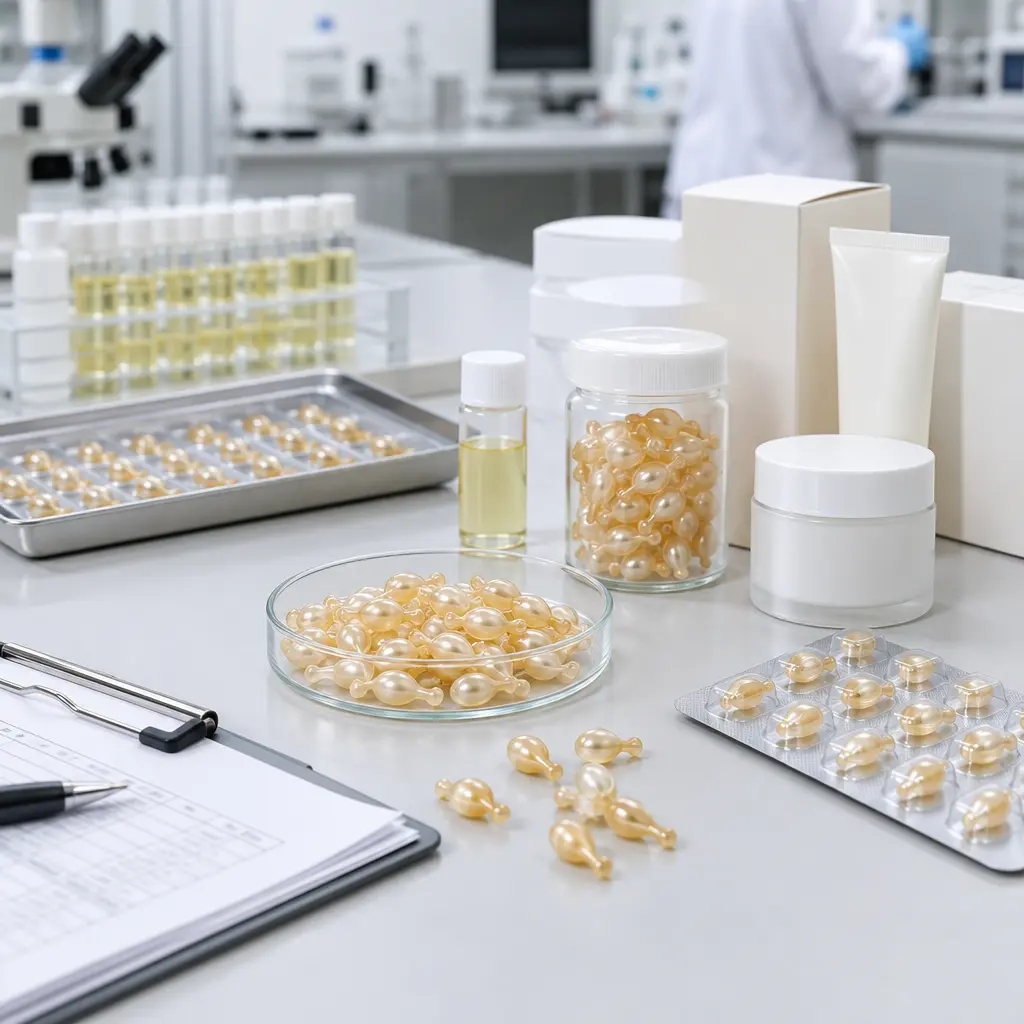
Direct Answer
The moisturizing skincare capsules product route should be selected by failure mode, not by product story alone. Buyers generally have three viable routes: an anhydrous facial oil or eye serum in a qualified standard shell and mold; an oxidation-sensitive active serum, such as retinol, paired with enhanced barrier packaging; or a differentiated vegan capsule with a custom mold and a longer qualification path. The first route normally offers the most predictable scale-up. The second requires tighter oxygen, light, and temperature controls. The third creates visual distinction but adds shell, tooling, packaging, and logistics dependencies.
Before approving any private label serum capsules program, procurement should lock the fill composition, shell chemistry, target fill weight, mold geometry, package format, storage profile, and claim jurisdiction as one integrated specification. A capsule that passes bulk stability can still leak, oxidize, stick, or deform after filling, packing, and international shipment.
Key Takeaways for Private Label Buyers
- Choose the route by technical exposure. A simple anhydrous moisturizing formula usually presents fewer compatibility risks than a retinol serum, cleansing oil, or active-heavy eye capsule.
- Qualify the shell and fill together. Review shell material, plasticizer system, fill viscosity, water activity, ingredient migration, and seam integrity as a combined system.
- Treat packaging as part of the formula. Jar, blister, sachet, and bottle formats create different oxygen, humidity, friction, and consumer-handling conditions.
- Test the saleable configuration. Stability work should include the production capsule, final package, closure, secondary carton, and intended shipment conditions.
- Separate launch speed from technical readiness. A supplier may support a pilot from 1,000 units and an under-30-day development track, but those operating claims do not replace validation, audit closure, or market-specific documentation.

Buyer Context
For multinational buyers, capsule skincare is not merely another serum format. It is a coupled manufacturing system in which the fill, shell, seam, mold, primary package, and distribution environment can each become the critical point of failure. This matters when a core supplier experiences a quality event or capacity interruption and procurement must qualify alternative production without changing the consumer experience.
The route also depends on product architecture. Facial oil capsules may prioritize oxidation control and dispensing feel. Eye serum capsules require precise dose consistency and a geometry that can be opened without sharp edges or excessive force. Cleansing oil capsules must maintain surfactant compatibility with the shell. Hair oil capsules may use a larger fill weight and face different consumer handling expectations. Buyers evaluating skincare capsule product lines should therefore avoid treating these formats as interchangeable.
Retinoid programs carry additional light, oxygen, claim, and labeling exposure. The technical file for retinol capsules should identify the active form, input concentration, assay method, antioxidant strategy, and packaging barrier assumptions. Cosmetic positioning must remain distinct from medical treatment language. The AAD treatment standards for hyperpigmentation provide useful context when reviewing adjacent pigmentation language, but they do not substitute for a jurisdiction-specific cosmetic claims assessment.
Regulatory qualification should run alongside development. United States launch files should be mapped against FDA MoCRA requirements, while Canadian distribution requires review against Health Canada’s cosmetic ingredient hotlist. Vegan shell composition and cruelty-free claims are separate questions; buyers using animal-testing claims should assess the Leaping Bunny cruelty-free certification standard without assuming it certifies the capsule shell as vegan.
Capsule Formula, Shell, Mold, and Packaging Factors
Fill Formula and Oxidation Control
Conventional softgel skincare performs most predictably with an anhydrous or tightly controlled low-water fill. Free water, volatile solvents, high levels of certain surfactants, and mobile fragrance components can soften, swell, embrittle, or permeate the shell. The buyer should request the final qualitative and quantitative formula, fill viscosity range, specific gravity or equivalent fill-control method, and evidence that the production batch uses the same material grades as the approved sample.
Oxidation-sensitive facial oil and encapsulated retinol skincare require controls beyond adding an antioxidant. Review raw-material peroxide exposure, headspace management, bulk hold time, light exposure during filling, and package oxygen transmission. Color and odor checks are useful but should not replace an assay when active retention is a release or shelf-life requirement.
Shell Material, Fill Weight, and Mold Geometry
Gelatin and vegan shells differ in moisture response, sealing behavior, appearance, and process window. A vegan claim should be supported by shell composition, processing-aid declarations, and cross-contamination controls rather than by appearance. When assessing a cosmetic softgel capsule factory, request shell supplier traceability, change-control rules, and aging data for the proposed fill.
Fill weight must be defined with target, tolerance, sampling method, and acceptance criteria. A heavier capsule may improve perceived dose but can increase seam stress or package volume. A smaller eye capsule may reduce material use but become difficult to open. Custom molds add differentiation, yet narrow tips, severe curves, logos, and uneven wall distribution can raise leakage, demolding, and breakage risks. Tool ownership, maintenance, replacement lead time, and backup-mold availability belong in the supply agreement.

Packaging, Storage, and Stability
Jars provide strong shelf visibility but expose capsules repeatedly to air, humidity, and consumer contact. Blisters isolate individual capsules and can strengthen barrier performance, although forming material, seal integrity, cavity geometry, and pack-out speed require qualification. The final choice should be supported by package compatibility, transport simulation, leakage inspection, and stability across the intended heat and humidity profile.
Ask the skincare capsules OEM to document capsule sticking, shell haze, brittleness, deformation, seam leakage, fill discoloration, odor shift, weight change, and active retention where applicable. Samples should be evaluated upright, inverted, and in representative shipper cases. Release controls must also state whether capsules are conditioned before packing and how temperature excursions are managed during export.

Decision Framework Table
| Factor | What to Check | Why It Matters | ODM Buyer Note |
|---|---|---|---|
| Product route | Anhydrous moisturizer, active serum, cleansing oil, hair oil, or vegan capsule | Each route has a different shell and oxidation risk profile | Compare only technically equivalent serum capsule products |
| Fill system | Viscosity, water activity, specific gravity, volatile components, and active assay | Fill behavior affects dosing, sealing, migration, and shelf life | Require production limits, not sample-only observations |
| Shell | Material source, plasticizer, colorants, processing aids, and aging behavior | Shell changes can alter leakage and consumer handling | Place shell substitutions under formal change control |
| Fill weight | Target, tolerance, sampling plan, and test method | Controls dose consistency and seam loading | Verify line capability at pilot and commercial scale |
| Mold | Geometry, opening force, cavity balance, ownership, and backup tooling | Complex shapes can increase breakage and supply concentration | Approve a standard fallback mold where continuity is critical |
| Primary package | Jar or blister barrier, closure integrity, capsule friction, and opening experience | Packaging can reverse acceptable bulk stability | Review the final capsule skincare collection configuration |
| Stability and shipment | Heat, humidity, light, orientation, transport simulation, and excursion handling | International distribution can expose latent leakage or oxidation | Define failure escalation and retain-sample access before launch |
| Documentation | Formula records, specifications, safety support, labeling review, batch traceability, and change control | Missing evidence delays cross-functional approval and market notification | Use a market-and-channel claims matrix before artwork release |
ODM Manufacturing Considerations
A workable moisturizing skincare capsules product route should move through controlled sample approval rather than relying on a visual match alone. The approval sample should define the fill composition, sensory profile, capsule dimensions, nominal dose, shell type, color, scent, and primary package. Buyers should retain signed samples and an approved specification so later production lots can be compared against the same standard.
Fill formula customization begins with the intended facial benefit, application feel, and target market. An ODM team may adjust emollient ratios, botanical oils, antioxidants, fragrance, or oil-soluble moisturizing ingredients, but every adjustment can change rheology, settling behavior, shell interaction, and dispensing. Ask the supplier to state which ingredients are fixed, which may be substituted, and how raw-material changes are approved. Buyers exploring adjacent formats can also compare facial oil capsule options and eye serum capsule formats.
Shell selection should cover material identity, plasticizer system, colorants, moisture range, and any animal-origin or vegan positioning. A plant-derived shell is not automatically suitable for every serum. The factory should produce trial capsules using the actual fill and monitor appearance, elasticity, seam integrity, and dispensing behavior. If cruelty-free positioning is planned, confirm whether the finished-product program and supply chain can meet the Leaping Bunny cruelty-free certification standard, rather than treating a shell claim as sufficient.
Mold selection determines capsule shape, nominal volume, twist-off geometry, user handling, and tooling requirements. Existing molds generally simplify scheduling, while a proprietary shape requires drawings, trial output, dimensional tolerances, and ownership terms. Packaging should then be tested with the chosen capsule: jars need suitable closure performance and headspace, while blisters need cavities that do not pinch or compress the shell.
Stability planning should cover defined temperature and moisture environments, light exposure where relevant, package appearance, odor, capsule flexibility, dose uniformity, and leakage observations. MOQ should be quoted by formula, shell color, mold, and packaging configuration because each can create a separate production threshold. Before release, obtain ingredient nomenclature, batch coding rules, label copy support, safety substantiation files where applicable, and shipment instructions covering carton loading, storage range, and seasonal routing. For U.S. launches, buyers should also assess applicable responsibilities under MoCRA.

Common Problems or Failure Cases
Many capsule failures appear only after the pilot sample has moved into its final package or distribution environment. A useful investigation separates formula, shell, process, package, and logistics causes instead of assuming that every defect originated during encapsulation.
- Shell brittleness: Capsules crack during handling or opening when the shell loses too much moisture, encounters an incompatible fill, or remains in unsuitable storage. Compare retained samples from bulk, packed, and shipped stages.
- Sticking or deformation: Capsules may clump, flatten, or take impressions from neighboring units when exposed to excessive warmth, pressure, or moisture. Jar fill level, capsule count, closure seal, and case stacking should be checked together.
- Fill separation: Pigments, powders, or blended oils can stratify when dispersion is incomplete or the formula is outside its intended rheology range. Inspect capsules at the beginning, middle, and end of the filling run.
- Capsule leakage: Wet spots, odor transfer, or partially empty capsules may indicate seam damage, overfilling, shell incompatibility, or package compression. Defect counts should be recorded by batch and packaging line.
- Fragrance sensitivity: Fragrance components can alter shell texture, migrate into packaging, or create odor variation. An unscented moisturizing serum capsule is often the cleaner baseline when the target consumer has fragrance concerns.
- Packaging deformation: A jar, insert, or blister cavity may warp or press against capsules under warehouse conditions. Evaluate the decorated production package, not only an undecorated laboratory container.
These risks become especially important when qualifying a backup source after a current manufacturer experiences a serious quality disruption or loses standing following an independent audit. The replacement project should not skip technical approval merely because continuity is urgent.

Supplier Checklist
Use the following checks when comparing a serum-capsule OEM/ODM supplier or reviewing its OEM and ODM service scope:
- Obtain the shell material declaration, origin information, colorant details, and target moisture specification.
- Request the formula specification, rheology range, ingredient tolerances, antioxidant strategy, and substitution procedure.
- Confirm nominal fill weight, acceptance limits, in-process measurement frequency, and finished-lot records.
- Review mold ownership, cavity dimensions, opening method, tooling maintenance, and replacement responsibility.
- Ask for documented defect limits covering leaks, malformed capsules, sticking, discoloration, and empty units.
- Require data generated with the proposed jar or blister, including closure condition and capsule appearance over time.
- Separate MOQ requirements for the serum, shell color, capsule shape, decoration, and final pack.
- Verify label inputs, ingredient naming, claims support, batch traceability, and market-specific notification documents.
- Define release criteria, retained-sample periods, complaint escalation, shipment temperature guidance, and freight handoff responsibility.
FAQ
Can a factory guarantee that our core formula will never be disclosed?
No supplier can credibly promise absolute immunity from every breach. Buyers should verify role-based system access, separated customer files, physical sample controls, confidentiality agreements, visitor restrictions, backup security, and logs showing who can view or modify the master formula.
How can a buyer secure supply during a global raw-material shortage?
Priority should be contractual and measurable. Define reserved capacity, allocation rules, safety-stock ownership, approved secondary sources, forecast commitments, and notification deadlines. Ask for evidence that critical oils, shell inputs, and packaging components have realistic lead times rather than relying on verbal priority status.
How do we assess whether factory workers are treated fairly?
Review recent independent social-audit findings, corrective-action closure, age-verification controls, payroll records, working-hour data, grievance channels, and worker interviews. Audit scope should include temporary labor and any subcontracted capsule sorting or packaging operations.
What should be included in an ODM confirmation sample?
It should represent the intended fill, shell, mold, dose, opening feature, color, fragrance, and primary package. Record sample codes and acceptance criteria so production is not approved from photographs or an untraceable bench sample.
Which labeling documents should the supplier provide?
Expect an ingredient list using accepted nomenclature, product and batch coding information, relevant safety support, claim substantiation inputs, and manufacturer details required by the destination market. Canadian buyers should review Health Canada requirements and the Health Canada cosmetic ingredient framework.
Can MOQ be evaluated as one number for the whole capsule project?
Usually not. Formula batching, shell color, mold setup, printed components, jars, and blisters may each have different thresholds. Request an itemized MOQ table and identify which materials can be carried into a later production lot.