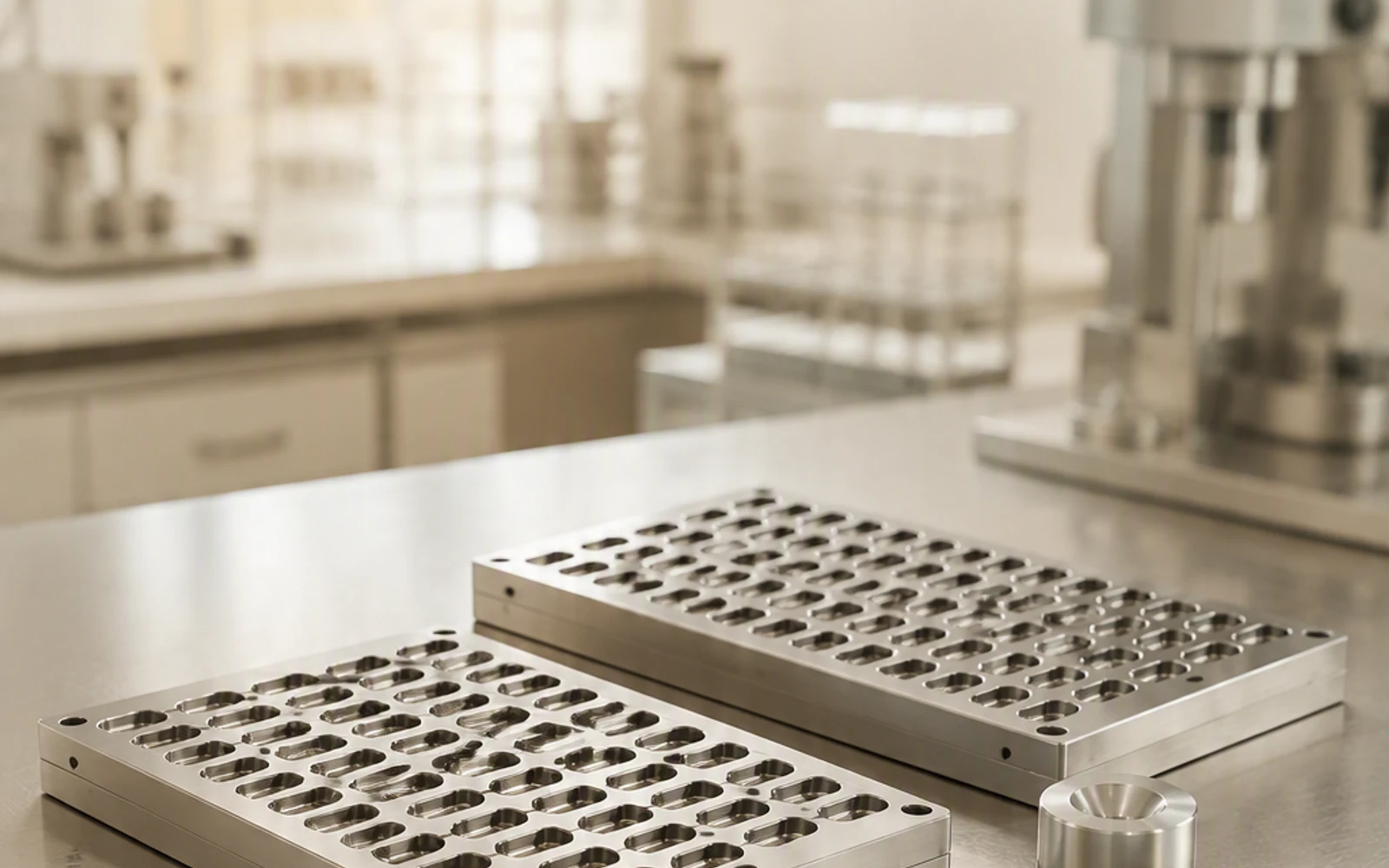
Short answer: choose a stock mold when an established shape and capacity meet the consumer use and commercial objective; investigate a custom mold only when the shape, application experience or visual distinction is central to the product proposition and the team accepts the added development and approval work. A custom mold is a manufacturing decision, not only a styling choice.
Project decision
- Use a stock mold to validate formula, fill and packaging before adding tooling complexity.
- Choose a custom mold only with a written reason tied to product use or defensible visual differentiation.
- Review the mold with shell, fill, count, packaging and commercial assumptions together.
Capsule shape can do real commercial work. It can signal a premium product, make a range recognizable and shape how a user opens and applies the formula. But a custom mold is not simply a creative decision. It becomes part of the manufacturing system, with implications for tooling, sample timing, fill selection, shell handling, inspection and the wider project plan.
What a stock mold gives a new project
Established molds let a brand concentrate on the decisions that usually determine early project viability: formula, shell, dose, package and market route. The available shape may already support the desired category and single-use experience. This can be especially useful for a first launch, a market test or a project where the consumer benefit comes from the formula and routine rather than a proprietary silhouette.
- A defined starting format for technical discussion and samples.
- A clearer way to compare fill capacity with the intended application dose.
- Less uncertainty around whether the brand needs a unique shape to meet its commercial goal.
- A practical reference for packaging and presentation exploration.
Browse the Capsule Mold Options before choosing a concept. The point is not to select a shape from a picture alone. Confirm what each option means for fill, shell, opening experience and package.
When a custom mold may be justified
A custom mold may be appropriate when a standard shape does not communicate the range, create the intended consumer interaction or fit a strategic brand asset. For example, a brand may need a distinctive silhouette that carries through a premium capsule program. The case should be made in the product brief, not assumed because a custom shape looks more original in a mood board.
| Use a stock mold when | Explore a custom mold when |
|---|---|
| The launch needs a proven, available capsule format. | The capsule shape itself is a meaningful part of the brand or product story. |
| The team is still validating formula, dose or channel demand. | The standard shapes cannot deliver the required visual or application experience. |
| Speed of initial sampling is more valuable than a proprietary silhouette. | The business case supports added development, approval and production planning. |
| The outer package can provide sufficient product differentiation. | The project can document the final mold specification and manage change control. |
Questions to resolve before tooling discussion
A custom mold request should be paired with the same discipline as a formula request. The technical team needs to know what the shape is intended to achieve and what constraints cannot change. Define the approximate dose requirement, preferred dimensions, opening point, visual references, package concept, shell direction and target markets. Then separate what is essential from what is simply a visual preference.
It also helps to define who has authority to approve the shape. A capsule can look different under product photography, in a clear tray, in a blister and in a consumer’s hand. A complete review considers those contexts rather than accepting a single rendering as the final decision.
Connect mold choice to the fill and package
The mold, shell and fill weight are interdependent. A new shape may affect the amount that can be filled, how the capsule presents in a pack and how the consumer receives the product. The outer package must protect and count the capsules consistently. If a format is selected only for shelf impact, the project may discover late-stage practical issues that should have been identified during sampling.
Use the fill-weight selection guide to define the intended dose and the packaging-count guide to check the consumer and retail route. Together, they make a mold decision more defensible.
Custom mold brief checklist
- Product category, intended consumer use and single-use amount.
- Reference images that distinguish essential geometry from general styling.
- Shell and fill direction, including questions still open for technical review.
- Primary package, count and display requirements.
- Target launch market, expected quantity range and decision owner.
Do not infer MOQ from the word “custom”
Custom tooling can affect a project plan, but it does not produce one universal MOQ. MOQ is shaped by the combined formula, shell, mold, packaging components, decoration and production sequence. Ask for a project-specific commercial discussion once the brief is defined. The private-label MOQ guide explains the dependencies in more detail.
Use the 4-question mold gate
The 4-question mold gate is our own product-development framework, not an industry standard. It helps a buyer decide whether the mold discussion is ready to move from a visual preference to a manufacturing brief. If the answer to any question is unclear, keep the route open and use a sample to reduce uncertainty.
Question 1: What job must the shape perform?
A capsule shape can support opening, application, range recognition, premium presentation or a distinctive brand asset. State the job in one sentence. “We want it to look different” is not enough to justify tooling. “We need a shape that supports one-use facial application and carries through a premium 10-count ritual” gives the manufacturer something to evaluate.
Question 2: What dose and formula must the mold support?
Define the intended amount, formula type, shell direction and use area before selecting geometry. A custom shape that cannot deliver the intended fill or opening experience is not a successful custom project. Use the fill-weight selection guide to keep the consumer routine visible.
Question 3: What package must carry the shape?
Review the mold with blister, tray, jar, carton and pack count assumptions. The capsule may need to be counted, protected, removed and displayed consistently. A shape that fits a render may not fit the selected primary pack or may create empty space that changes the commercial presentation.
Question 4: Can the team manage the approval path?
Custom tooling creates more reference points: geometry, sample, mold approval, shell, fill, package, inspection and change control. Identify the decision owner and the stage at which the shape becomes locked. If the brand cannot approve the geometry, package and production implications in a controlled sequence, stock tooling may be a safer first step.
| Mold decision | Stock mold is often suitable when | Custom mold may be justified when |
|---|---|---|
| Product maturity | The brand is still validating formula, dose or channel response. | The product proposition is stable enough to support tooling work. |
| Consumer use | An established shape already supports the intended opening and application. | The shape improves a clearly defined single-use or application experience. |
| Brand differentiation | Packaging, color or formula provides enough distinction. | The capsule silhouette is a meaningful and defensible brand asset. |
| Launch timing | The project needs a practical sample route with fewer open tooling questions. | The launch plan allows geometry review, sample iteration and approval. |
| Commercial risk | The buyer wants to test demand before adding proprietary components. | The business case supports added development and change-control work. |
What a stock mold gives the first project
Stock molds can help a new product move toward a useful sample without asking the brand to solve every design question at once. The team can focus on formula feel, fill amount, shell direction, package count and consumer instructions. If the product is still an idea rather than a validated route, this can preserve budget and time for the decisions that will determine whether the concept sells.
Stock does not mean generic. A selected stock format can still be differentiated through capsule color, fill appearance, package, count, instructions, photography, gift presentation and product-line architecture. It can also become the reference format for a later custom shape. The point is to use an established starting point to learn what the product needs before adding tooling complexity.
What a custom mold adds to the project
A custom mold adds a defined component that needs its own review. The team should align on geometry, approximate dimensions, target capacity, opening point, shell direction, package route and visual references. Distinguish essential geometry from mood-board styling. A manufacturer needs to know which surfaces, points, curves or proportions are non-negotiable and which can change to improve production or package fit.
Custom tooling also creates a change-management question. Once the mold is approved, a change to shape can affect fill, shell behavior, packaging, inspection and artwork. Keep the mold reference linked to the formula and package versions. This makes the project easier to control when different teams review samples, packaging and production documentation.
Do not confuse custom shape with custom formula
Some brands ask for a custom capsule shape because they want a unique product. Others need a new formula but can use an established shape. These are separate decisions. A custom mold does not automatically make a formula proprietary, and a private formula does not require a custom mold. Keep the commercial reason for each decision visible so the team does not add costs that do not improve the product.
This distinction is useful when preparing a phased launch. A brand may begin with an existing formula direction and stock mold to test the product route, then develop a custom capsule shape for a second phase after the channel and consumer response are clearer. Or it may need custom formulation but no custom geometry. The right path depends on the business problem the project is solving.
Review shape, fill and package in one sample
A shape should be judged inside the proposed consumer experience. Review the capsule loose, in the primary pack and in the retail presentation. Check whether the opening method works, whether the amount is appropriate, whether the capsule moves or scuffs, whether the count looks intentional and whether the package leaves enough room for instructions and coding. If the shape is only reviewed in a 3D rendering, the team may miss important practical constraints.
Custom mold RFQ packet
- Product route, target market and intended consumer use.
- Target single-use amount or a request for sample-led fill recommendation.
- Shell direction, formula direction and any material or claim requirements.
- Reference images with essential geometry separated from styling preference.
- Primary package, count, carton and display requirements.
- Expected quantity range, launch timing and approval owner.
- Questions about tooling, sample stages, inspection and change control.
How mold choice affects commercial planning
It is risky to publish a universal custom-mold fee, MOQ or lead time without a project scope. Commercial planning depends on the geometry, sample route, shell, fill, package, quantity and supplier process. Ask the manufacturer to separate one-time tooling or development assumptions from recurring production and packaging costs. Ask which decisions can still change the estimate and which are already fixed.
For finished-goods planning, connect the mold decision to the private-label MOQ guide. A custom shape may affect the capsule route, but MOQ is still a combined formula, shell, packaging and production-plan outcome.
When custom molding is the wrong first move
Custom molding may be premature when the formula is not defined, the consumer routine is unclear, the package count is undecided, the brand has not tested channel demand or the team is using shape to compensate for a weak product proposition. In those cases, a stock mold can provide a better learning route. It lets the brand validate product use and packaging before spending attention on a proprietary silhouette.
FAQ
Does a custom mold always make a capsule product more premium?
No. Premium value comes from the complete experience: formula, fill, shell, shape, package, instructions and channel fit. A custom shape that is difficult to open or package can reduce perceived quality.
Can I start with a stock mold and customize later?
Often that is a practical phased route, provided the first format supports the product concept and the later custom project is planned as a new configuration. Keep the two routes separate in sampling and commercial records.
What should a custom mold brief include?
Include product use, target amount, shell and formula direction, essential geometry, package, count, market, quantity range, timing and approval owner. Explain what the shape must do, not only what it should look like.
Does a custom mold automatically increase MOQ?
There is no universal answer. Custom tooling can affect development and production planning, but the final MOQ depends on the complete formula, shell, mold, packaging and quantity route.
Should packaging be designed before the mold?
The two should be developed together. A package that cannot protect, count or present the custom shape can force a late redesign. Review representative capsules inside a representative package before locking artwork.
Request a mold route review
Send PZIK your product category, intended amount, shape reference, shell preference, pack count and launch timing. We can help compare a stock-mold first route with a custom-mold route and identify which decision should be sampled first. Request capsule mold support.
About this guide
This article presents a manufacturer-side decision framework for stock and custom capsule molds. It does not publish a universal tooling fee, MOQ or lead time because those depend on the named project configuration and supplier review.
Decision summary
Start with a stock mold when it meets the consumer and commercial objective. Move to a custom mold when the brand has a clear reason, a controlled brief and enough project maturity to manage the implications. The strongest custom format is one that improves the product experience and can be consistently made, packaged and approved, not simply one that looks different in isolation.