Direct Answer
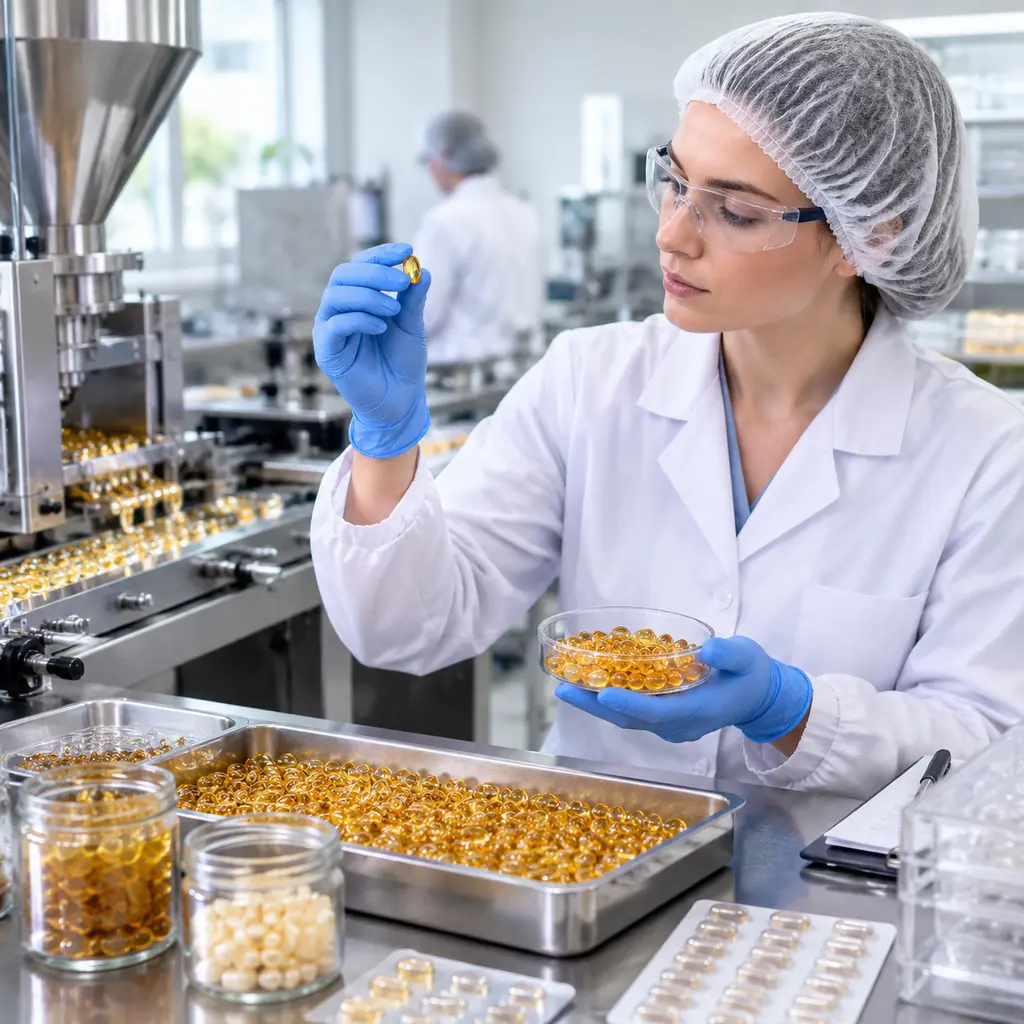
For a private-label skincare launch, cosmetic softgel factory due diligence should begin with evidence that connects the capsule formula, shell, mold, filling process, packaging, and release controls into one stable manufacturing route. A factory is not adequately qualified because it can produce attractive serum capsules or provide an ISO certificate. The buyer should verify whether the proposed line can reproduce fill weight, viscosity, seal integrity, oxidation control, and labeling documentation at the intended commercial scale.
The practical decision is to approve a product route only when the supplier can demonstrate traceable raw materials, validated filling parameters, compatible blister or jar packaging, stability data relevant to the target market, and controlled change management from sample to mass production. This is especially important when a global launch depends on retinol capsules, facial oil capsules, eye serum capsules, or vegan capsule shells. The appropriate evidence package should be reviewed jointly by procurement, formulation, QA, regulatory, and packaging teams.
For regulatory context, buyers should align the project with the Modernization of Cosmetics Regulation Act of 2022 and assess manufacturing controls against the ISO 22716 cosmetic GMP standard. Scientific substantiation should be assessed through relevant literature, including the International Journal of Cosmetic Science.
Key Takeaways for Private Label Buyers
- Approve the manufacturing route only after the factory links its formula, shell material, mold, fill weight, packaging, and release testing in one documented control plan.
- Require pilot samples from the same production architecture intended for scale-up. A laboratory sample that bypasses commercial filling equipment does not establish production equivalence.
- Match the serum base to the capsule shell. Oil polarity, active concentration, viscosity, water activity, and volatile content can affect leakage, brittleness, and oxidation.
- Test the capsule and its final pack together under heat, humidity, transport vibration, and orientation stress. Packaging compatibility is a system property, not a packaging-only decision.
- Require batch records, specifications, certificates of analysis, allergen statements, vegan or animal-origin declarations, stability protocols, and deviation records before commercial approval.
- Use a gated launch decision: formulation approval, packaging approval, stability review, regulatory file completion, and shipment release should have named owners and objective acceptance criteria.
Buyer Context
Serum capsules appear simple to the consumer but represent a tightly coupled supply-chain system. A retinol serum capsule may require light protection and strict oxidation controls. A facial oil capsule may require a shell with sufficient flexibility and a seal that remains intact during shipment. Eye serum capsules demand consistent dosing and a clean opening experience because the application area is sensitive. Cleansing oil capsules and hair oil capsules can impose different viscosity, fragrance, and fill-volume requirements.
Shell selection also changes the procurement and compliance profile. Gelatin may provide established forming performance, while vegan capsule shells based on materials such as modified starch or hydroxypropyl methylcellulose may support a different brand brief but require separate evaluation for moisture sensitivity, mechanical strength, and sealing behavior. The buyer should request a documented declaration of shell composition and processing aids rather than relying on a marketing statement.
Custom softgel molds create another decision point. A proprietary shape can improve product recognition, but it may increase tooling lead time, line adjustment requirements, inspection complexity, and spare-part dependency. Standard molds usually simplify qualification and replacement planning. When a core supplier has recently experienced a serious quality event, a labor disruption, or a capacity interruption, a second qualified capsule route can reduce concentration risk. The same logic applies when a group is preparing simultaneous launches across multiple markets and cannot tolerate a late packaging or filling qualification.
Buyers should therefore treat capsule manufacturing as a controlled technology transfer. The required evidence is not limited to a finished sample. It includes formula specifications, approved suppliers, in-process controls, fill-weight records, shell aging results, packaging drawings, transport assumptions, and a formal process for managing any change to ingredients, equipment, or pack components.
Relevant product-route references include serum capsules manufacturer, skincare capsules OEM, serum capsule products, private label skincare capsules, retinol capsules, encapsulated retinol skincare, retinol softgel capsules, and cosmetic softgel capsule factory.
Capsule Formula, Shell, Mold, and Packaging Factors
Formula and fill behavior. The factory should define the target viscosity range, density, fill temperature, active concentration, and allowable fill-weight tolerance. A highly viscous facial oil, a volatile cleansing oil, and a retinol emulsion may require different pump, hopper, and filling controls. Ask for representative fill-weight sampling across the start, middle, and end of a batch, together with reconciliation of theoretical and actual yield. Single-use capsule dosing is only credible when the fill system remains consistent throughout the run.
Shell material and seal integrity. Request the shell specification, moisture range, plasticizer information, colorant declaration, and animal-origin status. Review tensile behavior, brittleness after storage, and seal performance after exposure to the intended temperature and humidity profile. Leakage risk should be assessed after filling, cartoning, vibration, and aging. A capsule can pass an initial visual inspection while developing microleaks later because the formula migrates into the shell or the seal loses strength.
Mold and geometry. The mold drawing should identify dimensions, cavity count, neck or tip geometry, and acceptable dimensional variation. Custom geometry needs an inspection method that quality teams can reproduce. Confirm whether the mold is owned by the brand, the ODM, or a shared tooling pool, and document access, maintenance, and replacement rights. This is an IP and continuity issue as much as a design issue.
Packaging compatibility. Test the filled capsule in the final blister, sachet, jar, or tray rather than in a generic laboratory container. Check cavity dimensions, compression points, headspace, extraction force, label contact, and interaction with adhesives or inks. Blister packaging may improve unit separation and light control, while a jar may simplify presentation but increase exposure to repeated handling and humidity. The chosen pack must protect the capsule without creating a new opening or leakage failure.
Storage, stability, and shipment. The stability plan should reflect the target distribution markets and include appearance, odor, fill weight, shell condition, seal integrity, active assay where relevant, and microbial controls appropriate to the formula. Heat and humidity exposure should be paired with transport simulation and orientation checks. Ask whether stability samples are taken from the same batch and packaging configuration proposed for release. Shipment conditions should specify temperature limits, pallet configuration, moisture protection, data logging, and action thresholds for excursions.
Decision Framework Table
| Factor | What to Check | Why It Matters | ODM Buyer Note |
|---|---|---|---|
| Formula | Viscosity, density, oxidation sensitivity, active specification, fill temperature | Determines dosing consistency and equipment suitability | Approve the commercial fill route, not only a hand-filled sample |
| Shell | Material declaration, moisture range, plasticizer, seal strength, aging behavior | Controls brittleness, leakage, compatibility, and claims support | Obtain vegan or animal-origin documentation where applicable |
| Fill weight | Sampling plan, tolerance, start-to-end batch records, yield reconciliation | Protects dose consistency and commercial quantity compliance | Review raw records and retained samples before sign-off |
| Mold | Geometry, cavity count, ownership, maintenance, dimensional inspection | Affects identity, throughput, replacement risk, and IP control | Document tooling rights and business-continuity access |
| Packaging | Blister or jar fit, light barrier, extraction force, compression, seal interaction | Prevents damage during storage, use, and distribution | Test final pack components with filled capsules |
| Stability | Heat, humidity, vibration, orientation, assay, odor, appearance, leakage | Shows whether the product remains acceptable through its route to market | Require market-specific protocols and excursion procedures |
| Documentation | Batch records, certificates, specifications, deviations, change control, shipment data | Enables auditability, release decisions, and regulatory response | Assign review owners across QA, regulatory, procurement, and legal |
A disciplined route review should end with a written gap register. Each gap needs an owner, evidence requirement, target date, and launch impact. For a mature brand, the central question is not whether a factory can make one acceptable capsule. It is whether the factory can reproduce the same compliant result across batches, markets, packaging formats, and disruption scenarios while preserving formula confidentiality and supply continuity.


ODM Manufacturing Considerations
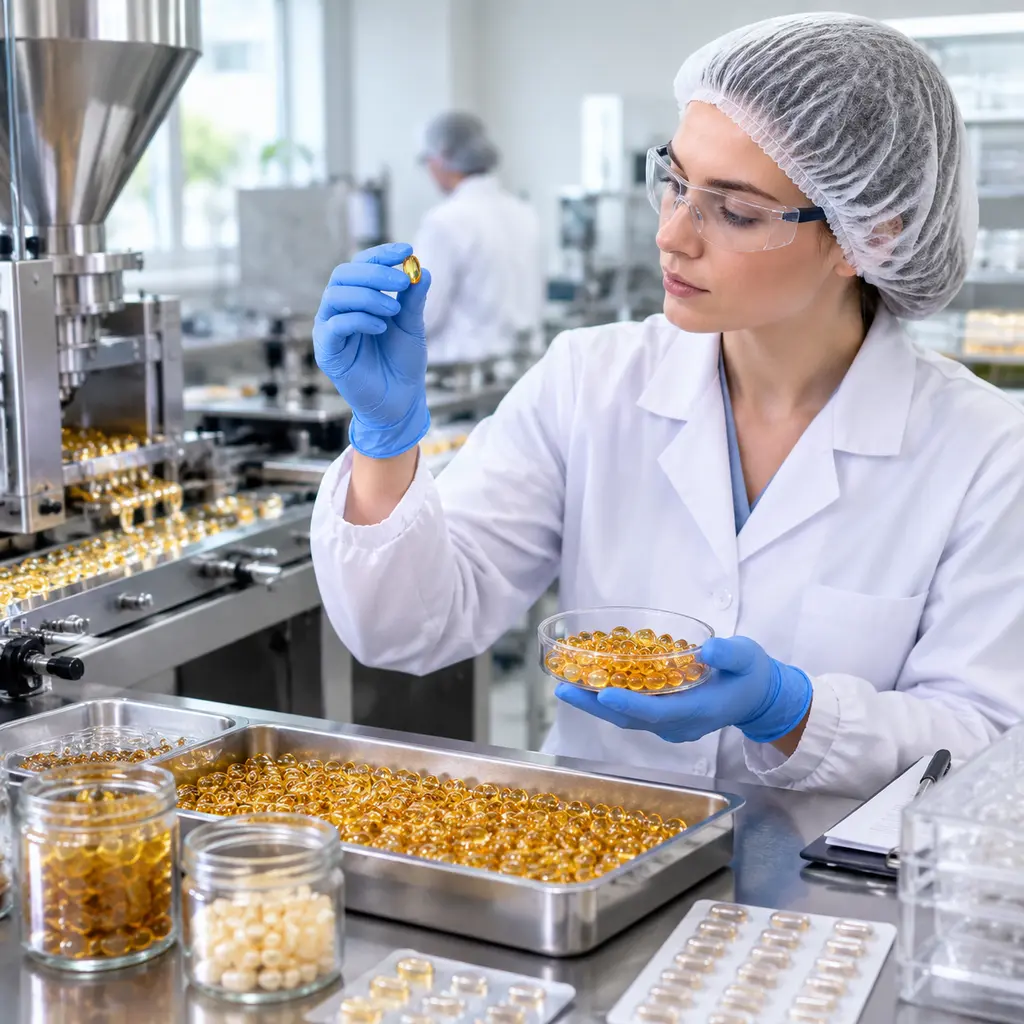
A credible ODM route begins with a controlled sample-confirmation process. Ask the factory to document the capsule shell material, shell color, dimensions, fill formula, target fill weight, fragrance level, and intended packaging before approval. The retained reference sample should be sealed, coded, and linked to a signed specification. This prevents later substitutions in the face formula, capsule shell, or fragrance profile.
Fill customization should be assessed against viscosity, oil polarity, active concentration, and storage conditions. A retinol capsule may require a different oxygen-control approach from a facial oil capsule, while an eye serum capsule may need a smaller dose and a milder fragrance profile. Request a written formula brief showing the permitted raw materials, allergen declarations, preservative approach where applicable, and acceptance limits for fill weight and appearance. For a new formula, review both a laboratory sample and a production-representative sample.
Shell selection is a commercial and technical decision. Ask whether the capsule uses gelatin or a vegan shell material, what plasticizer system is used, and how shell moisture is controlled. A vegan capsule shell may support a specific brand positioning, but it can react differently to humidity, oils, and prolonged storage. The factory should provide shell specifications, compatibility observations, and recommended temperature and humidity ranges rather than relying on a generic capsule statement.
Mold selection also affects dosing, appearance, tooling ownership, and future continuity. Confirm capsule length, shape, seam location, surface finish, and the number of cavities in the mold. The contract should state who owns custom tooling, who may authorize modifications, and how the factory will protect the approved geometry if production is transferred. Buyers can compare available capsule technology and mold options against the actual formula and package.
Packaging compatibility must be checked with the filled capsule, not only with empty shells. Review blister cavities, lidding material, jar liners, inner trays, and closure torque. Examine whether the fill migrates into a seal, whether capsules rub against one another, and whether the package distorts during storage or transport. A facial oil capsule in a jar may need a different headspace and insert design from a retinol capsule in a blister.
Stability review should cover appearance, odor, fill separation, shell integrity, leakage, weight change, and active-sensitive observations under the proposed storage conditions. Request a protocol, test intervals, sample quantities, and a report that identifies the actual package tested. Labeling documents should include the ingredient list using the destination market naming convention, net contents, batch coding method, shelf-life or period-after-opening basis, storage wording, allergen information, and any required manufacturer details. For United States distribution, buyers should map responsibilities against the Modernization of Cosmetics Regulation Act of 2022.
MOQ should be evaluated together with sample scope and change control. Ask whether the quoted minimum applies per formula, per capsule color, per mold, per package, or per finished SKU. Confirm the charge and lead time for pilot samples, artwork revisions, formula changes, and a second validation round. Shipment conditions should specify carton configuration, pallet requirements, temperature limits, humidity protection, freight responsibility, and what evidence is supplied if a shipment experiences a temperature excursion.
Common Problems or Failure Cases
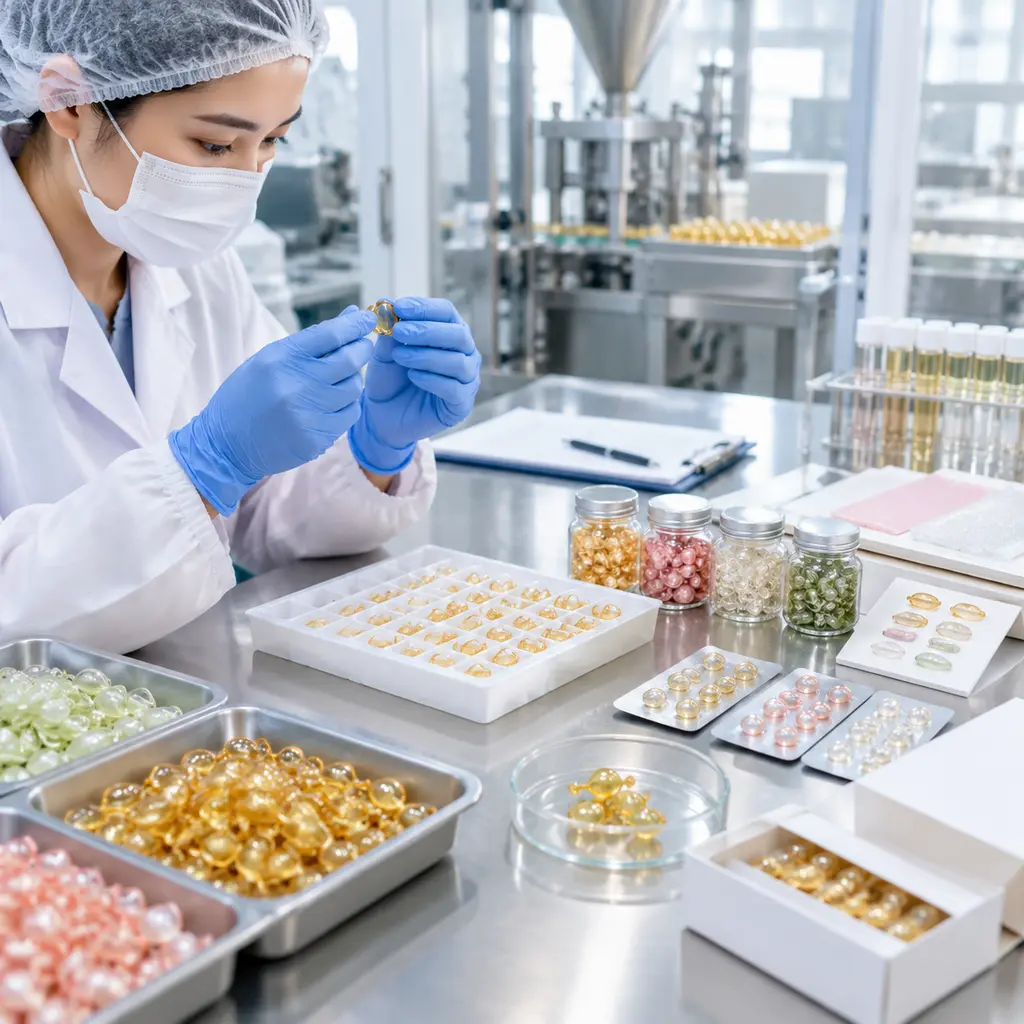
Capsule shell brittleness: Low or unstable shell moisture can make capsules crack during filling, packing, or transit. The buyer should compare shell condition at release with condition after storage and request a documented moisture-control range.
Sticking or deformation: Capsules can adhere to one another when surface moisture, residual oil, or warehouse humidity is poorly controlled. Heat can soften the shell and create flattened surfaces or seam distortion. Inspect capsules at the bottom, center, and top of shipping cartons, not just from a retained laboratory sample.
Fill separation: An oil-based serum may separate after temperature cycling even when it looks uniform immediately after manufacture. Ask for a mixing sequence, homogenization record where relevant, and acceptance criteria for visible layers, sediment, or color shift.
Leakage: Leakage can result from an incomplete seam, excessive fill volume, incompatible ingredients, or pressure inside a blister cavity. The investigation should identify the failure location and distinguish manufacturing leakage from package compression or transport damage.
Fragrance sensitivity: A fragrance that performs well in a bottle may become more noticeable after confinement inside a capsule shell or blister. Review fragrance concentration, allergen documentation, odor after storage, and a sensory comparison against the approved sample. For eye serum capsules, a low-odor or fragrance-free route may reduce consumer complaints.
Packaging deformation: A blister can warp under heat, while a jar insert can press against capsules and cause abrasion. Request package samples filled with the final capsule dimensions and test them through storage and shipment handling before artwork is finalized.
Supplier Checklist
- Verify the legal manufacturing entity, site address, production scope, quality contact, and subcontracted operations.
- Obtain shell specifications for gelatin and vegan options, including moisture range, plasticizer information, colorants, and storage requirements.
- Require a formula brief covering viscosity, fill weight, fragrance, oxidation controls, ingredient restrictions, and acceptance limits.
- Confirm mold dimensions, cavity configuration, tooling ownership, change approval, and continuity arrangements.
- Review sample records showing capsule appearance, seam quality, weight variation, leakage inspection, and package interaction.
- Ask for stability documentation using the proposed blister, jar, insert, or other final package.
- Define MOQ by formula, mold, shell type, color, and finished package; document all sample and revision charges.
- Check labeling files, ingredient nomenclature, batch traceability, storage wording, country-of-origin data, and destination-market compliance support.
- Review shipment specifications for carton strength, palletization, temperature exposure, humidity protection, and claims evidence.
- Assess information security, raw-material allocation, environmental records, insurance coverage, and labor practices through records and independent audits.
FAQ
Can the factory guarantee that our capsule formula will never be disclosed?
No supplier can credibly promise an absolute guarantee. Buyers should require role-based system access, physical segregation of formula records, controlled sample rooms, confidentiality agreements, audit logs, and a defined process for destroying obsolete documents and samples. Ask whether formula files are stored on shared systems and whether subcontractors receive only the minimum information needed.
How can a buyer protect supply during a global raw-material shortage?
Request a raw-material continuity plan identifying critical oils, antioxidants, shell materials, colors, and packaging components. The plan should show approved alternatives, allocation rules, safety stock policy, supplier qualification, and notification timing. Strategic buyers should also clarify whether reserved capacity and raw-material allocation are contractual or merely informal assurances.
What environmental evidence should an international buyer request?
Ask for current wastewater permits, discharge records, waste-transfer documents, energy data, and carbon-accounting boundaries. Confirm whether records cover the actual manufacturing site and whether an independent auditor can trace the data to source documents. A certificate alone is not a substitute for site-level evidence, especially when a group operates multiple facilities.
What protection exists if a major capsule quality complaint creates a commercial loss?
Review product liability and product recall insurance, territorial coverage, exclusions, policy limits, deductibles, and the claims process. The manufacturing agreement should define investigation costs, retained samples, notification duties, recall decisions, and responsibility for affected inventory. Insurance should supplement, not replace, batch traceability and documented release controls.
How should a buyer assess labor conditions at the factory?
Request labor policies, payroll and working-hour records, age-verification procedures, grievance channels, and recent social-audit findings. A credible review should include worker interviews and access to production areas, not only management documents. Any use of recruitment fees, withheld identity documents, forced overtime, or underage labor should be treated as a material supplier risk.
Which technical evidence matters most before approving a production order?
Prioritize a signed formula and capsule specification, production-representative samples, fill-weight results, seam and leakage checks, final-package compatibility, stability observations, labeling files, and shipment instructions. The evidence should identify the tested lot and package so the buyer can verify that the approved sample represents the intended production route.
References
For cosmetic GMP terminology and quality-system expectations, see the ISO 22716 cosmetic GMP standard. For research context on cosmetic formulation, product testing, and skin-care science, consult the International Journal of Cosmetic Science. United States regulatory responsibilities are outlined by the FDA in its guidance on FDA authority over cosmetics.