
Direct Answer
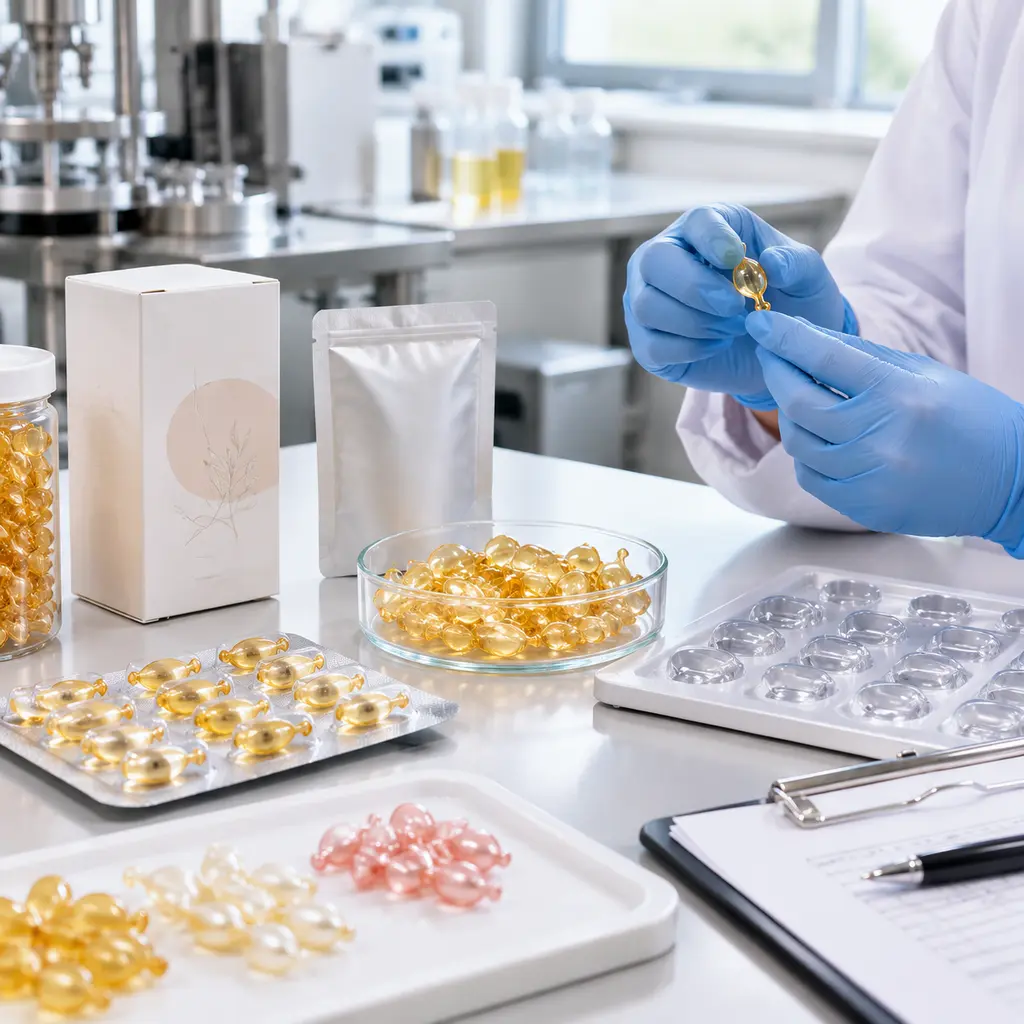
For private-label buyers evaluating skincare capsule carton packaging packaging options, the carton or pouch should be selected only after the capsule formula, shell material, fill weight, mold geometry, and distribution conditions are confirmed. The right route is not simply the package with the strongest shelf appearance. It is the route that protects a single dose from leakage, oxygen exposure, heat, humidity, abrasion, and labeling risk across the intended market.
Before sampling, require the ODM to validate the capsule inside its proposed blister, jar, pouch, or carton configuration. Retinol capsules, facial oil capsules, eye serum capsules, cleansing oil capsules, and hair oil capsules can behave differently because viscosity, oxidation sensitivity, shell composition, and fill weight affect both package compatibility and stability. A packaging decision should therefore be treated as a manufacturing qualification step, with written acceptance criteria, stability evidence, artwork specifications, and shipment conditions agreed before tooling or pilot production begins.
Regulatory review should run in parallel. Buyers should compare the proposed label and pack architecture with the FDA’s regulatory framework for cosmetics and the FDA summary of cosmetics labeling requirements, while also confirming market-specific obligations with internal regulatory counsel.

Key Takeaways for Private Label Buyers
- Approve the capsule shell and formula together. Gelatin, plant-based, and other vegan capsule shells can respond differently to moisture, heat, and oil-based fills.
- Lock the fill weight and mold geometry before requesting carton quotations. A small change in dose or capsule dimensions can alter cavity fit, packing density, and shipping performance.
- Test the complete packaging system, including blister, jar, pouch, insert, carton, closure, and secondary case. Component-level approval is not equivalent to finished-pack qualification.
- Define stability and leakage criteria before sampling. Include heat, humidity, light, vibration, compression, and orientation testing appropriate to the distribution lanes.
- Request documentation that supports global launch review: shell specifications, ingredient and allergen statements, batch records, label data, packaging specifications, and change-control procedures.
- Use sampling to qualify the future production route, not merely to judge appearance. The same mold, filling method, shell specification, and packaging materials should be available for scale-up.
Buyer Context
Serum capsules are small-format products, but they create a concentrated set of supply-chain decisions. A retinol capsule may require stronger oxidation control and light protection than a simple facial oil capsule. An eye serum capsule may need a smaller fill and tighter dimensional control because the consumer expects one clean application without excess residue. A cleansing oil capsule can place greater demand on shell integrity and seal performance because the formula may contain a high proportion of volatile or low-viscosity oils. Hair oil capsules may require a larger dose, which affects mold design, pouch count, and carton footprint.
For a global brand, these differences become qualification risks. Packaging must survive warehouse storage, container transport, parcel handling, and retail presentation without compromising the cosmetic formula. A vegan capsule shell may support a brand requirement, but it must still be evaluated for moisture transfer, brittleness, sealing behavior, and compatibility with the fill. A custom softgel mold can improve differentiation, but non-standard geometry may reduce line speed, limit cavity utilization, or require a dedicated tooling change during scale-up.
This is particularly important when a mature brand is adding an external ODM as alternate capacity after a quality incident, supplier interruption, or new category launch. Procurement may approve the proposed carton quickly, while R&D or QA later discovers that the capsule deforms in the blister, sticks to the jar, or shows fill migration during stability review. The result is a delayed launch and a second round of artwork, tooling, and validation. The commercial objective is therefore not just a visually acceptable sample. It is a repeatable packaging route that can pass internal quality, regulatory, ESG, and supply-continuity review.

Capsule Formula, Shell, Mold, and Packaging Factors
Formula and fill behavior
Start with the fill formulation. Record viscosity range, oil or water phase, volatile components, suspended particles, fragrance load, antioxidant system, and light sensitivity. The ODM should confirm whether the formula remains homogeneous through filling and whether its viscosity permits accurate dosing at production temperature. Fill-weight sampling should include minimum, target, and maximum values, with a defined tolerance and a method for checking net content without damaging the capsule structure.
Leakage risk is not limited to a visible seam defect. It can arise from shell softening, insufficient drying, excessive internal pressure, incompatible packaging friction, or formula migration through the shell. Ask for an inspection method that covers seal integrity, surface tack, deformation, odor change, and evidence of oil transfer. For retinol capsules and other oxidation-sensitive products, request a documented approach to oxygen exposure, headspace control where relevant, light protection, and heat and humidity storage.
Shell material and mold design
Shell selection should be documented by material specification rather than a marketing description. Confirm the source and grade of the shell, plasticizer system, colorants, residual moisture range, allergen status, and suitability for the destination markets. For vegan capsules, request the plant-derived material specification and evidence that the shell maintains mechanical performance during storage and shipment.
Mold geometry controls more than visual identity. It determines capsule volume, fill weight, sealing area, cavity spacing, pack density, and the risk of rubbing during handling. Compare standard and custom softgel molds using the same formula and target dose. A custom shape is justified only when its commercial value exceeds its tooling, line-change, inspection, and replacement risks. Confirm whether the mold is owned by the buyer, retained by the ODM, or governed by a documented IP and access-control agreement.
Carton, pouch, blister, and jar compatibility
Blister packaging offers individual separation and clear dose control, but the cavity depth, lidding material, and sealing temperature must be matched to capsule dimensions and shell sensitivity. A jar route can simplify counting and presentation, yet it exposes multiple capsules to repeated opening, moisture ingress, and consumer handling. A pouch route can improve transport efficiency, but the pouch must protect against puncture, compression, and seal failure, particularly when capsules have irregular geometry.
The carton should be evaluated as part of the secondary pack. Check internal movement, insert pressure, abrasion against printed surfaces, barcode readability, tamper evidence, and case-pack performance. Packaging compatibility testing should include filled capsules, not empty shells or dimensional drawings alone. Confirm that the finished pack can be stored and shipped under the intended heat and humidity conditions, and that the shipment specification is aligned with the stability protocol.

Decision Framework Table
| Factor | What to Check | Why It Matters | ODM Buyer Note |
|---|---|---|---|
| Formula and viscosity | Phase behavior, viscosity range, oxidation sensitivity, fill-temperature window | Determines dosing accuracy, leakage risk, and stability exposure | Request retained samples from the same fill batch used for packaging tests |
| Shell material | Material grade, plasticizer, moisture range, allergen and vegan status | Affects brittleness, sealing, deformation, and market eligibility | Require a signed shell specification and change-notification process |
| Fill weight | Target dose, tolerance, sampling method, net-content evidence | Influences consumer use, claims support, cavity fit, and costed pack count | Approve the fill-weight range before mold and artwork release |
| Mold geometry | Length, width, thickness, seal area, cavity spacing, tooling ownership | Controls line compatibility, pack density, and scale-up continuity | Compare standard and custom molds using production-representative samples |
| Primary packaging | Blister, jar, or pouch material; seal strength; friction; moisture and oxygen barrier | Protects capsule integrity during storage and distribution | Test the filled capsule in the final component, not only in a laboratory vessel |
| Secondary packaging | Carton fit, inserts, abrasion, barcode, tamper evidence, case pack | Reduces handling damage and labeling nonconformity | Review dielines, pack-out photos, and shipment samples with QA and procurement |
| Stability and shipment | Heat, humidity, light, vibration, compression, orientation, and lane conditions | Connects laboratory evidence with actual global distribution risk | Define acceptance limits and escalation rules before pilot production |
Before sampling, the buyer should issue one controlled technical brief covering formula, shell, dose, mold, primary packaging, carton dimensions, storage conditions, and destination markets. The ODM should return a traceable sample plan identifying which elements are production-representative and which remain provisional. This is the point at which a buyer can compare serum capsules manufacturer capabilities, review serum capsule products, and assess whether a proposed route can support a broader skincare capsule product lines strategy.
For product-specific evaluation, buyers can benchmark retinol capsules, compare encapsulated retinol skincare formats, and review skincare capsules OEM capability against internal qualification requirements. Packaging approval should remain conditional until the filled capsule, final package, label data, stability evidence, and shipment conditions have been reviewed together.
ODM Manufacturing Considerations
Sampling should confirm the complete capsule route before a private-label buyer approves production. Ask the supplier to document the formula version, capsule dimensions, shell material, target fill weight, mold reference, primary package, carton configuration, and intended storage conditions. A sample that looks acceptable in a jar may behave differently in a blister or pouch, so the approval record should identify the exact packaging combination being evaluated.
Formula customization begins with fill behavior. For facial oil capsules, eye serum capsules, cleansing oil capsules, or hair oil capsules, the supplier should record viscosity, fragrance load, oil compatibility, color, and any suspended ingredients. Retinol capsules require particular attention to light and oxygen exposure, while water-sensitive or highly aromatic ingredients may create different shell and seal risks. Request a retained sample from the approved batch and compare it with the development sample before signing off on scale-up.
Shell selection should be treated as a formulation decision, not only a marketing choice. Gelatin and vegan capsule shells can differ in moisture response, elasticity, appearance, and sealing behavior. For a vegan skincare capsule, ask which shell polymer is used, whether the shell requires special humidity control, and how it performs with the selected serum or facial oil. The supplier should also explain whether shell colorants, opacifiers, or botanical positioning affect the final label documentation.
Mold selection affects dose presentation, production efficiency, and packaging fit. Compare custom softgel mold options using the intended capsule length, diameter, tip shape, seam position, and fill volume. A smaller single-dose capsule may suit a facial treatment carton, while a larger capsule may require a deeper jar or wider blister cavity. Confirm the mold cavity layout and sampling scope in writing so the development sample reflects the proposed commercial format.
Packaging compatibility requires physical testing. Review whether capsules rub against carton dividers, stick to blister film, deform in a pouch, or become difficult to remove from a jar. Check the seal area, cavity depth, headspace, closure torque, and contact materials. Packaging should also be reviewed after heat and humidity exposure, because a capsule that releases cleanly at room temperature may soften, flatten, or adhere after storage.
Stability review should cover the formula, shell, and package as one system. Ask for a protocol that identifies appearance, odor, leakage, fill consistency, shell condition, and package integrity at planned intervals. The buyer should receive clear acceptance criteria rather than only photographs. Labeling documents should include the ingredient declaration using the required nomenclature, net contents, batch coding format, shelf-life or period-after-opening basis, storage wording, country-of-origin information where applicable, and any fragrance or allergen disclosures required for the target market. The FDA’s regulatory framework for cosmetics and its summary of cosmetic labeling requirements are useful references for products entering the United States.
MOQ should be separated into formula development, mold development, packaging procurement, and finished-goods production. Ask whether the first sample uses production-intent materials and whether unused cartons, pouches, blisters, or shells create additional commitments. Shipment conditions should specify carton stacking, pallet protection, temperature exposure limits, humidity precautions, transport duration, and the inspection point for transit damage. For international distribution, agree on who records shipment temperature and who handles a deviation.
Capsule technology, mold options, and OEM/ODM services should be reviewed together when comparing supplier proposals. Separate pages for retinol capsules, facial oil capsules, and vegan skincare capsules can help organize product-specific questions.
Common Problems or Failure Cases
Shell brittleness: A shell may crack during filling, packing, or removal from a blister when moisture balance is unsuitable. Review shell material, conditioning, capsule age, and storage humidity. Inspect both the seam and the body because damage is not always visible from the front.
Sticking or deformation: Capsules can adhere to one another, blister film, jar walls, or pouch interiors. Excess surface moisture, insufficient release treatment, heat, and compression during shipment are common contributors. Test the primary package after storage and after simulated transport, not only immediately after filling.
Fill separation: An oil serum containing incompatible ingredients may show sediment, color migration, or phase separation. The supplier should compare the filled capsule with an unfilled formula sample and record appearance at each review point. Fragrance sensitivity also matters: a strong aromatic system may permeate packaging or alter the sensory profile during storage.
Leakage: Leakage may originate at the seam, cut area, or a damaged shell. Request inspection records that distinguish manufacturing leakage from package-related abrasion. For retinol or oxygen-sensitive formulas, even a small seal weakness can increase oxidation risk and create odor changes.
Packaging deformation: A carton may crush around a rigid insert, a pouch may lose seal strength, or a blister may distort under heat. Confirm cavity dimensions, seal parameters, carton board strength, and pallet configuration with the actual capsule format. A replacement package should not be approved until the capsule and package have been retested together.
Supplier Checklist
- Confirm the capsule shell material, color system, dimensions, seam design, and storage requirements.
- Record formula viscosity, fragrance level, suspended ingredients, light sensitivity, and oxidation controls.
- Request the target fill weight, permitted variation, sampling method, and retained-sample policy.
- Compare mold cavity design, capsule geometry, development MOQ, production MOQ, and mold ownership terms.
- Test blister, carton, pouch, or jar compatibility using production-intent components.
- Review stability criteria for shell appearance, leakage, odor, separation, fill consistency, and package integrity.
- Obtain ingredient declarations, labeling files, batch coding rules, storage wording, and market-specific compliance documents.
- Ask how formula records, artwork, mold files, and production data are access-controlled and physically separated.
- Verify alternate sources for strategic shell and ingredient materials, allocation rules during shortages, and reserved capacity.
- Review environmental permits, waste records, carbon accounting, worker age verification, wage records, working hours, and independent audit access.
- Define shipment temperature and humidity limits, pallet protection, transit inspection, deviation reporting, and complaint escalation.
FAQ
Can an OEM supplier guarantee that our capsule formula will not be disclosed?
No supplier should describe confidentiality as absolute without evidence. Request a specific confidentiality agreement, role-based system access, separated formula records, visitor controls, production-area restrictions, and an incident notification process. Verify who can access the formula, mold, artwork, and batch documents, and ask whether contract manufacturers or material vendors receive identifiable formula information.
How can a brand protect supply during a global raw-material shortage?
Ask for a written allocation policy, approved alternate materials, minimum safety stock, lead-time assumptions, and reserved production capacity. Confirm that any substitute shell or ingredient requires buyer approval and a compatibility review. This is especially important when a capsule launch follows a quality accident, strike, regulatory suspension, or sudden capacity loss at the incumbent supplier.
What environmental records should a private-label buyer request?
Request current permits, wastewater and waste-disposal records, energy and carbon data, corrective-action reports, and the scope of any third-party audit. Records should identify the manufacturing site and reporting period. For a group pursuing a 2030 carbon-neutral supplier target, agree on the calculation boundary and evidence format before onboarding.
What should the first production-intent sample include?
It should use the proposed shell, formula, mold geometry, fill weight, and primary package. Include the carton or pouch if it affects compression or moisture exposure. The approval set should include photographs, physical samples, labeling documents, and the acceptance criteria used for leakage, appearance, odor, and package integrity.
How should a buyer investigate a capsule leakage complaint?
Preserve unopened and opened units, photograph the seam and package, record lot numbers and storage history, and separate samples from different cartons. Ask the supplier to perform a retained-sample review, package inspection, and transport assessment. The root-cause report should state containment, corrective action, and the evidence supporting closure.
What labor checks are relevant to a capsule OEM/ODM factory?
Review worker age verification, payroll records, working-hour logs, overtime approval, grievance channels, health and safety training, and recruitment-fee controls. An independent social audit should cover the actual production site and temporary labor providers. A written policy is not enough if payroll and attendance records cannot support it.
References
For United States market preparation, consult FDA cosmetics resources and the FDA summary of cosmetic labeling requirements. For ingredient safety context involving alpha hydroxy acids, review the CIR final report on alpha hydroxy acids. These sources support regulatory and ingredient-reference checks; they do not replace product-specific formula, package, stability, or market compliance review.