Direct Answer
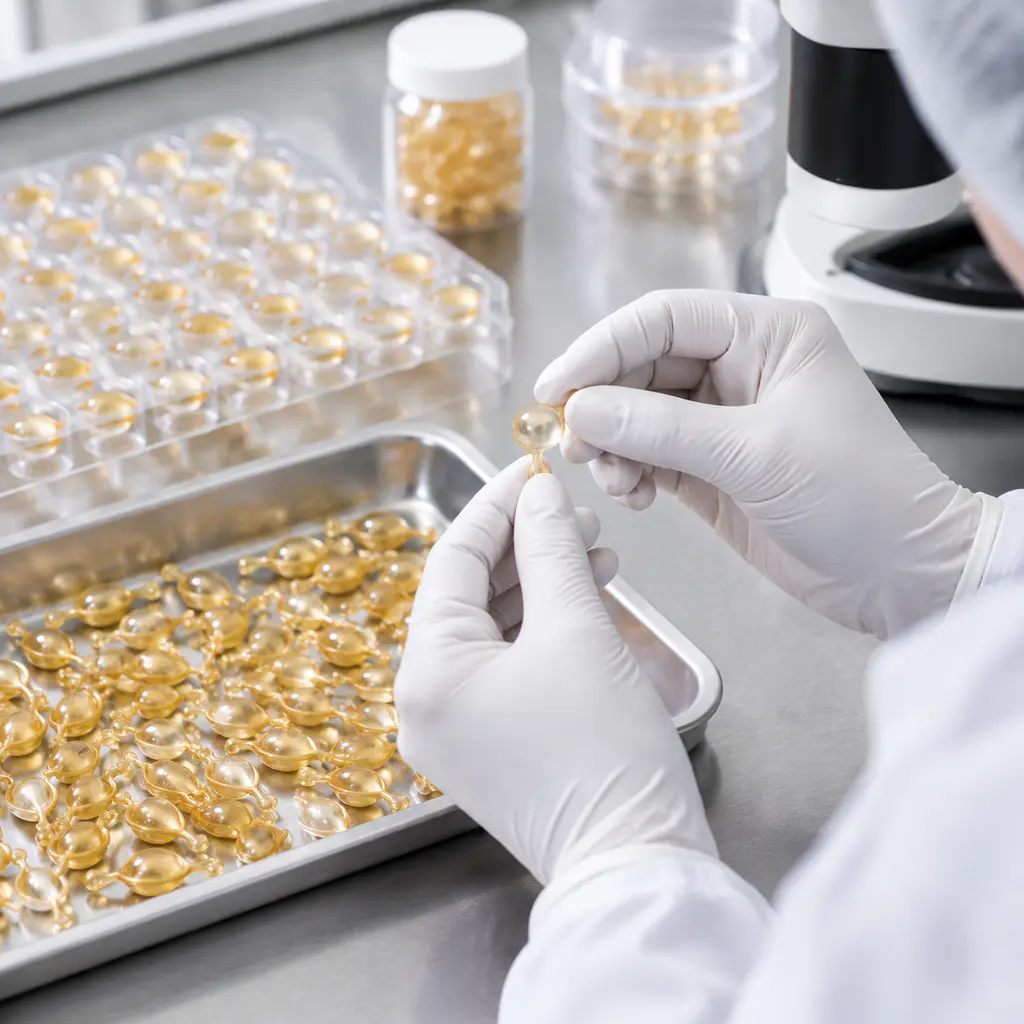
An eye serum capsules private label RFQ checklist should be completed before samples are requested, not after the first capsule arrives. For mature beauty organizations, the sample is not a creative starting point; it is a controlled evidence package that should already reflect target formula direction, capsule shell material, fill weight, mold geometry, packaging path, stability protocol, and compliance documentation. If those inputs are vague, the sample round becomes a hidden supplier qualification exercise, increasing delay, reformulation risk, and QA burden across procurement, R&D, regulatory, and legal teams.
For eye care specifically, the RFQ must translate commercial expectations into manufacturing controls: single-dose usability, low leakage risk, oxidation control, heat and humidity resilience, jar or blister compatibility, and label-ready documentation. Buyers evaluating serum capsules manufacturer options should therefore treat the RFQ as a risk-screening instrument. The objective is not merely to receive a good-looking prototype; it is to confirm whether the ODM can reproduce that capsule at scale without changing the formula, line, shell system, or release criteria.
Key Takeaways for Private Label Buyers
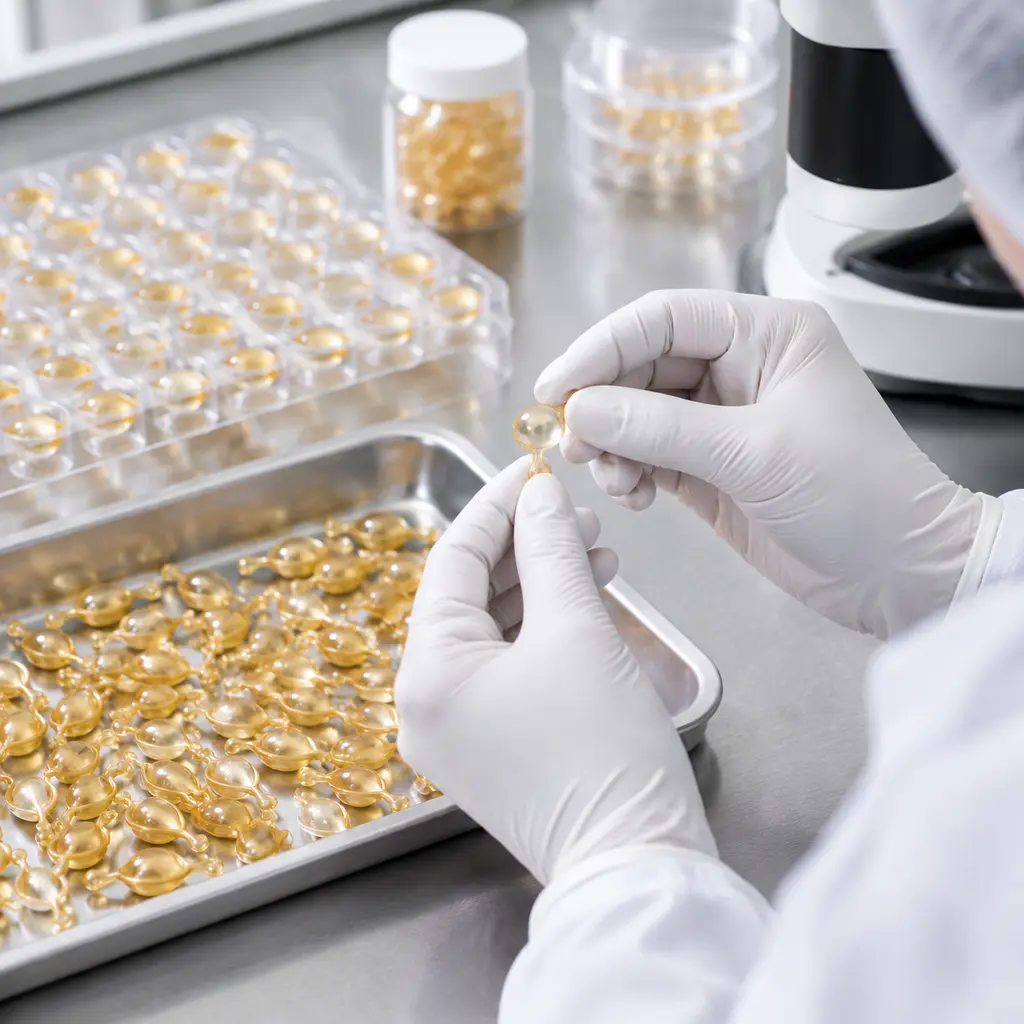
- Define the capsule use case first: An eye serum capsule, retinol capsule, facial oil capsule, cleansing oil capsule, or hair oil capsule may require different fill viscosity, shell strength, oxygen control, and packaging assumptions.
- Separate formula approval from shell approval: The serum fill may pass sensory review while the capsule shell still fails leakage, deformation, or humidity resistance checks.
- Ask for manufacturing evidence before sampling: ISO 22716 alignment, batch records, fill-weight control, microbial limits, allergen declarations, and packaging compatibility data should be requested with the RFQ.
- Confirm packaging before mold commitment: Blister cards, jars, sachets, and travel kits create different compression, migration, and heat-exposure risks for softgel cosmetics.
- Use sampling to validate execution, not invent direction: A structured RFQ reduces unnecessary reformulation and protects launch timing when multiple regional teams need approval.
Buyer Context
Eye serum capsules sit at the intersection of premium perception and operational fragility. The capsule format signals controlled dose, ingredient protection, and elevated skincare discipline, but it also introduces failure modes that conventional bottle or tube formats do not carry. A buyer sourcing private label skincare capsules must evaluate not only the formula, but also the mechanical behavior of the shell, the compatibility between fill and film, and the risk that storage, transport, or consumer handling will compromise the unit.
This matters most when a brand is using capsule products to extend an established global line. A mature procurement team may already have retinol creams, facial oils, masks, and eye care products in market; however, serum capsules add a discrete manufacturing architecture. The ODM must control shell casting, fill dosing, sealing, curing, inspection, and secondary packaging. A supplier that performs well on emulsions may not have sufficient expertise in cosmetic softgel products. For multinational buyers, that difference becomes material when a supplier is being introduced after a quality incident, a failed third-party audit, or a headquarters mandate to diversify supply across regions.
The buyer should also distinguish between capsule appearance and capsule readiness. A glossy sample may look suitable for executive review, but launch readiness requires repeatable fill weight, stable shell moisture, controlled oxidation for sensitive ingredients, and documentation aligned with the FDA’s regulatory framework for cosmetics. If the SKU is intended for Amazon, retailer distribution, or cross-border channels, packaging and shipment conditions also need to be assessed against practical fulfillment requirements such as those reflected in the Amazon FBA fulfillment program guidelines. Procurement should therefore use the RFQ to pressure-test whether the supplier can support global commercialization, not simply laboratory sampling.
PZIK’s operating position is relevant in this context because capsule development rewards vertical specialization. A buyer evaluating skincare capsules OEM capacity should ask whether the ODM has pre-validated capsule formulas, shell options, stability matrices, and pilot-to-scale continuity. The strategic question is not whether a factory can produce a visually acceptable capsule once. It is whether the same technical system can support controlled sampling, pilot runs, regional documentation, and commercial production without formulation re-engineering.
Capsule Formula, Shell, Mold, and Packaging Factors
The first RFQ decision is the fill formula. Eye serum capsules typically require a fill that feels elegant around the orbital area while remaining compatible with softgel encapsulation. Buyers should specify whether the direction is an oil serum, silicone-like sensory profile, anhydrous active blend, or another cosmetics-appropriate base. Water-rich systems are more complex for many capsule shells and can increase compatibility concerns. Sensitive ingredients, including retinol derivatives or antioxidant oils, require oxidation control through ingredient selection, headspace management, opaque packaging, or blister protection.
Fill viscosity is not a sensory detail only; it affects dosing accuracy, sealing behavior, leakage risk, and consumer experience. A fill that is too thin may migrate under pressure or create a poor opening experience. A fill that is too viscous may challenge pumping, filling, and dose uniformity. The RFQ should request the supplier’s target fill-weight tolerance, inspection method, and retained-sample protocol. For a single-dose eye capsule, small deviations can alter both perceived value and regulatory label consistency.
Shell selection is the second control point. Gelatin shells, vegan capsule shells, and modified softgel systems can behave differently under heat, humidity, and long-distance shipment. Buyers should request shell composition, plasticizer system, allergen status, animal-origin declaration where relevant, and any vegan or cruelty-free support documentation. For groups with ESG obligations, the RFQ should also ask for supplier traceability, labor audit readiness, and environmental records that can withstand independent review. Broader beauty market intelligence from Mintel global beauty market reports may help category teams frame consumer expectations, but procurement decisions still need factory-level evidence.
Mold geometry is the third decision. Eye serum capsules may use twist-off, pearl, oval, teardrop, or custom softgel molds. The mold must support opening force, dose perception, packing density, and automated inspection. A distinctive shape can support shelf recognition, but custom tooling can add validation steps and may constrain packaging options. Buyers should ask whether the ODM has existing molds suitable for eye care, whether custom tooling is required, and whether the same mold can be used from sample through production.
Packaging is often the underestimated risk center. Jars create convenience and premium shelf presence, but capsules can be exposed to repeated oxygen, humidity, and handling. Blisters provide better unit isolation and can support travel or professional protocols, but they require compatibility testing for film, foil, seal strength, and compression. Cartons, inserts, and labels must align with the claims file, ingredient list, responsible person or facility information, and country-specific language requirements. For related formats such as encapsulated retinol skincare, oxygen and light control may be even more important.
Storage and shipment conditions should be written into the RFQ rather than assumed. Buyers should ask for accelerated and real-time stability plans, heat-humidity challenge parameters, leakage inspection criteria, and shipping carton configuration. If a product is routed through regional distribution centers or marketplace fulfillment, the ODM should advise whether blister, jar, or secondary pouch protection is more appropriate. A sample that survives a conference-room review but fails a hot-lane shipment is not a viable launch asset.
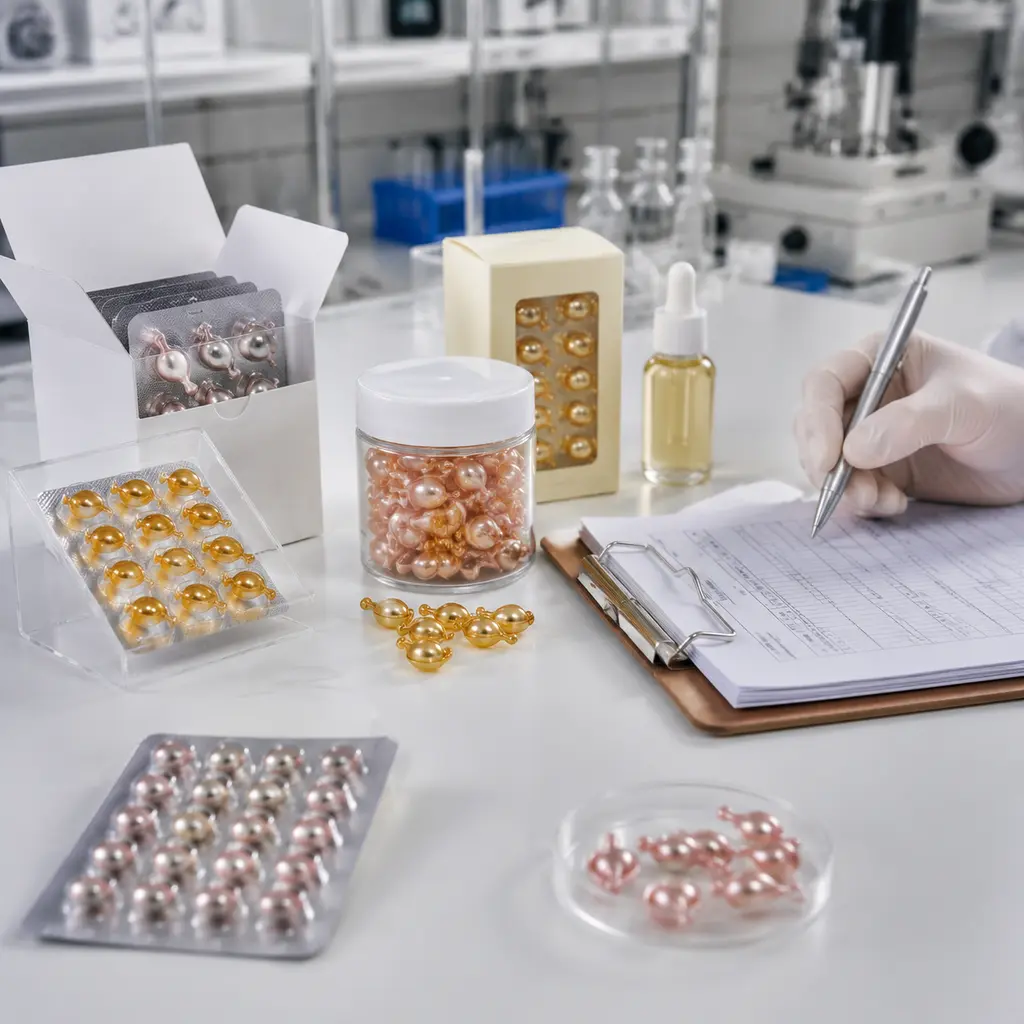
Decision Framework Table
| Factor | What to Check | Why It Matters | ODM Buyer Note |
|---|---|---|---|
| Fill formula | Base type, active compatibility, oxidation sensitivity, viscosity range | Determines capsule stability, dose feel, leakage risk, and claim support | Request a formula brief and sample matching statement before approval |
| Shell material | Gelatin or vegan shell, plasticizer, allergen status, moisture behavior | Controls capsule integrity under heat, humidity, and handling | Ask for shell composition disclosure and supporting documentation |
| Fill weight | Target dose, tolerance, in-process sampling, retained sample method | Protects consumer consistency and label accuracy across batches | Require fill-weight data from pilot and commercial-scale equipment |
| Mold option | Existing mold, custom mold, opening force, packing density | Affects tooling time, user experience, and packaging compatibility | Prefer proven molds unless brand differentiation justifies validation work |
| Packaging route | Jar, blister, sachet, carton, insert, and shipment configuration | Impacts oxidation exposure, deformation, retail readiness, and logistics risk | Test the selected packaging path before mass-production commitment |
| Stability program | Accelerated, real-time, heat-humidity, leakage, and appearance review | Identifies defects before regional launch and retailer submission | Align test points with internal QA and regulatory gate requirements |
| Documentation | INCI, COA, MSDS where applicable, GMP records, claim substantiation | Reduces cross-functional review friction and market entry risk | Ask for document samples with the RFQ, not after sample selection |
How to Use This Framework Before Sampling
The practical sequence is straightforward. First, define the intended capsule product line: eye serum capsules, facial oil capsules, retinol serum capsules, hair oil capsules, or another softgel skincare format. Second, lock the formula direction and sensory objective. Third, screen shell and mold options against packaging and shipment realities. Fourth, request evidence that the ODM can hold fill weight, seal quality, stability, and documentation standards under ISO 22716-aligned manufacturing.
For strategic procurement teams, the RFQ should also include continuity questions. Ask whether sample batches, pilot runs, and commercial orders remain on the same technical platform. Ask how the supplier protects confidential formulas, segregates customer information, and prioritizes capacity during ingredient shortages. Ask what happens if a batch deviates: who investigates, which records are shared, and what insurance or corrective-action process applies. These questions are not adversarial; they are standard controls for a global beauty supply chain.
A strong ODM response will be specific, documented, and internally consistent. It will connect the proposed serum capsule products to defined shell systems, mold availability, fill-weight controls, packaging validation, and market documentation. A weak response will over-index on appearance, avoid tolerances, defer compliance documents, or suggest that the mass-production formula may differ from the sample. For buyers managing international launches, that gap is where schedule risk, recall exposure, and supplier replacement cost accumulate.
Used correctly, the RFQ becomes a decision gate rather than an administrative form. It allows procurement, R&D, QA, and compliance to decide whether a cosmetic softgel capsule factory is technically qualified before the organization invests time in sample evaluation. That discipline is especially important for eye care, where small format, high perceived value, and close-to-face usage make consistency non-negotiable. The right question is not simply whether the capsule looks ready. The right question is whether the supply system behind it is ready.

ODM Manufacturing Considerations
Use the eye serum capsules private label RFQ checklist to define what constitutes an approved sample before development begins. The approval standard should cover appearance, color, odor, capsule dimensions, opening behavior, application feel, fill viscosity, target fill weight, and acceptable variation. Keep a signed master sample and written specification so later production batches are compared with documented criteria rather than memory.
Formula customization should begin with the intended direction of use and target market. Tell the ODM whether the single-dose formula will be positioned as an eye serum, facial oil, retinol capsule, cleansing oil capsule, or hair oil capsule. Identify prohibited ingredients, fragrance limits, antioxidant requirements, target texture, and any claim-support documents needed. For sensitive eye-area cosmetics, assess whether fragrance or essential oils are necessary at all. Buyers can review related formats through eye serum capsule options and retinol capsule development.
Require the supplier to identify the capsule shell material and any plasticizers, colorants, opacifiers, or processing aids. If a plant-derived shell is required, request composition statements and supporting declarations rather than relying on a general vegan description. Additional shell considerations are outlined in vegan skincare capsule formats.
Mold selection affects dose capacity, surface area, opening style, visual identity, and filling efficiency. Confirm whether the shape uses an existing tool or requires new tooling, who owns the mold, how it is maintained, and whether another buyer can use the same design. Review the supplier’s capsule mold options before approving artwork or pack dimensions.
Packaging must be evaluated with actual capsules, not empty-component drawings alone. Confirm capsule count, headspace, closure seal, insert material, blister cavity dimensions, and resistance to pack deformation. The stability plan should include predefined checkpoints for shell texture, sticking, discoloration, odor change, fill separation, and assay or other relevant chemical measurements. MOQ discussions should distinguish laboratory samples, tooling trials, packaging tests, validation batches, and commercial production.
The document package may include ingredient nomenclature, formula percentages where legally required, allergen statements, safety data, specifications, certificates of analysis, test reports, label copy support, batch coding rules, and market-specific responsible-party information. Shipment instructions should define temperature exposure limits, carton configuration, pallet pattern, moisture protection, transit testing, and acceptance procedures for damaged cases. If inventory will enter Amazon fulfillment, compare final pack and carton specifications with the Amazon FBA fulfillment program guidelines.

Common Problems or Failure Cases
Shell brittleness: Capsules may crack during packing or consumer opening when the shell loses moisture or is incompatible with the fill. Ask for breakage observations at initial release and after storage under the intended distribution conditions.
Sticking and deformation: Capsules stored in a jar may adhere to each other, flatten, or transfer color. The causes can include moisture migration, excessive pack compression, unsuitable liners, or prolonged elevated temperature. Evaluate the complete filled package in upright, inverted, and transit-simulated positions.
Fill separation: Suspended ingredients can settle, crystallize, or form visible layers. A sample that looks uniform on day one may change after temperature cycling. Define whether slight separation is acceptable and whether shaking is realistic for a single capsule.
Capsule leakage: Leaks may arise from weak seams, unsuitable viscosity, fill-shell interaction, excessive internal pressure, or mechanical damage from the package. Record the location and frequency of failures rather than reporting only a pass or fail result.
Fragrance sensitivity: Fragrance components can alter odor over time, interact with the shell, or create avoidable eye-area discomfort. Review fragrance concentration, allergen disclosure, and unscented alternatives during sample selection.
Packaging deformation: A blister tray or jar may warp during warehousing or transport, placing pressure on the capsules. Confirm component resin, wall thickness, closure performance, and finished-pack behavior under expected shipment conditions.
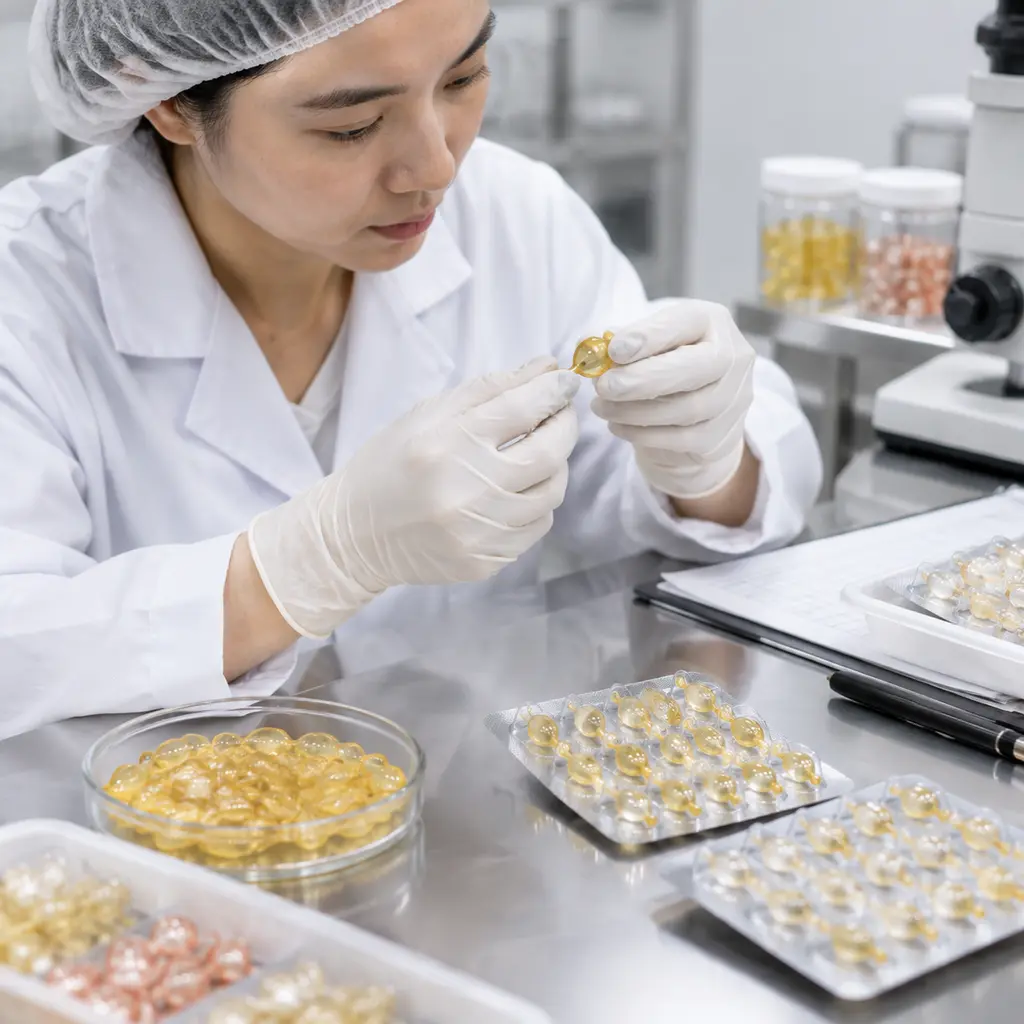
Supplier Checklist
- Confirm the legal manufacturer, production site, relevant scope of operations, and whether filling, shell formation, testing, or packing is subcontracted.
- Request the full shell composition, fill ingredient list, target viscosity range, nominal fill weight, permitted weight variation, and finished-capsule specification.
- Define mold status, ownership, cavity count, opening mechanism, tool maintenance, replacement responsibility, and restrictions on design reuse.
- Approve a sample protocol covering formula versions, sample quantities, packaging prototypes, test duration, acceptance limits, and retained samples.
- Review evidence for microbiological quality, chemical stability, shell integrity, pack interaction, and transportation resilience.
- Separate MOQ requirements for bulk capsules, custom molds, printed blisters, jars, cartons, and market-specific labels.
- Check ingredient nomenclature, warnings, net contents, batch coding, shelf-life presentation, traceability records, and supporting label documents.
- Verify raw-material qualification, alternate-source controls, capacity allocation, business-continuity procedures, and change-notification timelines.
- Assess data access controls, confidentiality terms, worker-welfare records, environmental permits, emissions records, and independent audit availability.
- Qualify a secondary source if the current manufacturer has experienced a major quality incident, labor interruption, capacity loss, or serious third-party audit finding.
FAQ
How many sample rounds should an eye serum capsule project allow?
There is no universal number. Plan separate rounds for formula direction, shell and mold fit, and final packaged-product confirmation. A revised fill can behave differently inside the selected shell, so approval of a loose formula is not final product approval.
Can a supplier guarantee that our core formula will never be disclosed?
No credible supplier can promise absolute security. Evaluate role-based system access, restricted formula files, physical separation of confidential records, employee confidentiality obligations, access logs, backup controls, and subcontractor disclosure. The agreement should define ownership, permitted use, breach notification, and remedies.
How should supply priority be handled during a global ingredient shortage?
Ask for written allocation rules, forecast commitments, safety-stock policy, approved alternate sources, reserved capacity, and notification lead times. Strategic status should be reflected in a supply agreement. Substituting an ingredient without written approval should remain prohibited even during a shortage.
What evidence supports environmental and worker-welfare claims?
Request current permits, waste-treatment records, energy and emissions data, corrective-action reports, wage and working-hour records, age-verification procedures, and independent social-audit results. For a corporate carbon-neutrality strategy, require consistent reporting boundaries and traceable source data rather than an unsupported declaration.
Should MOQ be accepted as one combined number?
No. Obtain separate thresholds for capsules, formula batches, custom molds, decorated containers, printed cartons, and labels. The highest component threshold often controls usable launch volume and excess inventory exposure.
Which label documents should be ready before shipment?
At minimum, verify the market-appropriate ingredient declaration, responsible-party details, net contents, directions, warnings, batch identification, and required language versions. United States buyers should compare the final presentation with the FDA regulatory framework for cosmetics.