
Direct Answer
The right retinol serum capsules private label product route is determined less by the retinol percentage than by the interaction between active format, capsule shell, fill weight, mold geometry, packaging, and stability evidence. For a mature brand, the preferred route is usually a pre-validated softgel platform that can be customized within controlled parameters, rather than a fully bespoke formula that introduces avoidable qualification risk. The supplier should demonstrate compatibility between the retinol serum, shell material, blister or jar format, and intended distribution conditions before commercial approval. It should also provide batch traceability, ISO 22716 controls, stability protocols, labeling documentation, and a documented change-control process. A practical evaluation therefore compares not only formulation performance, but also production continuity, raw-material resilience, data integrity, and the supplier’s ability to scale the approved sample into repeatable global production.
Key Takeaways for Private Label Buyers
- Source the platform, not only the ingredient. Confirm whether the retinol capsule formula is already supported by compatibility and stability evidence.
- Control shell and fill variables together. Shell composition, fill viscosity, fill weight, and seal integrity directly influence leakage, oxidation, and consumer dosing.
- Qualify packaging before artwork approval. A blister, jar, or travel format must protect the capsule through filling, transport, warehouse storage, and consumer handling.
- Separate customization from re-engineering. Changes to retinol level, oil phase, shell color, mold, or preservative strategy may trigger new testing and regulatory review.
- Require launch-ready documentation. The technical file should include specifications, certificates of analysis, ingredient and allergen statements where applicable, stability records, batch records, and labeling support.
- Evaluate continuity as a quality parameter. Dual-source planning for critical oils, shell materials, and packaging components should be assessed before the first purchase order.
Buyer Context
Capsule skincare is often evaluated as a packaging innovation, but procurement risk sits across the entire system. Retinol capsules can deliver a measured facial treatment format while limiting repeated exposure of the bulk formula to air and light. The same logic applies to facial oil capsules, eye serum capsules, cleansing oil capsules, and hair oil capsules. However, each route has a different viscosity profile, dosing expectation, and packaging burden.
This matters particularly when a group is adding a secondary manufacturing source after a quality incident, an unexpected labor interruption, or a failed third-party audit at an incumbent supplier. A replacement facility may appear technically capable but still lack validated mold control, capsule-shell traceability, or sufficient documentation for a multi-market launch. The risk is amplified when a brand is entering a new category, such as moving from facial cream into softgel serum production, and the existing supplier does not have the required filling and sealing equipment.
For international procurement teams, the decision should be treated as a controlled supplier qualification exercise. Commercial speed is useful only when it does not create a later hold at quality release, customs clearance, or regional notification. Market signals can be reviewed through Mintel global beauty market reports and Business of Fashion beauty intelligence, but those sources do not replace product-specific manufacturing evidence. The buyer still needs to review a serum capsules manufacturer against the brand’s internal quality, ESG, and information-security standards.
Capsule Formula, Shell, Mold, and Packaging Factors
Formula and fill behavior
Retinol is sensitive to oxidation, light, heat, and formulation conditions. The buyer should request the complete fill specification, including retinol form, oil-phase composition, antioxidant system, target viscosity, fill weight, and container-closure assumptions. A low-viscosity serum may fill efficiently but can increase seepage risk if the seal design or shell plasticization is not correctly matched. A higher-viscosity facial oil may reduce migration during storage, but it can create filling variation or incomplete discharge if the mold and nozzle are not selected accordingly.
Fill-weight sampling should be defined at the beginning, middle, and end of a production run, with acceptance limits agreed in the quality agreement. The supplier should explain how temperature control, deaeration, mixing time, and hold time are managed before encapsulation. These details are particularly important when the product is positioned as a measured daily dose. A supplier’s serum capsule products portfolio can demonstrate technical range, but the buyer must confirm that the selected retinol serum route has product-specific evidence.
Shell material and mold selection
Shell options may include conventional gelatin or vegan capsule shells based on hydrocolloid systems. The decision affects moisture exchange, mechanical strength, seal behavior, appearance, and storage requirements. Vegan shells can support a plant-based positioning, but they should not be accepted solely on declaration. Request shell specifications, source documentation, microbial controls, residual-moisture targets, and aging data. Review whether the shell remains flexible without tackiness or brittleness under the planned heat and humidity profile.
Custom molds influence capsule shape, surface area, fill capacity, consumer opening behavior, and packaging utilization. A small eye serum capsule may require a different geometry from a facial oil capsule intended for a larger daily application. Before approving a custom mold, obtain dimensional drawings, cavity tolerance information, tooling ownership terms, and a physical sample from the production-equivalent line. Buyers assessing broader private label skincare capsules should ensure that any mold change is subject to formal change control rather than informal production adjustment.
Packaging compatibility and storage
Blister packaging provides unit separation and can limit repeated exposure to air, but the forming material, lidding foil, seal temperature, and cavity dimensions must be validated against the shell. A jar format may simplify consumer presentation, yet it can expose capsules to more headspace, handling, and humidity after opening. The buyer should conduct leakage, compression, abrasion, and transport checks for the final pack rather than relying on an empty-shell demonstration.
Storage conditions should reflect the intended supply chain, including warehouse heat, humidity excursions, ocean shipment duration, and regional distribution. Stability testing should examine appearance, odor, shell integrity, fill-weight change, retinol assay or other agreed quality attributes, oxidation indicators, and package interaction. A supplier offering retinol capsules should be able to distinguish data from the exact formula and pack from data generated on a related capsule platform. For broader route comparison, buyers may also review encapsulated retinol skincare and the technical scope of skincare capsules OEM services.
Regulatory interpretation must remain market-specific. A cross-market overview such as FDA and EU cosmetic launch guidance can help structure the review, but the brand’s regulatory counsel should confirm claims, ingredient status, notification obligations, and labeling language for each destination.

Decision Framework Table
| Factor | What to Check | Why It Matters | ODM Buyer Note |
|---|---|---|---|
| Fill formula | Retinol form, oil phase, viscosity, antioxidant system, fill weight, and hold-time controls | Determines oxidation control, dosing consistency, and filling performance | Request the production formula and a sample filled on the intended line |
| Shell material | Gelatin or vegan composition, moisture profile, mechanical strength, seal behavior, and supplier traceability | Influences leakage, brittleness, consumer opening, and storage performance | Require shell specifications and aging evidence for the selected material |
| Mold geometry | Dimensions, cavity tolerance, tooling ownership, and compatibility with filling equipment | Affects fill capacity, package fit, and production repeatability | Approve a production-equivalent sample before tooling release |
| Packaging | Blister or jar compatibility, seal parameters, headspace, barrier properties, and transport protection | Controls exposure to air, light, humidity, compression, and handling | Test the final commercial pack, not only the capsule shell |
| Stability | Heat and humidity conditions, assay plan, appearance, leakage, odor, and package interaction | Supports shelf-life decisions and reduces regional release risk | Confirm whether evidence covers the exact formula, shell, mold, and pack |
| Production continuity | Critical-material sourcing, backup suppliers, batch records, release testing, and escalation procedures | Protects launch timing and reduces interruption exposure | Include continuity commitments and change notification in the quality agreement |
For procurement teams requiring a broader comparison, the relevant capsule skincare product lines should be mapped against the same criteria. The objective is not to select the most elaborate capsule; it is to select the route that can pass technical qualification, survive the intended logistics environment, and remain repeatable across commercial batches.

ODM Manufacturing Considerations
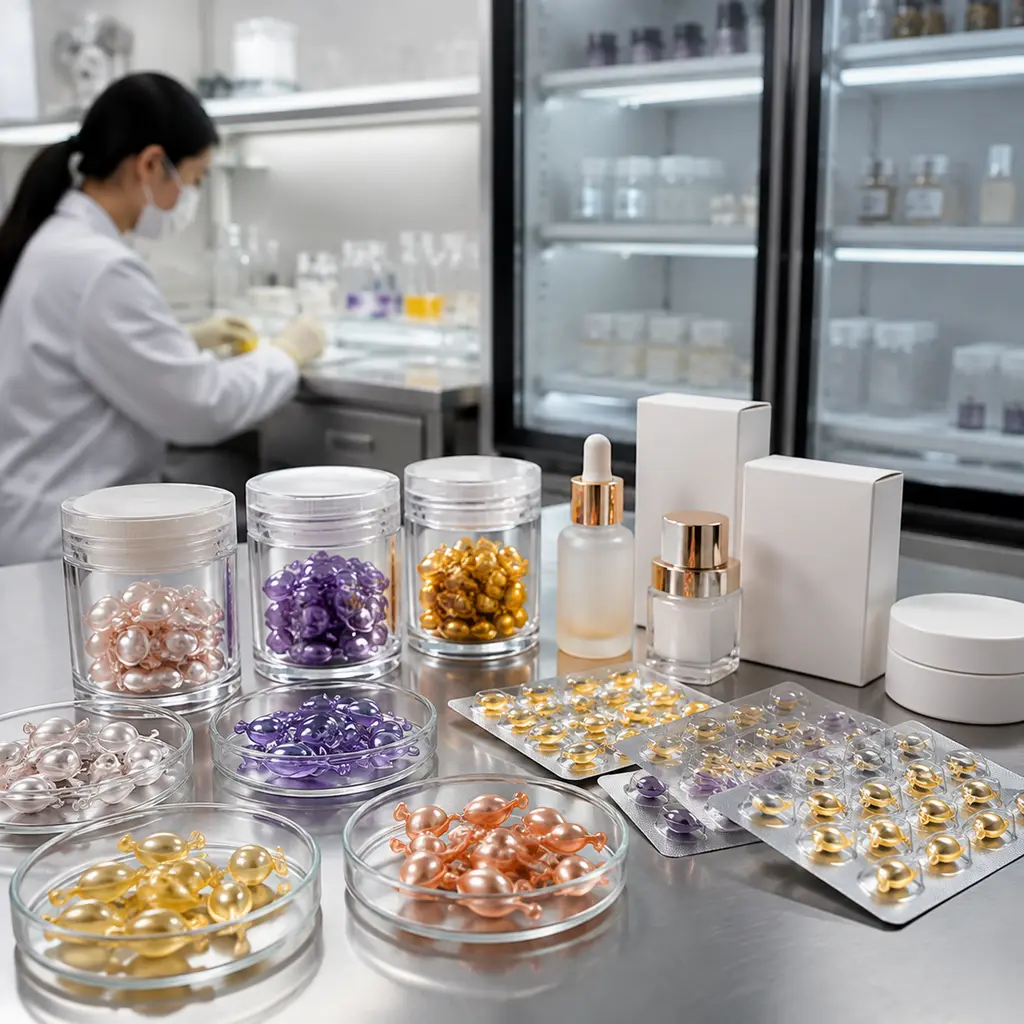
An effective ODM project begins with a controlled sample confirmation process. The buyer should receive a written sample brief covering the retinol concentration range, serum or facial oil base, target fill weight, capsule dimensions, shell material, fragrance profile, color, intended market, and primary packaging. A retained sample should be assigned a reference code, with the approved appearance, odor, texture, and capsule weight recorded before production planning. This prevents later disputes when a natural oil color or retinol-compatible antioxidant system varies slightly between batches.
Formula customization should be evaluated through the behavior of the fill, not only through an ingredient list. Ask the manufacturer to show whether the proposed serum remains uniform during storage, whether the viscosity supports accurate dosing into the selected capsule, and whether oil-soluble retinol remains compatible with the carrier oils, fragrance, and antioxidant system. For facial oil capsules, cleansing oil capsules, and hair oil capsules, the buyer should review spreading feel and residue as well as fill separation. Eye serum capsules require particular attention to fragrance sensitivity and user tolerance, while retinol capsules should use claims and directions that remain within the cosmetic rules of the destination market.
Shell selection is a commercial and technical decision. Gelatin softgels may provide a familiar production route, while vegan capsule shells can support a different brand positioning but may respond differently to moisture, temperature, and storage time. Request shell specifications, colorant details, allergen information where applicable, and aging or conditioning records. The mold should be selected with the fill volume, opening method, capsule shape, tooling ownership, and future SKU extensions in mind. A custom mold can create a distinctive product, but it also creates an additional approval and replacement-planning requirement.
Packaging compatibility should be confirmed with the actual capsule and the intended pack format. Blisters can protect individual serum doses, but the sealing layer, cavity depth, and compression during cartoning must be reviewed. Jars offer a different user experience and require an insert, closure, and headspace strategy that limits oxidation and capsule abrasion. Ask for package samples filled with production-equivalent capsules, then inspect sticking, deformation, odor transfer, leakage, and ease of removal. Packaging should also be reviewed for the shipment route, including vibration, compression, temperature exposure, and the time expected in distribution.
Stability review should match the formula, shell, and pack rather than rely on a generic report. The buyer should receive a schedule identifying test conditions, inspection intervals, acceptance criteria, and the measured attributes, such as retinol assay where applicable, appearance, odor, fill uniformity, shell integrity, and package seal performance. The manufacturing partner should also explain what happens when a sample falls outside specification and whether a reformulation, shell change, or packaging change is proposed.
MOQ should be quoted separately for a stock formula, a modified formula, a new shell color, and a new mold. Confirm whether the MOQ applies to one SKU, one fragrance, one capsule color, or the full purchase order. The documentation package should identify the formula INCI list, batch specifications, certificate of analysis format, safety or product information documents required for the target market, allergen or fragrance disclosure, packaging specifications, and labeling review responsibility. Shipment conditions should state carton configuration, temperature precautions, pallet or case protection, lot coding, shelf-life dating, and the records supplied at dispatch. Related routes can be compared through the supplier’s OEM/ODM services, retinol capsule options, and vegan skincare capsule specifications.

Common Problems or Failure Cases
Capsule shell brittleness is often linked to an unsuitable moisture balance, excessive storage heat, or a shell formulation that does not match the distribution environment. Brittle capsules may crack during counting, packing, or removal from a blister. The buyer should inspect samples after storage and handling, not only immediately after filling, and should request a defined shell integrity limit.
Sticking and shell deformation can occur when capsules are packed before the surface has conditioned adequately, when the package cavity is too tight, or when capsules experience heat and compression in transit. Sticking can make individual doses difficult to remove and may damage the shell. Check both loose capsules in a jar and sealed capsules in a blister, because the failure mechanism can differ between formats.
Fill separation is a concern for serum blends containing oils with different densities, suspended materials, or incompatible additives. A capsule can appear acceptable while delivering a nonuniform dose if the fill is not sufficiently homogeneous during the filling window. Ask for a mixing and hold-time specification, along with visual inspection criteria for sediment, clouding, or phase separation.
Leakage may result from an incomplete seal, excessive fill volume, sharp mold geometry, shell damage, or interaction between the fill and the shell. Leakage review should include upright and inverted samples, package contact surfaces, and transport simulation. Fragrance can also create problems: a strong aromatic component may soften the shell, migrate into packaging, or become unpleasant after storage. Fragrance-free and lightly fragranced versions should be assessed separately.
Packaging deformation is another practical failure case. A blister cavity may collapse under compression, while a jar insert may press against capsules and cause scuffing or rupture. Review the complete pack in its shipping carton, including closure torque, stacking pressure, and the condition of capsules after unpacking. These checks are especially important when a brand changes from standard capsule technology to a custom mold or unusual presentation.
Supplier Checklist
- Confirm the shell material, shell color, allergen position, moisture specifications, and suitability for the destination climate.
- Request fill viscosity, density, target fill weight, acceptable variation, mixing controls, and retinol or oil compatibility records.
- Review sample scope: formula sample, shell sample, mold sample, filled package sample, and the approval record for each version.
- Check whether the supplier can produce softgel retinol, facial oil, eye serum, cleansing oil, and hair oil capsules using documented process controls.
- Clarify mold ownership, tooling charges, dimensional tolerances, replacement timing, and rights to use the approved custom shape.
- Test blister and jar compatibility with filled capsules, including seal integrity, abrasion, sticking, odor transfer, and removal performance.
- Obtain a stability protocol and reports covering shell condition, fill uniformity, appearance, odor, packaging, and relevant formula attributes.
- Verify MOQ by SKU and by customization level, plus the sample lead time, approval gates, production schedule, and change-control procedure.
- Request labeling documents, INCI information, batch coding rules, certificate of analysis format, fragrance disclosure, and market-specific compliance support.
- Document shipment conditions, carton protection, temperature limits, storage instructions, insurance responsibility, and the procedure for transit damage or quality claims.
- Ask how confidential formulas, customer files, molds, and samples are access-controlled, backed up, and separated from other customer projects.
- Review labor, environmental, and quality audit records, including corrective actions and the right to conduct or commission an independent audit.
FAQ
Can the supplier protect a proprietary retinol capsule formula from internal or external disclosure?
Ask for a confidentiality agreement, role-based access controls, customer-file segregation, sample coding, mold custody records, and a documented approval trail. No information system can honestly promise absolute secrecy, so the practical test is whether access is limited, monitored, and supported by enforceable contractual obligations.
How can a brand secure supply when raw materials are constrained?
Request a written allocation policy for strategic materials, approved alternative sources, minimum safety-stock expectations, and advance notification of shortages. The supplier should explain how priority is assigned among customers and whether the approved retinol, carrier oils, shell components, and packaging materials can be reserved against a forecast.
What documents should be available before a private-label launch?
At minimum, request the formula INCI list, product specification, batch release documents, certificate of analysis format, packaging specification, labeling review, fragrance or allergen information, shelf-life basis, and shipment records. The exact regulatory package depends on the destination market and the product claims.
How should a buyer evaluate a vegan capsule shell?
Compare shell integrity, moisture response, deformation, fill compatibility, appearance, and removal performance against the intended pack. A vegan shell should be evaluated in the actual retinol serum or facial oil formula, since shell performance cannot be inferred from the shell description alone.
What should happen after a major quality complaint?
The supplier should provide a complaint procedure covering lot traceability, retained samples, investigation timing, root-cause analysis, corrective action, and communication responsibilities. Ask for evidence of product-liability insurance and clarify geographic coverage, exclusions, claim limits, and responsibility for recall or replacement costs.
How can a buyer check whether factory workers are treated fairly?
Request recent social-compliance audits, payroll and working-hour records in a suitably redacted form, grievance procedures, age-verification controls, and corrective-action reports. Independent audits should be permitted, especially when the supplier is being considered after a serious incident or a failed third-party inspection.
References
For broader category context, see Mintel global beauty market reports. For a general comparison of cosmetic market obligations and product launch considerations, review the FDA and EU cosmetic launch guide. These sources provide market or regulatory context; capsule specifications, formula performance, and packaging acceptance should still be confirmed directly through the supplier’s technical documentation.