
Direct Answer
A cosmetic capsule shell appearance RFQ checklist should define the shell material, color tolerance, surface finish, mold geometry, fill weight, formula viscosity, packaging interface, storage conditions, and acceptance criteria before a supplier sends a sample. Appearance is not a cosmetic detail to be approved at the end of the project. It is an early indicator of shell compatibility, filling control, oxidation exposure, leakage risk, and mass-production repeatability. For retinol capsules, facial oil capsules, eye serum capsules, cleansing oil capsules, or hair oil capsules, buyers should request samples only after the ODM has documented the intended shell specification and the test method used to verify it. The same capsule must remain visually consistent after filling, sealing, transport, and heat-humidity exposure. A sample that looks acceptable on delivery may still fail if the shell becomes tacky, brittle, opaque, discolored, or distorted during storage. The RFQ should therefore function as a controlled technical brief, not a request for photographs or an unqualified sample.

Key Takeaways for Private Label Buyers
- Specify whether the shell is gelatin-based, plant-derived, or a vegan capsule shell, and require documentation for composition, allergens, origin, and regulatory status.
- Define appearance using measurable criteria such as color range, transparency, seam visibility, surface defects, dimensional tolerance, and acceptable fill-weight variation.
- Match the fill formula to the shell. Oil-rich serum, anhydrous retinol systems, and cleansing oil formats can create different swelling, brittleness, or migration risks.
- Approve the mold and packaging together. A capsule mold that performs well in a jar may not feed reliably into a blister, sachet, or high-speed counting system.
- Require stability and transport evidence covering heat, humidity, light, oxidation, compression, and vibration before launch approval.
- Separate sample approval from production release. The approved reference, inspection method, labeling documents, and change-control process must be recorded in the purchase specification.
Buyer Context
For a mature beauty organization, capsule appearance sits at the intersection of brand consistency, quality risk, and supply continuity. A procurement team may be qualifying a second source after a quality incident, an unsuccessful third-party audit, or an unexpected interruption at an incumbent plant. In each case, a visually attractive sample is insufficient evidence of manufacturing control. The buyer needs to know whether the supplier can reproduce the same shell and fill behavior across pilot and commercial lots without reformulation or an unapproved material substitution.
Capsule skincare introduces a narrower operating window than many conventional cream or pump formats. Retinol capsules may require protection from oxygen and light. Facial oil capsules can expose shell materials to plasticization, migration, or seal stress. Eye serum capsules require consistent geometry and clean opening behavior because the consumer uses a small dose close to a sensitive area. Cleansing oil capsules must tolerate the selected oil phase and remain compatible with the secondary pack. Hair oil capsules may need a larger fill or a different mold profile, increasing the importance of weight control and container fit.
These requirements also affect global documentation. A supplier should be able to connect shell composition, formula ingredients, batch records, artwork information, and release testing to the relevant market file. Buyers can review serum capsules manufacturer capabilities alongside documented GMP controls, then compare the proposed format with the supplier’s serum capsule products. For regulatory testing oversight, Intertek’s regulatory testing and certification services provide useful external context. Ingredient safety questions should also be assessed through specialist literature, including the Journal of Cosmetic Dermatology, without treating a supplier claim as a substitute for product-specific review.

Capsule Formula, Shell, Mold, and Packaging Factors
Shell material and appearance
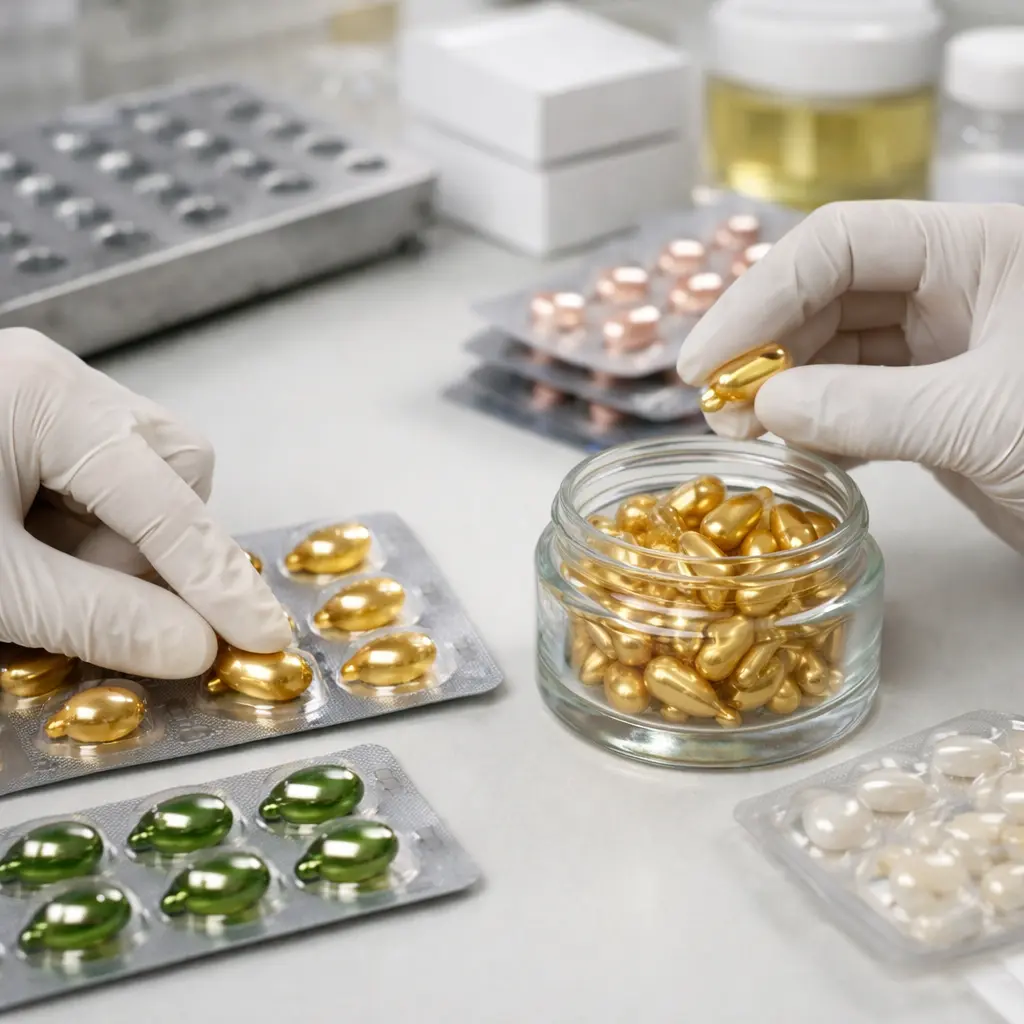
The RFQ should name the intended shell platform and identify what may not change without written approval. Gelatin and plant-derived shells can differ in clarity, color development, moisture response, sealing behavior, and mechanical strength. A vegan capsule shell may support a particular brand requirement, but it still needs compatibility testing with the selected serum and package. Ask the ODM to provide a shell specification, raw-material source, allergen statement, colorant declaration, and a description of the inspection method. Terms such as clear, pearl, amber, or translucent should be supported by a physical master standard or an agreed color reference.
Inspect the shell for pinholes, bubbles, wrinkles, weak seams, tail formation, oil sweating, cloudiness, and surface tack. Confirm whether the seam is expected to be visible and whether the opening point is controlled by a tear line, twist-off tip, or puncture design. These details influence consumer handling and can expose inconsistencies that are not visible in a single photograph. A capsule skincare collection should not be approved on appearance alone when the underlying shell response to the formula remains unverified.
Formula, fill viscosity, and weight
Provide the formula type, viscosity range, density estimate, volatile content, light sensitivity, and oxidation sensitivity in the RFQ. An anhydrous oil serum behaves differently from a water-containing emulsion or a silicone-rich facial oil. The filling line must control dose accuracy without introducing excessive air, heat, or shear. Ask for the target fill weight, tolerance, weighing frequency, balance calibration record, and the response plan for an out-of-trend result. The buyer should also confirm whether the fill weight is based on net content or a nominal machine setting.
For retinol formats, request evidence that the fill process and package limit light and oxygen exposure. A dedicated retinol capsules review should cover assay retention, color drift, odor change, shell interaction, and closure integrity. The encapsulated retinol skincare format may be operationally suitable, but only a product-specific stability program can establish shelf-life support.
Mold, packaging, and storage
Mold selection controls capsule length, width, tip profile, seam placement, and usable fill volume. Ask for mold drawings, dimensional tolerances, cavity count, tooling ownership, and changeover controls. Confirm that the proposed capsule can be counted, oriented, and dispensed through the intended package. Blister pockets may compress a soft shell differently from a jar, while a wide-mouth jar may permit movement, abrasion, or contact with a desiccant. Review blister, jar, tray, and insert compatibility using filled capsules rather than empty shells.
Storage and shipment conditions should be defined before sampling. Request heat and humidity exposure data, light-protection requirements, carton configuration, pallet limits, and transport testing. The supplier should explain how finished capsules are protected from compression, freezing, excessive humidity, and prolonged exposure to elevated temperature. Review the proposed skincare capsules OEM process against the brand’s actual distribution lanes, including regional warehousing and ocean shipment duration.
Decision Framework Table
| Factor | What to Check | Why It Matters | ODM Buyer Note |
|---|---|---|---|
| Shell material | Composition, origin, allergens, moisture response, color standard | Determines compatibility, compliance, and appearance stability | Record approved material and change-notification requirements |
| Fill formula | Viscosity, density, oxygen sensitivity, volatile content, light sensitivity | Influences filling accuracy, leakage, oxidation, and shell aging | Test the commercial formula, not a visually similar substitute |
| Fill weight | Target weight, tolerance, sampling frequency, calibration controls | Supports label accuracy, dose consistency, and yield planning | Link weight records to batch release documentation |
| Mold geometry | Length, width, tip, seam, cavity design, tooling ownership | Affects opening, feeding, filling, and package fit | Approve filled capsules inside the intended primary pack |
| Packaging compatibility | Blister or jar fit, compression, abrasion, closure, light barrier | Reduces leakage, deformation, and oxidation during distribution | Run transport and storage checks after final pack selection |
| Stability evidence | Heat, humidity, light, oxidation, appearance, odor, assay, leakage | Shows whether the sample can support a commercial launch | Require a written protocol, test limits, and deviation process |
Before issuing a sample request, procurement should send the supplier a controlled specification that includes the shell reference, formula identity, mold drawing, package format, shipment conditions, inspection criteria, and required documentation. The supplier response should identify what is confirmed, what remains provisional, and which results depend on pilot filling. This approach gives QA, regulatory, packaging, and sourcing teams a common decision record. It also lets the buyer assess whether a proposed private label serum capsules program can move from sampling to repeatable production without hidden formulation or packaging changes.
ODM Manufacturing Considerations
Before requesting physical samples, define what the sample is intended to prove. A cosmetic capsule shell appearance RFQ checklist should separate visual approval from formula approval, packaging approval, and production feasibility. Ask the supplier to identify the exact shell material, colorant or opacifier system, surface finish, capsule dimensions, nominal fill weight, and proposed packaging format for every sample version.
Sample confirmation should be documented rather than handled through informal images alone. Request a sample matrix covering the approved shell color, translucency, gloss level, seam appearance, tip shape, and surface uniformity. The supplier should state whether the sample was made on the proposed production mold or on a development mold. A development sample can demonstrate direction, but it may not predict final capsule geometry, filling speed, or packaging fit. Buyers evaluating capsule technology should also ask for retained samples from the same lot for later comparison.
Formula customization needs a defined technical window. Confirm the planned serum or facial oil ingredients, fragrance level, viscosity range, density, sensitivity to oxygen, and compatibility with the shell. Retinol capsules, eye serum capsules, and cleansing oil capsules may require different protection and handling controls than a simple facial oil capsule. Ask whether the supplier will adjust the formula, fill temperature, deaeration process, or shell composition, and which changes require a new approval sample. A written formula brief reduces the risk that a requested sensory change creates leakage, separation, or shell instability.
Shell options should be evaluated against the product brief, not only against appearance. Compare gelatin and vegan capsule shells for flexibility, moisture response, opacity, surface feel, and compatibility with the fill. For vegan skincare capsules, request the shell specification, plant-derived polymer information, colorant declaration, and any allergen or animal-origin statement needed for the intended market. A supplier offering vegan skincare capsules should explain which appearance differences are inherent to the shell material and which can be controlled through processing.
Mold selection affects more than shape. Confirm capsule length, diameter, tip profile, wall thickness, seam position, and the dimensional tolerance that the filling and packaging equipment can accept. Ask for a drawing or controlled specification before approving a custom mold. The mold should be assessed alongside the blister cavity, jar opening, tray pocket, or dispensing format. A visually attractive capsule that rubs against a blister seal or becomes compressed in a jar is not production-ready.
Packaging compatibility should be checked with filled capsules, not empty shells. Request testing in the intended blister film, foil, jar, divider, or insert. Review headspace, friction, cap pressure, seal temperature, orientation, and the time capsules remain in the package before use. For retinol and facial oil capsules, ask how the package limits light and oxygen exposure. Suppliers providing OEM/ODM services should be able to connect the capsule specification to packaging trials and stability observations.
Stability review should include appearance, shell flexibility, leakage, fill odor, color, separation, and package deformation under the expected storage and shipment conditions. Ask for the proposed test design, inspection intervals, acceptance criteria, and sample quantities. The review should reflect the destination market and shipping route, including exposure to heat, humidity, vibration, pressure changes, and temporary warehouse delays.
Commercial questions must be documented at the same time. Confirm MOQ by formula, shell color, mold, and packaging configuration; sample charges and timing; tooling ownership; revision limits; and the point at which a development sample becomes a production specification. Request labeling documents such as ingredient declarations, net contents, batch coding requirements, country-of-origin information, shell composition, packaging material details, and market-specific artwork dimensions. For United States projects, compare the supplier documentation with the FDA Summary of Cosmetics Labeling Requirements.
Shipment conditions should be explicit. Ask how capsules are protected from compression, heat, moisture, light, and movement during transit; whether temperature indicators or data loggers are used; and what inspection must occur when the shipment arrives. The supplier should define claims timing, photographs required at receipt, retained samples, and the disposition process for damaged cartons or deformed capsules.
Reviewing mold options early helps align appearance, fill weight, packaging, and production constraints before a buyer commits to a sample direction.

Common Problems or Failure Cases
Shell brittleness: A capsule may look correct at room temperature but crack during filling, packing, or transport. Common contributing factors include excessive dryness, an unsuitable shell formulation, sharp mold geometry, or exposure to low humidity. Ask the supplier to compare flexibility before and after conditioning and to inspect the seam and tip, where stress may concentrate.
Sticking or deformation: Capsules can adhere to one another, blister film, or jar walls when residual moisture, surface finish, fill temperature, or storage humidity is not controlled. Deformation may also occur when capsules are over-compressed in a tray or when a cap applies uneven pressure. Verify the release behavior and dimensions after packaging exposure, rather than approving only loose capsules.
Fill separation: A serum containing oils, botanical extracts, or suspended actives may separate during storage even when the initial sample appears uniform. Ask for the formula mixing method, homogeneity inspection, density range, and criteria for visible separation. For retinol capsules, also review color shift, odor change, and light protection as part of the same assessment.
Leakage: Leakage can originate at the seam, tip, puncture area, or from shell incompatibility with the fill. High fragrance content, solvents, low-viscosity oils, and certain active systems can increase risk. Request leak testing after filling, packaging, conditioning, vibration, and shipment simulation. Do not accept a general statement that the formula is compatible without a defined test method and inspection result.
Fragrance sensitivity: A scented capsule can transfer odor to the package or develop a stronger, altered, or rancid note over time. Confirm fragrance concentration, raw material documentation, odor controls, and whether the shell absorbs or retains the fragrance. The same review applies to hair oil capsules and cleansing oil capsules, where aromatic oils may have a stronger effect on the shell and package.
Packaging deformation: Blisters may warp, seals may weaken, or jars may become difficult to close when the capsule dimensions, package material, sealing temperature, or storage conditions are mismatched. Request filled-capsule packaging samples and check opening force, seal integrity, capsule recovery after compression, and appearance after heat and humidity exposure.
Supplier Checklist
- Confirm shell material, plant or animal origin, colorants, opacifier, finish, dimensions, seam position, and tolerance.
- Record formula composition, viscosity range, density, fragrance level, fill temperature, nominal fill weight, and acceptable variation.
- Ask whether samples use the proposed production mold and filling process.
- Approve capsule geometry together with the intended blister, jar, tray, or insert.
- Request leakage, flexibility, separation, odor, appearance, and package-deformation results after relevant conditioning.
- Define MOQ by formula, shell color, mold, and packaging format, along with sample timing and tooling ownership.
- Obtain ingredient, shell, allergen, animal-origin, batch, labeling, and packaging documents for the destination market.
- Verify information-security controls, formula access permissions, visitor rules, sample retention, and confidentiality procedures.
- Ask how raw-material allocation is handled during shortages and whether strategic accounts receive documented supply-priority rules.
- Review worker welfare controls, payroll practices, working-hour records, age verification, grievance channels, and independent audit access.
- Specify shipment packaging, temperature and humidity limits, data-log requirements, receipt inspection, and claims timing.
FAQ
How can a buyer verify that the core serum formula will remain confidential?
Ask for a written confidentiality agreement, role-based system access, physical segregation of development and production records, sample coding rules, visitor controls, and a list of personnel authorized to view the formula. Request evidence that formula files, weighing records, and sample labels are traceable. Confidentiality should be treated as an operating control with audit records, not only as a contractual promise.
Can a supplier guarantee priority supply when key raw materials are scarce?
No supplier should promise priority without defining the mechanism. Ask for approved alternate materials, safety-stock policy, allocation rules, supplier dependency, lead-time triggers, and escalation contacts. A strategic supply agreement may specify reserved capacity or allocation criteria, but the buyer should still approve formula changes and requalification requirements before an alternate material is used.
What should be included in the first capsule sample request?
Include the shell material and appearance target, capsule dimensions, formula or fill direction, viscosity range, fill weight, fragrance level, mold status, package format, destination market, storage route, and required documents. Ask for enough samples to assess loose capsules, filled packages, retained references, and destructive testing.
Should packaging be approved before the capsule shell?
They should be developed together. Shell flexibility, capsule diameter, tip shape, seam location, and fill weight all affect blister cavities, jar capacity, cap clearance, and compression. Approving an empty shell first can hide problems that appear only after filling and packaging.
How should a buyer investigate worker treatment at an OEM or ODM factory?
Request age-verification records, payroll samples, working-hour and overtime records, grievance procedures, recruitment-fee controls, and the latest independent social-compliance assessment. Ask whether workers can be interviewed privately and whether corrective actions are tracked to closure. These checks are relevant to supply continuity as well as responsible procurement.
When is a capsule sample ready for commercial approval?
Approval is appropriate only when the shell, fill, mold, packaging, documents, and shipment conditions are linked to a controlled specification. The buyer should have reviewed appearance, fill weight, leakage, flexibility, odor, separation, package fit, and relevant stability observations. Any unresolved variation should be recorded as an open decision, not treated as an informal production tolerance.
References
Intertek regulatory testing and certification services support independent review of cosmetic product and packaging requirements.
The Journal of Cosmetic Dermatology published by Wiley provides peer-reviewed cosmetic dermatology research relevant to responsible ingredient and product evaluation.
The CIR safety assessment on thioglycolate-based depilatories illustrates how cosmetic ingredient safety assessments should be consulted when a formula includes an ingredient with a specific safety profile.